Vanderbilt ADHD Alternatives Compared: What to Use Instead
The best alternative to the Vanderbilt depends on who is being rated: Conners, SNAP-IV or SWAN for children and teenagers, and the ASRS or Conners’ adult scales for grown-ups. None of them can diagnose ADHD by itself, because NICE guideline NG87 requires a full clinical and psychosocial assessment by a qualified specialist. So the practical question is which tool gives your clinician the clearest picture, and which one you can actually get hold of in the UK.
Key takeaways
- The Vanderbilt, Conners, SNAP-IV and SWAN are rating scales completed by parents, teachers or the person themselves. They inform an assessment and do not replace one.
- Conners is the closest like-for-like swap, but the full versions are commercial products. SNAP-IV and SWAN are the freely available options.
- For adults, the ASRS is a screener, and screeners produce many false positives, according to the Royal College of Psychiatrists.
- Omniprism is a free, private self-assessment across 14 areas, with an optional €9.99 Specialist Briefing that summarises your results for a clinician.
- Whatever you choose, bring examples of impairment from more than one setting. That is what clinicians weigh most.
What is the Vanderbilt ADHD scale actually for?
The Vanderbilt is a pair of questionnaires, one for a parent and one for a teacher, that ask how often a child shows ADHD-type behaviours at home and at school. It has its roots in US paediatric practice, which is why UK clinicians are more likely to hand you a Conners form or a locally preferred questionnaire. If a UK service has not asked for it by name, you are not missing anything.
Rating scales such as the Vanderbilt and Conners are widely relied on in child and adolescent ADHD, particularly for observing treatment response and behaviour change. That is a different job from deciding whether someone has ADHD. The Royal College of Psychiatrists’ good practice guidance for adults adds that rating scales are better suited to monitoring symptom change than to initial triage.
What can I use instead of the Vanderbilt?
The table below sets out the realistic options. It describes what each tool is for, rather than ranking them by quality, because they answer different questions.
| Tool | Who completes it | Age group | Cost and access | Best used for |
|---|---|---|---|---|
| Vanderbilt parent and teacher scales | Parent and teacher | Children | Widely available online | Comparing home and school behaviour |
| Conners (Conners 4, and the adult CAARS) | Parent, teacher, self | Children, teens, adults | Commercial; clinicians usually administer it | Detailed clinic assessment and follow-up |
| SNAP-IV | Parent and teacher | Children | Freely available | Symptom counts that map onto diagnostic criteria |
| SWAN | Parent and teacher | Children | Freely available | Seeing strengths as well as difficulties |
| ASRS | Self | Adults | Freely available | A first screen before seeing a GP |
| Omniprism self-assessment | Self, or a parent for a child | Adults, children, teens | Free to take; optional paid briefing | Understanding your profile across 14 areas and preparing for a clinician |
Conners: the closest like-for-like swap
Conners is the other big name in child ADHD rating, and the Frontiers review lists it alongside the Vanderbilt and SWAN as a standard tool. It has versions for parents, teachers and young people themselves, plus adult forms. The catch is access: the full forms are commercial and tend to be scored by the clinic, so most families meet Conners through a service rather than choosing it.
SNAP-IV and SWAN: the free options
If you want a free questionnaire to complete before an appointment, SNAP-IV and SWAN are the usual suggestions. SNAP-IV follows diagnostic symptom lists closely. SWAN is built around a spectrum from strengths to difficulties, so it picks up the child who is unusually focused as well as the child who struggles to focus. Neither is a diagnostic instrument, and a score you work out yourself should be treated as a conversation starter.
ASRS and the adult scales
For adults, the ASRS is the screener most often mentioned by UK services. The Royal College of Psychiatrists notes that ADHD rating scales are not very discriminating for triage: people who have read about ADHD can endorse most items, and because ADHD traits are spread across the whole population, many people without ADHD recognise themselves in the questions, especially under stress. A high score is a reason to ask for a proper assessment. A low score taken alone should not talk you out of one either.
Omniprism: a profile rather than a symptom count
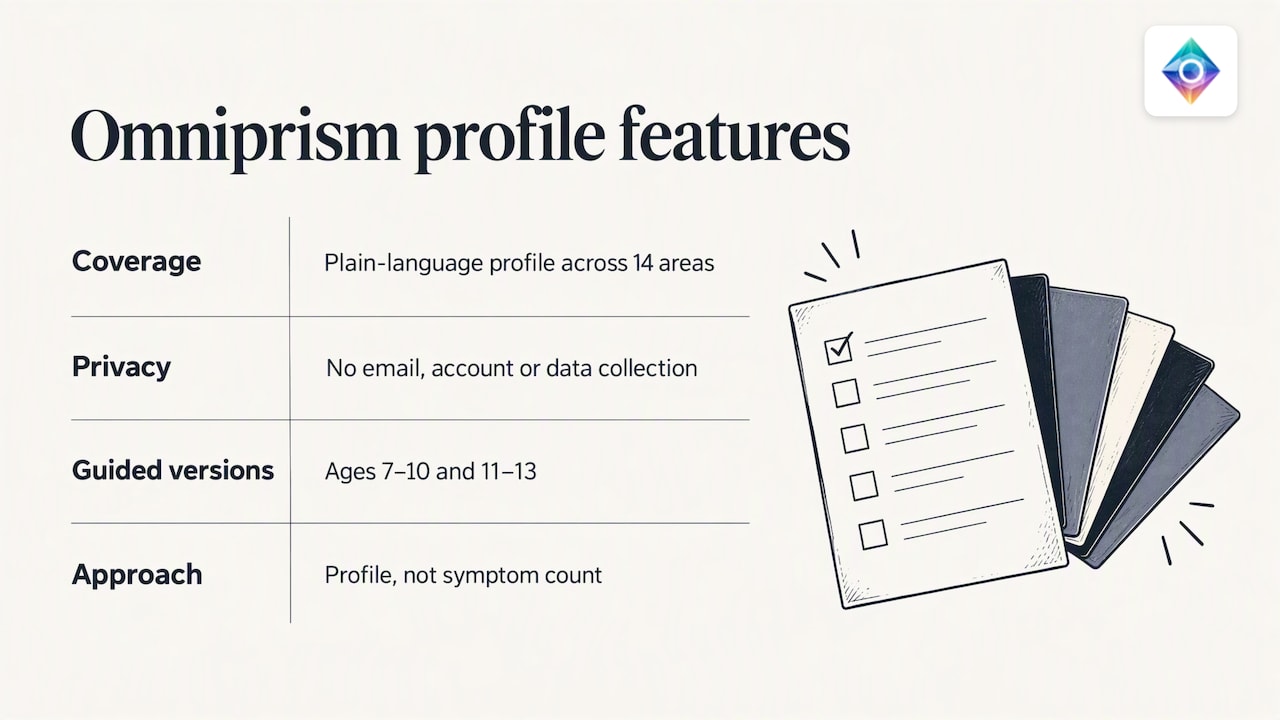
Omniprism works differently from the scales above. Instead of counting ADHD symptoms, it gives an instant plain-language profile across 14 areas, including ADHD, autism, dyslexia, masking, dyspraxia, dyscalculia, sensory processing, high sensitivity, OCD traits and synesthesia. That matters because these conditions overlap, and a questionnaire built for one of them cannot tell you much about the others. There is no email, no account and no data collection, so you can answer honestly without a record of it existing anywhere.
There are guided versions for children aged 7 to 10 and young people aged 11 to 13, with an overview on the children and young people page. For a longer look at how a multi-area test fits into clinical work, see our guide to turning an online test into clinician-ready evidence.
Vanderbilt vs Conners: which is better?
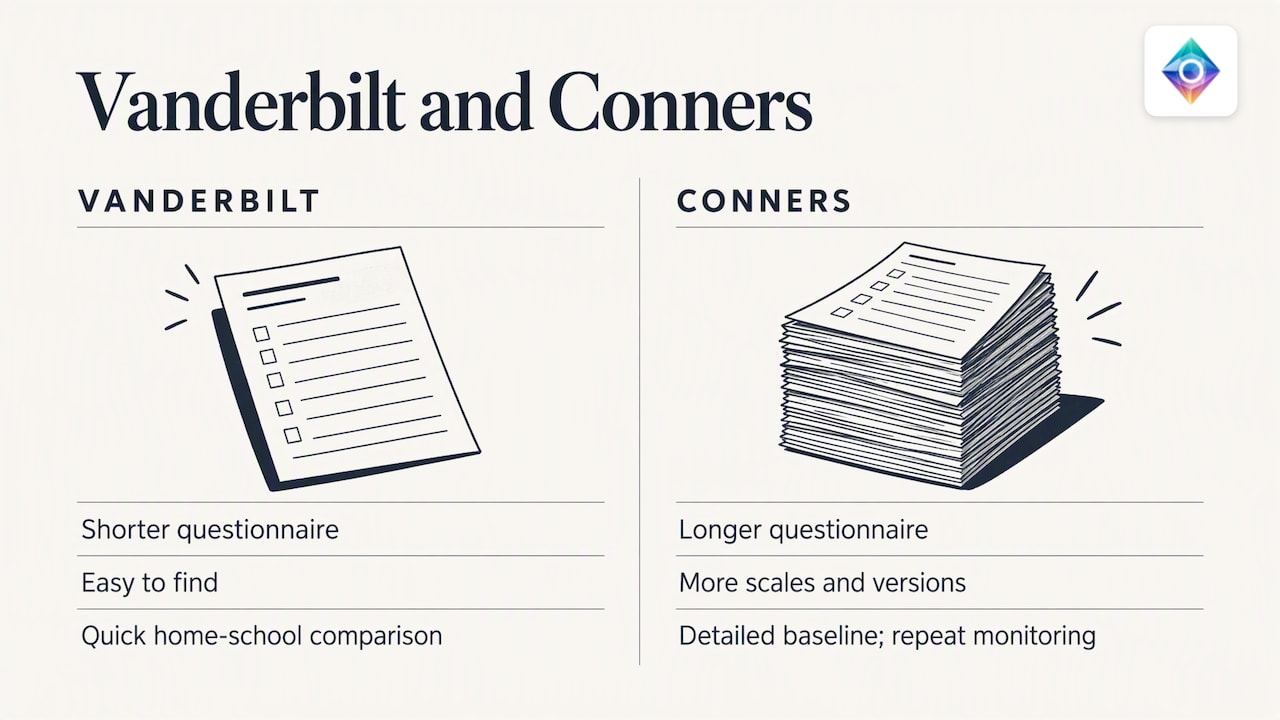
Neither is better in the abstract. The Vanderbilt is shorter and easy to find, and Conners is longer, with more scales and versions for different ages and raters. A clinician will choose according to the question: a quick comparison of home and school, or a detailed baseline they can repeat later to see whether treatment is working.
One point holds for both. NICE guidance says a diagnosis rests on symptoms across multiple settings, a developmental history and current impairment, with specialists considering whether symptoms cause at least moderate psychological, social, educational or occupational impairment. A scale supplies one input to that picture, and the clinician supplies the rest.
Can any rating scale diagnose ADHD?
No. The NHS Scotland clinical guidelines summary describes ADHD as a lifelong neurodevelopmental condition with core symptoms of inattention, hyperactivity and impulsivity, and not all of them need be present. That variety is the reason a single questionnaire cannot settle the question.
The Royal College of Psychiatrists identifies the biggest risk as treating a tool as a substitute for a thorough clinical history. It also stresses that the differentiator is persistent, significant impairment across several areas of life, and the presence of traits alone does not settle it. Our piece on why quizzes are not diagnoses goes through the same distinction in plain language.
How do I choose the right option for my situation?
Start with who the questions are about, then what you want to do with the answers.
- A child with a school-based concern. Ask the SENCo or GP which form the local service uses. Complete a free scale such as SNAP-IV or SWAN if you want something to discuss, and add dated examples from home and school.
- A teenager. Self-report matters more at this age. Our teen signs guide shows how to turn everyday behaviour into evidence a clinician can use.
- An adult who suspects ADHD. Take a screener, then write down specific examples from work, home and relationships. Our guide to what to bring after a self-screen lists them.
- Someone who suspects more than one thing. A single-condition scale will miss overlap. A broad profile is a better first step.
- A professional wanting a clear patient summary. See the Omniprism page for professionals.
Pro Tip: Whichever tool you use, add a short note for each answer that gives a real example with an approximate date. Clinicians can do more with “missed three deadlines in March because I lost track of the task” than with a score of 3.
Our perspective on rating scales
We built Omniprism because most people arrive at an assessment with a feeling and no structure. I was diagnosed with ADHD at 42, so I write this having been on the patient side of the process. Our view is that a tool should do two things well: help you understand your own pattern, and help a clinician understand it quickly.
That is why Omniprism asks for no account and keeps no data. A person answering about their own struggles should not have to worry about where the answers go. It is also why we do not present results as a verdict. The Royal College of Psychiatrists notes that people who are high-achieving may still have significant impairment hidden behind the effort it takes to maintain that performance. A profile that shows strengths, masking and sensory differences alongside ADHD traits makes that effort visible.
— Valerio Cozzi
What does the Specialist Briefing add?
The free assessment gives you your profile on screen. If you want something to hand to a GP or specialist, the Specialist Briefing is a one-off digital report that summarises your results for clinicians, at €9.99. You can read the Specialist Briefing details before deciding, or start the free assessment first. Parents can use the guided child and teen assessments and the Youth Briefing in the same way.
If you are weighing up costs more broadly, our article on free screens versus paid reports sets out what each is good for.
What should I do while waiting for an assessment?
Waiting lists are long, and the independent ADHD Taskforce report published by NHS England describes the urgency of dealing with wait times. A wait does not have to mean going without support. The Royal College of Psychiatrists’ advice for parents emphasises patience, understanding and a consistent routine at home, since children with ADHD process information and respond to their surroundings differently and are not trying to be difficult.
Some practical steps:
- At school, ask the SENCo about adjustments. We have set out five classroom changes that help, and the workplace equivalent for adults.
- Keep a dated log of difficulties and what helped. It will shorten your first appointment.
- Read about when to push for referral in our guide to when impairment spans two areas.
- Ask whether your own situation, such as driving, needs attention. This UK guide to ADHD and driving is a starting point.
Frequently asked questions
Is there a free alternative to the Vanderbilt?
Yes. SNAP-IV and SWAN are freely available child questionnaires, and the ASRS is a free adult screener. Omniprism’s self-assessment is also free to take, with no email or account. Free tools are best used to prepare for an appointment and not to reach a conclusion on your own.
Do UK clinicians use the Vanderbilt?
It varies by service. Clinicians choose tools to suit the question and the age of the person, and NICE does not make any single scale mandatory. If you are unsure, ask the service which questionnaires it wants completed before your appointment.
Can I use a self-assessment to get an NHS referral?
A self-assessment cannot replace a GP’s judgement, but it can help you describe your difficulties clearly. Bring examples from different settings and how they affect daily life. A one-page summary such as the Specialist Briefing is designed for that purpose.
Should I worry about a high or low score?
Not on its own. The Royal College of Psychiatrists explains that screeners often give false positives, and that everyone relates to some symptoms to some degree. What counts is persistent impairment, which only a clinician can assess.
Sources
- NICE NG87: Attention deficit hyperactivity disorder, diagnosis and management
- Royal College of Psychiatrists: ADHD in adults, good practice guidelines
- Frontiers in Psychology: Evaluating ADHD, a review of current methods and issues
- NHS Scotland: ADHD clinical guidelines summary
- NHS England: Report of the independent ADHD Taskforce, Part 2
- Royal College of Psychiatrists: ADHD in children and young people
Recommended
- Conners Alternatives for Adults and Kids: Private Prep, Clinical Fit
- Teen ADHD Signs: Turn Everyday Behaviors Into Evidence for Clinicians
- Parents: Clinician Ready Notes for ADHD Symptoms in Preschoolers
Written and edited by Valerio Cozzi, founder of Omniprism. Omniprism began after my own ADHD diagnosis at 42.
This article is educational. It is not medical advice, not a diagnosis, and not a substitute for assessment by a qualified clinician. The Omniprism self-assessment is free, needs no account and no email address, and runs entirely in your browser — your answers are never sent to a server. The optional Specialist Briefing report is a paid add-on.