Turn an Online ADHD Test Covering 14 Domains Into Clinician Ready Evidence

Online self-screeners can clarify ADHD-related traits and produce clinician-useful briefings, but they are not diagnostic. National bodies including NICE and the Royal College of Psychiatrists set the standard here, and tools such as Omniprism give readers a privacy-first way to build an instant profile before that conversation even starts. The best approach combines a validated symptom screener with a structured profile and a short briefing you take to a clinician, which is exactly what the next section shows you how to build.
TL;DR:
- Self-screeners are useful for preliminary insights but cannot provide an official ADHD diagnosis, which requires a full clinical assessment.
- Validated tools like ASRS, DIVA, and ACE+ should be supplemented with developmental history and third-party evidence for accurate evaluation.
- Exported profiles should highlight impairment areas and include a timeline with concrete examples to facilitate quicker clinical review.
- Self-assessment results are most effective when combined with documentation of onset, functional impact, and corroborating observations from others.
- Online tools can prepare you for a clinical conversation but do not replace expert evaluation, especially in cases of severe impairment or crisis situations.
What is an online ADHD self-assessment tool?
An online ADHD self-assessment gives you a structured way to check your traits against known symptom patterns. Most produce a symptom count, a trait profile across several domains, and prompts asking where those traits cause friction, at work, at home, in relationships. A good one hands you a plain-language summary you can actually show someone, rather than a raw score you have to interpret alone.
These tools sit alongside clinical care, not in place of it. The Royal College of Psychiatrists states that questionnaires can help prepare for assessment, but a diagnosis needs a full interview and consultation-based assessment that draws on your developmental history. A self-screener narrows down what to talk about, it does not replace the conversation.
If you are choosing between tools, look for:
- No account or email required, so results stay private by default.
- Instant export of your profile as something readable, not a spreadsheet of numbers.
- Plain-language reporting rather than clinical jargon you then have to look up.
What are the most validated ADHD screening tools?
Clinicians rely on a handful of instruments, each doing a different job. Understanding the difference helps you make sense of what a self-screener is and is not offering you.
- Symptom screeners, such as the Adult ADHD Self-Report Scale (ASRS), ask about frequency of specific behaviours and flag when your answers cross a threshold worth discussing with a professional.
- Structured clinical interviews, such as DIVA and ACE+, are administered by clinicians and combine symptom checklists with developmental history. No self-screen can substitute for these, and RCPsych’s good practice guidance treats cluster evidence and multi-setting impairment as the standard clinicians work to.
- Impairment and observer scales, such as WHODAS and WFIRS, capture how symptoms affect daily functioning and often draw on input from someone other than the person being assessed, which matters because self-report alone can miss blind spots.
Symptom counts on their own are rarely enough. People sometimes over-endorse items when anxious or under-endorse them when a trait has become so normal it no longer feels remarkable, and ADHD traits themselves sit on a spectrum rather than a clean cutoff. A clinical review of adult ADHD guidance lists ASRS, DIVA, ACE+, Conners’, WHODAS and WFIRS among the instruments in regular clinical use, noting some are free and others require purchase, and all function as adjuncts to a proper history rather than standalone verdicts.
How do you turn a self-screen result into a clinician-ready briefing?
A screener result is only useful once it becomes evidence a clinician can act on. Here is the sequence that works.
- Document onset and setting. Note when traits first appeared, ideally before age 12, and whether they show up in two or more settings such as work, home or school, since this is the threshold NICE guidance and RCPsych both expect clinicians to look for.
- Export your profile and highlight impairment items, not just symptom counts, so the reader can see where traits actually interfere with your life rather than just that a box was ticked.
- Gather third-party evidence. School reports, old performance reviews, or observations from a partner or colleague carry weight that self-report cannot, because RCPsych’s guidance treats corroborating evidence as central to speeding up referral decisions.
- Build a one-page timeline. List concrete examples, missed deadlines, a classroom incident, a relationship strain, rather than vague impressions; our self-assessment guide walks through exactly what to include.
- Prepare your request. A short, direct line such as “I’ve completed a validated screener and would like a referral for a full ADHD assessment” tends to move things along faster than describing symptoms from scratch in the room.
Pro Tip: Bring your timeline and screener export on paper or as a PDF; clinicians read written evidence faster than they can follow a verbal history during a short appointment.
Parents preparing a case for a teenager can adapt the same structure using our guide to documenting teen ADHD signs.
Why can’t an online ADHD test diagnose you?
Self-screeners have real limits, and knowing them protects you from false confidence in either direction. People can learn to endorse items in a way that inflates or deflates a score, conditions such as anxiety or sleep disorders can mimic ADHD traits closely enough to confuse a checklist, and no online tool has access to your developmental history the way a clinician interview does.
NICE’s evaluation of digital ADHD technologies is explicit that there is no single diagnostic test for ADHD. Digital tools can add objective information but are meant to sit alongside a full clinical assessment, never instead of one.
Watch for these signals that mean a self-screen is not enough, and professional input is needed sooner rather than later:
- Severe impairment affecting safety, work, or relationships right now.
- Symptoms overlapping with a possible mood, anxiety or trauma-related condition.
- A crisis of any kind, which always needs urgent professional attention rather than a screening tool.
Our piece on ADHD red flags covers these in more depth, and NICE’s CKS management page is a good place to find local support signposting while you wait for an appointment.
An honest look at what self-screening can and cannot do
I was diagnosed with ADHD at 42, after years of assuming my difficulties were just personality. As the founder of Omniprism, that gap between noticing a pattern and having language for it is exactly why I think structured self-assessment matters: not as an answer, but as a way to walk into a clinical conversation already knowing what to say.
— Valerio Cozzi
How Omniprism helps you prepare for that conversation
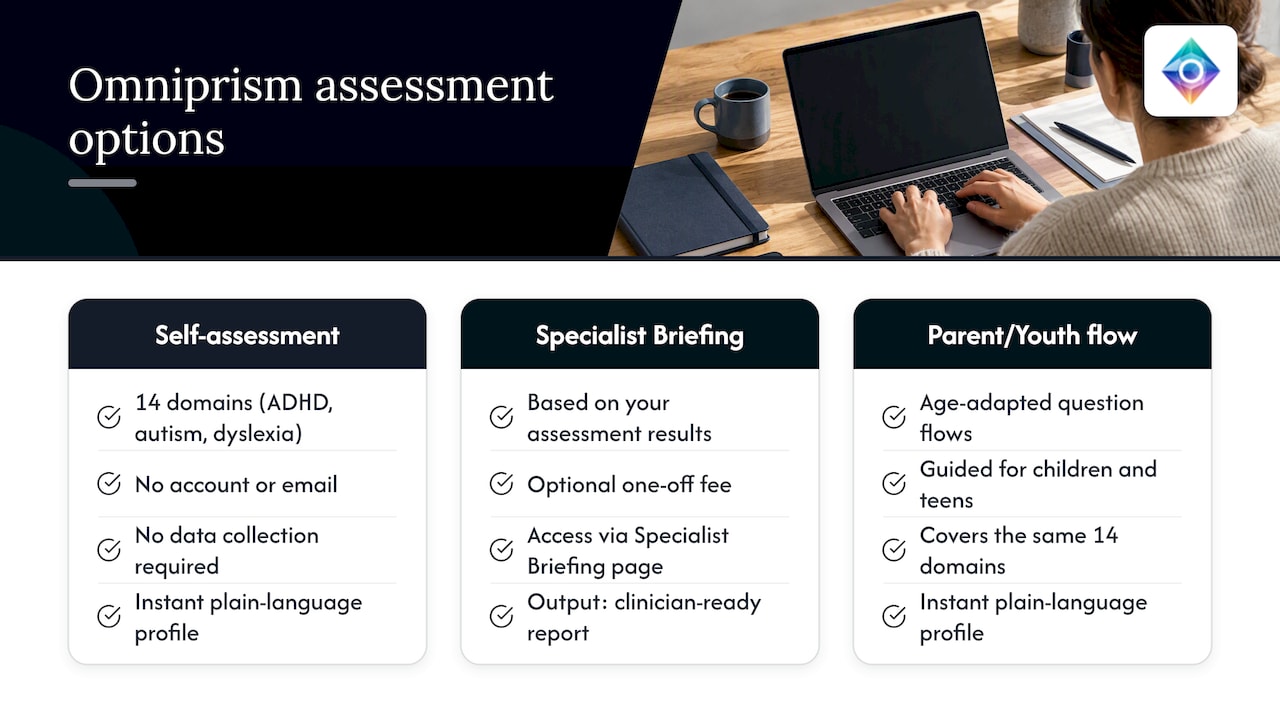
Omniprism gives you a free self-assessment across 14 domains, including ADHD, autism, dyslexia, and other traits that often overlap and get mistaken for each other. There is no account, no email, and no data collection required, so you get an instant, plain-language profile without handing over personal details to anyone.
If a clinical conversation is next on your list, the optional Specialist Briefing turns your results into a report designed for easy use by healthcare professionals, at one-off fee through the Specialist Briefing page. Parents can use the same guided approach for children and teens, with age-adapted flows built around how younger people actually describe their experiences. Start with the free self-assessment whenever you are ready, no pressure to buy anything to see where you land.
Sources
This article draws on national and professional guidance, including NICE’s evaluation of digital ADHD technologies, NICE’s NG87 guideline on ADHD diagnosis and management, NICE’s CKS management topic, RCPsych’s guidance on ADHD in adults, RCPsych’s good practice report CR235, and the NHS ADHD in adults page. These are the primary references clinicians themselves work from when assessing ADHD, and parents may also find our screen time strategies for families useful alongside them.
This article is general information, not a substitute for advice from a qualified doctor. Consult a qualified healthcare professional about your own circumstances before acting on anything here.
- Digital technologies for assessing attention deficit hyperactivity disorder (ADHD) | NICE
- ADHD in adults | Royal College of Psychiatrists
- Attention deficit hyperactivity disorder: diagnosis and management | NICE (NG87)
- ADHD in adults: good practice guidance | RCPsych (CR235)
- CKS topic: ADHD management | NICE/CKS
FAQ
Can an online ADHD test give me a diagnosis?
No. Online self-screeners can highlight traits worth discussing, but a diagnosis requires a full clinical interview and history, as RCPsych and NICE both make clear.
What is the ASRS and should I use it?
The Adult ADHD Self-Report Scale (ASRS) is a validated symptom screener widely used to flag traits worth a clinical conversation. It works best as a starting point, not a verdict, alongside documented examples of impairment across settings.
How much does a formal ADHD assessment cost?
Costs vary widely between public and private routes, and by country, so there is no single figure that applies everywhere. Our guide to ADHD assessment costs breaks down the typical decisions involved in choosing a free screen versus a paid report.
Do self-screeners work the same way for children as adults?
No, tools for children and teens are adapted to how younger people describe their experiences and often draw on parent or teacher observations, whereas adult tools rely more on self-report. NICE’s NG87 guideline recommends primary care use validated tools suited to a child’s developmental stage to support referral decisions.
What should I bring to my first ADHD appointment?
Bring a documented timeline of when traits started, examples of impairment in at least two settings, and any third-party observations you can gather, such as old school reports or feedback from a partner or colleague. Our DSM-5 ADHD criteria guide explains what clinicians are specifically looking for in that history.
Recommended
- DSM-5 ADHD Criteria: A Clear Guide for Parents and Clinicians
- Teen ADHD Signs: Turn Everyday Behaviors Into Evidence for Clinicians
- Speed Your UK ADHD Diagnosis: 5 Things to Bring After a Self Screen
- ADHD Red Flags: What Parents and Adults Should Know
Written and edited by Valerio Cozzi, founder of Omniprism. Omniprism began after my own ADHD diagnosis at 42.
This article is educational. It is not medical advice, not a diagnosis, and not a substitute for assessment by a qualified clinician. The Omniprism self-assessment is free, needs no account and no email address, and runs entirely in your browser — your answers are never sent to a server. The optional Specialist Briefing report is a paid add-on.