Speed Your UK ADHD Diagnosis: 5 Things to Bring After a Self Screen

A self-assessment cannot diagnose ADHD, but it can tell you whether your symptoms look severe and pervasive enough to warrant a full clinical review. Tools like the Adult ADHD Self-Report Scale (ASRS) work well as a first filter, not a verdict. If your score is high, or your symptoms are already disrupting work, relationships, or daily routines, the next move is to prepare for a proper assessment, referencing NICE and NHS pathways alongside a structured self-assessment tool.
TL;DR:
- A high score combined with real-world impairments, such as missed deadlines or relationship issues, should prompt a formal clinical evaluation for ADHD.
- Conditions like anxiety, depression, sleep problems, and substance use can produce ADHD-like scores, necessitating a structured interview for accurate diagnosis.
- Preparing for assessment involves gathering childhood reports, employment examples, health history, and specific, dated examples of symptoms to support a clinical interview.
- Omniprism offers a non-diagnostic, multi-domain self-assessment tool that can clarify symptoms and streamline discussions with healthcare providers.
How to do a quick, reliable ADHD self-screen
The ASRS comes in a 6-item and an 18-item version, both asking you to rate symptoms from the past six months, not your whole life. Answer honestly about how you function now, not how you wish you functioned.
Here’s a routine that keeps the process useful rather than anxiety-inducing:
- Take the screen in one sitting. Rushing or splitting it across days skews your answers.
- Record your raw score before comparing it to any threshold. Write down which items you scored highest, not just the total.
- Check the score against the published cutoff for that version of the ASRS.
- Note concrete examples of impairment tied to each high-scoring item, such as missed deadlines, unpaid bills, or repeated arguments about forgetfulness.
- Decide whether to act. A high score plus real-world impairment is the signal to pursue a clinical assessment; a high score with no functional impact is worth monitoring, not panicking over.
Watch for two biases that distort self-screens. Mood on the day you take it changes your answers, so a rough week can inflate your score. Recency bias also matters. If nothing has gone wrong lately, you might underrate symptoms that are still there. If your result feels inconsistent with your gut sense of your own history, repeat the screen in a fortnight or run it past a GP before drawing conclusions.
What screening tools can and cannot tell you
Screening tools are excellent at catching people who need a closer look and poor at confirming who actually has ADHD. That gap is the single most misunderstood part of self-testing.
The clearest evidence for this comes from population research on the ASRS itself:
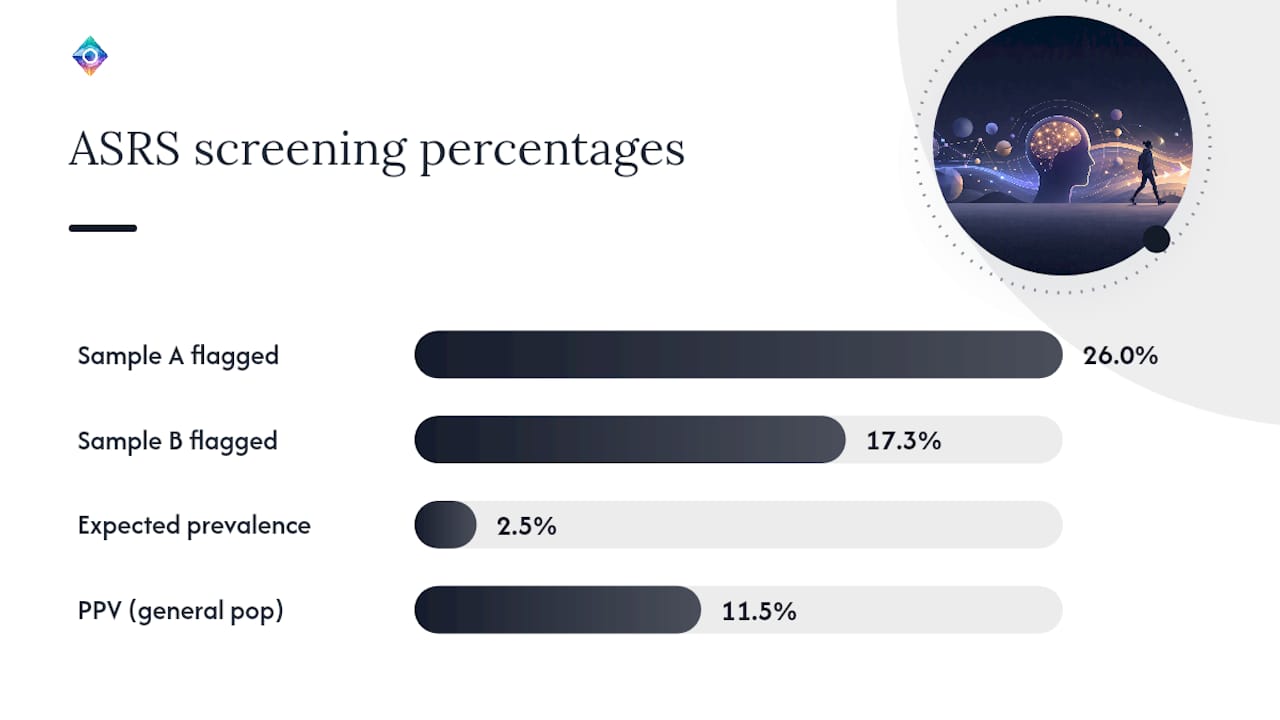
Two population samples flagged “probable ADHD” in 26.0% and 17.3% of respondents, far above the expected prevalence of around 2.5%. The estimated positive predictive value in general population use was only about 11.5%.
In practice, that means roughly nine out of ten people who screen positive in a general population sample won’t turn out to have ADHD once assessed properly. Sensitivity and specificity also shift depending on setting: a primary care sample behaves differently from a general population sample, which is why clinicians treat a positive ASRS as a prompt for interview, not confirmation.
Several other conditions produce ADHD-like scores on a self-screen:
- Anxiety disorders, which mimic restlessness and poor concentration.
- Depression, which can look like the inattentive presentation of ADHD.
- Chronic sleep problems, which blunt attention and processing speed.
- Substance use, which affects impulse control and focus.
- Other impulse-control difficulties, which inflate hyperactivity items.
A comparison of ADHD and bipolar disorder shows how much overlap exists between conditions that share surface symptoms but need very different treatment. This is exactly why a structured clinical interview, not a scored questionnaire, remains the diagnostic anchor.
How to prepare for a clinical ADHD assessment
Preparation shortens the assessment and sharpens the outcome. Clinicians need a lifelong pattern, not a snapshot of last week.
Bring these with you:
- School reports from primary and secondary education, even old ones. Comments about “not paying attention” or “capable but disorganised” carry real weight.
- Employment history examples, including any disciplinary notes, missed promotions, or repeated job changes tied to organisation or focus.
- A medication and health history, including anything already tried for anxiety or sleep.
- A written symptom timeline, covering childhood, teenage years, and adulthood.
- Names of informants, such as a parent, sibling, or long-term partner who can describe you as a child.
Ask family members for short, specific memories rather than general impressions. “You never finished your homework without someone sitting with you” is more useful to a clinician than “you were always distracted.”
Pro Tip: Write your examples as single sentences with a date or age attached (“Age 9, sent to detention weekly for talking in class”) rather than a paragraph. Clinicians move faster with specific, dated evidence.
How to get assessed and what happens next
Three main routes exist in the UK, and each comes with trade-offs worth knowing before you commit.
- GP referral into local NHS adult ADHD services. Free, but waiting lists vary widely by region.
- NHS Right to Choose (England) lets you ask your GP to refer you to any NHS-contracted provider, which can cut the wait if your local service is overwhelmed, under a legal right some patients can use.
- Private assessment offers speed and often a longer session, at a cost the NHS route doesn’t carry.
A thorough adult assessment typically runs 45 to 120 minutes or longer, covering childhood history, current functioning across work, relationships, and daily life, and screening for overlapping conditions. A proper report documents the evidence behind the diagnosis, not just a yes or no.
After diagnosis, options usually include therapy, workplace adjustments, or medication. If medication is prescribed, titration to a stable dose commonly takes around three months of monitored adjustment. If you’re in crisis or struggling to function safely in the meantime, contact your GP or a crisis line rather than waiting for the assessment date.
How Omniprism’s assessment fits the pathway
Omniprism is built to sit between “I suspect something” and “I’ve had a proper assessment”, giving people a clear, plain-language starting point rather than a scored guess.
When I was diagnosed with ADHD at 42, what struck me most was not the diagnosis itself. It was how long it took to describe what I’d been feeling my whole life in language a clinician could actually use. That gap between lived experience and clinical vocabulary is what Omniprism was built to close.
The tool covers 14 domains, including ADHD, autism, dyslexia, masking, dyspraxia, and sensory processing, generating an instant profile without tracking or lengthy questionnaires. Guided assessments are also available for children and teens, built for families navigating the same uncertainty. None of this replaces a clinical interview. It’s a resource for self-understanding and a document you can bring to a GP or specialist to make that conversation faster.
Author perspective: screening informs, it doesn’t replace judgement
The instinct after a high self-screen score is to treat it as fact. It isn’t. A screen is a compass, not a map, and Valerio Cozzi’s own diagnosis journey took decades partly because self-doubt kept overriding a pattern that, in hindsight, was obvious. The honest use of any self-assessment for ADHD is to take the result seriously enough to act, and lightly enough to let a clinician’s judgement have the final word.
— Valerio Cozzi
Try Omniprism: where to go next
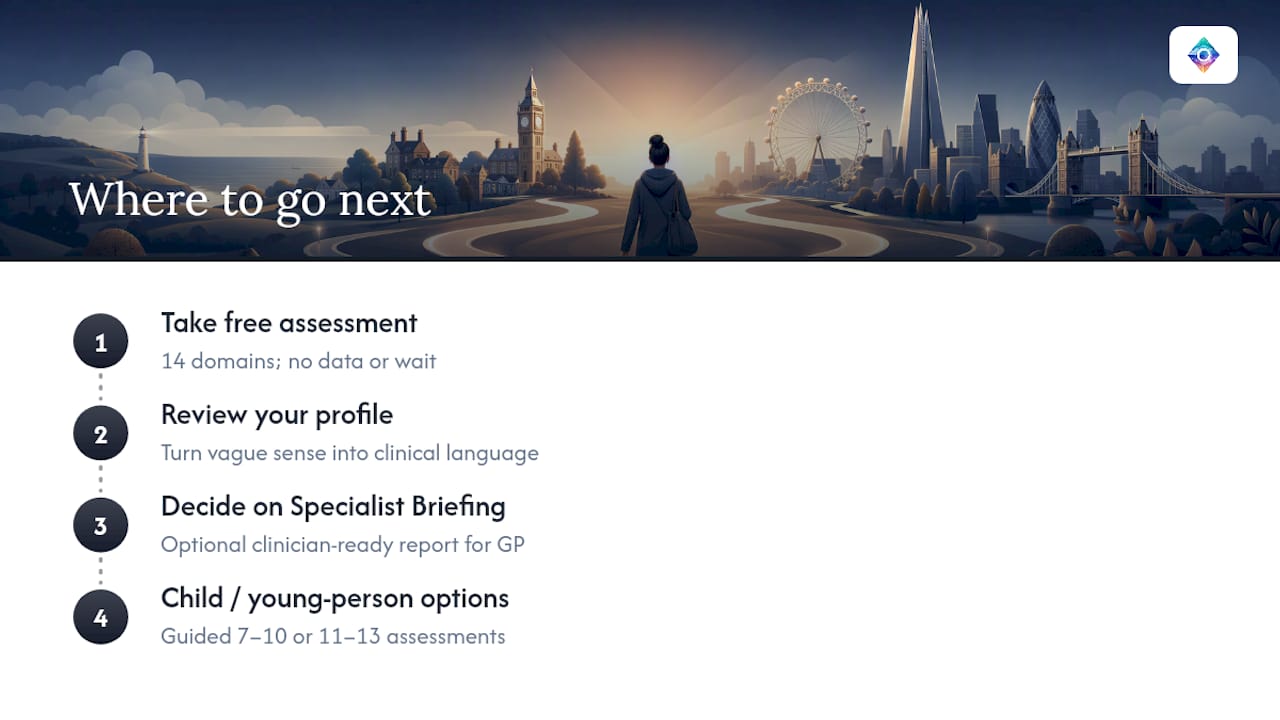
If you’ve run a self-screen and the pattern looks real, Omniprism’s free neurodivergence self-assessment gives you a clearer, more structured starting point than a single questionnaire score, covering all 14 domains in one sitting with no data collection and no waiting list. It won’t diagnose you, and it isn’t a substitute for the clinical interview described above, but it can turn a vague sense of “something’s off” into language you can actually bring to a GP.
For anyone planning that conversation, the optional Specialist Briefing report summarises your results in a format built for clinicians, which can help organise your results for discussion in your first appointment. Parents weighing up a similar step for a child can look at the guided assessment for ages 7 to 10 or the young person’s assessment for ages 11 to 13. Full detail on how the 14-domain model was built sits in the methodology page. Start with the free assessment, see what the profile shows, and decide from there whether a Specialist Briefing is worth adding before your appointment.
This article is general information, not a substitute for advice from a qualified doctor. Consult a qualified healthcare professional about your own circumstances before acting on anything here.
Sources
- Screening for adult ADHD using brief rating tools: What can we conclude from a positive screen? Some caveats
- ADHD in adults – NHS
- Adult ADHD referrals and assessment – Oxford Health NHS Foundation Trust
- ADHD in adults – Royal College of Psychiatrists
- Adult psychiatric morbidity survey – NHS Digital (attention deficit hyperactivity disorder)
FAQ
What is the 30% rule for ADHD?
There’s no established clinical “30% rule” in NICE, NHS, or Royal College of Psychiatrists guidance; if you’ve seen it online, treat it as informal shorthand rather than a diagnostic standard.
Can I use the NHS self-assessment tool to check for ADHD?
The NHS points adults toward recognised screening questionnaires like the ASRS as a first step, but these are screening aids, not diagnostic tools, and a positive result still needs a clinical assessment.
What is the best ADHD self-assessment?
The 6-item or 18-item ASRS is the most widely validated brief screen for adults, though tools like Omniprism, which map symptoms across 14 domains including ADHD, give a fuller picture than a single-condition questionnaire.
What is the 1/3/5 rule for ADHD?
This isn’t a recognised clinical framework in NICE or NHS guidance; if you’ve encountered it, it’s likely an informal productivity tip rather than an assessment or diagnostic standard.
Is a high score on an ADHD self-test proof I have ADHD?
No. Population studies found the ASRS can flag probable ADHD in over a quarter of respondents with a positive predictive value of only around 11.5%, so a high score means “get assessed,” not “you have ADHD.”
Recommended
- DSM-5 ADHD Criteria: A Clear Guide for Parents and Clinicians
- ADHD Assessment Cost: Free Screen or Paid Report?
- ADHD Red Flags: What Parents and Adults Should Know
- ADHD vs. Bipolar Disorder: Key Differences Explained
Written and edited by Valerio Cozzi, founder of Omniprism. Omniprism began after my own ADHD diagnosis at 42.
This article is educational. It is not medical advice, not a diagnosis, and not a substitute for assessment by a qualified clinician. The Omniprism self-assessment is free, needs no account and no email address, and runs entirely in your browser — your answers are never sent to a server. The optional Specialist Briefing report is a paid add-on.