Parents: Clinician Ready Notes for ADHD Symptoms in Preschoolers

Preschoolers can show real ADHD symptoms, and they matter clinically when inattention, hyperactivity or impulsivity are persistent, appear both at home and at nursery, and clearly get in the way of daily life. If that pattern sounds familiar, the next step is straightforward: talk to your GP or your child’s nursery SENCO and bring specific examples with you.
TL;DR:
- Most preschool ADHD symptoms involve persistent inattention, hyperactivity, or impulsivity across multiple settings for at least six months.
- Behaviors are typical if they are not significantly more extreme than peers and do not cause daily life difficulties.
- Early intervention with routine building, visual supports, and parent training is recommended before considering specialist referral.
- Diagnosis usually requires symptoms to be present before age 12, in more than one environment, and beyond typical developmental expectations.
- Girls and children with higher intelligence or social skills may show less obvious signs, increasing the risk of underrecognition.
What ADHD symptoms look like in preschoolers at home and nursery
Symptoms in preschoolers rarely look like the stereotype of a child bouncing off the walls. They show up in ordinary moments: getting dressed, sitting for a story, playing with another child. NHS guidance groups these behaviours into three clusters, and most children show some overlap between them rather than a single, clean pattern.
- Inattention: very short focus even on preferred activities, losing toys or shoes repeatedly, drifting off mid-task, or not following simple two-step instructions.
- Hyperactivity: constant movement even when seated, climbing on furniture, struggling to stay in a chair at circle time, or talking non-stop.
- Impulsivity: grabbing toys without waiting, running into a road without checking, interrupting conversations, or acting before thinking about consequences.
A child might mostly struggle with sitting still at nursery but manage fine one-to-one at home, or the reverse. Presentation also shifts with tiredness, hunger and how structured the setting is, which is exactly why a single difficult afternoon tells you little on its own. What matters for a clinical picture is the pattern across days and across places, not one incident.
How to tell ADHD from normal preschool energy
Most two to five year olds are impulsive, easily distracted and full of energy. That is typical development, not a symptom list. The question worth asking is whether your child’s behaviour is noticeably more extreme than that of other children the same age, not just lively but consistently harder to manage in ways that cause real difficulty.
Healthier Together, run by NHS services including Alder Hey, frames this clearly: traits can appear early, but distinguishing them from ordinary development depends on behaviours being much worse than peers and causing practical problems in everyday life. Two rules of thumb help:
- Two-settings rule: the difficulties show up in more than one place, such as both home and nursery, not only where routines are less structured.
- Six-month persistence: the pattern has lasted for a reasonable stretch of time rather than appearing during a single stressful period, such as a house move or a new sibling.
A short informal check: does the behaviour happen most days, in more than one setting, and does it stop your child from doing things other children their age can manage? If all three are true, it is worth raising with a professional.
When to get help and who to contact
If you recognise a persistent pattern that causes real difficulty, act in a set order rather than jumping straight to a specialist referral.
- Speak to nursery staff or the SENCO first. They see your child in a different setting and can confirm whether the behaviour matches what you see at home.
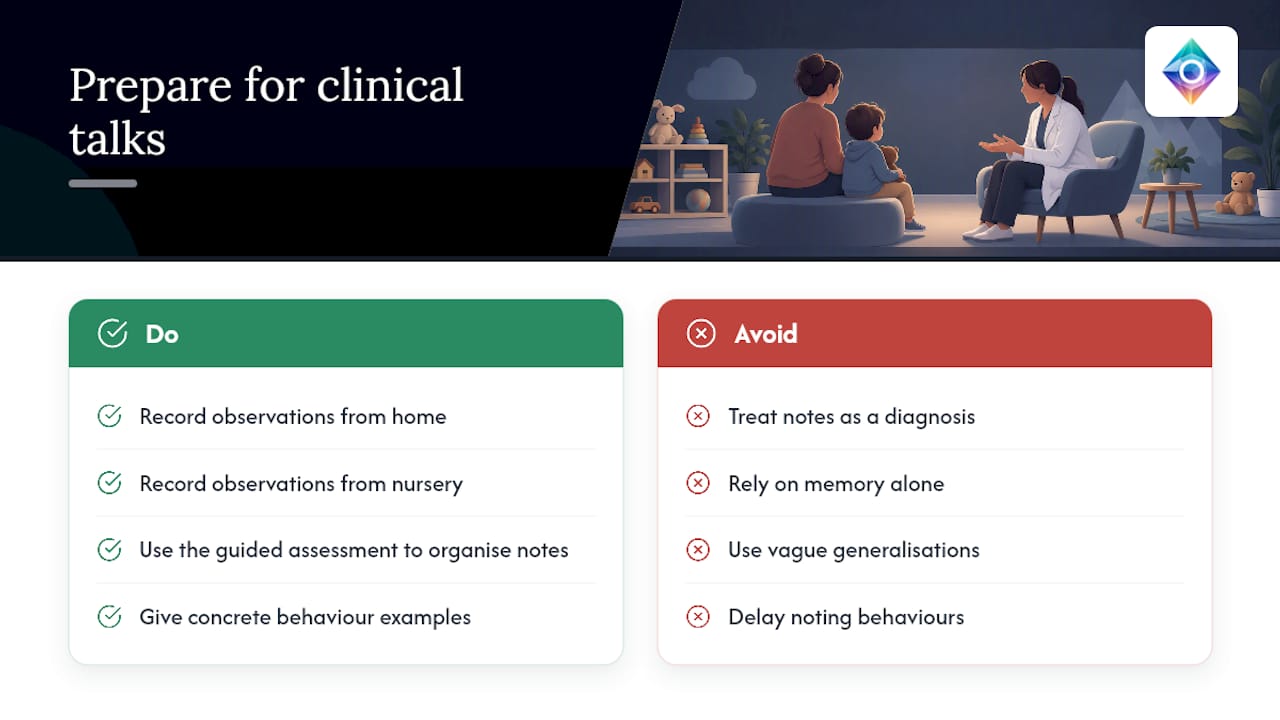
- Keep a short behaviour log for two to four weeks. Note specific examples, roughly when they happen, and what seemed to trigger them.
- Book a GP appointment if the pattern persists across both settings. Bring your log, any nursery observations, and a plain description of what daily life looks like.
- Ask about specialist referral only if impairment continues despite early support at home and nursery, since referral pathways for under fives typically start with monitoring and support rather than an immediate specialist assessment.
What to bring to any appointment: concrete examples (not just “he’s difficult”), a rough timeline of when concerns started, and anything nursery has written or said informally. Clinicians generally expect evidence of impairment in at least two settings before they consider a fuller assessment, so specific, dated examples carry more weight than general worry.
What professionals look for: diagnostic criteria and their limits before school age
Formal diagnosis rests on meeting recognised clinical criteria, not on a parent’s impression alone. RightDecisions, an NHS Scotland guideline, summarises the requirements plainly: symptoms from the inattention, hyperactivity or impulsivity clusters, present before age 12, causing impairment in two or more settings, and persistent rather than occasional.
- Onset and persistence: symptoms must have been present for a meaningful period, not just during a stressful few weeks.
- Cross-setting impairment: difficulties appear in more than one environment and get in the way of daily functioning, not just adult convenience.
- Developmental mismatch: behaviour is clearly beyond what is typical for the child’s age.
Clinicians are often cautious about a formal diagnosis before school age, since normal development already includes short attention spans and high energy, which makes the picture harder to separate from typical behaviour at three or four. Many will monitor, recommend parent-focused support, and revisit the question once a child enters a more structured school environment. A typical assessment draws on developmental history, input from nursery staff, and structured screening tools rather than a single observation.
One point is worth stating clearly: medication is not a first-line option for preschoolers. RightDecisions notes medication is not licensed for routine use under six and should only be initiated by specialists in specific circumstances. For a fuller breakdown of the criteria themselves, see this guide to DSM-5 ADHD criteria.
What parents can do now: strategies backed by clinical guidance
You do not need a diagnosis before making changes that help. NICE and CKS guidance place environmental modification and parent training as the first-line approach for preschool children, well ahead of any discussion of medication.
- Build predictable routines. Same wake-up, meal and bedtime sequence each day reduces the number of transitions your child has to manage cold.
- Give instructions one step at a time. “Put your shoes on” lands better than “get ready, we’re leaving in five minutes.”
- Use visual supports. A simple picture schedule on the fridge or by the door helps a child who struggles to hold verbal instructions in mind.
- Simplify transitions. A two-minute warning before switching activities, said directly to the child, cuts down on meltdowns at changeover points.
- Ask nursery for small adjustments. A quieter spot for circle time, a fidget object, or a shorter listening task can make a real difference without singling the child out.
NICE quality standards specifically recommend parent training programmes for carers of under-fives showing ADHD symptoms. These are structured, time-limited courses covering consistent routines, positive reinforcement and planned ignoring of specific low-level behaviours, and they are not a judgement on parenting. As the Open University points out, this kind of support is a recognised intervention in its own right, not a fallback for parents who are “getting it wrong”. Practical task-initiation techniques, such as those set out by EmpowerED Professional Learning, can also help translate these principles into specific classroom or home routines.
Pro Tip: Instead of a general warning like “we’re leaving soon”, give your child one physical object to hold (their shoe, a bag) as the transition cue. It works better than words alone because it turns an abstract instruction into something concrete they can act on immediately.

Common pitfalls, sex differences and why some preschool ADHD gets missed
Girls with ADHD often show less obvious hyperactivity and more internalised difficulty such as anxiety or emotional dysregulation, which makes their symptoms easier to overlook. A UK population study found that children with higher cognitive ability or better prosocial skills were more likely to go unrecognised, while emotional dysregulation and peer or conduct problems were linked to earlier recognition.
- Quiet, capable children are frequently missed because their difficulties do not disrupt a classroom in visible ways.
- Socioeconomic factors can complicate access to recognition and support, and professionals are encouraged to take a broader view rather than waiting for a nursery to flag concerns first.
- Overlapping conditions, such as autism, language delay or oppositional behaviour, can mask or mimic ADHD symptoms, which is a common reason a case needs re-evaluation later.
A note from Valerio Cozzi on preparing for clinical conversations
I was diagnosed with ADHD at 42, long after anyone thought to look. That gap is part of why I founded Omniprism: clear, organised observations make conversations with professionals shorter and more useful, whatever age the person is. A guided assessment for children helps parents structure what they notice across home and nursery into something a clinician can actually work with. It is a preparation tool, not a diagnosis.
Watchful waiting with early support is not doing nothing
Starting parent-training strategies and nursery adjustments while you wait to see how things develop is not a compromise position. It is exactly what clinical guidance recommends as the first step for preschool children, regardless of where things end up diagnostically. If impairment continues despite consistent routines and nursery support, that is the signal to push for a fuller conversation with your GP or SENCO, not a reason to feel you missed a window.
— Valerio Cozzi
How Omniprism’s child assessment can support your next appointment
Watching for patterns across weeks, then trying to describe them clearly to a GP in a ten-minute slot, is genuinely hard. Omniprism’s guided assessment for children walks parents through structured questions covering attention, activity and impulse control, and turns scattered observations into an organised profile you can actually bring to an appointment.
- The free self-assessments provide an instant plain-language profile without requiring an account or data collection.
- The paid Specialist Briefing, available for €9.99 one-off, summarises results in a format designed for clinicians to read quickly.
- Neither replaces a clinical assessment. Both are built to make the conversation with your GP, SENCO or paediatrician more focused.
If you want a clearer starting point before your next appointment, start the free assessment at Omniprism and see whether a Specialist Briefing is worth adding for your GP visit.
This article is general information, not a substitute for advice from a qualified doctor. Consult a qualified healthcare professional about your own circumstances before acting on anything here.
Sources
- ADHD in children and teenagers — NHS
- ADHD: management — CKS / NICE
- Study on earlier recognition and later recognition of ADHD — PubMed
- ADHD guidelines update — RightDecisions Scotland (NHS)
- ADHD | Child under 5 years — Healthier Together (NHS)
FAQ
What are the signs of ADHD in a 5 year old?
A 5 year old with ADHD may show very short attention even during play, constant movement or fidgeting, and acting without thinking, such as grabbing things or running off without checking. These behaviours matter clinically when they appear at both home and school and clearly affect daily functioning, according to NHS guidance.
What are the signs of ADHD in a 3 year old girl?
Girls often show less obvious hyperactivity and more difficulty with emotional regulation, frustration or anxiety rather than visible disruption. A UK population study found this quieter presentation is one reason ADHD in girls is recognised later than in boys.
What are some early warning signs of ADHD in preschoolers?
Early signs include very short focus even on enjoyable activities, difficulty sitting through group activities like circle time, and impulsive actions such as running into unsafe situations. NHS guidance notes these only point to ADHD when they are persistent, appear in more than one setting, and go beyond what is typical for the child’s age.
Are there effective supplements for children with ADHD?
There is no supplement recognised by NHS or NICE guidance as a first-line treatment for ADHD in preschool children. Clinical guidance instead points to parent training and environmental changes as the recommended first step, with medication reserved for specialist-managed cases later on.
Can a preschooler be formally diagnosed with ADHD?
Formal diagnosis is possible but often deferred, since clinicians need to see persistent symptoms across two or more settings and rule out typical developmental variation first, as outlined by RightDecisions NHS guidance. Many professionals monitor and recommend early support rather than diagnosing immediately, revisiting the question once the child is in a more structured school setting.
Recommended
- DSM-5 ADHD Criteria: A Clear Guide for Parents and Clinicians
- ADHD Red Flags: What Parents and Adults Should Know
- Parents: 14 Domain Self Check to Uncover Autism Misdiagnosed as ADHD
- 50–70% Overlap in Autism and ADHD: What Families and Clinicians Need
Written and edited by Valerio Cozzi, founder of Omniprism. Omniprism began after my own ADHD diagnosis at 42.
This article is educational. It is not medical advice, not a diagnosis, and not a substitute for assessment by a qualified clinician. The Omniprism self-assessment is free, needs no account and no email address, and runs entirely in your browser — your answers are never sent to a server. The optional Specialist Briefing report is a paid add-on.