Teen ADHD Signs: Turn Everyday Behaviors Into Evidence for Clinicians
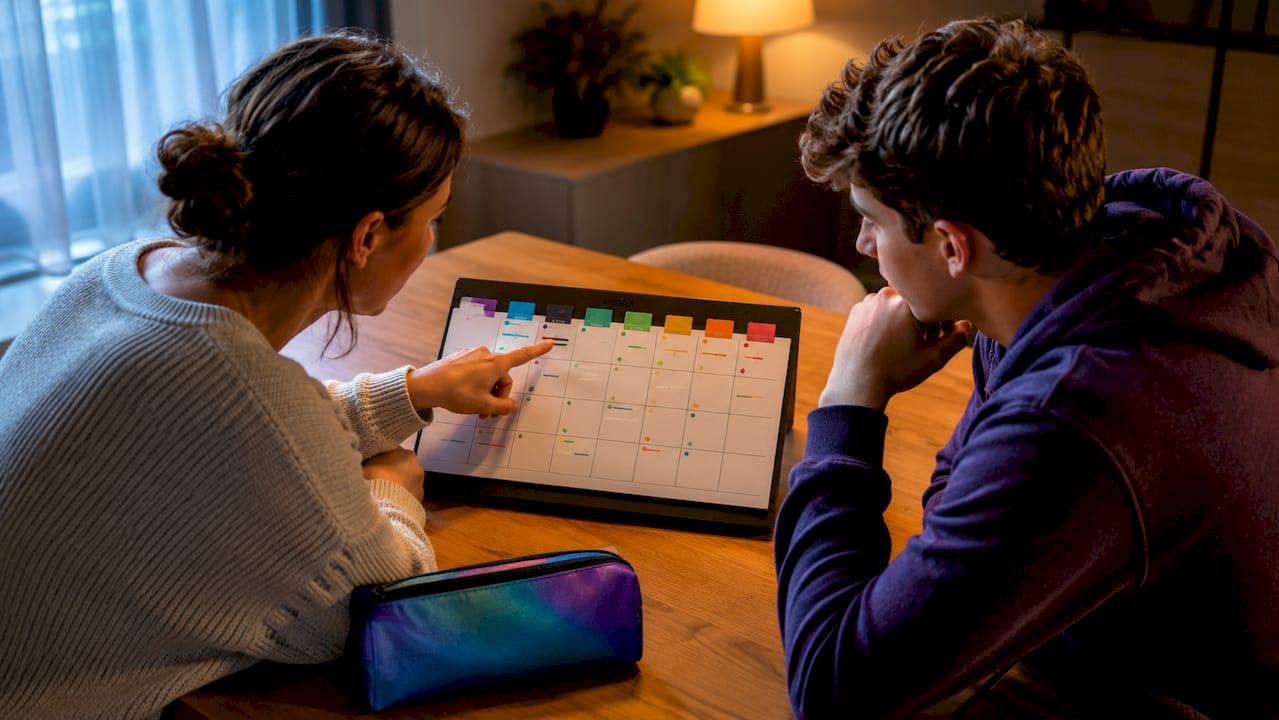
If your teen loses their phone weekly, blows deadlines, and melts down over a text they misread, that combination points toward ADHD, especially when it disrupts school, friendships, or home life. The three symptom domains are inattention, hyperactivity/impulsivity, and combined presentation. The DSM-5 requires fewer symptoms for older teens than younger ones. If the pattern is causing real impairment, start writing down specific examples across settings and get your teen in front of a pediatrician or mental health clinician.
TL;DR:
- Teens with ADHD often show consistent patterns of missing deadlines, losing items, and difficulty completing multi-step tasks across different settings.
- Hyperactivity in teens tends to manifest as inner restlessness or relentless racing thoughts rather than physical hyperactivity seen in younger children.
- Girls with inattentive symptoms are diagnosed less often early, but their signs become more disruptive and noticeable during adolescence.
- Untreated ADHD impacts teens socially and academically, increasing risks of rejection, low self-esteem, poor grades, and traffic violations.
- Accurate diagnosis relies on multiple sources of evidence, developmental history, and symptom patterns, with the importance of structured self-assessments before clinical visits.
Table of Contents
- Key Signs of ADHD in Teenagers
- How ADHD Looks Different in Teens Versus Kids
- What ADHD Costs Teens Socially and Academically
- Conditions That Mimic or Accompany ADHD
- How Doctors Diagnose ADHD in Teens
- When to Get an Evaluation and What to Bring
- Treatment Options That Actually Help Teens
- Daily Habits That Reduce Friction at Home
- Using a Structured Self-Assessment Before the Doctor’s Visit
- A Parent’s Honest Take on Spotting ADHD Early
- Get a Clearer Picture Before Your Next Appointment
- Where to Learn More
- Sources
Key Signs of ADHD in Teenagers
Many teenagers occasionally forget permission slips or lose chargers. Teen ADHD signs are different because they’re chronic, cluster together, and show up in more than one setting. Clinicians look for patterns that repeat across school, home, and social life, not isolated bad days.
Inattention shows up as:
- Missing assignment deadlines even when the teen knows the due date and cares about the grade
- Losing the same items repeatedly, a phone, a charger, a permission slip, a specific homework sheet
- Starting one task and drifting to another before finishing either
- Struggling with multi-step directions (“read chapter 6, answer the review questions, then email me your outline”)
- Notes that are disorganized, incomplete, or missing key details from lectures
Hyperactivity and impulsivity often look internal rather than physical. Instead of running around a classroom, a teen might describe constant inner restlessness, a racing mind that won’t settle even when their body is still. Impulsivity shows up in bigger, riskier ways than it did at age seven: driving too fast, jumping into a relationship or a dare without thinking it through, blurting out answers or interrupting conversations, and talking in long tangents that lose the original point.
Emotional dysregulation and rejection sensitive dysphoria (RSD) are frequently the piece parents miss entirely. A teen with RSD can have an explosive reaction to a minor correction from a teacher, or withdraw for days after feeling excluded from a group chat. According to Medical News Today, RSD is a recognized feature in many teens with ADHD, and it’s often mistaken for typical teenage moodiness.
To tell the difference between a rough week and a real pattern, keep short observation notes: what happened, where, and how often over two to three weeks. A missed assignment on a Tuesday means nothing. Five missed assignments across three classes in a month, alongside a blowup over a joke a friend made, starts to form a picture worth bringing to a clinician.
How ADHD Looks Different in Teens Versus Kids
The symptoms don’t disappear in adolescence. They just change shape, which is exactly why so many teens get diagnosed later than they should have been.
Younger kids with ADHD often look hyperactive in the classic sense: running, climbing, unable to sit through story time. By high school, that physical hyperactivity usually turns inward. The teen sits still but describes a mind that won’t stop racing, or a constant urge to fidget that they’ve learned to mask in front of teachers. Meanwhile, inattention tends to become the dominant symptom as hyperactivity fades into the background.
High school also raises the bar dramatically. A child with mild organizational struggles in elementary school, where one teacher and one folder covered everything, can fall apart junior year when they’re juggling six classes, six sets of expectations, independent homework, and college planning with no one walking them through it step by step.
Girls are diagnosed less often in childhood because inattentive presentations, daydreaming, quiet disorganization, missed details, don’t trigger the same concern that visible hyperactivity does. Diagnostic patterns narrow between boys and girls as adolescence progresses, partly because girls’ symptoms finally become disruptive enough to notice, and partly because clinicians have gotten better at recognizing the quieter presentation.
What ADHD Costs Teens Socially and Academically
Unmanaged ADHD in adolescence isn’t just an inconvenience. It touches nearly every part of a teen’s life, and the stakes climb the longer it goes unaddressed.
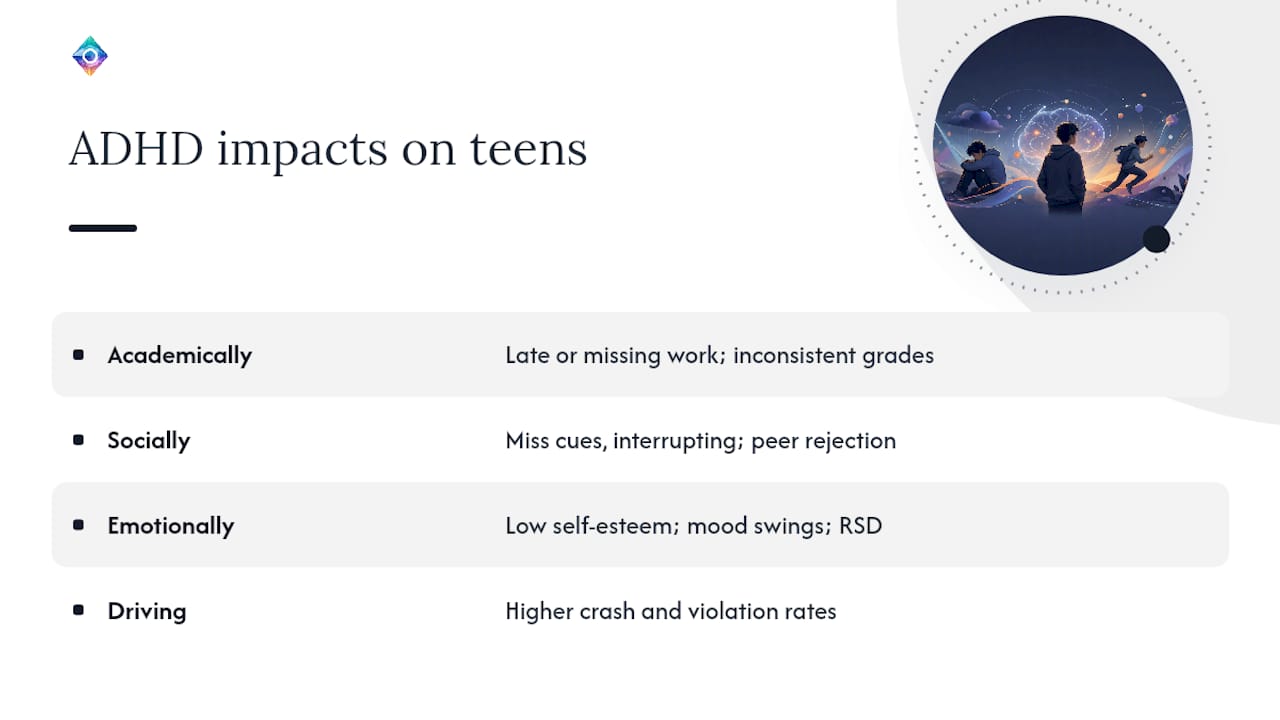
Academically, the pattern usually looks like late or missing assignments, grades that don’t reflect actual intelligence, and in more serious cases, suspension risk from behavioral incidents or disciplinary write ups. College applications become a genuine obstacle when a transcript shows wild inconsistency, strong scores in some terms and failing ones in others.
Socially, teens with ADHD often miss subtle social cues, talk over friends without meaning to, or overshare in ways that push peers away. That combination makes them more vulnerable to rejection and, in some cases, bullying. Friendships can stay fragile even when the teen genuinely wants connection.
Emotionally, chronic difficulty keeping up leads to low self-esteem that compounds over years. Mood swings and RSD episodes add another layer, making the teen feel like they’re constantly failing at things their peers find easy.
Driving deserves its own callout. Research on ADHD across adolescence points to higher rates of crashes and traffic violations among teens with the condition, tied directly to impulsivity and attention lapses behind the wheel. Families should treat driving privileges as something to build gradually, with more supervised practice hours and a slower path to solo driving than might feel necessary for a neurotypical sibling.
Conditions That Mimic or Accompany ADHD
ADHD rarely travels alone, and some of its most common companions can be mistaken for the condition itself.
Anxiety and depression frequently overlap with ADHD in teens, and either one can produce inattention or restlessness that looks identical to ADHD on the surface. Learning disorders, oppositional defiant disorder, conduct disorder, and substance use also show up more often in teens with ADHD than in the general teen population.
Sluggish cognitive tempo (SCT), sometimes described as a foggy, low-energy inattentiveness, overlaps heavily with the inattentive presentation and can confuse the diagnostic picture further. Before assuming ADHD explains everything, a clinician should also rule out poor sleep, chronic stress, unresolved trauma, and substance use, all of which can produce symptoms that mimic the disorder almost exactly.
This is why multi-source data matters so much. A single snapshot, one bad semester or one worried phone call from a teacher, isn’t enough to separate ADHD from something else that needs a different treatment plan entirely.
How Doctors Diagnose ADHD in Teens
There’s no blood test or brain scan that confirms ADHD. Diagnosis is a clinical judgment built from several pieces of evidence layered together.
The DSM-5 sets different symptom thresholds by age: teens under 17 need at least six symptoms of inattention, hyperactivity/impulsivity, or both, while teens 17 and older need at least five. In every case, symptoms must have started before age 12, even if no one recognized them as ADHD at the time.
Clinicians lean heavily on validated rating scales like the ADHD Rating Scale (ADHD-RS), Conners scales, and the Vanderbilt Assessment. These tools collect input from more than one person, usually a parent and the teen, and ideally a teacher, since behavior at school often diverges sharply from behavior at home. That multi-informant approach matters because teacher observations frequently catch patterns parents don’t see, and vice versa.
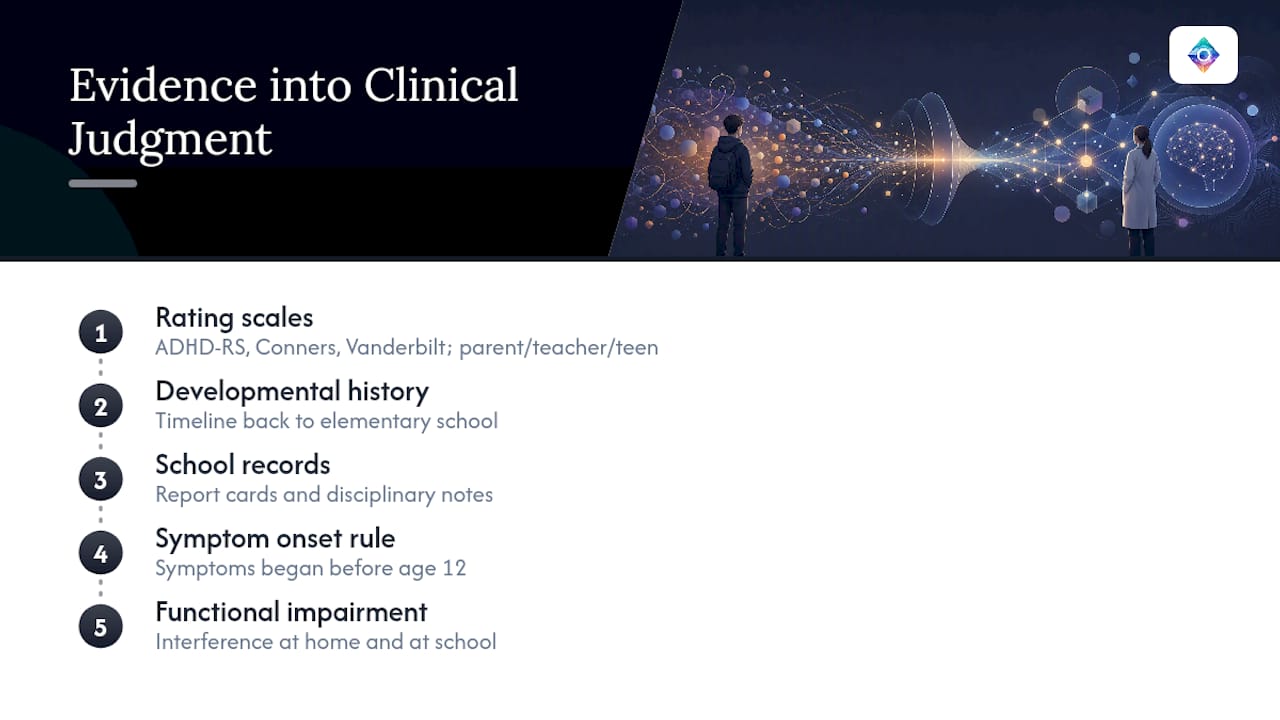
Beyond the scales, a thorough evaluation covers developmental history going back to elementary school, a review of report cards and disciplinary records, and a direct look at how much the symptoms are actually interfering with daily functioning across settings, not just how annoying they are.
When to Get an Evaluation and What to Bring
Certain changes are worth acting on rather than waiting to see if they resolve on their own: a sustained drop in grades, any safety incident tied to impulsivity, growing social isolation, or a noticeable decline in mood or self-worth over weeks rather than days.
Once you decide to schedule an evaluation, arrive prepared:
- Pull together report cards and progress notes going back several years, looking specifically for patterns that predate age 12.
- Keep a simple log of missed or late assignments over two to four weeks, noting the subject and the reason given.
- Write down two or three specific incidents with dates, what happened, where, and how your teen reacted.
- Note any history of substance use or medication trials, even minor ones.
- Prepare direct questions for the clinician: What testing will you use? What accommodations might my teen qualify for at school? What’s a realistic timeline before we see a treatment response?
Bringing your teen into the conversation early, rather than presenting an evaluation as something being done to them, makes cooperation far more likely. Frame it as gathering information together, not as a verdict already reached.
Treatment Options That Actually Help Teens
Most effective treatment plans combine more than one approach rather than relying on a single fix.
Medication remains the most studied intervention, with stimulant options (like methylphenidate or amphetamine based medications) and non-stimulant alternatives available depending on the teen’s health history and response. Regular monitoring checks for side effects like appetite changes, sleep disruption, or mood shifts, and dosing often needs adjustment as a teen grows.
Behavioral therapy and CBT adapted for adolescents help teens build coping skills for organization, emotional regulation, and the specific social friction ADHD tends to create. This work matters especially for RSD, since learning to reframe rejection in the moment can reduce how often small setbacks spiral into bigger emotional crashes.
School-based supports, including 504 plans or IEPs, extended time on tests, preferential seating, or executive-function coaching, give teens structural help that medication and therapy alone can’t provide. These supports also lay groundwork for accommodations teens will eventually need in the workplace.
Lifestyle factors, consistent sleep, regular exercise, predictable routines, and honest conversations about substance use, round out a plan that treats the whole teen rather than just the symptom list.
Daily Habits That Reduce Friction at Home
Small structural changes tend to outperform lectures about trying harder.
- One single planner or app for everything, not five different systems for five different classes
- Checklists posted somewhere visible, like the front door or bathroom mirror, for morning and evening routines
- A consistent “launch pad” by the door where backpack, keys, and school items always live
- Short timers (15 to 25 minutes) for homework chunks, with a real break built in afterward
- Calendar blocking for big projects, breaking them into smaller deadlines instead of one looming due date
- Scheduled, low-pressure check-ins rather than ambush conversations sprung during an already tense moment
- Specific praise (“You remembered your gym clothes without me reminding you”) instead of vague encouragement
Pro Tip: Managing time is often harder than managing tasks for a teen with ADHD. If deadlines and “losing track of time” keep coming up, look into strategies for recognizing and working around time blindness before assuming the issue is motivation.
For safety, treat driving as a skill to build in stages, with supervised hours well beyond the state minimum, and have direct, non-judgmental conversations about substance use before it becomes an issue rather than after.
Using a Structured Self-Assessment Before the Doctor’s Visit
Walking into a clinician’s office with scattered memories of “a few rough months” rarely helps. A structured self-assessment gives you something concrete instead: a domain-by-domain profile, prompts that jog your memory on developmental history, and a summary written in language a clinician can actually use.
Omniprism’s assessment for young people ages 11 to 13 walks teens and parents through this process together, then compiles results into a clear, shareable snapshot. Families have used similar structured reports to open school meetings and primary care visits with specifics instead of vague worry, which tends to move the conversation forward faster.
A Parent’s Honest Take on Spotting ADHD Early
Most families I’ve seen research this topic aren’t looking for a label. They’re looking for relief, some explanation for why a smart, capable kid keeps missing the mark on things that should be simple. That instinct is worth trusting. You know your teen’s baseline better than any checklist does.
Here’s a six-item checklist to act on this week:
- Observe your teen across at least two settings (school, home, social) for two weeks.
- Document specific incidents with dates, not just impressions.
- Talk to your teen directly and ask how things feel from their side.
- Schedule an evaluation with a pediatrician or mental health clinician.
- Share your documented examples and any self-assessment report you’ve completed.
- Follow up in six to eight weeks, since most treatment plans need adjustment before they click.
ADHD responds well to the right combination of support, and most teens who get an accurate diagnosis see real improvement once treatment starts.
— Valerio
Get a Clearer Picture Before Your Next Appointment
A pediatrician’s fifteen minute slot rarely leaves room to explain months of missed assignments, meltdown patterns, and driving close calls in a way that actually sticks. Omniprism gives you a structured way to organize that history before you ever sit down in the office, so the conversation starts with specifics instead of a scattered summary you’re piecing together on the spot.

The teen self-assessment for ages 11 to 13 walks your teen through questions across 14 areas, not just ADHD, and returns a plain-language profile you can bring straight into a school meeting or a clinical visit. It’s not a diagnosis, and it doesn’t replace a licensed evaluation, but it turns vague concern into a document a clinician can actually work from. If you want to see how the profile is built before you start, the methodology page breaks down how each domain is scored. Start the assessment today and walk into your next appointment with real evidence instead of a foggy memory of a hard month.
Where to Learn More
For deeper reading, the NIMH overview of ADHD and CDC symptom guide cover diagnostic basics clinicians rely on daily.
This article is general information, not a substitute for advice from a qualified doctor. Consult a qualified healthcare professional about your own circumstances before acting on anything here.
Sources
- Attention-Deficit/Hyperactivity Disorder: What You Need to Know — NIMH
- Diagnosis and treatment of ADHD during adolescence in the primary care setting: review and future directions — PMC
- Symptoms of ADHD | CDC
- ADHD and rejection sensitive dysphoria — Medical News Today