5 classroom adjustments that actually help ADHD in UK schools
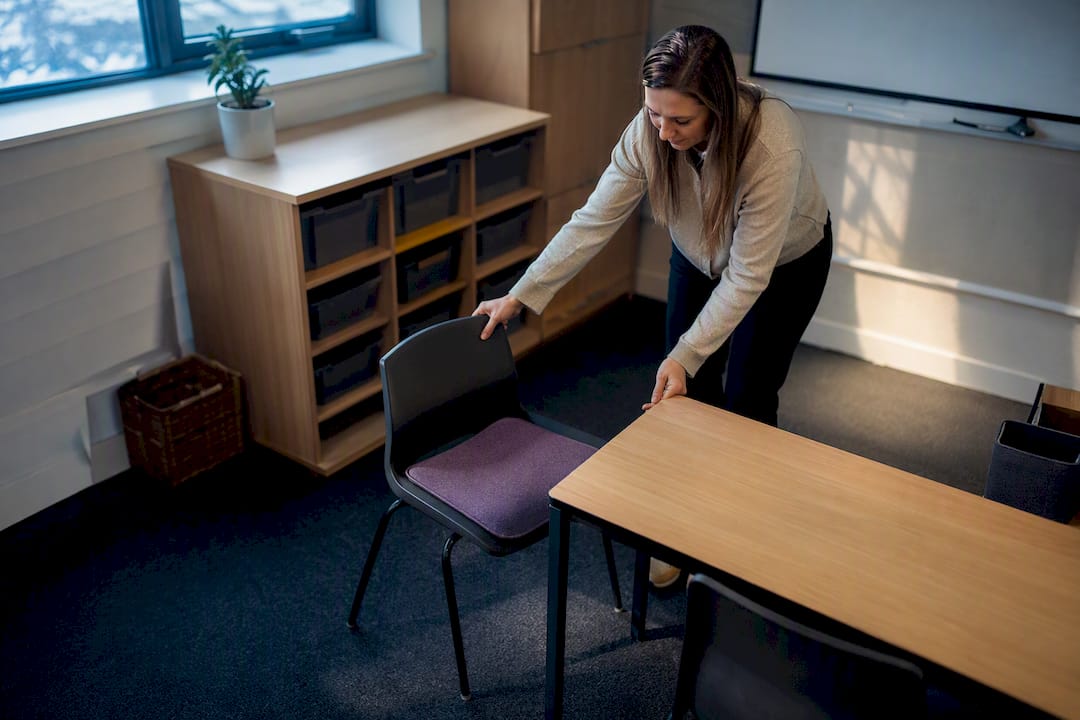
The accommodations with the strongest track record are quiet, low-distraction seating, short one-step instructions, a predictable daily routine, planned movement breaks, and assessment adjustments such as extra time or a separate room. Support should be needs-led and can start informally, before any diagnosis is confirmed. Ask the class teacher or SENCO to write down whatever you agree, because that record becomes essential if you need to push for more formal support later.
TL;DR:
- Seating near the teacher and away from distractions such as doors or high-traffic areas can improve concentration for pupils with ADHD.
- Giving one clear instruction at a time and using visual cues or checklists helps reduce task initiation difficulties.
- Formal exam accommodations like extra time and rest breaks should be trialed and monitored since their effectiveness varies by individual and assessment.
- Consistent routines, immediate praise, and scheduled movement breaks minimize disruptive behaviors and support self-regulation.
- Schools are encouraged to adopt needs-led, inclusive approaches that start before diagnosis, focusing on environmental adjustments rather than waiting for official labels.
Setting up the learning environment: sensory and physical adjustments
Where a pupil sits changes how much they absorb. Seating close to the teacher, away from doors, windows, and high-traffic areas, cuts down on competing stimuli without singling anyone out. Some pupils concentrate better with supervised standing options, a wobble cushion, or permission to move to a low-distraction corner when things get loud.
Lighting and noise matter more than most staff realise. Flickering strip lights, scraping chairs, and unpredictable background chatter all pull attention away from task. A consistent room layout, noise-reducing measures where practical, and a designated calm space give a pupil somewhere to reset without leaving the room entirely.
Visual organisation does a lot of quiet work: labelled trays, a visible daily timetable, and colour-coded books or folders reduce the number of decisions a distracted brain has to make just to find a pencil case.
- Seat near the teacher, away from doors and windows
- Offer a calm corner or quiet space for self-regulation
- Use consistent, uncluttered classroom layouts
- Colour-code books, trays, and folders by subject
- Display a visual timetable at eye level
Some pupils benefit from auxiliary aids, such as noise-reducing headphones or a laptop, and schools carry a duty to consider and maintain these where they are reasonable to provide, taking cost and resources into account, as set out in official guidance on reasonable adjustments.
Pro Tip: Ask the SENCO whether the school already owns spare noise-reducing headphones or a wobble cushion before assuming you need to buy or request new equipment.
Giving instructions and building organisation skills
Long, multi-step verbal instructions are one of the biggest friction points for pupils with ADHD, and small changes to how instructions are delivered make an outsized difference.
- Give one instruction at a time rather than a chain of three or four.
- Check understanding by asking the pupil to repeat the task back in their own words.
- Pair spoken instructions with a written or visual cue, such as a card or a symbol on the board.
- Break longer tasks into visible chunks using a first-then board or a visible countdown timer.
- Use a consistent planner, checklist, or colour-coded system for homework and hand-ins.
- Keep storage and hand-in routines identical week to week so the steps become automatic.
None of this works in isolation. When home and school use the same visual planner or the same colour code for subjects, a pupil only has to learn one system instead of two, and that consistency is often what turns a good week into a good term. Time blindness compounds task initiation problems too, so a visible timer that counts down, rather than up, tends to work better than a standard clock.
Completing tests and assignments: assessment adjustments and informal accommodation
Formal access arrangements exist precisely so that ADHD does not distort what an assessment is actually measuring. The common ones include extra time, scheduled rest breaks, a separate or reduced-distraction room, a reader or scribe, and permission to use a laptop or assistive software.
Day-to-day assignments benefit from smaller, less formal tweaks: chunked deadlines instead of one distant due date, and the option to submit work in an alternative format such as a recorded response.
- Extra time for exams, though schools set their own policy
- Rest breaks built into longer assessments
- A separate room away from classroom noise
- A reader, scribe, or speech-to-text software
- Chunked coursework deadlines with interim check-ins
A systematic review of testing accommodations found that benefits vary by accommodation and by assessment type, so no single adjustment helps every pupil in every subject, and schools should trial and monitor each one rather than assume it will automatically help. Review any arrangement after a term, and adjust it based on what actually changed.
Managing behaviour, routines and movement: positive, preventative strategies
Punitive responses to fidgeting, calling out, or missed deadlines tend to escalate the exact behaviours schools want to reduce. Preventative structure works better than sanctions after the fact.
Predictable routines and rehearsed transitions cut down on the moments where ADHD symptoms are most likely to surface, such as changing rooms or switching activities without warning. Immediate, specific praise, given the moment a pupil manages something difficult, teaches far more than a sanction handed out after the fact.
- Rehearse transitions between lessons and activities in advance
- Give immediate, specific positive feedback rather than delayed criticism
- Build scheduled movement breaks into the timetable, not just as a reward
- Use a sensory diet where a pupil needs regular physical input to stay regulated
- Write these strategies into the pupil’s behaviour plan so every staff member applies them consistently
Getting these into a written behaviour plan matters, because a strategy that lives only in one teacher’s head disappears the moment that teacher is absent.
How to request and document support at school
Start with the class teacher, then move to the SENCO if things do not improve. Bring specific examples rather than general impressions: dates, what happened, and what was already tried at home.
- Email the class teacher to flag concerns and ask for an initial informal meeting.
- If concerns persist, request a meeting with the SENCO and bring examples of struggles at school and at home.
- Agree a small number of adjustments to trial, and set a review date, typically four to six weeks out.
- Keep a simple log: what was tried, when, and what changed, since documenting the graduated approach with dates and outcomes strengthens any future case for statutory assessment.
- If SEN support alone is not enough, ask the SENCO about requesting an Education, Health and Care needs assessment.
- Bring your log, examples of work, and any clinical letters to that discussion, since the SEND Code of Practice sets out what local authorities weigh when deciding whether to assess.
Reviewing accommodations does not stop once they are agreed. Ask the SENCO to schedule a short check-in each term to confirm which adjustments are still earning their place and which have quietly stopped being used.
Needs-led, whole-school approaches and recent UK policy recommendations
UK policy is shifting away from making pupils wait for a diagnosis before they get help. The Neurodivergence Task and Finish Group recommends inclusive-by-design classrooms and needs-led support that starts regardless of diagnostic status, and the independent ADHD Taskforce has pushed for wider rollout of Mental Health Support Teams and Partnerships for Inclusion of Neurodiversity in Schools, with MHSTs already reaching roughly 2,800 primary schools in England.
- Ask whether your school participates in an MHST or PINS programme
- Ask what inclusive-classroom training staff have received this year
- Ask whether assessment policy allows flexible formats as standard, not exception-only
- Ask how the school tracks attendance and exclusion data for pupils with SEN
Schools that build these adjustments into everyday practice, rather than treating them as special favours, tend to see fewer exclusions and steadier attendance for neurodivergent pupils.
Why a structured self-assessment can help school conversations
Valerio Cozzi, founder of Omniprism, was diagnosed with ADHD at 42 long after school had already shaped how he saw himself. That gap between symptoms and recognition is exactly why he built a tool meant to surface patterns earlier, in language parents and pupils can actually use.
A structured self-assessment cannot diagnose ADHD, but it can help a family put words to patterns they had only vaguely noticed, which makes conversations with a SENCO or GP more specific from the first meeting. It sits alongside clinical assessment as a preparation tool, not a replacement for one.
What actually moves the needle for pupils with ADHD
The evidence points somewhere unfashionable: the environmental tweaks (seating, routine, one-step instructions) do more sustained good than the accommodations parents often fight hardest for, like extended exam time. Extra time helps on the day of a test. A predictable classroom helps every single day of term.
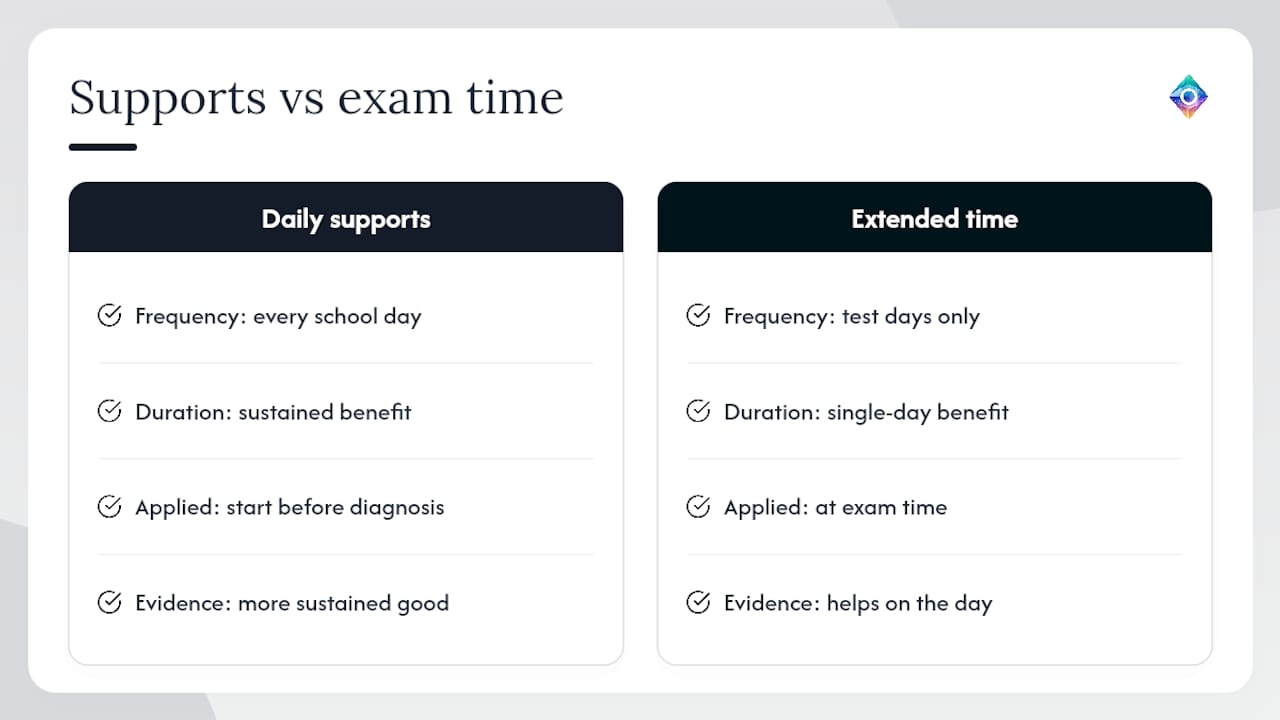
Where conventional advice falls short is treating diagnosis as the gate you must pass through before support starts. National guidance from the ADHD Taskforce is explicit that this delay costs pupils real time they cannot get back, and schools that wait for a formal label before adjusting seating or instructions are working against their own pupils’ interests.
If you take one thing from this article, make it the log. Parents who write down what was tried, when, and what changed walk into SENCO meetings with something a school cannot easily dismiss. Structured self-assessment tools, including our own take on ADHD red flags, can sharpen that log further, but the habit of documenting matters more than any single tool you use to do it.
— Valerio Cozzi
Get a clearer picture before your next school meeting
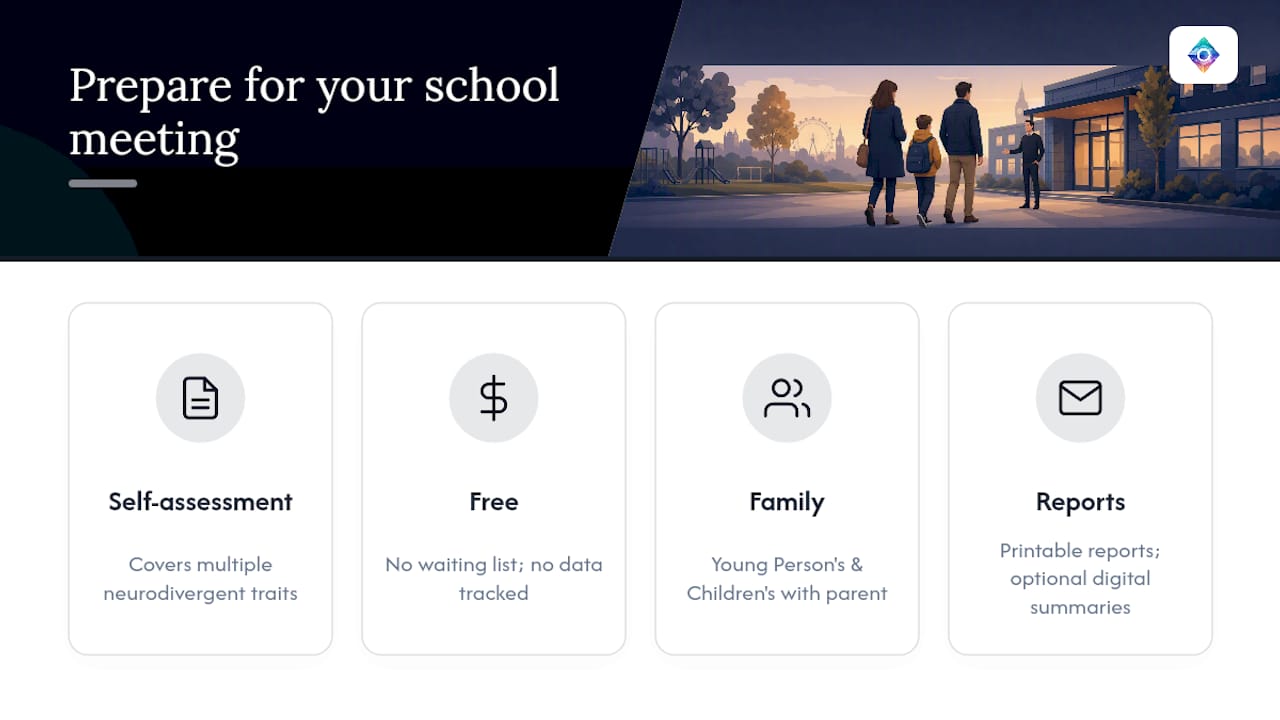
Omniprism is a free way to gather structured evidence before you ever sit down with a SENCO. The self-assessment covers multiple neurodivergent traits and gives instant, plain-language results with no data tracked and no waiting list. For families of children or teenagers, the Young Person’s Assessment and Children’s Assessment walk younger users through age-appropriate questions with a parent alongside them, and either report can be printed and taken straight into a school meeting.
If a clinical conversation follows, optional digital reports can summarize results for sharing with clinicians. It is not a diagnosis, and Omniprism says so plainly on its own disclaimer page, but it is a sharper starting point than turning up with a vague sense that something is not working. Start the free self-assessment today and bring the results to your next meeting with the class teacher or SENCO.
This article is general information, not a substitute for advice from a qualified doctor. Consult a qualified healthcare professional about your own circumstances before acting on anything here.
Sources
- Neurodivergence Task and Finish Group report
- Report of the independent ADHD Taskforce: Part 2
- Academic testing accommodations for ADHD: Do they help?
- Reasonable adjustments for disabled pupils: guidance
- SEND code of practice: 0 to 25 years
FAQ
What accommodations do schools give for ADHD?
Common accommodations include preferential seating, short stepwise instructions, movement breaks, visual timetables, and exam adjustments such as extra time or a separate room, all of which can be arranged through SEN support before any formal diagnosis.
What are some consequences for a child with ADHD at school?
Without adjustments, children with ADHD face higher risks of missed instructions, incomplete work, behavioural sanctions, and exclusion, which is part of why the ADHD Taskforce pushes for support that starts before diagnosis rather than after.
What can I do if my child with ADHD is struggling in school in the UK?
Speak to the class teacher first, request a SENCO meeting with specific examples, and keep a written log of any adjustments tried and their results, since that record supports a request for statutory assessment if SEN support alone is not enough.
What are examples of reasonable adjustments for ADHD?
Reasonable adjustments include seating changes, extra processing time, auxiliary aids like noise-reducing headphones, chunked coursework deadlines, and exam access arrangements, all covered under schools’ anticipatory duty to make reasonable adjustments.
Do I need a diagnosis before a school will make adjustments?
No. National guidance recommends needs-led support that begins as soon as a difficulty is identified, without waiting for a formal ADHD diagnosis to come through.
Recommended
- DSM-5 ADHD Criteria: A Clear Guide for Parents and Clinicians
- ADHD Red Flags: What Parents and Adults Should Know
- Time Blindness in ADHD: How to Spot It and Manage It
- ADHD in Women: Why It’s Missed and How to Get Help
Written and edited by Valerio Cozzi, founder of Omniprism. Omniprism began after my own ADHD diagnosis at 42.
This article is educational. It is not medical advice, not a diagnosis, and not a substitute for assessment by a qualified clinician. The Omniprism self-assessment is free, needs no account and no email address, and runs entirely in your browser — your answers are never sent to a server. The optional Specialist Briefing report is a paid add-on.