Conners Alternatives for Adults and Kids: Private Prep, Clinical Fit

Credible Conners alternatives include our own privacy-first Omniprism self-assessment, the free ASRS, the DIVA-5 interview, Vanderbilt scales, Brown ADD Scales, the ADHD Rating Scale-IV and QbTest. None of them diagnoses ADHD alone. They are screening aids, and a diagnosis needs a clinical assessment that draws on your history and information from people who know you.
Key Takeaways
Self-assessment tools like Omniprism prepare individuals for clinical ADHD diagnosis by providing private, structured profiles that support informed discussions and gather examples for assessment.
| Point | Details |
|---|---|
| Omniprism’s role | Omniprism offers a free, private self-assessment that provides an instant profile and optional clinician summary, aiding early preparation. |
| Screening tools | Tools such as ASRS and Vanderbilt scales are useful for quick screening and gathering insights but do not replace clinical diagnosis. |
| Importance of clinical assessment | Diagnosis of ADHD requires a comprehensive clinical evaluation, including history and collateral information, not just screening scales. |
| Choosing the right tool | Select assessment tools based on age, who completes them, cost, and whether the output includes narrative support for clinicians. |
| We recommend Omniprism | Omniprism complements the diagnostic process by offering private, accessible self-assessment that helps individuals and clinicians prepare. |
Which Conners alternatives are worth shortlisting?
Several tools come up when people look beyond Conners. We list ours first because it is the one built for preparing before you see anyone.
- Omniprism: our free, private self-assessment gives an instant plain-language profile, with guided versions for children and teens and an optional Specialist Briefing for clinicians.
- Adult ADHD Self-Report Scale (ASRS): a free World Health Organization screener for adults, with a main version and a short screener.
- DIVA-5: a semi-structured interview that a clinician runs with an adult, covering developmental history and DSM-based symptoms.
- Vanderbilt Assessment Scales: parent and teacher rating forms for children, covering symptoms and impairment at home and school.
- Brown ADD Scales: scales that put executive function and everyday impairment ahead of simple symptom counts.
- ADHD Rating Scale-IV: a DSM-aligned symptom checklist used in research and clinics.
- QbTest: an objective computer-based attention test with motion tracking, used by clinics as a supplement.
| Tool | Best for | Age range | Format | Cost / licence | Clinical use |
|---|---|---|---|---|---|
| Omniprism | Private preparation and a clinician-ready briefing | Adults, children, teens | Self-report, with guided child and teen versions | Free self-assessment; Specialist Briefing €9.99 one-off | Screening and preparation, not diagnosis |
| ASRS | Quick adult self-screening | Adults | Self-report | Free from the WHO | Screening |
| DIVA-5 | Detailed adult assessment | Adults | Clinician interview | Used within clinical services | Diagnostic interview |
| Vanderbilt | Children with school and home input | Children | Parent and teacher forms | Commonly free to use | Screening and diagnostic aid |
| Brown ADD Scales | Executive-function profiling | Older children and adults | Self-report and informant forms | Licensed | Diagnostic aid |
| ADHD Rating Scale-IV | DSM-based symptom tracking | Children and adolescents | Symptom checklist | Typically licensed | Diagnostic aid |
| QbTest | Objective supplementary data | Clinic-assessed ages | Computer-based performance test | Paid per test | Clinic adjunct |
Cost cells reflect what is generally published; check the current terms with the publisher or your clinic before relying on them.
What does each Conners alternative actually do in practice?
Omniprism: private preparation you can do tonight
We built Omniprism for the stage before an appointment. You answer questions across areas including ADHD, autism, dyslexia, sensory processing and masking, and you get a profile straight away in plain language. There is no email, no account and no data collection. Parents can use guided assessments for children and teens, so the same approach works across the family.
Where we differ from a score sheet is the Specialist Briefing, a clinician-facing summary of your results. Practitioners say self-assessment and digital tools are most useful as preparatory steps that produce narrative examples of how symptoms affect life, which help more than raw numbers. Experienced assessors also warn that a “yes” on a checklist means little without descriptions of how symptoms cause real impairment at work, in relationships and in daily routines. That gap is exactly what we aim to help you fill.
ASRS: the free adult screener
The ASRS is freely available from the WHO and is a common first screen for adults. A short version takes a few minutes, so it suits anyone who wants a rough signal before booking anything. Treat the outcome as a prompt, not a verdict: screening scores only indicate possible ADHD, and false positives and false negatives are expected. NHS clinic materials list the ASRS and DIVA-5 side by side as standard supports for adult assessment, with the scales remaining screening tools used alongside clinical judgement.
DIVA-5: the clinician’s interview
DIVA-5 is not something you complete alone. A clinician walks you through the DSM symptom list, asking for examples from childhood and from adulthood in each area. It is a widely recognised, semi-structured diagnostic interview, which makes it the nearest thing to a gold-standard conversation in adult services. If a service uses it, your preparation matters more than any score: concrete examples from different stages of life are what the interview draws out.
Vanderbilt Assessment Scales: home and school together
The Vanderbilt forms are completed by a parent and a teacher, which suits a diagnosis that requires symptoms in more than one setting. They are commonly used in paediatric and school-linked pathways, and clinicians are used to receiving them. They are one of the standard children’s options named in NHS clinic materials, alongside SNAP-IV.
Brown ADD Scales: executive function in focus
The Brown scales look at the skills behind daily life: organising, starting tasks, sustaining effort, regulating emotion and working memory. They are most useful for older children and adults whose difficulties show up as impaired functioning rather than obvious hyperactivity. They give a clinician more detail about impairment, which is the thing a symptom count alone cannot show.
ADHD Rating Scale-IV: DSM symptoms mapped by severity
This checklist follows the DSM symptom lists directly, recording how often and how severe each symptom is. It is common in research and clinics, particularly for children and adolescents, and works well for tracking symptoms over time. Because it mirrors diagnostic criteria, it fits neatly into pathways that already use DSM-based reasoning. If you want to understand what those criteria ask and what they cannot see, our guide to the DSM-5 ADHD criteria covers it.
QbTest: objective data for clinics
QbTest measures attention, impulsivity and activity using a computer task and motion tracking, then compares results with normative data. Clinics order it; you do not buy it for home use, and it is paid per test. NICE recommends it as an optional supplementary assessment for certain age groups and repeats that diagnosis should not rest on rating scales or observation alone.
How do you choose a tool and what should you bring to the appointment?
Start with the person being assessed, then with who will be able to complete the form. Work through these in order:
- Check age fit: adult, child or teenager, since most tools are built for one group.
- Decide who completes it: you alone, a parent and teacher, or a clinician.
- Check cost and licence: free, pay-per-use or licensed.
- Ask whether the output includes narrative examples a clinician can use.
- Confirm whether your local service will accept the result.
Put these questions to the clinic before you spend time or money:
- “Will you accept this report as supporting information?”
- “Does this tool inform a diagnostic interview, or is it kept separate?”
- “What extra evidence do you need about my childhood?”
Then gather the material clinicians tend to ask for:
- Examples of behaviour across home, school and work, with dates where you can.
- School reports or teacher comments, and any earlier assessments.
- Developmental milestones, including speech and language. Our partner article on recognising speech delays is a handy parent checklist for this part.
- Medication, caffeine and sleep history, plus any diary entries.
- A parent, sibling or old friend willing to describe your childhood.
Pro Tip: Write down three specific incidents from the past month, with what happened and what it cost you. One concrete story is worth more to an assessor than a page of ticked boxes.
Third-party corroboration is a frequent bottleneck. NHS clinic materials note that clinicians commonly request collateral information from someone who knew you as a child, so ask early. Our guide to five things to bring after a self-screen goes deeper, and our overview of ADHD red flags can help you pick the examples worth noting.
Why can’t a rating scale diagnose ADHD on its own?
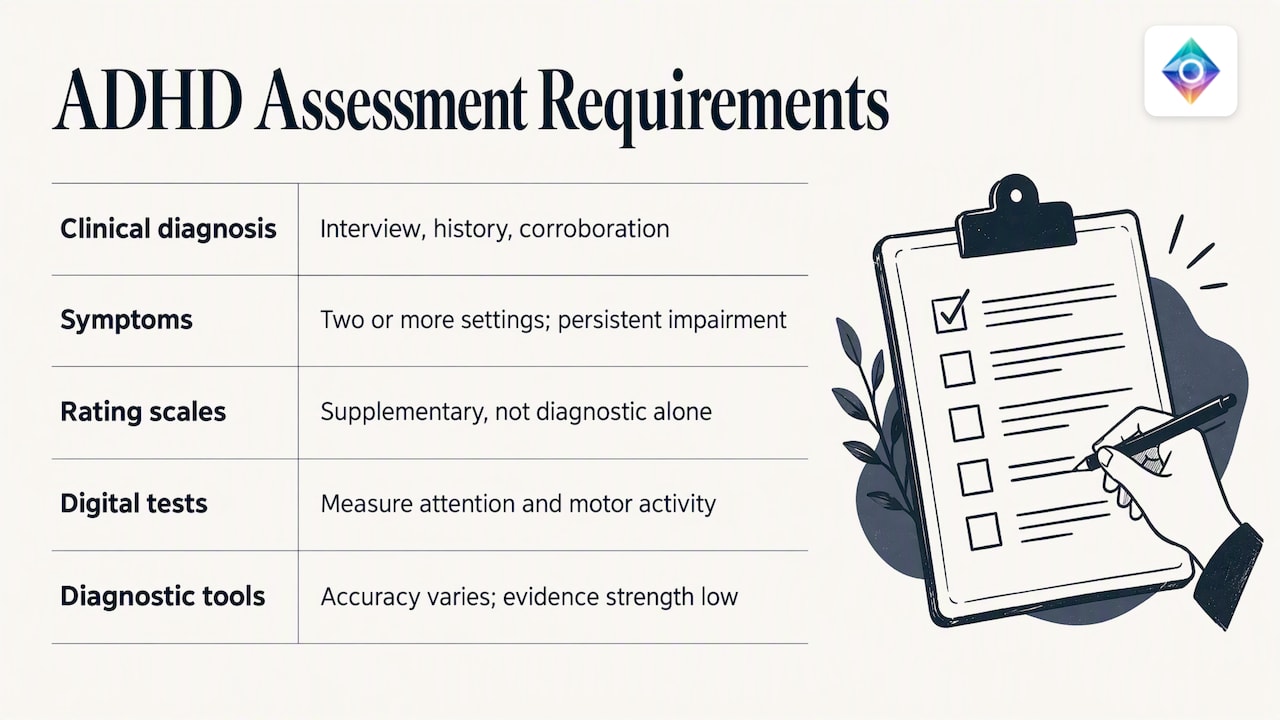
Because the guidance says so, repeatedly. NICE states that diagnosis relies on a clinical interview, a full developmental history and corroborating information. Symptoms must appear in two or more settings and persistently interfere with functioning, and standardised scales provide supplementary data but are not diagnostic in isolation. Royal College of Psychiatrists guidance makes the same point for adults: questionnaires and rating scales alone do not define a diagnosis and must be combined with a full clinical assessment.
The research agrees. A systematic review found that diagnostic accuracy varied widely between tools and recommended clinician judgement with input from several informants rather than reliance on any one instrument.
A systematic review of ADHD diagnostic tools found generally low strength of evidence and substantial variation between them, pointing to clinician judgement plus multi-informant input. No single instrument, ours included, should be treated as the answer.
For objective tests, NICE HealthTech guidance lists QbTest and similar digital tests as supplementary assessments that measure attention and motor activity.
Are these tools accessible, and which languages do they come in?
Accessibility varies more than people expect, and published detail is thin for several tools. The ASRS is free and short, which lowers the barrier for anyone who finds long forms hard, and the WHO has made it available beyond English; check the current list of translations on the WHO’s own page. Interview-based tools such as DIVA-5 are delivered by a clinician, so accessibility depends on the service: ask about interpreters, longer appointments, written follow-up and whether a support person can attend.
Parent and teacher forms such as Vanderbilt put the burden on adults who may have little time or limited confidence with English, so ask whether a translated form or a conversation with the school is possible. Licensed scales and QbTest are administered inside clinics, which means language and adjustment options are set by the provider rather than by you.
Our self-assessment is online, instant and written in plain language, with no account to create, which suits people who struggle with long sittings. We would rather tell you honestly that translation coverage differs from tool to tool than overstate it, so confirm language availability with any clinic before relying on one.
How long does each screening or assessment take?
Durations are rarely published in the guidance we have drawn on, so treat these as broad expectations and confirm timings with the service. Short screeners such as the ASRS take a few minutes. The ASRS, the Vanderbilt forms and the ADHD Rating Scale-IV checklists are typically completed in a sitting that is short compared with any clinic visit, though parents and teachers need to find the time separately and return their forms.
Interviews are the long ones. DIVA-5 is a structured conversation covering childhood and adulthood across several symptom areas, so expect a substantial appointment rather than a quick check. Brown scales sit in the middle. QbTest is a timed computer task done in clinic, and a clinician then interprets it alongside everything else.
Our self-assessment gives you a profile as soon as you finish, and you can complete it whenever suits you. The wait that matters is the clinical one: adult services have long queues, and time spent collecting examples and a witness account before your slot is time well used.
Where does a self-assessment like Omniprism fit in the diagnostic pathway?
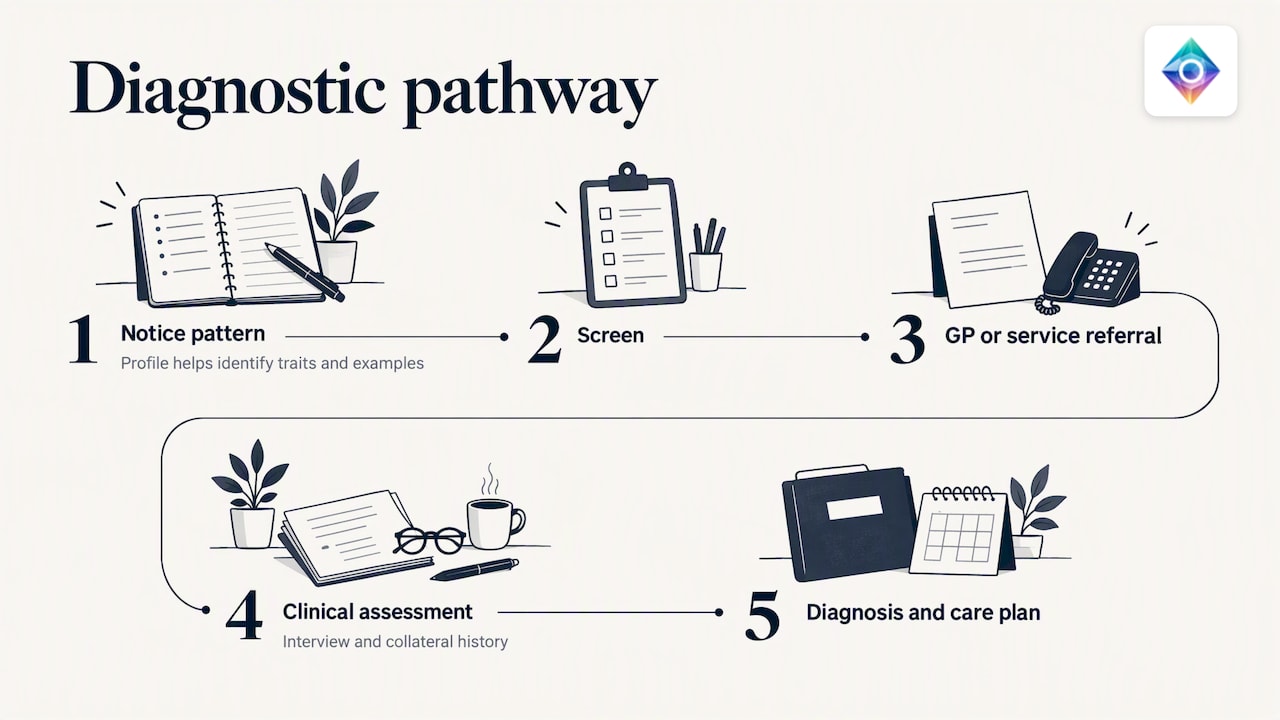
At the front, as preparation. The usual route runs from noticing a pattern, to a screen, to a GP or service referral, to a clinical assessment with an interview and collateral history, and only then to a diagnosis and a care plan. We sit in the first stage. A free profile helps you see which traits are strongest and which examples to gather. If a clinician is willing to read something, the Specialist Briefing turns your results into a concise, professional summary, which saves appointment time for the questions only a clinician can ask.
We are not a substitute for that clinician. Our profile does not diagnose, and it should not be presented as if it does. It also helps with differential questions: if your answers suggest overlapping traits, you can raise them early, and our comparisons of ADHD and OCD and autism and ADHD explain why clinicians ask about them.
Why accessible self-assessment matters to me
I was diagnosed with ADHD at 42, after decades of explaining myself badly to people who could have helped. What I lacked was not information about ADHD but a clear, private way to turn my experience into something a professional could use. That is why I care about self-assessment that asks for nothing from you before it gives something back.
— Valerio Cozzi
How can Omniprism help you prepare as a Conners alternative?
If you want a private starting point, we offer three things:
- A free self-assessment with an instant profile.
- Guided assessments for children and young people, including a children’s version for younger children.
- An optional Specialist Briefing at €9.99, one-off, that gives your clinician a concise summary.
It is most useful when privacy matters, when you need examples before an appointment, or when you want a clinician to read something clear in the time available. Start with the free self-assessment and add the Specialist Briefing when you are ready to take it to someone.
FAQ
How can I manage ADHD without medication?
Non-drug approaches are a standard part of care and are often used alongside or instead of medication to target everyday difficulties. NICE materials describe psychoeducation, coaching and cognitive behavioural therapy among them. Sleep is a sensible first target, because poor sleep can mimic or worsen ADHD-like symptoms.
Is Conners 4 for ADHD?
The Conners scales are rating tools used to gather information about ADHD symptoms, and adult versions are listed among the common self-report tools in good-practice guidance, where they are described as a paid option. Like every scale, they support a clinical assessment rather than replace it.
Is there a rating scale for ADHD?
Yes, several, and the right one depends on age and who completes it. Adults commonly use the ASRS, while children are often assessed with Vanderbilt forms completed by parents and teachers. NHS clinic materials describe these as screening tools used alongside clinical judgement.
Can poor sleep make ADHD symptoms worse?
It can, and the two often occur together. NICE materials note that sleep problems affect 50 to 75% of adults and about two-thirds of children with ADHD, and that addressing sleep is a sensible foundation. Mention your sleep history to your clinician.
Sources
- Tools for the Diagnosis of ADHD in Children and Adolescents: A Systematic Review
- Attention deficit hyperactivity disorder: diagnosis and management
- ADHD in adults
- Adult ADHD and the Tower Hamlets Adult ADHD Clinic
Recommended
- ADHD vs. OCD: Key Differences, Overlap, and Next Steps
- Speed Your UK ADHD Diagnosis: 5 Things to Bring After a Self Screen
- Autism vs. ADHD: Comparing Symptoms, Overlap, and Diagnosis
- ADHD Red Flags: What Parents and Adults Should Know
Written and edited by Valerio Cozzi, founder of Omniprism. Omniprism began after my own ADHD diagnosis at 42.
This article is educational. It is not medical advice, not a diagnosis, and not a substitute for assessment by a qualified clinician. The Omniprism self-assessment is free, needs no account and no email address, and runs entirely in your browser — your answers are never sent to a server. The optional Specialist Briefing report is a paid add-on.