UK ADHD Diagnosis: When Impairment Spans Two Areas
Seek a professional ADHD assessment when symptoms of inattention, hyperactivity or impulsivity cause moderate to severe impairment in two or more areas of your life, such as work and relationships, and have been present since childhood. If that description fits you or someone you care for, the next step is a GP appointment to discuss a referral for specialist assessment.
Key Takeaways
Seeking an ADHD assessment is essential when symptoms cause significant impairment across multiple areas of life since childhood, and persist over time, affecting daily functioning.
| Point | Details |
|---|---|
| Persistent symptoms across settings | ADHD traits must be present in at least two settings for a diagnosis, showing they are not isolated incidents. |
| Impairment in daily life | Multiple indicators such as job instability or relationship issues signal significant impairment worth a referral. |
| Age-appropriate signs vary | ADHD symptoms shift with age, from hyperactive behaviors in children to internal restlessness in adults. |
| Diagnosis involves thorough evaluation | Assessments include developmental history, clinical interview, questionnaires, and collateral reports from people who know the individual well. |
| Use structured self-assessment tools | Preparing with tools like Omniprism’s self-assessment can streamline referral conversations and improve diagnostic accuracy. |
What are the common signs of ADHD?
ADHD symptoms cluster into three groups: inattention, hyperactivity/impulsivity, and executive function difficulties. Recognising which cluster dominates, and how long it has been happening, helps you decide whether a referral conversation is worth having.
Inattentive signs include losing track of conversations mid-sentence, making careless mistakes on routine tasks, and forgetting appointments or deadlines despite reminders. In adults, this often looks like missing emails that need a reply or rereading the same paragraph three times without absorbing it. In children, it shows up as daydreaming in class or leaving homework half-finished.
Hyperactivity and impulsivity are easier to spot in children, who might fidget constantly, struggle to stay seated, or blurt out answers before a question finishes. In adults, the same traits often look quieter: an internal restlessness, interrupting colleagues in meetings, or making impulsive purchases and decisions without weighing consequences.
Executive function problems tie the other two together. Planning a project, starting a task that feels boring, and estimating how long something will take are all common sticking points. A person might know exactly what needs doing and still fail to start it until the deadline is hours away.
- Inattention: losing focus mid-task, frequent careless errors, forgetting commitments.
- Hyperactivity or impulsivity: restlessness, interrupting others, acting without thinking through outcomes.
- Executive dysfunction: poor time estimation, difficulty starting tasks, disorganised planning.
Stress, poor sleep and mood disorders can produce similar lapses in focus or irritability, which is why a single bad week rarely points to ADHD. What distinguishes the condition is persistence across years and consistent disruption across more than one setting, not an occasional rough patch.
How do I know if my symptoms are impairing my life enough for diagnosis?
Clinicians look for a specific pattern before accepting a referral: impairment in at least two areas of daily life, present since childhood, and significant enough to disrupt normal functioning. This is sometimes called the two-settings rule, and it sits behind both NHS and NICE assessment criteria.
For a diagnosis, adults typically need to show five symptoms from the DSM-5 inattentive or hyperactive-impulsive categories, while children generally need six, with symptoms present before the age of 12, according to NHS guidance. The symptom count matters less than the lived impact, though: a clinician wants to see that these traits are shaping outcomes, not just appearing on a checklist.
Concrete signs that impairment has crossed the threshold worth raising with a GP include:
- Repeated job changes or underperformance despite genuine effort and ability.
- Academic results that consistently fall short of known potential.
- Relationship breakdowns linked to forgetfulness, impulsivity or emotional dysregulation.
- Safety concerns, such as a pattern of near-miss accidents or risky driving.
- Struggling to manage basic self-care, bills or household responsibilities over an extended period.
One or two of these on their own might point to something else entirely. Several occurring together, over years, and across more than one setting is what typically moves a GP conversation from “let’s monitor this” to “let’s refer you.”
How is ADHD diagnosed in adults versus children?
The diagnostic pathway differs by age, though the core components overlap. Here is how each typically unfolds:
- Referral route for children: a GP usually refers to a paediatrician or Child and Adolescent Mental Health Services (CAMHS), often after school-based concerns are raised.
- Referral route for adults: a GP refers to a specialist adult ADHD or community mental health service, as recommended by the Royal College of Psychiatrists.
- Gathering childhood history: clinicians assessing adults look for corroborating evidence, such as old school reports or accounts from someone who knew the person as a child, because adult ADHD assessments rely heavily on this corroboration.
- When childhood evidence is limited: clinicians proceed cautiously, weighing other documentary evidence and clinical judgement rather than ruling out diagnosis outright.
- Core assessment components for both groups: a clinical interview, a full developmental history, standardised screening questionnaires, collateral reports from family, teachers or partners, and screening for overlapping conditions.
Children’s assessments lean more heavily on observational reports from school and home, since the child’s own account of their difficulties is often limited by age. Adult assessments depend more on self-report alongside whatever historical records can be tracked down, which is partly why gathering old school reports before your appointment can make a measurable difference to how smoothly the process goes.
What happens during an ADHD assessment?
An assessment appointment typically runs as a structured conversation rather than a quick questionnaire. Expect a clinical interview covering your developmental history, current symptoms, and how they affect different areas of your life, often supported by standardised rating scales, as described in East London NHS Foundation Trust’s assessment process.
- Expect questions about childhood behaviour, school experiences and family history.
- Expect to complete or discuss structured questionnaires about current symptoms.
- Expect the service to request, or invite you to bring, collateral information from someone who knows you well.
Outcomes vary. Some assessments conclude with a diagnosis, others identify a different explanation such as anxiety or a sleep disorder, and some result in referral to a different service entirely. ELFT notes that assessment outcomes are summarised in a letter sent to both the patient and their GP, which then guides next steps.
Specialist ADHD assessment waiting times vary depending on location, and patients in England who meet referral criteria can use the NHS Right to Choose scheme to select an alternative provider, which can shorten the wait considerably in some regions.
How can I prepare for an ADHD referral or assessment?
Preparation genuinely speeds things up. A GP or specialist service working from vague descriptions has to ask more follow-up questions; one working from specific, dated examples can triage and refer faster.
- Write down concrete examples of difficulties in at least two settings, such as work and home.
- Gather school reports, old performance reviews or medical letters that mention attention or behaviour.
- Note the approximate age when symptoms first appeared.
- List names of people, a parent, teacher or partner, who could describe your childhood or current behaviour if asked.
- Record any medications or diagnosed conditions you currently manage.
Our checklist for assembling clinician-ready notes goes through how to phrase these examples so they hold up in a short appointment slot. For families building a timeline from school records, a guide to classroom adjustments can help identify which school-based observations are worth including.
Pro Tip: Bring written examples rather than relying on memory in the appointment room; a five-minute consultation rarely leaves room to think of good ones on the spot.
A structured self-assessment, like the one we built at Omniprism, can help organise these details into a plain-language profile before you ever see a clinician, though it remains a starting point for conversation rather than a diagnosis in itself.
What are the early signs of ADHD at different ages?
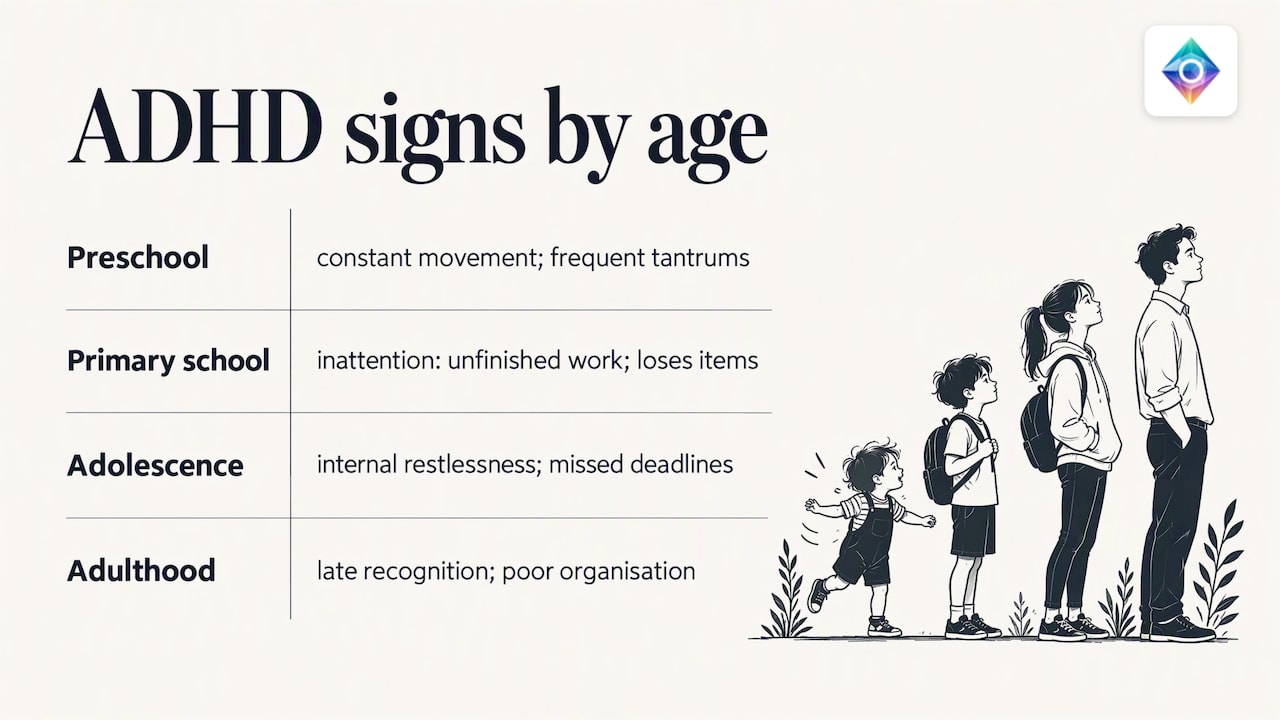
Signs of ADHD shift noticeably as children grow, which is why the same underlying traits can look completely different at age 4 compared with age 14. In preschool years, the most visible signs tend to be constant movement, difficulty sitting through a story, and frequent tantrums disproportionate to the trigger.
By primary school age, teachers often notice the inattentive pattern more: unfinished classwork, difficulty following multi-step instructions, and losing belongings like coats or pencil cases repeatedly. Hyperactivity at this stage might look like climbing on furniture or struggling to queue.
In adolescence, the picture changes again. Hyperactivity often becomes internal restlessness rather than obvious physical movement, while inattentive symptoms show up as missed deadlines, disorganised schoolwork, and a widening gap between known ability and actual grades. Our piece on recognising teen ADHD signs covers how to document these changes for a referral conversation.
Adults who were never flagged as children sometimes only notice the pattern once life demands more independent organisation, a first job, a household to run, a relationship to maintain. Looking back, many recognise early signs that were dismissed as personality traits rather than something worth raising with a doctor. A broader list of ADHD red flags across ages can help if you are still unsure which stage’s signs apply to you or your child.
How do I tell ADHD apart from other conditions or normal behaviour?
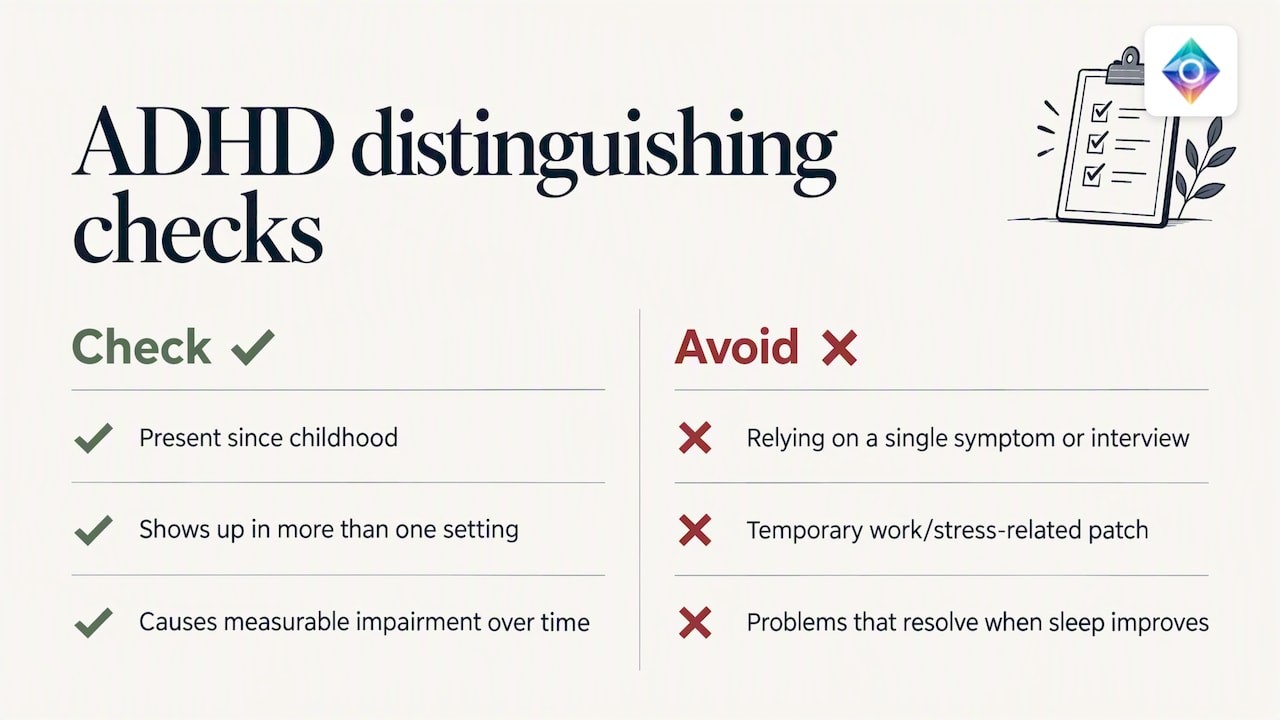
Many conditions mimic ADHD symptoms, and ordinary behaviour, boredom, tiredness, or a stressful period at work, can also produce temporary inattention or restlessness. The distinguishing features are duration, consistency and cross-setting impact rather than any single symptom in isolation.
Anxiety can cause poor concentration and restlessness that resemble ADHD, but anxiety-driven inattention usually centres on worry about a specific situation rather than a general difficulty sustaining focus across unrelated tasks. Sleep problems produce similar daytime inattention, but typically resolve once sleep improves, whereas ADHD symptoms persist regardless of rest.
Learning difficulties such as dyslexia can also look like inattention in a classroom setting, when the real issue is difficulty processing written text rather than an attention problem itself. The Royal College of Psychiatrists cautions that clinicians should not rely on a single semi-structured interview at first contact, precisely because overlapping conditions can produce false positives if screened too quickly.
The practical test is whether the pattern has been present since childhood, shows up in more than one setting, and has caused measurable impairment over time. A rough patch at work during a difficult project is not the same as a lifelong struggle to meet deadlines regardless of circumstances.
Why do anxiety or depression often come up alongside ADHD concerns?
ADHD rarely travels alone. Many children diagnosed with the condition continue to experience symptoms into adulthood, and the presentation often becomes more complex over time, frequently co-occurring with anxiety or depression, according to Cumbria, Northumberland, Tyne and Wear NHS Foundation Trust.
This overlap matters for two reasons. First, untreated ADHD, with its pattern of underperformance, missed deadlines and relationship strain, can itself contribute to anxiety or low mood over time. Second, anxiety and depression can mask or complicate an ADHD picture, making it harder for a clinician to separate which symptoms stem from which condition without a careful history.
The Royal College of Psychiatrists notes that clinicians need to actively screen for these overlapping conditions during assessment rather than assume one diagnosis explains everything. If you have been treated for anxiety or depression for years without much improvement, and the underlying pattern of inattention or impulsivity has always been there, it is worth mentioning that history explicitly when you see your GP. It may be the detail that prompts a referral rather than another medication adjustment.
A founder’s perspective on seeking clarity
I was diagnosed with ADHD at 42, after decades of assuming my scattered focus and chronic lateness were just personality flaws. Getting a name for the pattern changed how I understood years of my own history. If this article resonates, talk to your GP, and consider using a structured tool to organise your thoughts before that appointment.
— Valerio Cozzi
An alternative: use a self-assessment to prepare for clinical assessment
Before you sit down with a GP, it helps to arrive with a clear picture rather than a jumble of half-remembered examples. Our self-assessment at Omniprism gives you an instant, plain-language profile across 14 areas, including ADHD, without asking for an email address or creating an account, and it includes guided versions built for children and teens.
For readers who want something more formal to hand a clinician, our optional Specialist Briefing report, priced at a modest one-off fee, turns your results into a clinician-friendly summary designed to make referral conversations clearer and faster. It sits alongside your GP visit as preparation, not a replacement for it.
This article is general information, not a substitute for advice from a qualified doctor. Consult a qualified healthcare professional about your own circumstances before acting on anything here.
FAQ
When should I get diagnosed for ADHD?
Seek assessment when symptoms of inattention, hyperactivity or impulsivity have been present since childhood and are causing moderate to severe impairment in two or more areas of life, such as work, relationships or education. The NHS recommends starting with a GP conversation if this pattern fits you.
What are the top three signs of ADHD?
The three core symptom clusters are inattention, such as losing focus or forgetting commitments, hyperactivity or impulsivity, and executive function difficulties like poor time management. No single sign confirms ADHD on its own; clinicians look at how consistently these patterns appear across different settings and over time, as outlined in NHS diagnostic guidance.
What is the 30% rule for ADHD?
There is no officially recognised “30% rule” in NICE, NHS or DSM-5 guidance on ADHD diagnosis. The figure sometimes circulates informally to describe a developmental lag in skills like emotional regulation, but it is not part of any formal diagnostic criterion, so it should not be used to decide whether to seek assessment.
What are the diagnostic criteria for ADHD according to the DSM-5?
DSM-5 criteria generally require five symptoms of inattention or hyperactivity-impulsivity for adults, and six for children, with several symptoms present before age 12 and causing impairment in two or more settings, according to NHS guidance. A full clinical assessment, not a checklist alone, is needed to confirm diagnosis.
How long does an NHS ADHD assessment take?
Specialist ADHD assessment waiting times vary widely depending on location and service demand. In England, patients who meet referral criteria can use the NHS Right to Choose scheme to select an alternative provider, which can reduce waiting time in some areas.
Sources
- ADHD in adults - NHS
- Attention deficit hyperactivity disorder (ADHD) in adults: Good practice guidance - Royal College of Psychiatrists
- Assessment process | East London NHS Foundation Trust
- NHS England — ADHD programme update
- Cumbria, Northumberland, Tyne and Wear NHS Foundation Trust - ADHD information
Recommended
- 50–70% Overlap in Autism and ADHD: What Families and Clinicians Need
- DSM-5 ADHD Criteria: What They Ask, and What They Can’t See
- ADHD vs. OCD: Key Differences, Overlap, and Next Steps
- ADHD vs. Bipolar Disorder: Key Differences Explained
Written and edited by Valerio Cozzi, founder of Omniprism. Omniprism began after my own ADHD diagnosis at 42.
This article is educational. It is not medical advice, not a diagnosis, and not a substitute for assessment by a qualified clinician. The Omniprism self-assessment is free, needs no account and no email address, and runs entirely in your browser — your answers are never sent to a server. The optional Specialist Briefing report is a paid add-on.