Self Assessment vs Diagnosis: ADHD and Autism Quizzes Aren’t Diagnoses
A self-assessment is a screening and reflection tool, while a diagnosis is a formal clinical decision made after a full assessment by a qualified specialist, as NHS England guidance describes. A self-assessment, such as the privacy-first one we built at Omniprism, can raise awareness and help you prepare for an appointment. It cannot replace the clinical process.
Key Takeaways
Self-assessments can support reflection and readiness for clinical diagnosis but cannot replace professional assessment or validation.
| Point | Details |
|---|---|
| Self-assessments support awareness | They help individuals notice patterns and prepare questions for healthcare providers. |
| Diagnosis involves a structured process | It includes interviews, history, reports, and standardized tools conducted by specialists. |
| Online tests have limited accuracy | Most online symptom checkers are prompts, and their diagnostic reliability is generally low. |
| Seek professional help when needed | Persistent difficulties affecting multiple life areas call for a clinical assessment starting with a GP. |
| Omniprism offers privacy-first profiles | Their self-assessment tool provides clear reports without data collection, aiding appointment preparation. |
What is a self-assessment, and what does it actually do?
A self-assessment is any questionnaire, checklist, online screener or social-media quiz you complete yourself to reflect on traits or symptoms. Formats range from validated screening questionnaires to quick quizzes with no published testing behind them.
People tend to use them for several reasons:
- To notice patterns they had not put into words before
- To identify topics worth raising with a GP or clinician
- To track how difficulties show up across weeks or months
- To feel confident enough to ask for help
The limits matter as much as the uses. Many online versions are administered without standardised scoring, and a systematic review of online inventories on Amazon Mechanical Turk found that many did not report following validated administration or scoring, which can inflate prevalence estimates. A result is a prompt for a conversation, not a conclusion.
What does a professional diagnosis and clinical assessment involve?
A diagnosis follows a structured process, not a single checklist. For ADHD and autism, NHS England guidance describes assessment by a specialist, such as a psychiatrist or paediatrician, using structured tools and a full review of psychiatric and developmental history.
A typical clinical assessment includes:
- A detailed interview about current difficulties and how long they have been present
- A developmental and psychiatric history, often going back to childhood
- Reports from third parties, such as a parent, partner or teacher
- Standardised tools, used alongside clinical judgement
For adults, the Royal College of Psychiatrists notes that ADHD diagnosis involves significant difficulties in at least two areas of daily life, and that questionnaires can help but cannot alone give an accurate diagnosis. The aim is to understand your needs and any coexisting conditions. A diagnosis is one possible outcome, not the only one.
How do self-assessment and diagnosis differ in practice?
The two differ most in purpose, rigour and what follows from the result.
- Purpose: A self-assessment supports reflection and screening. A diagnosis confirms or rules out a condition and informs care planning.
- Rigour: A self-assessment rests on one person’s own answers. A clinical assessment draws on several informants, a developmental history and professional judgement, which guards against both over- and under-recognition.
- Consequences: A self-assessment can prompt you to seek help, but it does not by itself unlock formal services or medication. A diagnosis supports clinical decisions, treatment options and, in many settings, formal accommodations at work or school.
One difference is easy to miss. A self-assessment captures how you see yourself on the day you complete it. A clinician is trained to test that picture against your history and against what other people have observed, which is why the same person can score highly on a screener and still not meet diagnostic criteria, or the reverse.
Are online ADHD and autism tests accurate?
Accuracy is limited and uneven. A 2023 systematic review of online symptom checkers found that diagnostic and triage accuracy was generally low and variable.
Of the 14 studies included, 69% reported suboptimal triage accuracy (Triage and Diagnostic Accuracy of Online Symptom Checkers: Systematic Review). Online tools should be treated as prompts, not verdicts.
Screening instruments fare better when they are properly validated. A systematic review of screening tools in primary care identified 11 tools using multiple-disorder or transdiagnostic approaches. Most were time-efficient and reported sufficient sensitivity and specificity, but their scope varied widely. Putting a questionnaire online can also change how it behaves: a practitioner-focused review notes that many online inventories do not describe how they were adapted for digital use, and that results are heterogeneous when screeners are applied online.
Social media adds a further layer. An RCPsych essay on social media and psychiatry argues that it raises awareness but also feeds misinformation, concept creep and echo chambers that reinforce beliefs people already hold.
When should you seek a professional assessment?
Seek an assessment when difficulties are persistent and getting in the way of ordinary life. Concrete triggers include:
- Difficulties that cause moderate or greater impairment in two or more settings, such as work, school and home
- Persistent distress, or any concern about your safety, which needs prompt attention from a GP or urgent services
- A self-assessment result that matches a long-standing pattern you can describe with examples
- Struggles that keep recurring despite your own coping strategies
The route usually starts with your GP. Black Country ICB guidance advises preparing your developmental history and concrete examples of difficulties, then asking for a referral if clinically appropriate. If you are a parent, writing down early milestones helps, and this developmental milestones guide for new parents is a useful companion. Our guide to when impairment spans two areas explains the diagnostic threshold in more detail.
Support often does not have to wait. NHS mental health assessment guidance makes clear that you do not always need a formal diagnosis to access support or reasonable adjustments.
How do you use a self-assessment responsibly?
Treat any result as a hypothesis to test, not a label to adopt. Practical habits that reduce harm:
- Write down specific examples of how the traits affect your day, with dates and settings where you can
- Ask someone who knows you well, or knew you as a child, to describe what they have noticed
- Avoid self-treatment, including changing medication or diet on the strength of a quiz
- Check what data a tool collects, and avoid posting results publicly before you have discussed them with a clinician
- Bring the results to your GP appointment and ask directly about referral
Pro Tip: Condense your results and examples into a concise summary before your appointment, so the clinician can review it easily. Our one-page neurodiversity report examples show how.
Caution is warranted because self-diagnosis changes consultations. A psychiatric study of online self-diagnosis found that it has altered the doctor-patient relationship and can lead patients to describe symptoms that match their own research, which complicates assessment.
What are the differences in outcomes between a self-assessment profile and a diagnosis?
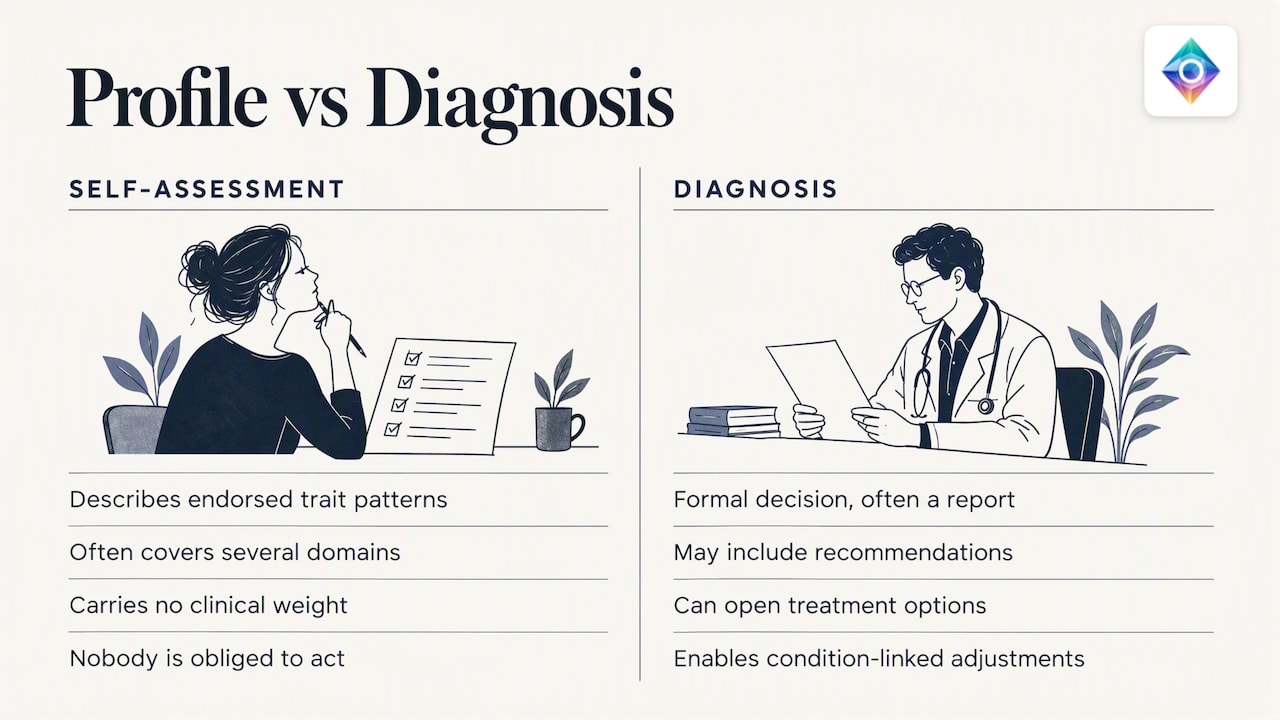
The two produce different kinds of output, meant for different jobs. A self-assessment profile describes how strongly you endorse certain traits, often across several domains at once. It is useful for spotting where your difficulties cluster and for deciding what to ask about. It carries no clinical weight on its own, and nobody is obliged to act on it.
A diagnosis produces a formal decision, usually written up as a report with recommendations. It can open doors that a profile cannot: treatment options, workplace or school adjustments tied to a recognised condition, and a shared clinical record. A diagnosis can also decline to confirm a condition while still explaining what is going on, because NHS guidance on mental health assessments frames assessment as a collaborative process to understand the whole person, with diagnosis only one possible result.
There is also a difference in what each one can get wrong. A self-assessment can over-identify traits that are common in the general population, or miss them because masking hides them. Our piece on how masking hides adult autism signs shows why a quiz and a clinician can reach different conclusions. A clinician can also err, so if you disagree with an outcome, RCPsych guidance notes you can ask for a review or second opinion, and NHS autism assessment guidance mentions second opinions and private assessments where referral is difficult.
Can a self-assessment complement a professional diagnosis?
Yes, and that is the role it does best. Think of the self-assessment as the preparation and the clinical assessment as the decision. A good profile helps you describe your difficulties in plain language, which clinicians value because assessment depends on a clear history.
In practice, a self-assessment can shorten the first conversation. Instead of struggling to recall examples under time pressure, you arrive with a structured summary, a list of settings where difficulties appear, and notes from people who know you. That speaks directly to what clinicians look for: Right Decisions clinical guidance describes a thorough assessment as built on patient history, screening for other symptoms and risk assessment.
It also helps while you wait. Local NHS guidance says you do not always need to wait for a diagnosis before receiving help, and a profile can point you towards adjustments worth requesting. For a school-age child, ideas such as those in our classroom adjustments for ADHD article can be discussed with teachers in the meantime.
Our guide on turning an online ADHD test into clinician-ready evidence covers this workflow step by step. The principle is simple: use the tool to organise what you already know about yourself, then let a qualified clinician decide what it means.
How do culture, gender and age affect self-assessment and diagnosis?
Both routes are shaped by who is answering and who is interpreting. Questionnaires are written with particular assumptions about how traits look, and those assumptions do not fit everyone equally. Someone raised in a culture that values quiet compliance may not recognise their own restlessness or social strain as unusual, while another person may score high on items that reflect a cultural norm rather than a difficulty.
Gender plays a similar role. Presentations that differ from the textbook picture can be overlooked by both a quiz and a clinician, and masking, where a person learns to hide their traits in public, can make impairment invisible to observers and understated in self-report. Our article on adult autism signs and masking explains why this is one reason an assessment draws on several informants rather than one.
Age matters because diagnostic frameworks require evidence of difficulties across time, including earlier life, and memories of childhood fade. Parents and school records become valuable. Children and teenagers also need different questions from adults, because what counts as typical behaviour changes with development. A teenager’s answers may reflect school pressure or stress as much as a lasting trait, which is part of why this guide to navigating stress in school is useful for families seeking support alongside assessment.
None of this makes self-assessment pointless. It means you should read a result in context, and tell your clinician about your background, language and life circumstances so they can weigh it properly.
Author perspective: why clear guidance matters
I am Valerio Cozzi, founder of Omniprism, and I was diagnosed with ADHD at 42. Having reached a diagnosis later in life, I know how much clearer the path feels when someone explains what a result means and what it does not. A self-assessment helped me start the conversation, and a clinician finished it.
— Valerio Cozzi
How can a privacy-first self-assessment help you prepare?
We built Omniprism’s self-assessment to give you an instant, plain-language profile, with no email, account or data collection, plus guided versions for children and teens. If you want something a clinician can read quickly, our Specialist Briefing is a one-off report at 9.99 EUR. It supports your appointment and does not replace a clinical diagnosis.
This article is general information, not a substitute for advice from a qualified doctor. Consult a qualified healthcare professional about your own circumstances before acting on anything here.
FAQ
Can a self-assessment diagnose ADHD or autism?
No. A self-assessment can suggest traits worth discussing, but a diagnosis needs a clinical assessment by a qualified specialist, which includes interview, history and third-party reports, as NHS England guidance describes.
How accurate are online ADHD and autism tests?
Accuracy varies widely and is often limited. A 2023 systematic review of online symptom checkers found generally low and variable diagnostic and triage accuracy, so treat results as prompts for a conversation.
What does a mental health assessment involve?
It involves questions about your symptoms, history and the impact on daily life. The NHS describes diagnosis as based on clinician questions rather than a physical test, sometimes supported by questionnaires.
Do I need a diagnosis to get support?
Not always. NHS guidance says support or reasonable adjustments can often begin on a needs-led basis before a formal diagnosis is confirmed.
Sources
- England
- Triage and Diagnostic Accuracy of Online Symptom Checkers: Systematic Review
- Screening tools assessing mental illness in primary care: A systematic review
- ADHD in adults
Recommended
- Autism vs. ADHD: Comparing Symptoms, Overlap, and Diagnosis
- UK ADHD Diagnosis: When Impairment Spans Two Areas
- 50–70% Overlap in Autism and ADHD: What Families and Clinicians Need
- DSM-5 ADHD Criteria: What They Ask, and What They Can’t See
Written and edited by Valerio Cozzi, founder of Omniprism. Omniprism began after my own ADHD diagnosis at 42.
This article is educational. It is not medical advice, not a diagnosis, and not a substitute for assessment by a qualified clinician. The Omniprism self-assessment is free, needs no account and no email address, and runs entirely in your browser — your answers are never sent to a server. The optional Specialist Briefing report is a paid add-on.