Autism Self-Advocacy: What It Means and Why It Matters
Self-advocacy for autistic people means knowing what you need and knowing how to get those needs met, whether at home, at school, at work or in a clinic. It matters because support, adjustments and rights tend to arrive when you can name a need clearly, or when someone speaks with you if speaking is hard. This guide covers what the skill involves, how to practise it, and how to prepare for the conversations where it counts most.
Key Takeaways
- Self-advocacy has two parts: knowing what you need and knowing how to get it met. It applies to every area of life.
- Scripts, written notes and an “about me” page make it easier to speak up when talking face to face is hard.
- Children learn it through small choices, role-play and a parent who steps back gradually.
- You choose whether, when and to whom you disclose a diagnosis, and asking for adjustments in writing helps them last.
- Shared advocacy, with a supporter or an independent advocate, is a legitimate form of self-advocacy, not a lesser one.
What is self-advocacy for autistic people?
The Autistic Self Advocacy Network describes self-advocacy as taking control of our own lives: making choices about home, school, work and relationships, and working together to shape how society treats disabled people. The CHOP Research Institute puts it more practically. It gives the example of asking for teaching that suits your learning style, requesting workplace accommodations, or knowing which shop has the least flickering light.
For children, Raising Children Network says self-advocacy helps them take part in decisions, feel capable and develop independence. The Autism Association of Australia adds that people with more profound autism may rely on parents, carers or guardians to advocate for them, and that this is part of the picture, not a gap in it (Autism Association of Australia).
Language is part of this too. In a survey of 150 autistic adults quoted in the Autism Speaks toolkit, only 19% chose “autistic person” and 17% “person with autism”, so the best habit is to ask how someone wants to be described.
How do autistic people explain their needs?
The first step is knowing your own profile. Leicestershire Partnership NHS Trust describes self-advocacy as deciding what you need and asking for it with confidence, which starts with a clear view of your strengths, needs and preferences. Many late-diagnosed adults were told for years that because they speak well in one setting they should manage in all of them. The Autism Speaks toolkit stresses that these communication challenges are real and not the person’s fault.
That toolkit and the NHS trust both suggest practical formats that take pressure off live speech:
- A script written before a call or meeting.
- A checklist or bulleted list you can read from.
- An email or message for ideas that are hard to say aloud.
- A rehearsed conversation with someone you trust.
- A pause to type your thoughts on your phone in the moment.
- A pre-printed card for high-stakes situations.
- A short “about me” note or phone document with your key needs and communication tips.
- A request for information in writing and in plain English.
An AAC device, such as a tablet with speech software, is also a fully valid way to advocate where speech is limited.
A self-assessment can give that first step some structure. Our Free Adult Self-Assessment gives an instant plain-language profile across 14 areas, including autism, ADHD, masking and sensory processing, so you have words for your patterns before you need to use them.
What self-advocacy skills can you build, and how?
The Autism Education Trust toolkit for autistic young people lists eight guidelines: prioritise your needs, prepare and plan, be creative, find your voice, know your rights, follow up and ask for confirmation, keep written records, and look after your wellbeing. It says preparation can help you feel less nervous, and that knowing your rights helps you specify what you want.
The Vanderbilt Kennedy Center teaches a three-step routine you can use on any problem:
- Scan the situation and name the obstacle.
- Brainstorm solutions and weigh strengths and risks.
- Communicate the request, choosing a sensible moment.
The guide recommends coaching on timing, for example before class, at break or at the next support meeting, plus communication scripts and frequent role-play.
A worked example: a student finds the canteen unbearably loud. They name the obstacle (noise at lunch), list options (eat earlier, eat in a quieter room, wear ear defenders), and email a teacher with the preferred option and the reason. The Autism Education Trust toolkit specifically suggests writing or emailing staff when discussing sensory needs face to face is hard.
How can parents help an autistic child self-advocate?
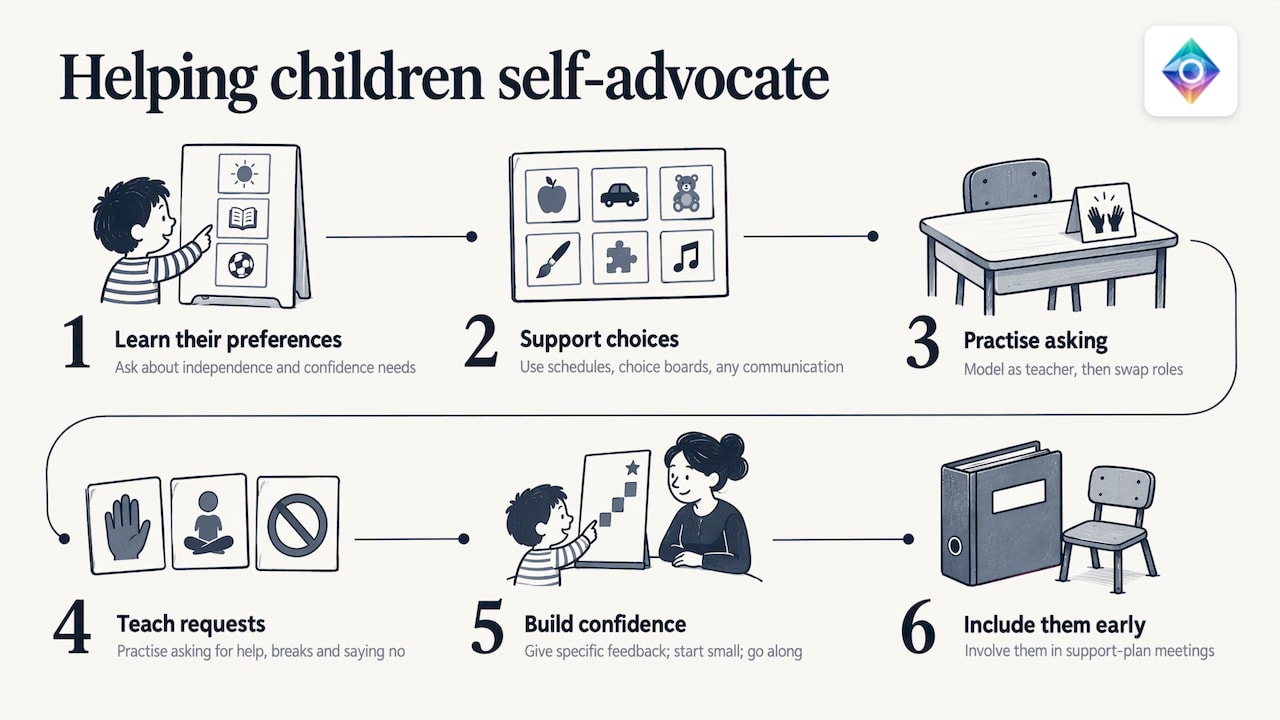
Start with knowing themselves. Raising Children Network suggests asking about opinions and preferences, and asking questions such as what they can do by themselves and what they need to feel more confident. Visual schedules and choice boards help with daily decisions, and any form of communication counts: gestures, signs, images or an alternative system.
The same page recommends role-play in which you play the teacher first, to model asking for help, and then swap so your child can practise. Give specific positive feedback, begin with small steps, and go along for support before your child speaks to the teacher alone.
For younger children, the Vanderbilt caregiver guide suggests commenting on what you observe (“I see you spinning around, I can tell you like moving that way”), offering choices of snack or activity order, and teaching ways to ask for help, ask for a break and say no, whether by words, gestures or visual cards. It also recommends involving the child in support-plan meetings from an early age.
If you are still working out what your child’s profile looks like, our Children & Young People Free Assessment offers guided assessments for children and teens, and there are versions for ages 7 to 10 and ages 11 to 13. The Autism Checklist for Parents covers signs to note and next steps.
How do you self-advocate at school?
School is where many autistic people first learn to ask for something. The Vanderbilt guide for middle and high school staff recommends preference assessments shared with students, choices throughout the day, ownership of assignments and several ways to communicate needs, as well as including students in support-plan meetings in roles from observer to decision maker.
Educators should know that the environment matters as much as the student’s skill. A 2026 peer-reviewed study interviewed 19 autistic adolescents and adults and found structural barriers to self-advocacy in US schools across six areas: erasure, conformity, isolation, oppression, hidden expectations and authority. The authors conclude that ableism operates at system level, not only between individuals. A student who is asked to speak up in a setting that does not listen will struggle however well prepared they are.
Peer support can change that. A study of the Self-Determined Learning Model of Instruction found teachers observed increased self-confidence and assertiveness in students, and that peers learning to support classmates broke down communication barriers.
Practical school strategies from the Autism Education Trust toolkit include a visual daily timetable, a visual checklist at school and at home, packing equipment the night before, and bringing sensory items such as ear defenders or fidgets into the classroom. For UK families, our guide to legal school autism adjustments and the article on a sensory friendly classroom turn this into requests you can make. Older students asking about rights and access to support may also find what getting assessed involves useful, since recognising a trait and holding a diagnosis are different things.
Should I disclose autism at work?
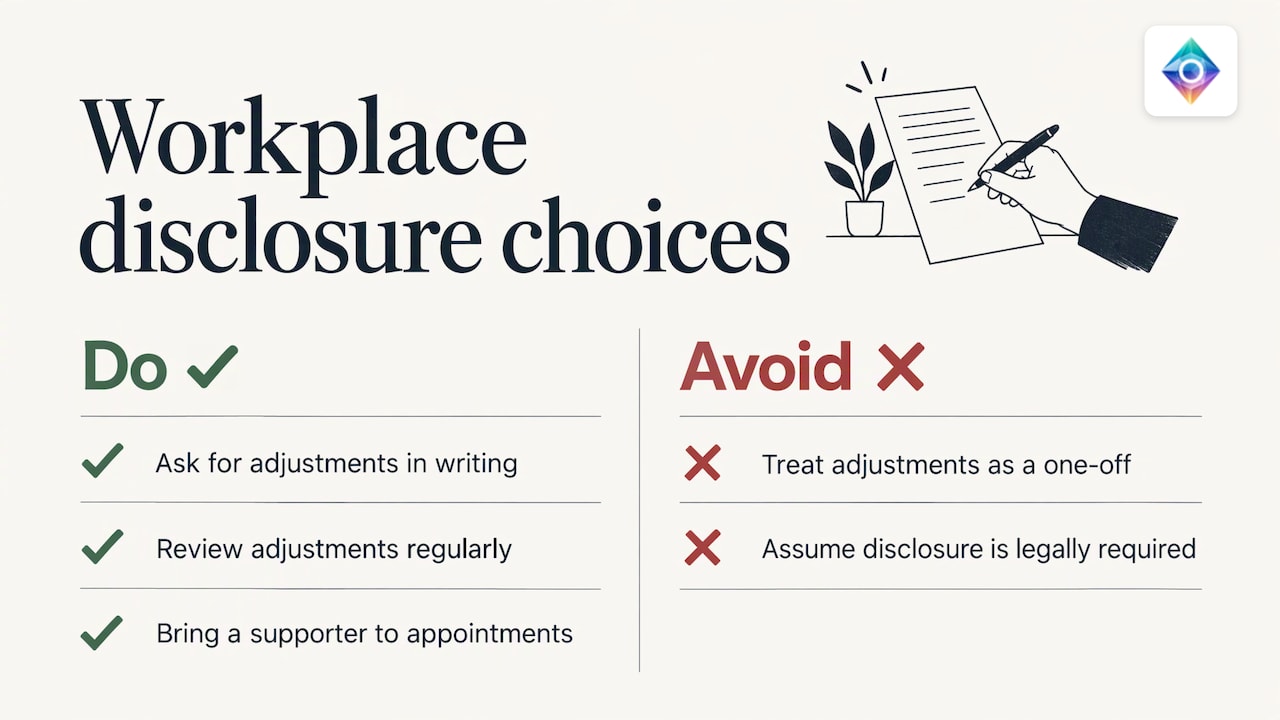
The decision is yours. The Autism Speaks toolkit notes that, in the US, no law obliges you to disclose a diagnosis, although some disclosure is needed to be eligible for accommodations or legal protections. Dr Stephen Shore, in an Autism Research Institute summary, describes “partial disclosure”: speaking to one aspect of autism rather than the whole condition, for example saying that you work best with written instructions.
Once you ask for adjustments, follow up. The Third Space Scotland report cites research finding that fewer than half of autistic employees who discussed reasonable adjustments had them put in place, and that adjustments are often treated as a one-off and then forgotten. It recommends asking in writing and having them reviewed regularly. The Autism Education Trust toolkit lists examples such as a permanent desk instead of hot-desking, a quieter location, a visual whiteboard to-do list and calendar blocks so others cannot book you into unnecessary meetings.
Our article Disclosing Autism at Work goes through the decision in more detail.
The same Scottish report adds a caution: for some people, having to self-advocate is stressful, and having others advocate alongside you matters too. Leicestershire Partnership NHS Trust says independent advocates can speak up, challenge decisions and attend meetings when someone finds it hard to understand information or communicate their views. Bringing a supporter to appointments is part of self-advocacy, not a step back from it.
How do young adults prepare for an autism assessment?
A clinician has limited time, so the aim is to arrive with your experiences organised. Use the same tools as above. Write a short list of the situations where you struggle, with a concrete example for each, such as how you cope in noisy places, how you manage change, and what social effort costs you afterwards. Bring an “about me” note and, if it helps, someone who knows you well. Ask for information in writing and in plain English, as the NHS trust advises.
Masking can make this harder, because the person in the clinic may look more at ease than they feel. Our guide on how masking hides adult autism signs explains what to describe, and the sensory processing checklist helps you record sensory patterns before an NHS meeting.
The Third Space Scotland report also stresses that support should not depend on a formal diagnosis. You can describe your needs and ask for adjustments while you wait.
Where Omniprism fits
Our free assessments need no email, no account and no data collection, and they return a plain-language profile instantly. If you then want something to hand to a clinician, the Specialist Briefing is a one-off €20 report that summarises your results for healthcare professionals. Parents can choose the Youth Briefing, also €20 one-off. Neither is a diagnosis. Both are designed to help you start the conversation with a clinician.
Our perspective
Self-advocacy is hard to do when you cannot yet describe yourself. I was diagnosed with ADHD at 42, and in my experience the missing piece for many adults is not courage but vocabulary: a clear picture of their own patterns.
That is why we built Omniprism around an instant profile across 14 areas, in plain language, with no account and no tracking. We believe a person should be able to reflect privately first and decide afterwards who sees the results.
The Specialist Briefing exists so that the person across the desk, whether a GP, a psychologist or a teacher, receives a clear summary instead of a rushed description. For families, the guided assessments for children and teens are designed to lay a foundation for better conversations with healthcare professionals, with the young person included from the start.
Valerio Cozzi
FAQ
What is an example of self-advocacy for an autistic person?
Emailing your manager to ask for a permanent desk because open-plan noise makes concentration hard is a typical example. A child asking their teacher for a short break using a visual card is another. Both involve naming a need and making a specific request.
Is self-advocacy possible if I do not speak?
Yes. Raising Children Network encourages communication in whatever form works, including gestures, hand signs, images or an alternative communication system. The Autism Association of Australia notes that parents, carers or guardians may also advocate for someone who needs that support.
Do I need a diagnosis before I ask for adjustments?
Not necessarily. The Third Space Scotland report states that support should not be dependent on formal diagnosis. Some formal protections or eligibility rules may still ask for evidence, so check the policy of your school, employer or service.
How can I help my teenager speak up without taking over?
Rehearse the conversation first, attend meetings as support rather than spokesperson, and give specific positive feedback afterwards. Let your teenager lead more of each meeting over time.
Sources
- Self-Advocacy, Autistic Self Advocacy Network
- Self-Advocacy, CHOP Research Institute
- Self-advocacy for kids and teens, Raising Children Network
- Self advocacy and autism, Autism Association of Australia
- Adult Autism Diagnosis Tool Kit, Autism Speaks
- Autism self-care and advocacy, Leicestershire Partnership NHS Trust
- Self Advocacy Toolkit for Autistic Young People, Autism Education Trust
- 3-Step Self-Advocacy Process, Vanderbilt Kennedy Center
- Supporting Autistic Self-Advocacy in Elementary School, Vanderbilt Kennedy Center
- Supporting Autistic Self-Advocacy in Middle and High School, Vanderbilt Kennedy Center
- Good intentions are not enough: Autistic perspectives, PMC, 2026
- Perspectives of autistic students and their teachers, Research in Autism Spectrum Disorders
- Transition to Adulthood, Autism Research Institute
- Beyond Accommodations: Supporting Autistic Health Professionals, Third Space Scotland, 2024
Recommended
- Self Assessment vs Diagnosis: ADHD and Autism Quizzes Aren’t Diagnoses
- Disclosing Autism at Work: Should You, and How?
- Masking Hides Adult Autism Signs: UK NHS Steps to Assess
- Unmasking Autism Safely for Adults & Allies NHS Steps, 14 Domain Check
Written and edited by Valerio Cozzi, founder of Omniprism. Omniprism began after my own ADHD diagnosis at 42.
This article is educational. It is not medical advice, not a diagnosis, and not a substitute for assessment by a qualified clinician. The Omniprism self-assessment is free, needs no account and no email address, and runs entirely in your browser — your answers are never sent to a server. The optional Specialist Briefing report is a paid add-on.