Autism Checklist for Parents: Signs to Note and Next Steps
A parent’s autism checklist is a structured way to record what you notice in your child’s communication, play, behaviour, interests and sensory reactions, so you can take specific examples to a GP, health visitor or SENCO. It cannot tell you whether your child is autistic: only a professional assessment can do that. The checklist below follows NHS guidance on signs of autism in children and shows you how to turn your observations into notes a clinician can use.
Key Takeaways
- Group what you notice under social communication, play, repetitive behaviour and interests, and sensory reactions, and write down real examples with dates.
- Signs vary widely by age and child. Some appear in the first months of life, others much later, and girls’ signs can be subtler or masked.
- Screening tools and checklists do not diagnose. A positive result should lead to a fuller assessment, and a negative one does not rule autism out.
- If you have concerns, speak to your GP or health visitor. Photos, videos and a simple diary make that conversation easier.
- Our free assessment for children and teens gives you a plain-language profile you can bring to that appointment.
What are the signs of autism in a child?
The NHS lists signs across social communication, behaviour, interests and sensory responses. Use the checklist as a prompt for observation, not a score. Tick what you have seen more than once, and add a short example beside each.
Social communication and interaction
According to the NHS, parents may notice:
- less eye contact than you would expect
- little or no response when their name is called
- difficulty joining other children’s play
- difficulty taking part in pretend play
Write down where and when it happened. “Did not turn when I called from the kitchen, twice, while watching a tablet” is more useful than “ignores me”, because a clinician can weigh the context.
Repetitive behaviour and strong interests
The same NHS page describes repetitive movements and strong, intense interests. Note what the movement is, what seems to trigger it and how long it lasts. For interests, record the topic, how many hours a week it takes up and what happens when it is interrupted.
Sensory responses
The NHS says autistic children may react very strongly, or not at all, to lights, sounds, smells, tastes or textures. Useful notes include food textures your child refuses, clothing labels they cannot tolerate, and noisy places such as hand dryers or supermarkets where they cover their ears or leave.
A simple way to record it
| Area | What I noticed | Where and when | How often |
|---|---|---|---|
| Name and eye contact | |||
| Play with other children | |||
| Repetitive movements | |||
| Interests | |||
| Sounds, lights, textures, tastes |
Two or three weeks of notes usually give a clearer picture than memory alone.
How do autism signs differ by age?
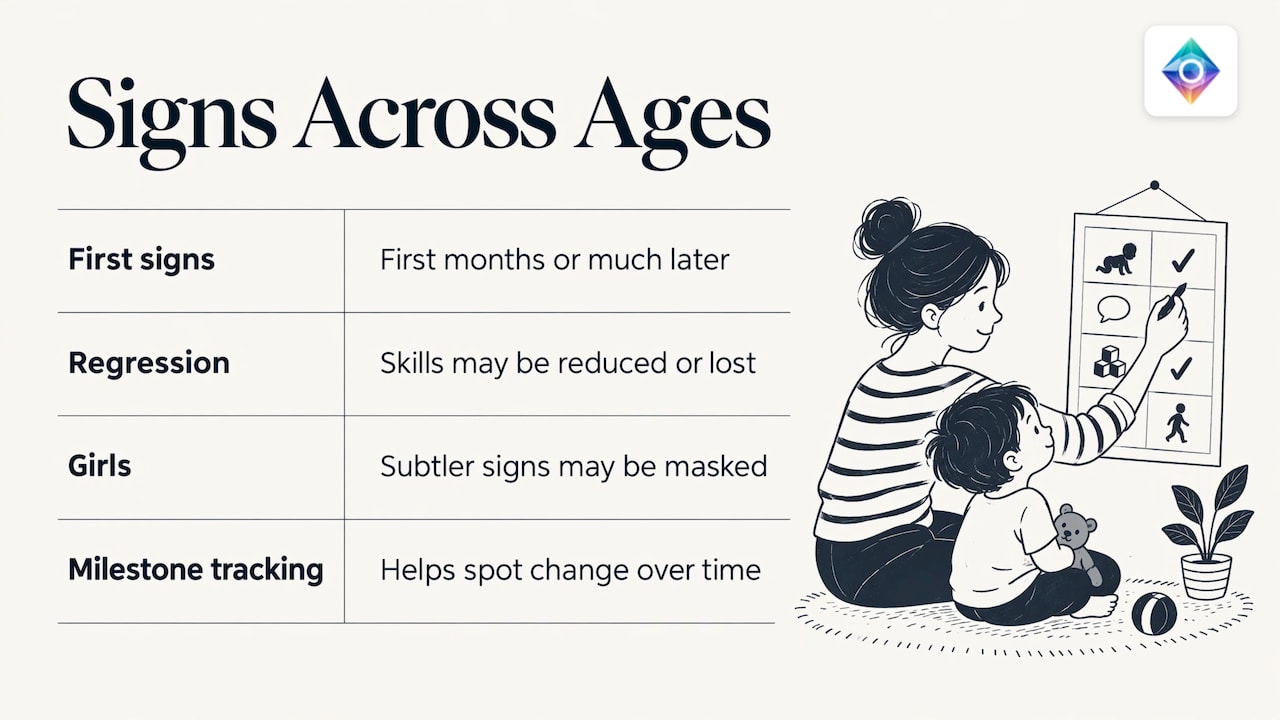
There is no single age at which signs appear. Canada’s public health guidance says signs vary widely: some people show them within the first few months of life, while others do not show them until much later.
Two patterns are worth knowing when you fill in your checklist.
Regression. A 2019 review of early detection notes that developmental regression at any age can involve reduced or lost social behaviours and communication, such as words and gestures. If your child has lost skills they once had, record when you first noticed it and raise it promptly with a health professional.
Subtler presentation in girls. The same review reports that some girls present with subtler signs than boys, and that learned strategies may mask them. A child who copies peers at school and then falls apart at home may not look like the classic picture. Our article on autistic traits in women explains how this carries into adulthood.
For babies and toddlers, tracking skills against expected milestones helps you see change over time. A guide to tracking child development milestones gives a practical way to keep that record, and the developmental milestones guide covers what to expect in the early months.
Which autism screening checklists are used for children?
You may meet several named tools. They are mostly used by professionals, though some are open to parents.
| Tool | Age or stage | What it does |
|---|---|---|
| M-CHAT-R | Toddlers | Parent questionnaire built to maximise sensitivity |
| ASQ | Early childhood | General developmental screen: communication, motor, problem-solving, personal adaptive skills |
| SCQ | 4 years and older, mental age over 2 | Parent-completed screen used in primary care |
The US Centers for Disease Control and Prevention describes the ASQ as a general developmental screening tool covering communication, motor, problem-solving and personal adaptive skills. The American Academy of Paediatrics, according to the CDC, recommends developmental screening at 9, 18 and 30 months, and autism-specific screening at 18 and 24 months. These are US schedules. In the UK, routine health and development reviews are run through health visiting services, so ask your health visitor what applies to your child.
For older children, a children’s hospital clinical pathway recommends the SCQ for children aged 4 and over with a mental age above 2 years.
The M-CHAT-R is designed to maximise sensitivity, so it has a high false-positive rate. Its authors say some children who screen positive will not be diagnosed with autism but may have other developmental disorders or delays. That is why a positive result is a reason to look further, not a conclusion.
The US Preventive Services Task Force found insufficient evidence to recommend for or against universal autism screening at 18 to 30 months when no concerns have been raised, a 2016 statement. Your own observations therefore carry real weight.
Can a parent checklist diagnose autism?
No. The CDC states that a screening tool does not provide a diagnosis and that a positive result should be followed by a thorough assessment.
NICE guidance for under 19s, reproduced in a local NHS copy of the guideline, says signs and symptoms should be considered in the context of the child’s overall development. It adds that tools may help gather information but should not be used to make or rule out a diagnosis.
That applies to any checklist, including ours. Treat the result as organised information about your child, and let a clinician interpret it. Our piece on self-assessment versus diagnosis sets out where the line sits.
What should I do if I think my child is autistic?
Follow these steps in order.
- Keep notes for two to three weeks. Use the table above and include context: place, time, what came just before.
- Collect evidence. Canada’s guidance suggests photographs, logs or diaries, and video recordings to help a provider understand your concerns.
- Gather the history. Note early milestones, any lost skills, and relevant family history.
- Speak to a professional. The same Canadian guidance advises talking to your healthcare provider about an autism assessment. In England that is usually your GP or health visitor; for school-age children, your child’s SENCO can also be part of the conversation.
- Ask about the next stage. Assessment is often carried out by a team. According to the Canadian guidance, a professional looks at communication, relationships, cognitive abilities, overall development, behaviour and interests.
Developerly, the CDC describes developmental monitoring as watching how a child grows and discussing their skills with providers, across playing, learning, speaking, behaving and moving. You can do that while you wait for an appointment.
If your child is under 5, note that the Royal Australian College of General Practitioners advises eliciting parent or carer concerns and observing development rather than formally assessing it in general practice. Your account of daily life is the main input at that age.
How do I explain my concerns to a GP?
Bring one page, not a diary. A clear structure helps a short appointment:
- Your main concern in one sentence. For example, “He does not respond to his name and avoids busy places.”
- Three to five dated examples. Pick the clearest.
- What helps and what makes it worse.
- Any lost skills, with a rough date.
- Short video clips of behaviour that is hard to describe.
- Other settings. Ask nursery or school staff what they see, since behaviour often differs between home and classroom.
Say what you are asking for: a referral for an autism assessment, or a developmental review first. If the answer is to wait and see, ask what would change that advice and when to come back.
If school is part of the picture, our guide to school adjustments for autistic pupils explains what support can look like while a decision is pending.
Is it autism, ADHD or something else?
Children can show overlapping signs across conditions, which is one reason professional assessment matters. The M-CHAT-R’s authors note that children who screen positive may have other developmental disorders or delays. Attention difficulties, sensory sensitivity and strong interests can show up in more than one profile. Our articles on autism misdiagnosed as ADHD and giftedness versus autism look at these overlaps, and the one on ADHD symptoms in preschoolers helps you write clinician-ready notes if attention is your main worry.
Perspective from our founder
I was diagnosed with ADHD at 42. That is the reason Omniprism exists as a tool that gives people a clear, plain-language picture of how they think, without asking for an email address, an account or any data.
We built the children’s and teens’ assessments on the same belief. A parent should be able to walk into a GP appointment with organised observations instead of a vague worry. Our assessment covers 14 areas, including autism, ADHD, dyslexia, dyspraxia, sensory processing and masking, so you see the whole child and not a single label.
A profile is not a diagnosis, and we say so plainly. What it does well is give you the words, and give your clinician a quicker route to the right questions. That is the job we designed the optional Youth Briefing to do.
Valerio Cozzi
How can Omniprism help you prepare?
Our children and young people assessment is guided, so a parent can answer on behalf of a child and receive a plain-language profile straight away, with no email, account or data collection. There are versions for the 7 to 10 age group and the 11 to 13 age group. The self-assessment itself is free.
If you want something a clinician can read quickly, the Youth Briefing is a one-off €20 report that summarises the results for a professional. Adults who recognise themselves in the checklist can use the free self-assessment, and there is a Specialist Briefing for adults at €20 one-off. Clinicians and educators can see how we work on our professionals page.
FAQ
At what age can autism signs be noticed?
There is no fixed age. Canada’s public health guidance says some people show signs in the first few months of life, while others do not show them until much later. Keep a note of what you see whatever your child’s age, and raise concerns whenever they arise.
Can I use an online checklist instead of seeing a doctor?
A checklist helps you organise observations, but it does not replace an assessment. The CDC says a screening tool does not provide a diagnosis and that a positive result should be followed by a thorough assessment. Use your results as a starting point for a conversation with your GP or health visitor.
What if my daughter seems to cope at school but struggles at home?
That pattern is worth recording. A 2019 review notes that some girls present with subtler signs than boys, and that learned strategies may mask them. Write down what happens after school, and ask her teacher what they observe, then share both with your GP.
What evidence should I bring to an autism assessment?
Canada’s guidance suggests photographs, logs or diaries and video recordings. Add early milestones, any lost skills and notes from school or nursery. Short, dated examples are easier for a clinician to use than general descriptions.
Sources
- Signs of autism in children, NHS
- Autism: Signs and characteristics, Canada.ca
- Early detection for autism spectrum disorder in young children, 2019 review
- Clinical Screening for Autism Spectrum Disorder, CDC
- Screening for Autism Spectrum Disorder, CDC
- Autism Screening Clinical Pathway, Primary Care
- Autism in under 19s: recognition, referral and diagnosis, NICE guideline
- Modified Checklist for Autism in Toddlers, Revised
- USPSTF Final Recommendation Statement: Autism Spectrum Disorder in Young Children
- RACGP: Developmental Delay and Autism
- Step-by-step guide to tracking child development milestones
- Developmental Milestones for New Parents: A Clear Guide
Recommended
- Parents: 14 Domain Self Check to Uncover Autism Misdiagnosed as ADHD
- Masking Hides Adult Autism Signs: UK NHS Steps to Assess
- Spot Twice Exceptional Autism: Use a 14 Domain Self Check to Build Evidence
- Autism vs. ADHD: Comparing Symptoms, Overlap, and Diagnosis
Written and edited by Valerio Cozzi, founder of Omniprism. Omniprism began after my own ADHD diagnosis at 42.
This article is educational. It is not medical advice, not a diagnosis, and not a substitute for assessment by a qualified clinician. The Omniprism self-assessment is free, needs no account and no email address, and runs entirely in your browser — your answers are never sent to a server. The optional Specialist Briefing report is a paid add-on.