Sensory Processing Checklist for UK Children: Prepare for NHS Meetings
This checklist helps parents, carers and teachers spot likely sensory processing differences and decide whether simple adjustments or a professional assessment are needed. Copy or print the checklist below, then observe the child across at least two settings, such as home and school, over a week or two before drawing any conclusions.
Key Takeaways
A structured, repeated observation using a sensory checklist helps identify sensory processing differences that may require adjustments or professional assessment.
| Point | Details |
|---|---|
| Observation across multiple settings | Monitor behaviors in at least two environments over several weeks for accurate pattern recognition. |
| Identify pattern types | Look for hyper-responsivity, hypo-responsivity, or sensory seeking behaviors across different systems. |
| Start with low-cost adjustments | Implement simple changes like noise reduction or movement breaks before considering formal assessment. |
| Use professional tools when needed | Seek assessment if behaviors persist across settings, involve safety risks, or do not improve. |
| Omniprism’s approach | Omniprism offers self-assessment and professional briefing tools to facilitate understanding and referral. |
Copy-ready sensory processing checklist by system
Use this list as a working document rather than a one-off tick-box exercise. For each item, record whether the behaviour is present, sometimes present, or not seen, and note the setting and time of day; for helpful activity ideas, see this sensory play and child development guide. Keep the language factual: you’re recording what you observe, not naming a condition.
Visual
- Covers eyes or squints in normal indoor lighting.
- Avoids screens, patterns or flickering lights.
- Becomes distressed by bright or fluorescent lighting.
- Seeks out spinning objects, flashing lights or visual patterns.
Auditory
- Covers ears at sudden or loud noises (hoovers, hand dryers, alarms).
- Struggles to filter background noise in a busy classroom.
- Seeks out loud noises or repeats sounds.
- Appears not to notice when spoken to directly.
Tactile
- Avoids certain fabrics, clothing tags or textures.
- Dislikes being touched unexpectedly, including light touch.
- Avoids messy play (sand, paint, glue).
- Chews non-food items such as sleeves or pencils.
- Seeks out firm pressure, tight hugs or heavy blankets.
Taste and smell
- Has a very limited range of accepted foods based on texture.
- Reacts strongly to smells others don’t notice.
- Smells objects or people before interacting with them.
Vestibular and proprioception
- Avoids swings, slides or activities involving movement.
- Seeks constant movement: spinning, rocking, jumping.
- Appears clumsy or frequently bumps into things or people.
- Struggles to judge how much force to use (too hard or too soft).
Interoception and body awareness
- Seems unaware of hunger, thirst or needing the toilet.
- Doesn’t notice being too hot, too cold or injured.
- Struggles to identify or name physical feelings linked to emotion.
How do you use a sensory checklist reliably?
A single tick on this list tells you very little. The value comes from repeated, structured observation.
- Choose two or more environments, typically home, school or nursery, and observe for the same behaviours in each.
- Watch over several days rather than a single afternoon, since sensory responses shift with tiredness, illness or routine changes.
- Score each item as present, sometimes, or not seen, and add a short note on context (time, place, what happened just before).
- Combine your own notes with a teacher’s or carer’s observations to check whether the pattern holds across settings.
- If you introduce an adjustment, such as noise-cancelling headphones or a quieter workspace, apply it consistently for four to eight weeks before reviewing whether it helped.
Pro Tip: Record a baseline before changing anything, noting the setting, time of day and what happened immediately before the behaviour, so you can tell later whether an adjustment actually made a difference.
What do seeking, avoiding and under-responsivity actually mean?
Once you have a few weeks of notes, look for patterns rather than isolated incidents. Three broad response types tend to recur across sensory systems.
Hyper-responsivity (over-reacting) shows up as a child covering their ears at moderate noise, refusing certain food textures, or becoming distressed by light touch. Hypo-responsivity (under-reacting) looks like a child not noticing a loud alarm, failing to register pain from a bump, or appearing unaware of hunger. Sensory seeking involves actively pursuing input: spinning, chewing non-food items, or craving constant movement.
- A child who is both auditory-sensitive and seeks heavy movement input may struggle more with transitions than one pattern alone would suggest.
- A child who is hypo-responsive to pain or temperature may be at higher risk of injury without realising it.
- Patterns that show up in more than one sensory system, rather than a single isolated behaviour, are more likely to have a functional impact worth addressing.
A retrospective study in BMJ Paediatrics Open found that auditory hyper-responsivity and vestibular or proprioceptive seeking were linked to higher rates of tantrums and difficulty adapting to change in autistic children. Auditory sensitivity and movement-seeking together were associated with greater behavioural risk in that sample, which is one reason multi-system patterns deserve closer attention than a single tick on a list. When a child shows difficulty across two or more systems, and that difficulty shows up in more than one setting, it’s a reasonable point to consider a more structured assessment rather than relying on checklist observations alone.
What should you do after completing the checklist?
Once you’ve gathered a week or two of notes, the next step depends on how widespread and disruptive the patterns are.
Start with low-cost adjustments: reduce background noise, allow movement breaks, offer alternatives to disliked textures, and keep routines predictable. The Cerebra sensory processing guide lists sensory diets, noise reduction and predictable routines as practical starting strategies families can trial before seeking formal input.
- Try one or two adjustments at a time and monitor for four to eight weeks before judging the result.
- Seek a professional opinion if the difficulty affects daily life in two or more settings, involves safety risks, or doesn’t improve with consistent strategies.
- A typical assessment combines caregiver history, direct observation and standardised tools such as the Sensory Profile, often with input from an occupational therapist.
Local guidance such as the Bury multi-agency sensory processing toolkit recommends this same graduated path: universal strategies first, then targeted support, then specialist assessment if the difficulty persists. For school-based ideas, see our piece on building a sensory-friendly classroom.
Using a guided self-assessment to prepare for professionals
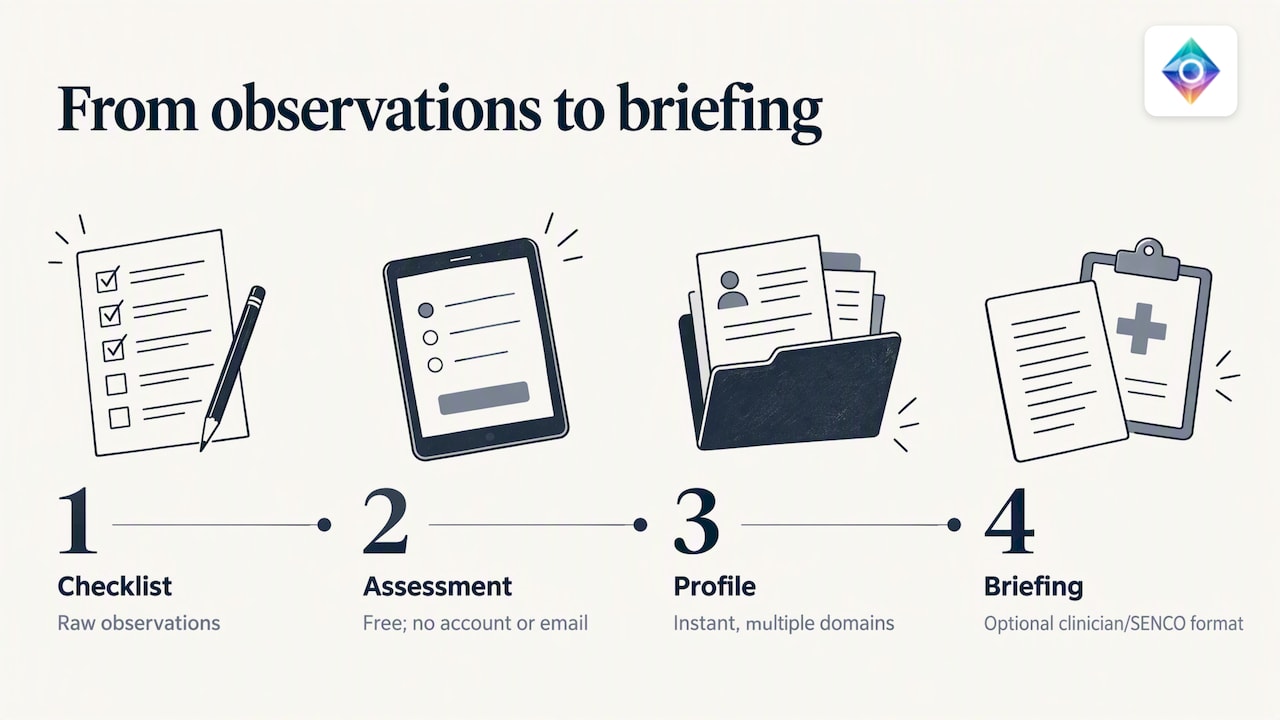
A checklist gives you raw observations. A guided self-assessment can help turn those observations into a structured profile before a school meeting or referral. Our self-assessment tool offers a free, privacy-first option for children and young people, requiring no account or email, that produces an instant, plain-language profile across multiple domains, including sensory processing alongside traits such as ADHD, autism and dyslexia.
For families who want something to hand to a clinician or SENCO, our optional Specialist Briefing organises results into a format designed for easy use by healthcare professionals, which can make a referral conversation more focused than a verbal description alone.
A founder’s note on sensory differences
Valerio Cozzi, founder of Omniprism, was diagnosed with ADHD at 42. He built this tool after recognising how often sensory and attention differences get flagged late, and how much easier conversations with professionals become once observations are written down clearly.
— Valerio Cozzi
Try a guided assessment before your next school or NHS meeting
Our self-assessment tool gives you an instant, plain-language profile across 14 domains, including sensory processing, with no account or data collection required. For parents preparing for a school meeting or an OT or NHS referral, the optional Specialist Briefing report turns those results into a summary designed for clinicians to read quickly. Guided options exist for children and teens.
This article is general information, not a substitute for advice from a qualified doctor. Consult a qualified healthcare professional about your own circumstances before acting on anything here.
FAQ
What is a sensory processing checklist used for?
A sensory processing checklist is a tool for recording observable behaviours, such as covering ears at noise or avoiding certain textures, across different sensory systems. It’s a screening aid, not a diagnostic test, and works best when combined with observation in more than one setting, as Lancashire and South Cumbria ICB guidance recommends.
Is Sensory Processing Disorder a recognised diagnosis in the UK?
Standalone “Sensory Processing Disorder” is not a recognised diagnostic label in UK clinical manuals. UK services generally describe “sensory processing differences” and consider them within a wider assessment, according to the Lancashire and South Cumbria ICB position statement.
How do sensory processing differences relate to ADHD, autism and dyslexia?
Sensory processing differences commonly overlap with ADHD, autism and dyslexia, though they aren’t exclusive to any one of them. Checklist patterns, such as auditory sensitivity or movement seeking, are best read alongside a fuller picture of attention, communication and learning traits rather than in isolation.
What standardised tools do professionals use alongside a checklist?
Professionals commonly use parent-report measures such as the Sensory Profile and the Sensory Processing Measure, which research reviewed in this PMC resource describes as most useful when interpreted alongside direct observation. A home checklist can usefully complement these but doesn’t replace them.
When should I seek a professional sensory assessment?
Consider seeking a professional assessment if difficulties show up across two or more settings, involve safety risks, or don’t improve after several weeks of consistent, low-cost adjustments. A typical assessment combines caregiver history, observation and standardised tools, often with occupational therapy input.
Sources
- Children and young people sensory processing position statement — Lancashire & South Cumbria ICB
- Sensory processing differences and behavioural problems in children with autism — BMJ Paediatrics Open
- Bury multi-agency sensory processing needs toolkit
- Cerebra sensory processing guide
- Reviews and observational studies on sensory processing assessments (PMC resource)
Recommended
Written and edited by Valerio Cozzi, founder of Omniprism. Omniprism began after my own ADHD diagnosis at 42.
This article is educational. It is not medical advice, not a diagnosis, and not a substitute for assessment by a qualified clinician. The Omniprism self-assessment is free, needs no account and no email address, and runs entirely in your browser — your answers are never sent to a server. The optional Specialist Briefing report is a paid add-on.