Parents & Teachers: Legal School Autism Adjustments That Work

Schools have a legal duty to make reasonable adjustments for autistic pupils, and there is a wide set of practical accommodations that can be agreed now, without waiting for a formal assessment. The Equality Act 2010 and the SEND Code of Practice set out what schools must do. Below is a checklist of examples and a stepwise plan for agreeing and monitoring them.
TL;DR:
- Schools must proactively identify and implement specific, trialed accommodations for autistic pupils, focusing on sensory, routine, and assessment adjustments.
- Regular documentation and review of adjustments, involving the SENCO and possibly an EHC plan, are essential to ensure support is effective and enforceable.
- Sensory assessments and simple reversible modifications, like ear defenders or visual schedules, should be trialed individually over at least a week to determine their impact.
- Evidence-based teaching approaches, such as explicit instruction, clear routines, and relevance-based motivation, support better participation and learning outcomes for autistic students.
- Multi-agency involvement and a clear, written profile of needs streamline communication and tailor interventions, with self-assessments helping families prepare for meetings.
What accommodations can schools make for autistic pupils?
Adjustments work best when they are specific, trialled and reviewed rather than left as vague good intentions. Local authority and charity practice guides list a consistent set of changes that reduce distress and improve access without needing specialist equipment or funding, as set out in reasonable adjustments guidance for sensory differences.
Sensory and environmental changes tend to have the most immediate effect on a child’s ability to stay in the room:
- A quiet space or sensory room the pupil can use without asking permission each time.
- Ear defenders or noise-cancelling headphones for assemblies, corridors and the dinner hall.
- Adjusted lighting, uncluttered classroom walls and seating away from doors or windows.
Routine and timing adjustments reduce the anxiety that builds around unpredictable transitions:
- Visual schedules showing the shape of the day in pictures or words.
- Staggered or early transitions between lessons, breaks and assemblies.
- A stress card or time-out pass that lets the pupil leave a lesson without explanation.
Assessment and participation adjustments matter just as much as classroom comfort:
- Extra processing time for instructions, questions and written work is a common adjustment, and parents may also consider seeking additional support through targeted tuition or subject support to complement classroom strategies.
- Alternative formats for tasks, such as typed rather than handwritten answers.
- Permission to stim, use fidget tools, or access exam arrangements such as a separate room.
A short guide to building a sensory friendly classroom covers three low-cost fixes teachers can try this term.
What are the school’s legal duties and statutory guidance?
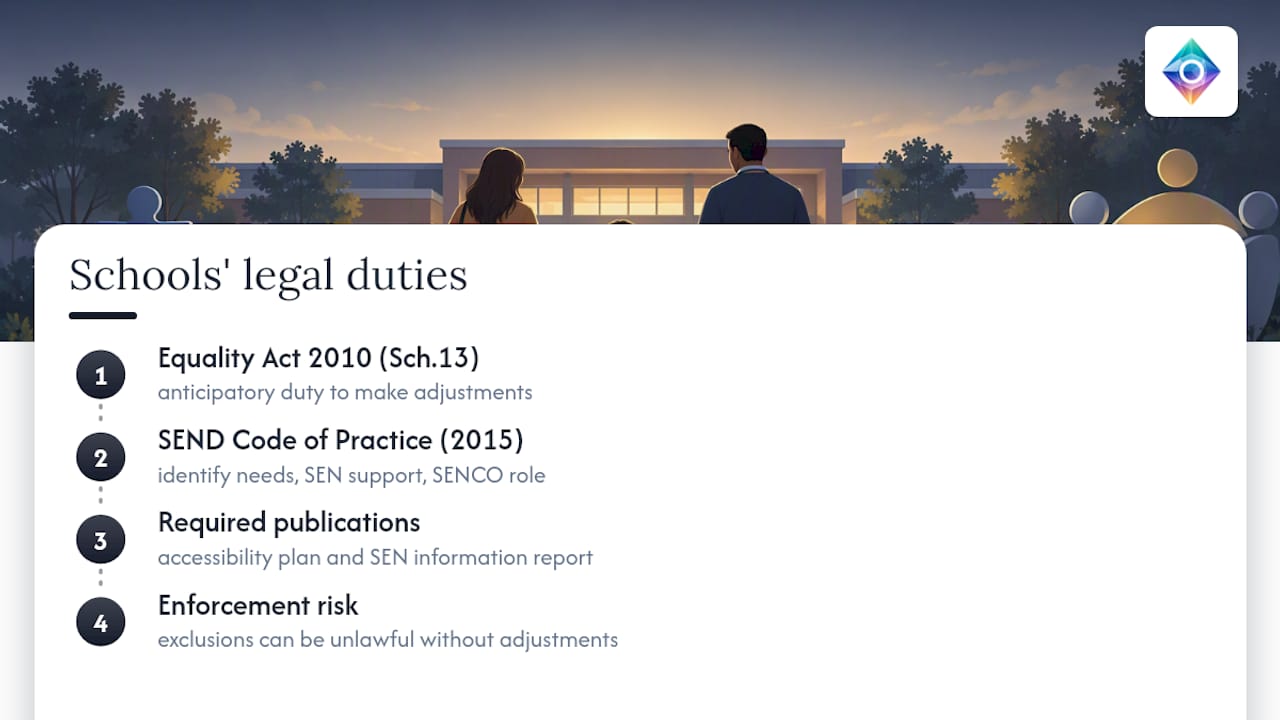
Under Schedule 13 of the Equality Act 2010, schools have an anticipatory duty: they must think ahead about the adjustments disabled pupils, including autistic pupils, are likely to need, rather than waiting for a request. This covers changes to provisions, criteria and practices, and the provision of auxiliary aids.
The SEND Code of Practice (2015) sits alongside this duty. It sets statutory expectations for mainstream schools on identifying needs early, delivering SEN support, and defining the SENCO’s responsibilities for coordinating provision and, where needed, for triggering an Education, Health and Care (EHC) plan. A schools’ guide to the Code summarises how these duties interact.
In practice, this means every school must publish an accessibility plan and a SEN information report, and both are meant to describe how autistic pupils are supported. Exclusions can be unlawful where a school failed to make agreed adjustments before resorting to sanctions, as the Autism Education Trust’s exclusions guidance sets out for governing bodies.
How do you assess sensory needs and choose adjustments to trial?
Sensory differences run in both directions. Some autistic pupils are hyper-sensitive, meaning ordinary sounds, lights or textures feel overwhelming; others are hypo-sensitive and seek out sensory input the classroom does not naturally provide. The same child can shift between the two depending on the setting, the time of day or how tired they are, which is why a single fixed adjustment rarely covers every situation.
A short in-class sensory audit helps identify what to try first:
- Note which lessons, times or transitions trigger distress or withdrawal.
- List the sensory inputs present at those moments (noise, lighting, crowding, smell).
- Trial one small, reversible change at a time and record the effect over a week.
- Keep what helps, drop what does not, and share the results with the SENCO.
Reversible options worth trying first include ear defenders, a quiet corridor route between lessons, small uniform adjustments such as removing a scratchy label, a quiet space for lunch, and a no-questions toilet pass.
Pro Tip: Trial one adjustment at a time for at least a week before adding another, so you can tell which change actually made the difference.
Interoception, the sense of what is happening inside the body, often affects how a child reports hunger, pain or the need for the toilet, and a short self-check on interoception can help caregivers spot patterns worth flagging.
Which teaching strategies help autistic pupils learn and participate?
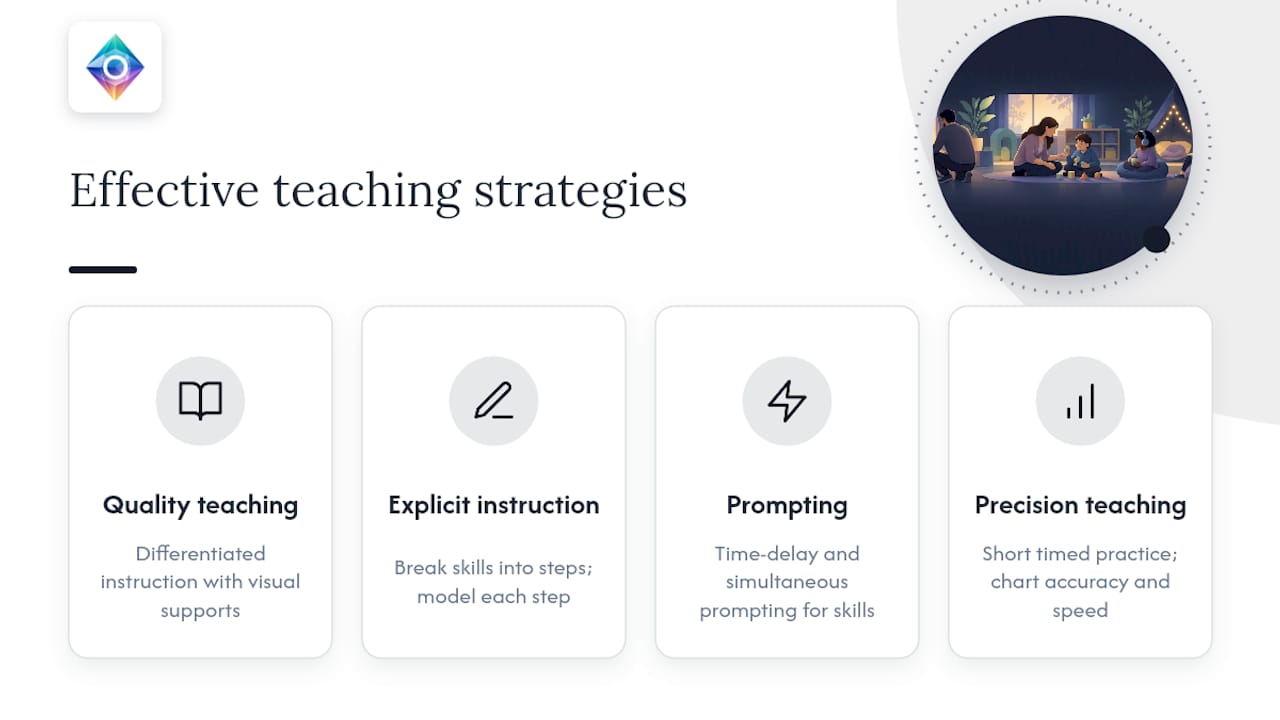
Quality first teaching remains the foundation: clear, differentiated instruction with visual supports benefits autistic pupils and the rest of the class alike. Explicit instruction, meaning breaking a skill into steps and demonstrating each one directly rather than expecting the pupil to infer it, is consistently identified as effective in a rapid evidence review of support for autistic children and young people.
The same review points to more targeted methods for specific skill-building. Constant time delay, where a prompt is given immediately at first and then gradually delayed to encourage independent responses, and simultaneous prompting, where the prompt and the response happen together before the prompt is withdrawn, both have evidence behind them for teaching discrete skills such as vocabulary or self-care routines. Precision teaching, which uses short, timed practice and frequent charting of accuracy and speed, suits fluency-building in reading or maths. None of these replace whole-class teaching; they sit alongside it for specific gaps.
In subject terms, this can mean using a pupil’s fixed interest in trains to frame a maths word problem, or letting a pupil with strong visual recall use diagrams instead of paragraphs in science. Motivation follows relevance far more reliably than generic praise does.
How do parents and educators agree and monitor a plan?
Getting adjustments agreed works best as a documented process rather than an informal conversation that nobody follows up on.
- Document observed needs and adjustments trialled, including what worked and what did not, using notes from home and school.
- Meet the SENCO with that evidence, asking specifically what SEN support the school can put in place.
- Agree SEN support or request an EHC needs assessment if needs are more complex than the school can meet from its own resources, as described in the SEND Code of Practice.
- Set measurable targets and a review date, so the plan is checked rather than assumed to be working.
Useful evidence includes the sensory audit, dated teacher notes, and any reports from health or education professionals. If agreed adjustments are not actually implemented, record each instance in writing, request a formal review with the SENCO, and escalate to the governing body or local authority if the pattern continues; guidance for governing bodies notes that undocumented, inconsistent adjustments are harder to defend if challenged.
When should multi-agency teams and health professionals get involved?
A request for an EHC needs assessment brings education, health and social care partners together when a child’s needs go beyond what a single school can coordinate alone. NICE guideline CG170 recommends tailored social-communication interventions and clear information sharing between professionals and parents, with parental consent, to keep education plans grounded in a child’s actual developmental profile rather than assumptions.
A founder’s note on getting this right
I am Valerio Cozzi, founder of Omniprism, and I was diagnosed with ADHD at 42. Watching families navigate school meetings taught me one thing: a clear, written profile of a child’s needs makes every conversation with a school shorter and more productive.
— Valerio Cozzi
How a short self-check can prepare you for a SEN meeting
There is a free, privacy-first self-assessment covering multiple domains, including sensory processing, masking and attention, available without requiring an account or data collection. For children, assessments are available that provide a plain-language profile which parents can bring to a SENCO meeting.
- Complete the Self-assessment for children and young people to get an instant profile across 14 domains.
- Use the Young Person’s Assessment (ages 11 to 13) or Children’s Assessment (ages 7 to 10) for the right age range.
- Add a paid Specialist Briefing report if you want a formal summary written for clinicians and school professionals.
Sources
- Equality Act 2010: Schedule 13 (education: reasonable adjustments)
- Special educational needs and disability code of practice: 0 to 25 years (2015)
- NICE clinical guideline CG170 — autism spectrum disorder in under 19s: support and management
- Reasonable adjustments to reduce the impact of sensory differences (local authority guidance)
FAQ
What are some examples of school accommodations for autism?
Common examples include ear defenders, a quiet space or sensory room, visual schedules, extra processing time, alternative exam formats and permission to stim or use fidget tools. Local guidance on reasonable adjustments for sensory differences lists many more that schools can trial at low or no cost.
Does autism qualify for reasonable adjustments in UK schools?
Yes. Autism is recognised as a disability, and under Schedule 13 of the Equality Act 2010 schools have an anticipatory duty to make reasonable adjustments for autistic pupils, not just to respond once a request is made.
Can masking lead to burnout in autistic people?
Sustained masking, meaning suppressing or hiding autistic traits to fit in, is widely described by autistic people and clinicians as contributing to exhaustion and burnout over time. A short self-check on stimming versus fidgeting can help identify behaviours a pupil may be masking at school.
Is autism classed as a disability under UK law?
Yes, autism meets the legal definition of disability under the Equality Act 2010 when it has a substantial, long-term effect on daily activities. This means autistic pupils are entitled to the reasonable adjustment duties described in Schedule 13 of that Act.
Recommended
- Parents: 14 Domain Self Check to Uncover Autism Misdiagnosed as ADHD
- 50–70% Overlap in Autism and ADHD: What Families and Clinicians Need
- Three Fixes Teachers Can Use to Make a Sensory Friendly Classroom
- Autism vs. ADHD: Comparing Symptoms, Overlap, and Diagnosis
Written and edited by Valerio Cozzi, founder of Omniprism. Omniprism began after my own ADHD diagnosis at 42.
This article is educational. It is not medical advice, not a diagnosis, and not a substitute for assessment by a qualified clinician. The Omniprism self-assessment is free, needs no account and no email address, and runs entirely in your browser — your answers are never sent to a server. The optional Specialist Briefing report is a paid add-on.