Disclosing Autism at Work: Should You, and How?
You do not have to tell your employer you are autistic: in the UK, Acas states that employees are not required to tell their employer they are neurodivergent, although it can matter where there is a health and safety risk. Whether you disclose is your decision, and it usually comes down to whether the support you could gain outweighs the exposure you would accept. The same applies to ADHD, with a few differences in what people tend to ask for.
Key Takeaways
- Disclosure is voluntary. The National Autistic Society says there is no legal obligation to tell an employer, but you will normally need to say something to request adjustments.
- You can describe barriers and needed changes without naming a diagnosis, which is sometimes enough to get support in place.
- Benefits include adjustments and less masking. Risks include stigma and being seen as less capable, and they depend heavily on the team and manager.
- Prepare before you speak: know your needs, choose who to tell, and decide what to share and in what form.
- You can tell HR without telling colleagues. The two are separate decisions.
Do I have to tell my employer I am autistic or have ADHD?
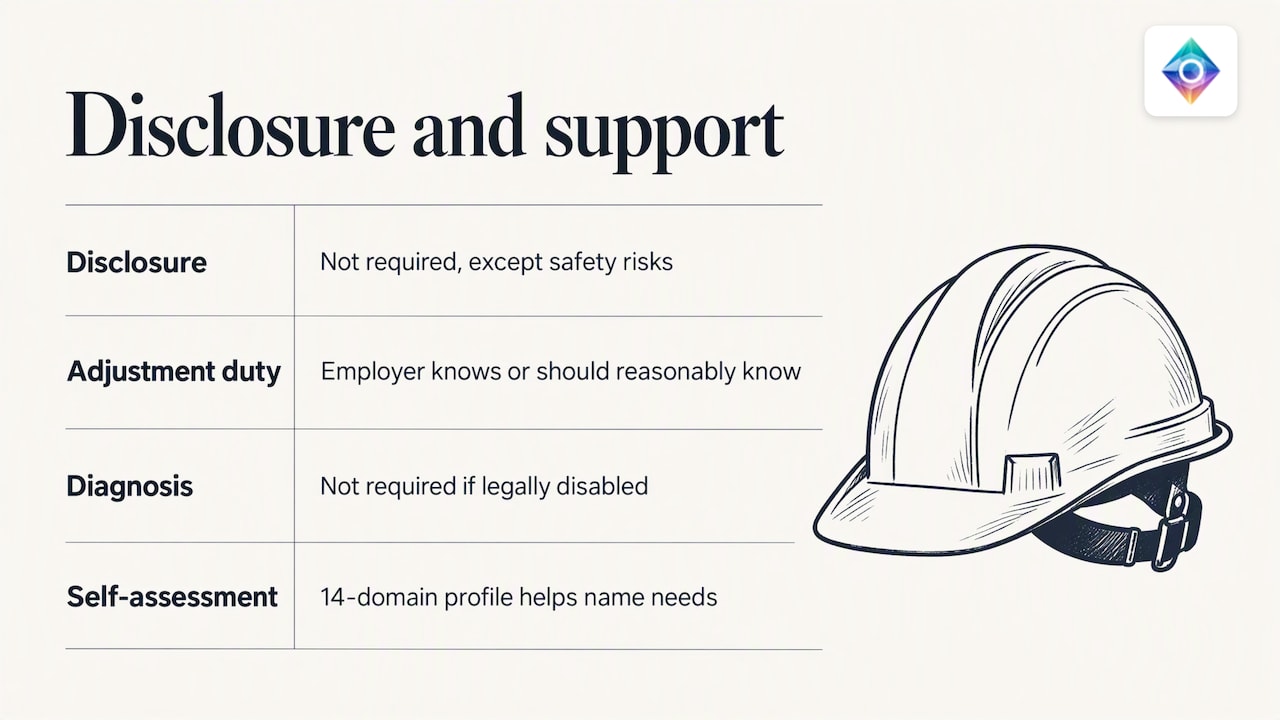
No. Acas guidance for the UK says employees do not have to tell an employer they are neurodivergent, with the exception of situations involving a health and safety risk. An example would be a role involving machinery or driving, where a trait could affect safe working and your employer needs the information to protect you.
The practical catch is that an employer can only adjust what it knows about. The Fire Brigades Union’s neurodiversity booklet explains that the duty to make reasonable adjustments applies where an employer knows, or could reasonably be expected to know, that someone is disabled. So an employer cannot wait for a formal announcement if the signs are plain, but in practice staying silent often means support is not offered.
You also do not need a formal diagnosis to be protected. The National Autistic Society notes that rights to reasonable adjustments and protection from discrimination often apply without a diagnosis, provided you meet the legal definition of disability. If you are still working out whether your traits fit a pattern, a structured self-assessment such as our 14-domain profile can help you put words to your needs before any conversation.
What are the benefits of disclosing autism at work?
The NAS lists the main reasons people tell an employer: requesting reasonable adjustments, increasing understanding and acceptance, and reducing the need to mask. A peer-reviewed article in Industrial and Organizational Psychology reaches a similar position, finding that disclosure can help neurodivergent workers obtain accommodations and may reduce masking.
Masking deserves particular attention. Suppressing natural behaviours all day is tiring, and many people find that once a manager understands, they can stop rehearsing every meeting. If you suspect you have been masking for years, our guides on unmasking autism safely and on how masking hides adult autism signs explain what it can look like.
Visibility has a wider effect too. The FBU booklet argues that seeing neurodivergent colleagues openly represented helps challenge discriminatory beliefs and misconceptions. That is a collective benefit, though, and not one you owe anyone.
What are the risks of disclosing autism at work?
The risks are real and worth weighing honestly. The NAS names stigma, bullying, discrimination and being seen as less capable. A peer-reviewed study of autistic adults in the UK reports that disclosure can bring stigma, discrimination, bullying and a lack of support, understanding or acceptance.
The benefits and risks are not evenly spread. Outcomes depend on the culture of the team, the attitude of your line manager and whether HR has handled similar requests well. That is why many people judge the environment first: how has your employer treated someone who asked for flexibility, or who was open about a health condition?
If something does go wrong, the usual route is to raise it with your manager or HR first. In the UK, Acas offers guidance on talking about neurodiversity and, if informal routes fail, the next steps are a formal grievance and advice from Acas or a union representative. Outside the UK, rules differ: in Australia, for instance, JobAccess says colleagues cannot share your disability information without your permission.
How do I prepare to tell my employer about my autism?
Use these steps in order. Most of the work happens before the conversation.
- List the barriers, not the label. Write down what makes tasks harder: open-plan noise, unclear verbal instructions, back-to-back meetings, unexpected changes.
- Match each barrier to a change. Examples include written instructions, a quieter desk, advance agendas, or flexibility over start times. Autism Speaks’ employment toolkit advises identifying your needs and possible accommodations first, then planning whether, how and what to disclose.
- Choose the right person. The same toolkit suggests explaining the work-related barrier to someone who can act on it, such as a manager, supervisor or HR representative.
- Decide how much to share. You might name the diagnosis, say you are neurodivergent, or describe only the functional need.
- Put it in writing. An email afterwards confirms what was agreed, and creates a record if you later need to refer to it. For a UK request, the National Autistic Society’s guidance on reasonable adjustments is a good place to check what you can ask for.
- Agree who else knows. Ask your manager to confirm that the information goes no further without your say-so.
Pro Tip: Bring a one-page summary of your needs to the meeting. A copyable report example shows how to lay one out so a manager or GP can read it in two minutes.
Can I ask for adjustments without disclosing a diagnosis?
Often, yes. Autism Speaks describes a “soft disclosure” approach, in which you describe functional barriers and the accommodations you need without necessarily disclosing a formal diagnosis, and this can sometimes be enough to get support put in place. Something like “I concentrate better with written instructions after meetings” is a request a manager can act on without a medical conversation.
There are limits. In the UK, what counts as reasonable depends on factors such as employer size, available resources, potential disruption and health and safety requirements. A small employer may refuse something a large one could easily provide. If a request is bigger, such as a formal change of duties, your employer may reasonably ask for supporting evidence, and that is where a diagnosis or clinician’s letter can help.
How is disclosing ADHD at work different from disclosing autism?
The legal position is the same in Great Britain: you are not obliged to disclose, and the duty to adjust applies where the employer knows or should reasonably know about a disability. What differs is what people usually ask for, and how the traits show up in a working day.
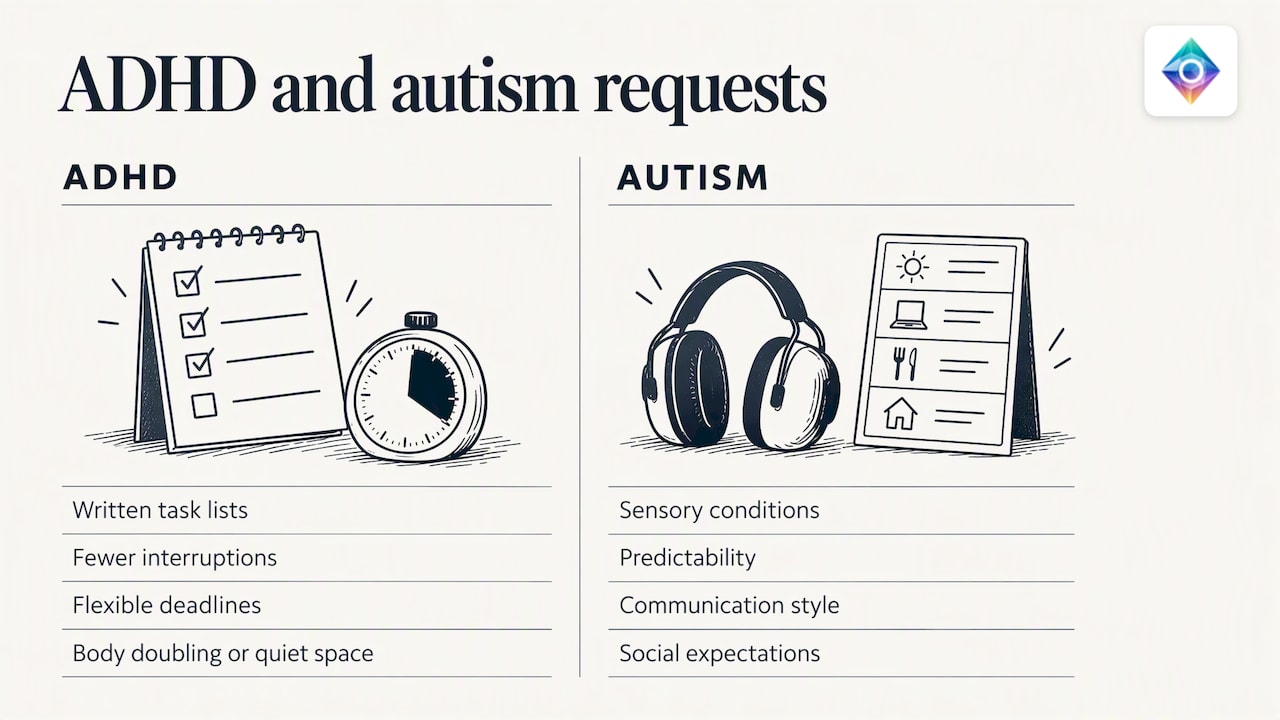
With ADHD, requests tend to concentrate on structure and attention: written task lists, fewer interruptions, flexible deadlines, body doubling or a quiet space. Our practical guide to workplace accommodations for ADHD goes through these in detail, with wording you can adapt.
With autism, requests more often involve sensory conditions, predictability, communication style and social expectations. Many people are both autistic and have ADHD, and in that case the list of barriers should cover both.
One point applies to both: changes that benefit everyone are easier to win. A US employer-facing resource, The ADHD Desk, observes that written agendas and asynchronous meeting habits often give the highest-leverage support to people who would rather not disclose. If you prefer privacy, proposing a team-wide change is one route.
Should I tell my colleagues as well as my manager?
That is a separate decision. Simply Psychology makes the point that telling an employer in order to trigger legal duties is distinct from choosing to tell your team. You can tell HR and nobody else, tell your manager only, or later choose to be open with the wider team.
If you tell colleagues, decide what you want from it. “I’m autistic, so I’ll often reply by email rather than in the corridor” tells people how to work with you. A bare announcement leaves them to guess.
What if I work in education?
Teachers, teaching assistants and university staff face the same choice, with an added layer: you may be supporting neurodivergent pupils while deciding whether to be open about your own profile. Policies and procedures vary between schools and trusts, so look at the equality or staff wellbeing policy before you speak. If you also manage your own deadlines across terms, a tool that is clear about data security and trust is worth looking for, since you are choosing what personal information to share and where.
For classroom practice, we have written about legal school autism adjustments and classroom adjustments that help ADHD in UK schools.
Perspective: why a plain-language profile comes first
I was diagnosed with ADHD at 42. Looking back, what I needed before any conversation with an employer or clinician was a clear description of how my mind works, in words I could say out loud.
We built Omniprism around that idea. Our self-assessment gives an instant profile across 14 domains, in plain language, with no email, no account and no data collection, so you can reflect privately and decide later who, if anyone, to tell.
We think disclosure goes better when it is specific. A person who can say “I struggle with verbal instructions, and written ones help” has a far easier conversation than one who has only a label. That is why our optional Specialist Briefing summarises your results in a format designed to be easy for clinicians to read, so your needs are on the table in a few minutes.
Nobody should feel pushed into disclosure. We want you to hold the information, so that the choice stays yours.
Valerio Cozzi
Getting your results ready for a conversation
If you want a structured starting point, you can complete the free self-assessment in one sitting and see where your traits and strengths sit across the 14 domains. If you then want something to hand to a GP, occupational health adviser or specialist, the Specialist Briefing is a one-off €9.99 report that summarises your results for clinicians. It supports a conversation about your needs and does not replace a clinical diagnosis.
Parents preparing a young person for school or work experience can use the guided assessments for children and young people. Professionals who work with clients can see how Omniprism is used by psychologists, coaches and companies. If you are still sorting out the vocabulary, our neurodiversity language guide will help, as will mapping your strengths across 14 domains, which gives you something positive to bring as well as barriers.
FAQ
Can my employer ask me if I am neurodivergent?
Employers can offer support and invite people to say what would help, and you can choose how to respond. Acas states that you do not have to tell your employer you are neurodivergent. If you decline, you can still describe a barrier and ask for a change without naming a condition.
Is it better to disclose before or after I get the job?
There is no single right answer, and the sources do not prescribe a timing. Many people wait until they have a reason, such as needing an adjustment. If you need something at interview, such as questions in advance, you can ask for that without giving a diagnosis, and a recruiter can then act on the request.
Do I need a diagnosis to ask for reasonable adjustments?
Not necessarily. The National Autistic Society says that legal protections often apply even without a formal diagnosis, provided you meet the legal definition of disability. A diagnosis or clinician’s letter can still make a larger request easier to evidence.
Who can my employer share my disclosure with?
That depends on your country and your employer’s policies. In Australia, JobAccess says information about your disability cannot be shared at work without your permission. In the UK, ask your manager or HR in writing who will be told and for what purpose before you share details.
Sources
- Deciding whether to tell employers you are autistic, National Autistic Society
- Talking about neurodiversity, Acas
- Autistic adults’ experiences of diagnostic disclosure in the workplace, PubMed Central
- Disclosure versus masking in the workplace, Industrial and Organizational Psychology
- Neurodiversity in the workplace, Fire Brigades Union
- Self-Advocacy, Accommodations and Disclosure, Autism Speaks
- Talking about your disability at work, JobAccess
- Adult ADHD at work, The ADHD Desk
- Reasonable accommodations for neurodivergent employees, Simply Psychology
Recommended
- Masking Hides Adult Autism Signs: UK NHS Steps to Assess
- Unmasking Autism Safely for Adults & Allies NHS Steps, 14 Domain Check
- Parents: 14 Domain Self Check to Uncover Autism Misdiagnosed as ADHD
- Autism vs. ADHD: Comparing Symptoms, Overlap, and Diagnosis
Written and edited by Valerio Cozzi, founder of Omniprism. Omniprism began after my own ADHD diagnosis at 42.
This article is educational. It is not medical advice, not a diagnosis, and not a substitute for assessment by a qualified clinician. The Omniprism self-assessment is free, needs no account and no email address, and runs entirely in your browser — your answers are never sent to a server. The optional Specialist Briefing report is a paid add-on.