Masking Hides Adult Autism Signs: UK NHS Steps to Assess
A cluster of lifelong social communication differences alongside restricted or repetitive behaviours, strong fixed interests, or unusual sensory sensitivity is the pattern that most reliably points to autism in an adult. If several of these have been present since childhood and now affect your work, relationships or daily life, a structured self-check or a conversation with your GP is a reasonable next step.
Key Takeaways
Adult autism is characterized by lifelong social communication differences, restrictive behaviors, sensory sensitivities, and masking, which often remain hidden for years.
| Point | Details |
|---|---|
| Social communication signs | Adults may struggle to interpret others’ thoughts and feelings, rely on routines, or feel anxious in social situations. |
| Masking behaviors | Many adults consciously or unconsciously hide autistic traits through scripting conversations, mimicking others, or suppressing stims. |
| Sensory sensitivities and stimming | Unusual sensitivity to sounds, light, textures, or smells, along with subtle repetitive movements, are common signs. |
| Overlap with other conditions | Autism often co-occurs with ADHD, anxiety, and depression, making pattern recognition essential for diagnosis. |
| Omniprism’s approach | Omniprism offers a confidential, self-guided assessment to help adults recognize autism-related patterns before seeking formal diagnosis. |
What are the common signs of autism in adults?
Autism in adults rarely looks like the stereotypes from films or outdated clinical textbooks. The NHS guidance on adult signs describes a set of recurring patterns rather than one fixed presentation, and most adults recognise only some of them.
Social communication differences tend to show up in specific, nameable moments rather than constant awkwardness. You might find yourself replaying a conversation hours later, unsure whether a joke landed or whether you spoke too long about one subject. Figurative language, sarcasm or a colleague saying “we should catch up sometime” without meaning it literally can genuinely confuse rather than merely annoy.
Restricted and repetitive patterns show up differently in adulthood than in childhood descriptions. A need for routine might mean eating the same breakfast for years, feeling disproportionately unsettled when a meeting moves without notice, or needing a specific order to your evening before you can relax. Strong interests, sometimes called special interests, can absorb hours without the usual sense of time passing, and losing access to that interest (a cancelled class, a broken hobby tool) can feel like losing a limb rather than a minor inconvenience.
According to NHS signs-in-adults guidance, the everyday signs clinicians look for include:
- Finding it hard to understand what others are thinking or feeling.
- Getting very anxious about social situations.
- Finding it hard to make friends or preferring to be alone.
- Seeming blunt, rude or not interested in others without meaning to.
- Finding it hard to say how you feel.
- Taking things literally and missing sarcasm or implied meaning.
- Relying on routines and becoming distressed by sudden change.
None of these on its own confirms autism. It is the combination, and how long it has been present, that matters to an assessment.
Masking and camouflaging: what it looks like and why it matters
Masking is the conscious or unconscious effort to hide autistic traits so you appear more neurotypical, and it is one of the biggest reasons adult autism goes unrecognised for decades. According to Autism Central’s guidance on masking, masking can include copying other people’s mannerisms, rehearsing conversations in advance, forcing eye contact that feels physically uncomfortable, and suppressing the urge to stim in public.
Common masking behaviours include:
- Scripting small talk or social openers before a meeting or party.
- Mimicking the tone, posture or phrases of people around you.
- Forcing eye contact you find draining or distracting.
- Suppressing repetitive movements and saving them for when you are alone.
Clinicians increasingly ask about the cost of coping rather than relying only on how someone presents in the room, because surface competence can hide significant internal effort. Peer-reviewed research linking camouflaging to mental health outcomes, including work by Hull et al. and Bradley et al., associates higher masking scores with greater anxiety, depression and exhaustion in autistic adults, even though measurement approaches vary between studies.
Pro Tip: Track how much recovery time you need after socialising (a quiet evening, a cancelled plan, a day in bed). That recovery cost is often a stronger clue to masking than how confident you looked in the moment.
Sensory differences and stimming: what do they look like?
Sensory differences sit alongside restricted and repetitive behaviours in most diagnostic frameworks, and they can be hyper-sensitive, hypo-sensitive, or both depending on the sense involved. The NHS list of adult signs includes unusual sensory sensitivity as a recognised feature, and the National Autistic Society’s guidance on recognising autism places sensory processing differences among the core features considered during assessment.
- Sound: struggling to filter background chatter in an open-plan office, or finding certain pitches physically painful.
- Light and texture: discomfort under fluorescent lighting, or an inability to tolerate certain fabric seams or food textures.
- Taste and smell: a narrow range of tolerated foods, or being overwhelmed by smells others do not notice.
- Hypo-sensitivity: seeking strong flavours, pressure or movement because ordinary sensation registers as too faint.
Stimming, repetitive movements like rocking, tapping or hand-flapping, often serves a regulatory function rather than being random. Adults frequently substitute subtler versions: clicking a pen, chewing gum, or tapping a foot under a desk. Practical coping strategies include noise-cancelling headphones in loud environments, scheduling sensory breaks between meetings, and carrying a small fidget object that is discreet enough for a shared workspace.
How does autism overlap with ADHD, anxiety and depression?
Autism, ADHD, anxiety and depression overlap heavily enough that misdiagnosis in either direction is common, which is why clinicians look at the pattern over time rather than a single symptom. Difficulty with executive function, time management and impulsivity points more towards ADHD, while social communication differences and restricted or repetitive interests point more towards autism, though many adults genuinely have both. If this distinction interests you, our comparison of autism and ADHD symptoms goes into the overlap in more depth.
The NICE guideline on autism in adults defines autism specifically as lifelong differences in social interaction and communication, combined with restricted or repetitive behaviours or sensory responses, which is why clinicians ask about childhood rather than only current symptoms.
- Note specific triggers: was a meltdown caused by a sensory overload, a change in plan, or a social demand?
- Record the coping cost: how much downtime or recovery time follows a stressful social or sensory event?
- Gather childhood examples, even informal ones, since developmental history carries real weight in assessment.
- Mention any existing ADHD, anxiety or depression diagnosis, since co-occurrence is common rather than disqualifying.
When should you consider an autism assessment, and how do you get one?
Consider an assessment when these patterns have been present since childhood and are now affecting your education, work, relationships or daily functioning, rather than waiting for a crisis point.
- Start with your GP or a local adult autism service. Referral routes vary by region, and some areas allow self-referral directly to a diagnostic service, so check what is available locally before assuming you need a GP gatekeeper.
- Expect a brief screening tool first. The NICE recommendations for diagnosis and management suggest using the AQ-10, a ten-item screening questionnaire, and recommend that two or more categories of core autistic behaviour should prompt a fuller assessment.
- Bring concrete examples, not just feelings. Specific incidents, dates and patterns carry more weight than general statements like “I’ve always struggled socially.” Where possible, include a family member’s account of your childhood, since NICE guidance treats developmental history as central to a thorough assessment.
- Plan for variable waiting times. Post-diagnosis support, follow-up appointments and waiting list lengths differ considerably by area, so ask your service directly what happens after assessment rather than assuming a fixed timeline.
A 2023 scoping review on adult self-identification found that more adults are self-identifying as autistic partly because of barriers to formal assessment, and that self-identification can support personal understanding without replacing a full clinical evaluation.
Why is emotional regulation harder for autistic adults?
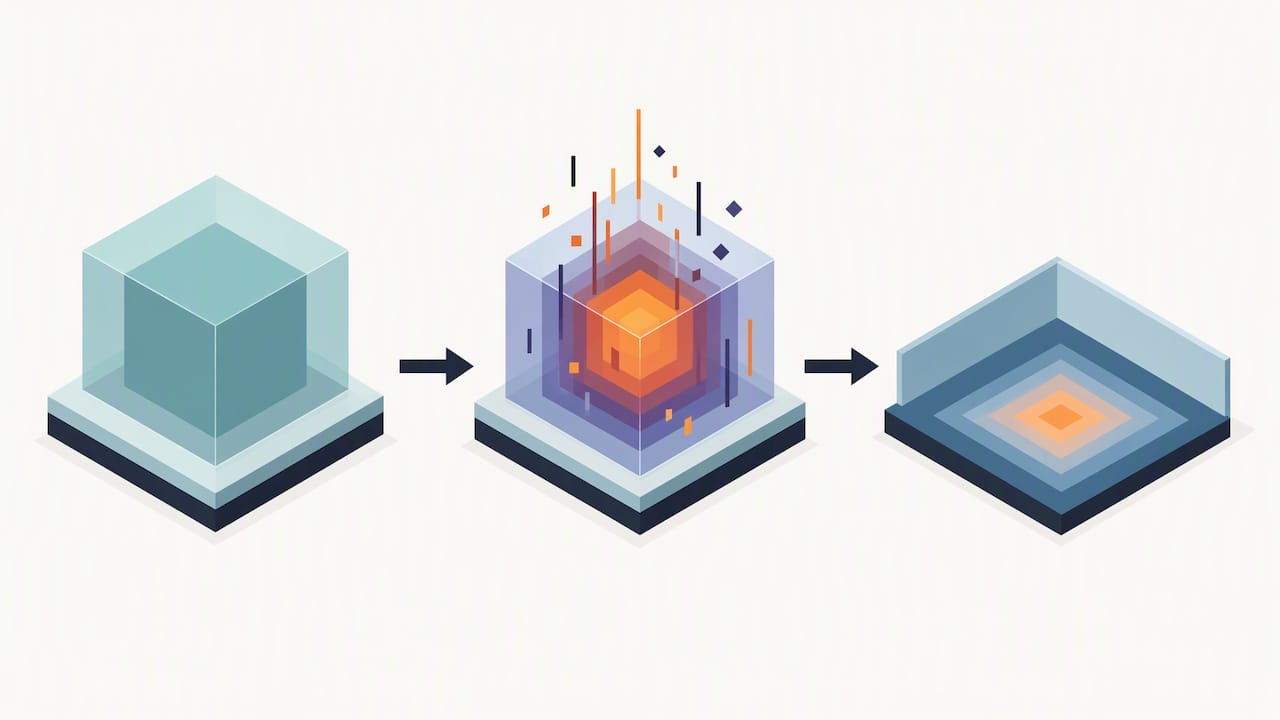
Emotional regulation difficulties are a distinct and often under-discussed feature of adult autism, separate from simply feeling anxious or low. Many autistic adults describe emotions arriving at full intensity with little warning, a state sometimes called an autistic meltdown or shutdown, followed by a slow and sometimes confusing recovery.
The gap between internal experience and outward expression can be wide. An autistic adult may appear calm in a stressful meeting while privately approaching overload, then struggle to explain afterwards why a seemingly minor change derailed the rest of their day. This mismatch is part of why colleagues, partners and even clinicians can misread genuine distress as overreaction or, conversely, miss it entirely because the outward presentation looked composed.
Alexithymia, difficulty identifying and naming your own emotional states, appears more often in autistic adults than in the general population and complicates regulation further: it is hard to manage a feeling you cannot yet name. Practical approaches that autistic adults and clinicians report finding useful include naming physical sensations rather than emotions first (tight chest, racing thoughts), building in recovery time after predictably demanding events, and treating a meltdown or shutdown as a signal of overload rather than a behavioural failure to correct.
What workplace challenges do autistic adults face, and what helps?
Workplaces built around open-plan offices, unstructured social expectations and last-minute changes create friction for many autistic adults, often regardless of how capable they are at the core job. Common friction points include unstructured networking events, ambiguous instructions delivered verbally rather than in writing, and sensory environments that make sustained concentration difficult.
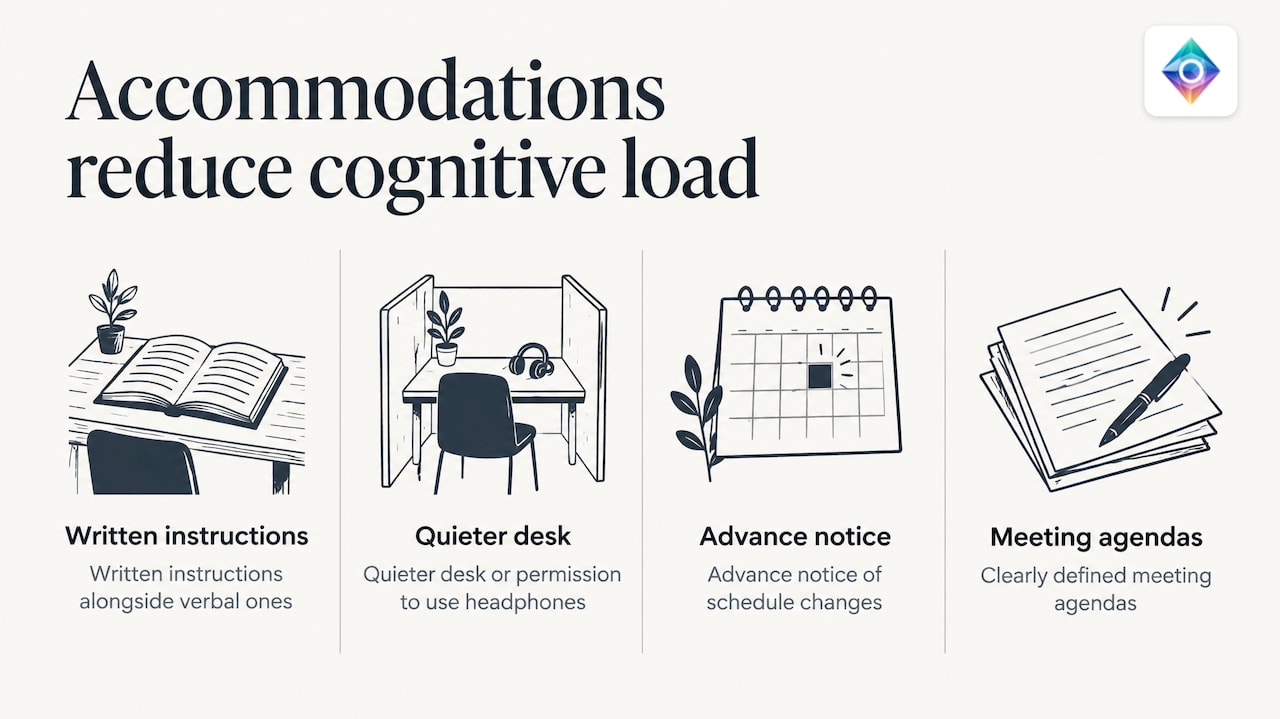
Reasonable accommodations are often straightforward once named explicitly rather than requested vaguely. Written instructions alongside verbal ones, a quieter desk or permission to use headphones, advance notice of schedule changes, and clearly defined meeting agendas all reduce the daily cognitive load of navigating an unpredictable environment. None of these require disclosing a diagnosis, though a diagnosis can make a formal accommodations request easier to support. For readers who manage or work alongside autistic colleagues, our page on Omniprism for professionals covers how structured self-assessment outputs can inform workplace adjustments.
What strategies help with daily living skills?
Daily living tasks that look simple from the outside, cooking, laundry, admin, replying to emails, can carry a disproportionate cognitive cost for autistic adults, particularly when executive function and sensory sensitivity overlap.
Breaking tasks into fixed routines reduces the decision fatigue of starting from scratch each time: the same few meals on rotation, laundry on a set day, admin batched into one weekly slot rather than scattered reactively. External structure, visual checklists, phone reminders, or body-doubling (doing a task alongside another person for accountability) helps where internal motivation alone is unreliable. Lowering the sensory cost of a task, doing laundry when the machine room is empty, batching phone calls to avoid repeated transitions, matters as much as the task itself for many autistic adults.
What misconceptions still surround adult autism?
A persistent misconception is that autism always presents the way it did in a childhood diagnosis criteria set decades ago, loud, obviously distressed, unable to make eye contact at all. Many autistic adults learned to adapt or mask some signs long before anyone considered testing them, which is exactly why late diagnosis is so common rather than a sign the person was never “really” autistic.
Another misconception treats checklists as sufficient on their own. The National Autistic Society’s guidance on masking explicitly warns that checklists can miss the internal effort behind an outwardly competent presentation, and recommends that assessment prioritise the adult’s own account of their experience rather than observable behaviour alone. Stigma also persists in the idea that seeking an adult diagnosis is attention-seeking or unnecessary if you have “managed fine” until now, when in reality the cost of that management is frequently chronic exhaustion, anxiety or burnout that only becomes visible once named.
A note from Valerio Cozzi
I’m Valerio Cozzi, founder of Omniprism, and I was diagnosed with ADHD at 42. That late diagnosis shaped why I believe accessible, privacy-first self-assessment matters: it gives adults a structured, low-pressure way to recognise patterns in themselves before deciding whether a formal assessment is worth pursuing.
— Valerio Cozzi
Omniprism: a privacy-first self-assessment and specialist briefing
We built Omniprism as a free self-assessment covering multiple domains related to neurodivergence, with no account, email or data collection required. You get a plain-language profile instantly, which makes it a discreet way to check whether your experience matches the patterns described above before deciding on next steps.
For readers preparing for a GP or specialist appointment, our optional Specialist Briefing turns your results into a clinician-ready summary for €9.99 one-off, written to be easy for a healthcare professional to use alongside your own account. We also offer guided assessments for children and teens through our children and young people’s pages for parents navigating the same questions on a family member’s behalf.
Start with the free self-check on our assessment page and decide from there whether a briefing or a formal referral makes sense for you.
This article is general information, not a substitute for advice from a qualified doctor. Consult a qualified healthcare professional about your own circumstances before acting on anything here.
FAQ
What are the 12 signs of autism in adults?
There is no single fixed list of exactly twelve signs in official NICE or NHS guidance; different organisations group the same core features differently. The consistent themes across NHS guidance are social communication differences, restricted or repetitive behaviours, strong fixed interests and sensory sensitivity, each showing up in several everyday forms.
What is the “autism third eye hug”?
This is not a recognised clinical term, concept or diagnostic feature in NHS, NICE or National Autistic Society guidance. If you have encountered this phrase online, it is best treated as an informal or social media term rather than an established part of autism assessment.
What are the 5 main symptoms of autism in adults?
Clinical guidance does not use a fixed “top five” list, but the recurring core features in NHS signs-in-adults guidance are difficulty with social interaction, trouble reading tone or body language, a strong need for routine, intense focused interests and unusual sensory sensitivity.
How can you tell if an adult is slightly autistic?
“Slightly autistic” is not a clinical category since autism is assessed as a spectrum of traits rather than a matter of degree, but milder or well-masked presentations still involve the same core pattern: lifelong social communication differences alongside restricted or repetitive behaviours or sensory sensitivity. A structured self-assessment, such as the free check on Omniprism, or the AQ-10 screening tool referenced in NICE guidance, can help clarify whether the pattern is strong enough to warrant a formal referral.
Can you be autistic and not know it until adulthood?
Yes, late recognition is common, particularly among adults who learned to mask traits from childhood or whose presentation did not match outdated stereotypes. A 2023 scoping review on self-identification found that adults increasingly recognise autistic traits in themselves well into adulthood, often after years of being misdiagnosed with anxiety or depression alone.
Sources
- Signs of autism in adults - NHS
- Autism in adults NICE guideline
- Masking and identity - Autism Central (NHS)
- Scoping review: self‑identification of autism in adults (2023)
- Doi
Recommended
- Parents: 14 Domain Self Check to Uncover Autism Misdiagnosed as ADHD
- Autistic Traits in Women: Signs Often Missed or Masked
- 50–70% Overlap in Autism and ADHD: What Families and Clinicians Need
Written and edited by Valerio Cozzi, founder of Omniprism. Omniprism began after my own ADHD diagnosis at 42.
This article is educational. It is not medical advice, not a diagnosis, and not a substitute for assessment by a qualified clinician. The Omniprism self-assessment is free, needs no account and no email address, and runs entirely in your browser — your answers are never sent to a server. The optional Specialist Briefing report is a paid add-on.