Unmasking Autism Safely for Adults & Allies NHS Steps, 14 Domain Check
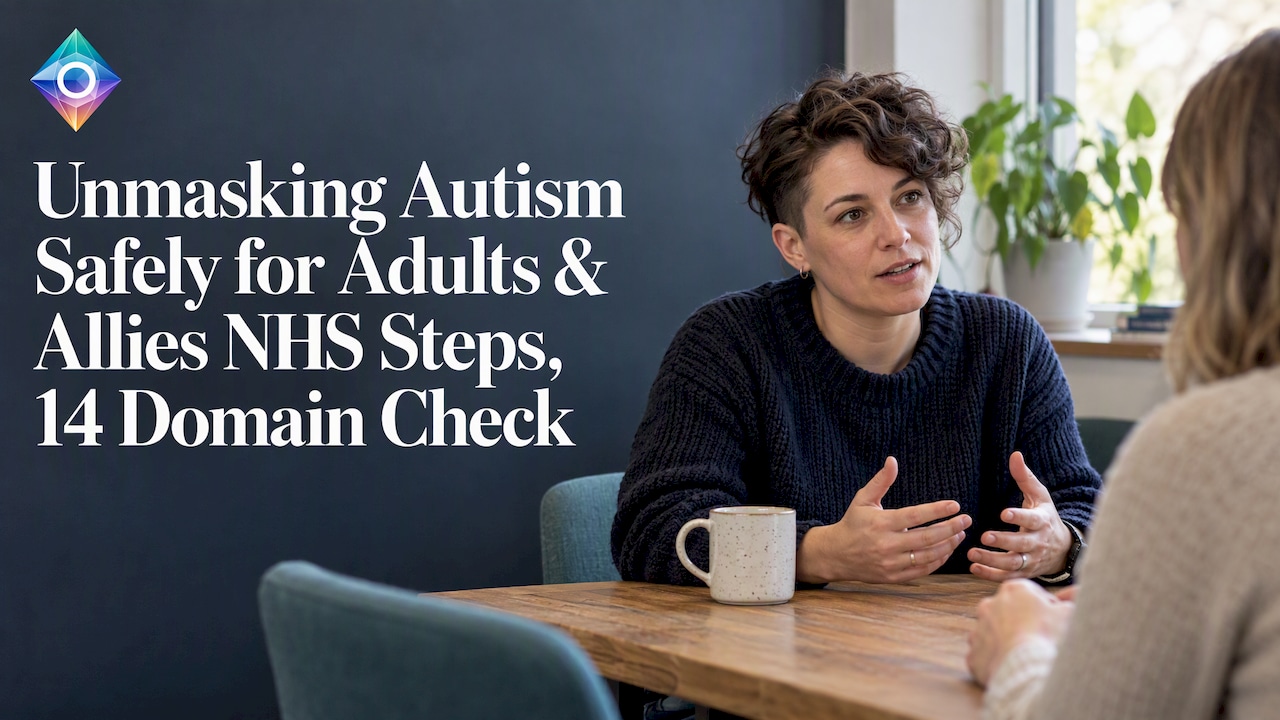
Unmasking autism means gradually reducing the learned behaviours, like forced eye contact, scripted small talk and suppressed stimming, that autistic people use to appear neurotypical. It can bring real relief and a stronger sense of identity, but it needs pacing, because dropping these strategies suddenly can trigger exhaustion or expose you to unsafe reactions in some settings.
Key Takeaways
Unmasking autism involves a gradual process that reduces learned behaviours used for camouflaging, improving mental health and authenticity without risking burnout or exhaustion.
| Point | Details |
|---|---|
| Masking behaviors | Autistic individuals often rehearse conversations, suppress stims, mimic others, and force eye contact to hide traits. |
| Reasons for masking | Masking develops as a response to social environments that penalize visible difference, providing safety and social access. |
| Mental health impact | Camouflaging is linked to higher levels of anxiety and depression, along with a smaller negative effect on overall wellbeing. |
| Challenges in diagnosis | Masking can delay autism diagnosis and lead to burnout, identity loss, and increased risk of suicidality if unrecognized. |
| Supporting safe unmasking | Gradual, monitored unmasking with environment adjustments, documentation, and recovery time promotes well-being and authenticity. |
What is masking (camouflaging) in autism?
Masking, sometimes called camouflaging in the research literature, refers to the conscious or unconscious suppression of autistic traits to fit into a predominantly non-autistic social world. Some strategies are deliberate, like rehearsing conversation scripts before a meeting. Others become automatic over years, such as forcing eye contact without thinking about it.
Common masking behaviours include:
- Scripting conversations in advance and rehearsing responses to anticipated questions.
- Suppressing stims like hand-flapping or rocking, often replacing them with less visible movements.
- Mimicking the facial expressions, tone or body language of people nearby.
- Forcing eye contact despite it feeling uncomfortable or overstimulating.
Prevalence data is still limited, but the systematic review from Teesside notes that camouflaging is widely reported across genders, with some evidence that women and girls mask more consistently, partly explaining why they are often diagnosed later in life.
Why do autistic people mask?
Masking develops as a response to a social environment that penalises visible difference, not as a personal flaw. The British Psychological Society frames masking as a social phenomenon as much as an individual coping strategy: autistic people adapt because the people and environments around them rarely do.
Masking can offer short-term advantages:
- Reduced risk of bullying, exclusion or discriminatory treatment at school or work.
- Easier access to jobs, friendships and services that assume neurotypical communication styles.
- A sense of safety in unpredictable or unfamiliar social situations.
These pressures are not evenly distributed. Autistic women often mask to match social expectations placed on them from childhood, a pattern explored in our piece on autistic traits in women. Autistic people who are also LGBTQ+, from minoritised ethnic backgrounds, or navigating multiple stigmatised identities frequently describe compounded pressure to mask in more than one direction at once.
What are the harms and the evidence linking masking to mental health outcomes?
Camouflaging carries a measurable mental health cost. A meta-analysis from the University of Birmingham, pooling 16 studies and 5,897 participants, found moderate positive relationships between camouflaging and both anxiety and depression, alongside a smaller but consistent negative relationship with overall wellbeing.
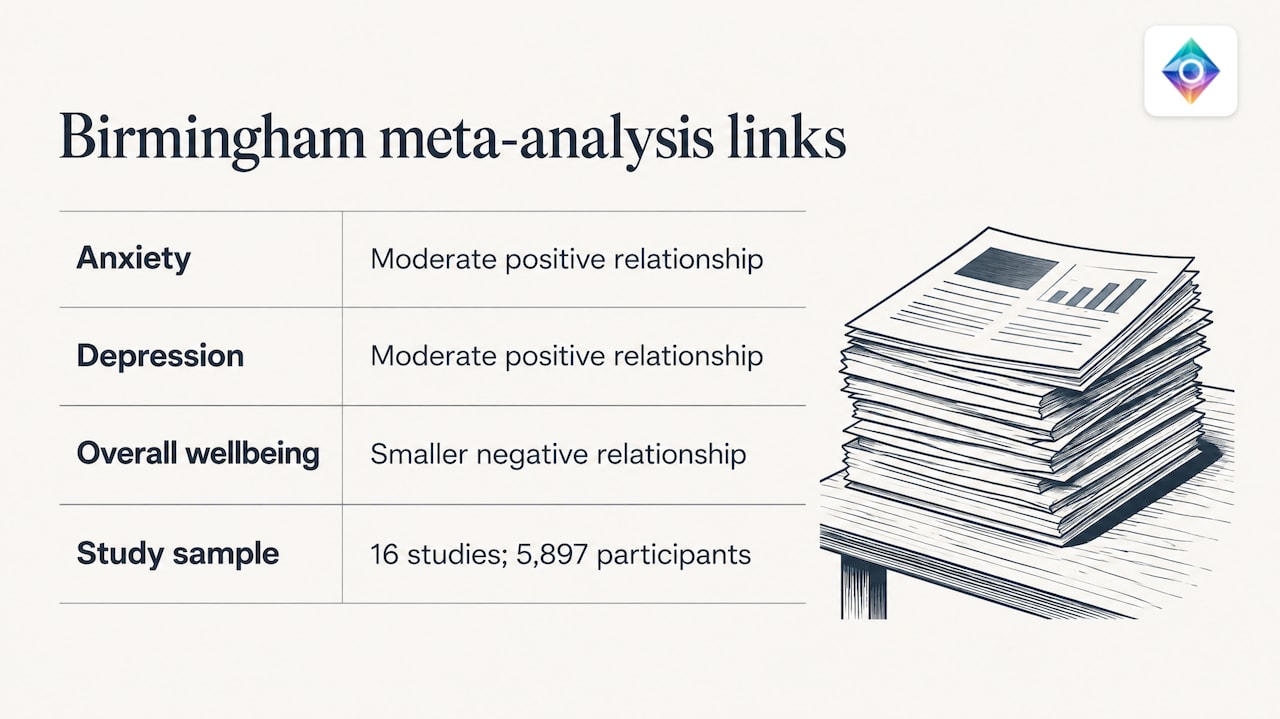
Camouflaging shows a moderate link to anxiety and depression, and a smaller negative link to wellbeing, according to the Birmingham meta-analysis, one of the clearest syntheses of this evidence to date.
Masking also delays diagnosis. Because it hides the traits clinicians look for, assessments can miss autism entirely or identify it only after years of unexplained distress, a gap that NICE guidance on autism recognition addresses by urging clinicians to gather full developmental history rather than relying on a single observed snapshot.
The Teesside review synthesised 24 papers and found a consistent pattern: short-term social benefits from camouflaging, set against long-term costs to identity, diagnostic access and mental health. Watch for chronic exhaustion, loss of a stable sense of self, and autistic burnout, a state of depleted functioning that can increase suicidality risk when it goes unrecognised.
How to unmask safely: step-by-step practical guidance
Unmasking works best as a gradual, monitored process rather than a sudden change. The following steps, drawn from NHS trust guidance and clinical literature, give a practical order to work through.
- Check your safety and energy first. Before changing any behaviour, assess whether your current environment is physically and socially safe, and whether you have enough capacity, using something like spoon theory to track your daily energy budget.
- Run small, reversible experiments. Leicestershire Partnership NHS Trust suggests dropping one scripted behaviour for a single interaction in a trusted space, such as a peer group or therapy session, rather than changing everything at once.
- Negotiate environmental adjustments. Ask for sensory breaks, flexible meeting formats or quieter workspaces at work or school, so the environment carries more of the adaptation instead of you.
- Document your masking history before clinical appointments. Note which behaviours you consciously perform and in which settings, since this detail helps clinicians who are applying masking-aware assessment practices.
- Plan recovery time after each experiment. Build in rest immediately after unmasking attempts and watch for signs of burnout, pausing the process and seeking support if exhaustion builds up.
Pro Tip: Keep unmasking experiments short and reversible, one dropped behaviour per interaction, and schedule recovery time straight afterwards rather than waiting until you feel depleted.
For more detail on pacing recovery after sustained masking, our guide on recovering from autistic burnout sets out how to rebuild capacity without relapsing, and our piece on distinguishing burnout from depression helps separate the two when symptoms overlap.
What should clinicians, employers and allies do about masking?
Supporters carry much of the responsibility for making unmasking safe. NHS England guidance recommends that adult autism assessments be adapted in pace, duration and setting specifically because masking can obscure the traits clinicians are looking for.
Useful actions include:
- Asking directly about learned coping strategies and using collateral history from family or partners where appropriate, rather than relying solely on observed behaviour in one appointment.
- Extending appointment time so autistic traits have room to surface without pressure to perform or disclose.
- Offering concrete environmental adjustments, such as sensory breaks and predictable routines, which Just One Norfolk’s guidance recommends for reducing masking pressure in children and young people.
- Supporting access to autistic peer groups, which helps identity exploration happen outside clinical settings.
Workplaces have a role too. Practical ideas for inclusive team activities, covered in Gatherilla’s guide to neurodivergent-friendly team building, show how adjusting shared activities rather than expecting individuals to adapt can lower everyday masking pressure. In education, AnyLearns’ explainer on adaptive learning setups illustrates how flexible, paced approaches can reduce the pressure autistic pupils feel to mimic neurotypical classroom behaviour.
Using structured self-assessment and community resources while unmasking
Understanding your own trait patterns before a clinical conversation can make unmasking feel less disorientating. A structured self-assessment gives you language for what you are experiencing, which helps when describing masking history to a clinician or deciding which environmental adjustments to request.
Peer contact matters just as much. Qualitative research on identity following autism recognition reports that connecting with other autistic people frequently speeds recovery from identity confusion and offers practical modelling of what authentic, unmasked behaviour can look like.
- A self-assessment clarifies which traits are consistently present, which helps distinguish long-standing patterns from situational stress.
- Autistic community spaces reduce isolation and offer lived models of unmasked communication.
- Our self-assessment offers instant, plain-language profiles across multiple areas without collecting personal data, and an optional Specialist Briefing report for those who want a summary to bring to a clinician.
A personal note from the founder
I founded Omniprism after being diagnosed with ADHD at 42, late enough to understand what years of unexplained masking cost. That experience shapes why accessible, non-judgemental resources for exploring neurodivergence matter so much to me, and why we built a tool that respects people’s time and privacy while they work it out.
— Valerio Cozzi
If you want structured support, consider a self-assessment or Specialist Briefing
Our free self-assessment gives you an instant, plain-language profile across 14 areas, including autism, masking and related traits, with no account, email or data collection required. If you want something concrete to bring into a clinical conversation, the optional Specialist Briefing report costs €9.99 as a one-off purchase and summarises your results in a format designed for clinicians to use quickly. Professionals exploring how to use these outputs in practice can find more detail on our page for psychologists, coaches and companies. You can start the free self-assessment whenever you are ready.
FAQ
What does it mean for an autistic person to unmask?
Unmasking means gradually reducing learned behaviours used to hide autistic traits, such as scripted speech or suppressed stimming, so your natural communication style and reactions become more visible. It is typically a paced process rather than a single event, done in trusted spaces first.
What is the 6 second rule in autism?
There is no established clinical guideline called the “6 second rule” in autism research or NICE, NHS or BPS guidance. If you have seen this referenced elsewhere, treat it as informal advice rather than a recognised clinical standard.
Is Unmasking Autism a good book?
This article is not a book review, so we cannot assess any specific title. For evidence-based reading, the peer-reviewed research and NHS guidance linked throughout this article are a reliable starting point.
What is tunnelling in autism?
“Tunnelling” is not a standard term used in NICE, NHS or BPS guidance on autism, so a precise definition is not available from these sources. If you encountered it describing intense focus on a narrow interest, that pattern is more commonly discussed under monotropism or special interests in the autism literature.
How can I tell if I’m masking without realising it?
Signs include chronic exhaustion after social situations, difficulty naming your own preferences, and a sense that your public self feels different from how you act alone. A structured self-assessment can help you spot these patterns before discussing them with a clinician.
Sources
- Meeting the needs of autistic adults in mental health services — NHS England (2023)
- A systematic review and meta-analysis of mental health outcomes associated with camouflaging in autistic people — University of Birmingham (2024)
- Masking when you’re autistic — Leicestershire Partnership NHS Trust (2024)
- The consequences of social camouflaging in autistic adults: A systematic review — Teesside research (2024)
Recommended
- Parents: 14 Domain Self Check to Uncover Autism Misdiagnosed as ADHD
- Spot Twice Exceptional Autism: Use a 14 Domain Self Check to Build Evidence
- Autistic Traits in Women: Signs Often Missed or Masked
- 50–70% Overlap in Autism and ADHD: What Families and Clinicians Need
Written and edited by Valerio Cozzi, founder of Omniprism. Omniprism began after my own ADHD diagnosis at 42.
This article is educational. It is not medical advice, not a diagnosis, and not a substitute for assessment by a qualified clinician. The Omniprism self-assessment is free, needs no account and no email address, and runs entirely in your browser — your answers are never sent to a server. The optional Specialist Briefing report is a paid add-on.