RAADS-R Alternatives: 6 Autism Self-Assessment Tools Compared
The closest alternatives to the RAADS-R are the Autism-Spectrum Quotient (AQ), the Camouflaging Autistic Traits Questionnaire (CAT-Q), the Social Responsiveness Scale-2 Adult Self-Report (SRS-2) and the Comprehensive Autism Trait Inventory (CATI), plus broader profile tools such as Omniprism. None of them diagnoses autism, so the right choice depends on whether you want a quick screen, a look at masking, or a structured summary to take to a clinician.
Key takeaways
- The AQ is the shortest well-known option (50 items), the RAADS-R is longer (80 items) and also asks about childhood, and the CAT-Q measures camouflaging rather than autistic traits as a whole.
- Studies of the RAADS-R and AQ in adult outpatient samples have found poor sensitivity and specificity, so a score should never be the sole basis for a conclusion.
- Newer tools such as the CATI were built to capture inner experience that older behaviour-based questionnaires can miss.
- Omniprism gives an instant plain-language profile across 14 areas with no email, account or data collection, and an optional €9.99 Specialist Briefing summarises results for a clinician.
- Whichever tool you use, the result is a starting point for a conversation with a professional, not an answer.
What are the best alternatives to the RAADS-R?
A 2022 peer-reviewed article in Autism in Adulthood names the AQ, SRS-A, ACIA and CATI as published alternatives or complements to the RAADS-R. The ACIA and CATI were developed with input from clinicians and researchers, and the CATI also with autistic college students. The CAT-Q sits beside these as a specialist tool for masking.
The table below puts the main options side by side. Item counts and scoring come from the papers linked in the sections that follow.
| Tool | Items | What it measures | Best suited to |
|---|---|---|---|
| RAADS-R | 80 | Autistic features now and in childhood | Adults 18+ with average or above-average intelligence, ideally with a clinician |
| AQ | 50 | Communication, social skills, imagination, attention to detail, attention switching | A quick, widely recognised first look |
| CAT-Q | 25 | Compensation, masking, assimilation | People who suspect they camouflage |
| SRS-2 Adult Self-Report | 65 | Social difficulties | Clinical and research settings |
| CATI | Not covered here | Autistic traits, including inner experience | Readers who want a newer, trait-focused measure |
| Omniprism | 14 areas profiled | Neurodivergent traits across ADHD, autism, dyslexia, masking and more | A private overview before talking to a professional |
What is the difference between the RAADS-R and the AQ?
The RAADS-R is an 80-question self-report instrument for adults aged 18 and over with average or above-average intelligence. Each answer records whether a statement applies now, applied in childhood, both, or never, and the authors designed it for clinician administration rather than online screening.
The AQ is a 50-item adult self-report. A systematic review describes its content as communication, social skills, imagination, attention to detail and attention switching, with binary scoring that gives a total from 0 to 50 and higher totals meaning more autistic traits.
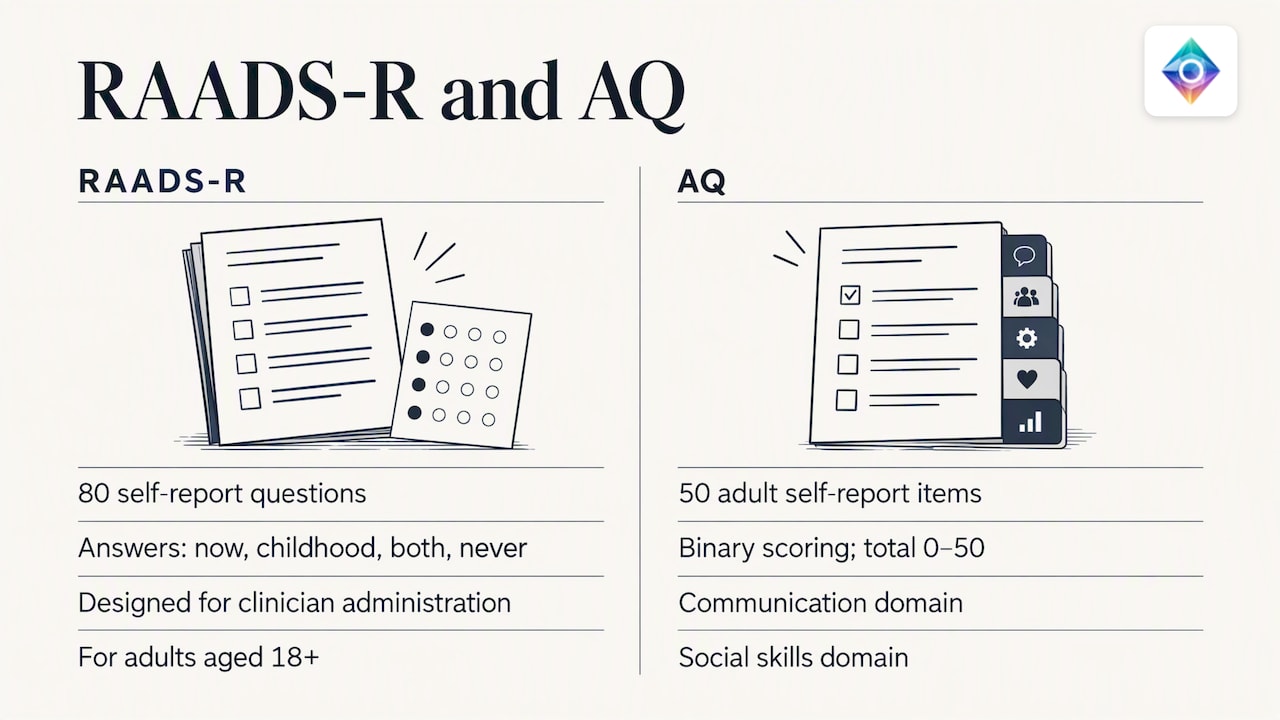
In practice, the AQ asks how you are today and takes minutes. The RAADS-R asks you to separate the present from your early years, which suits a clinical conversation but makes it harder to complete well alone. If you are weighing the two, ask whether you can recall your childhood clearly enough to answer, or whether a parent or sibling could help.
How accurate are the RAADS-R and AQ?
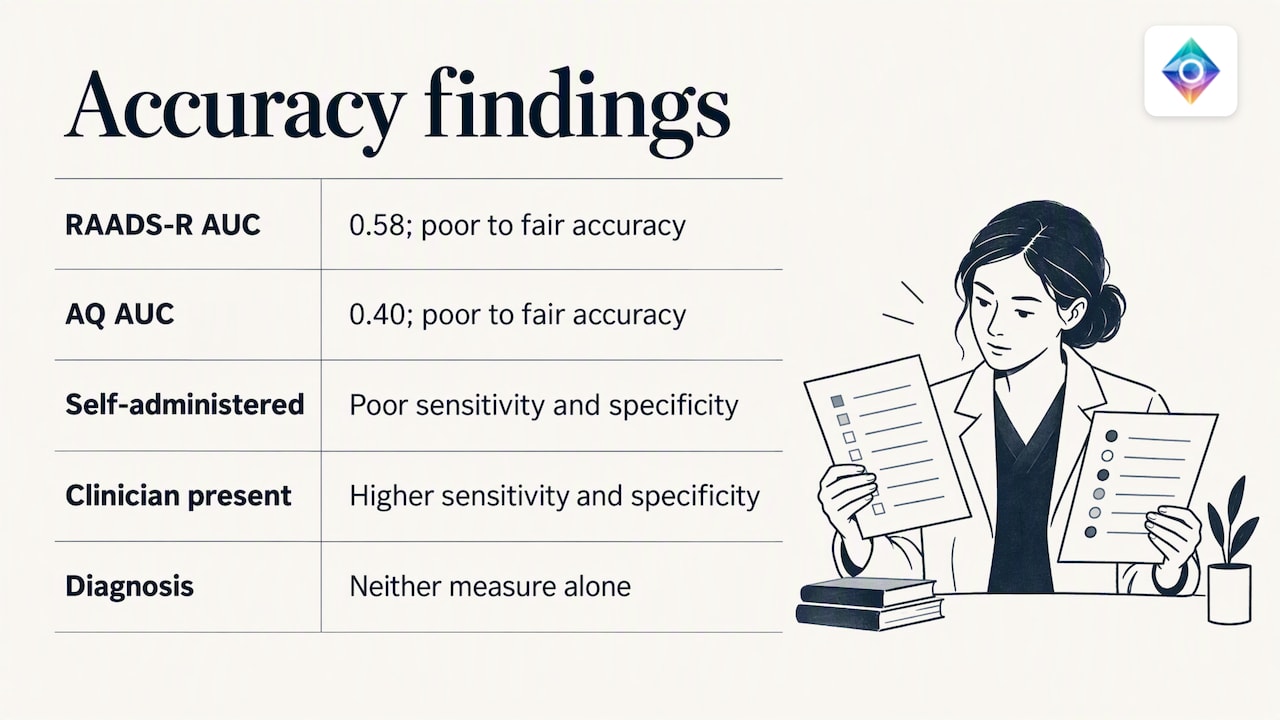
Less accurate than their popularity suggests. A 2023 Rutgers thesis reviewing studies in adult outpatient samples reports poor sensitivity and specificity for both measures, and concludes that neither should be the sole basis for diagnosis. The same review notes that studies in which a clinician was present to answer questions found higher specificity and sensitivity than self-administered versions.
A clinical study of adults reported an area under the curve of 0.58 for the RAADS-R and 0.40 for the AQ, described as poor to fair accuracy against clinician-derived diagnoses. The authors concluded that clinicians should not rely solely on self-report measures, or on the ADOS, and should use several measures together.
Reliability is a separate property from validity. A comparison of self-administered autism questionnaires found that the Subthreshold Autism Trait Questionnaire performed well and is short, while the AQ and SRS-2 Adult Self-Report had limits in internal consistency or discriminant validity. A questionnaire can produce consistent answers and still struggle to tell autistic traits from other clinical presentations.
Which tool measures masking and camouflaging?
The CAT-Q. It has 25 items and three factors: compensation, masking and assimilation. In its development paper the CAT-Q showed internal consistency of 0.94 and a three-month test-retest correlation of 0.77 in a subsample of 30 autistic participants, and it was validated in people aged 16 to 82. Responses are rated from 1 to 7, as described in a 2024 study of social camouflaging.
The CAT-Q does not tell you whether you are autistic. It tells you how much effort you put into hiding or compensating for social differences, which matters if you have been told for years that you seem fine. Our guides on how masking hides adult autism signs and unmasking autism safely cover what that can look like day to day.
Is the SRS-2 Adult Self-Report a better choice?
The SRS-2 Adult Self-Report has 65 items scored from 0 (Not True) to 3 (Almost Always True). A 2025 paper in the Journal of Autism and Developmental Disorders explains that higher scores indicate greater social difficulties and that total T-scores of 60 or above are clinically elevated under the instrument’s interpretation.
It is mainly a clinical and research instrument, and it focuses on social responsiveness rather than the full range of autistic experience. That makes it a sensible complement in a professional assessment but a less natural first step for someone exploring privately.
What do newer tools like the CATI add?
The authors of the 2022 paper behind the CATI argue that measures focused only on observable behaviour can miss subtle, covert or internalised autistic experiences. Tools such as the CATI and the ACIA were designed to ask about that inner side, which is why they are proposed as complements to conventional questionnaires and not replacements.
If your experience is mostly internal, such as sensory overload you hide, intense routines or exhaustion after socialising, a behaviour-only checklist may under-describe you. That is a reason to use more than one tool.
How does Omniprism compare?
Omniprism is a self-assessment tool that builds an instant profile across 14 areas: ADHD, autism, dyslexia, masking, dyspraxia, dyscalculia, sensory processing, high sensitivity, OCD traits, synesthesia and more. Results arrive in plain language, and there is no email, no account and no data collection. Because neurodivergent traits often overlap and coexist, seeing them in one profile can show patterns that a single-condition questionnaire never asks about.
Omniprism is a self-assessment, not a diagnostic test, and we say so plainly in our piece on why quizzes are not diagnoses. Its job is to give you clarity and language before you speak to a professional.
Another difference is the family route. Omniprism includes guided assessments for children and young people, with separate pages for ages 7 to 10 and ages 11 to 13. The RAADS-R was developed as an aid to diagnosing autism in adults of normal intelligence, so it is not a tool for a child. Parents who are noticing early language differences can also read a speech delays checklist for parents before choosing a child-focused screen.
Can any of these tools be used for children?
Most cannot. The RAADS-R is for adults, and the CAT-Q was validated from age 16. The AQ family has an adult form in the research reviewed here, and the National Autistic Society’s directory of an adult diagnostic service lists the AQ, EQ and a Sensory Integration Checklist alongside clinical tools, again for adults.
For a child or teenager, a parent-guided format is more appropriate than an adult questionnaire. Omniprism’s children and young people pages walk a parent through the questions, and a Youth Briefing can summarise the answers for a clinician. If you suspect autism has been mistaken for ADHD in your child, our guide on autism misdiagnosed as ADHD explains what to look for.
What can an online questionnaire tell you, and what can it not?
It can show whether your traits resemble a recognised pattern and give you words to describe them. It cannot establish autism. The Autism Research Centre states that its tests are not diagnostic, that no single score indicates autism, and that diagnosis comes through clinical assessment including clinical judgement.
The National Autistic Society’s description of the DISCO makes the same point from the clinical side: no single test establishes autism, and assessment should build a developmental and behavioural picture from history, observation, psychological assessment and other reliable information.
Our perspective: what a score is actually for
We built Omniprism around one belief: people should be able to explore their own neurodivergent traits without handing over an email address or being tracked. A score is useful only when it leads to a better conversation.
I was diagnosed with ADHD at 42, and that is why I care about the stage before a diagnosis, when someone has questions but no vocabulary for them. A tool in that position should be honest about its limits, quick to use and easy to take to a clinician.
That is also why we do not rank questionnaires by how impressive their cut-offs sound. The evidence above shows that RAADS-R and AQ scores are weak stand-alone predictors, so we recommend using any tool, ours included, as one input among several. People who also want to compare ADHD tools can read our guide to turning an online ADHD test into clinician-ready evidence.
— Valerio Cozzi
How should you use your results before a professional assessment?
Treat the result as preparation, not a verdict. A practical way to use two or three tools together:
- Take a broad profile first, such as Omniprism, to see which areas stand out.
- Add a focused tool where it fits: the CAT-Q if you think you mask, the AQ if you want a familiar, short reference score.
- Write down specific examples from childhood and adulthood. Clinicians value history over numbers, and the RAADS-R itself asks about both periods.
- Bring the results and examples to your GP or assessing clinician and ask what the next step is.
If your concerns overlap with anxiety, our article on autism and social anxiety explains how adults tell them apart and prepare. Readers in the UK can also look at when to seek an ADHD diagnosis if ADHD is part of the picture.
Pro Tip: Complete each questionnaire on a different day and compare your answers. Large swings usually point to mood or context, which is worth telling the clinician.
Want a clinician-ready summary?
The Omniprism self-assessment is free and gives you an instant profile. If you want to hand something to a professional, the optional Specialist Briefing is a one-off €9.99 report that summarises your results in a format designed for healthcare professionals. Psychologists and coaches can see how we work with practitioners on our page for professionals.
FAQ
Is the AQ better than the RAADS-R?
Neither is clearly better. The AQ is shorter and quicker, while the RAADS-R is longer and asks about childhood as well as now. Studies in adult outpatient samples found poor sensitivity and specificity for both, so choose by what you want to learn and not by which has the better reputation.
Can I use the RAADS-R online by myself?
You can find online versions, but the instrument was designed for clinician administration. Research summarised in the Rutgers review found that studies with a clinician present to answer questions reported higher sensitivity and specificity than self-administration, so a self-completed score is best treated as rough.
What is the best test for autistic masking?
The CAT-Q is the dedicated measure, with 25 items covering compensation, masking and assimilation. It describes camouflaging behaviour and does not say whether you are autistic. Omniprism also profiles masking as one of its 14 areas.
Do I need a diagnosis after a high score?
Only if you want one, for support, adjustments or clarity. A high score is a reason to talk to a GP or specialist, because no single score indicates autism and diagnosis rests on clinical assessment.
Sources
- Centering the Inner Experience of Autism: Development of the CATI (Autism in Adulthood, 2022)
- Development and Validation of the Camouflaging Autistic Traits Questionnaire (CAT-Q)
- Measuring autistic traits in the general population: a systematic review of the AQ
- The Ritvo Autism Asperger Diagnostic Scale-Revised (RAADS-R)
- The Swedish Version of the RAADS-R
- Associations Between the SRS-2 and the ASEBA Adult Self-Report (JADD, 2025)
- Social camouflaging study (JADD, 2024)
- Examining the Diagnostic Validity of Autism Measures Among Adults
- Rutgers thesis on diagnostic validity of autism measures (2023)
- Comprehensive comparison of self-administered questionnaires for autistic traits (PubMed)
- National Autistic Society: The DISCO
- National Autistic Society: Adult Autism Diagnostic Service listing
- Autism Research Centre: Tests
Recommended
- Self Assessment vs Diagnosis: ADHD and Autism Quizzes Aren’t Diagnoses
- Conners Alternatives for Adults and Kids: Private Prep, Clinical Fit
- Parents: 14 Domain Self Check to Uncover Autism Misdiagnosed as ADHD
- Spot Twice Exceptional Autism: Use a 14 Domain Self Check to Build Evidence
Written and edited by Valerio Cozzi, founder of Omniprism. Omniprism began after my own ADHD diagnosis at 42.
This article is educational. It is not medical advice, not a diagnosis, and not a substitute for assessment by a qualified clinician. The Omniprism self-assessment is free, needs no account and no email address, and runs entirely in your browser — your answers are never sent to a server. The optional Specialist Briefing report is a paid add-on.