Parents: 14 Domain Self Check to Uncover Autism Misdiagnosed as ADHD

Yes, autism can be misdiagnosed as ADHD, and it happens often enough that researchers now study the delay as its own clinical problem. If your child has an ADHD diagnosis, but symptoms don’t quite fit, start writing down social-communication patterns, sensory reactions, and repetitive routines, then ask your pediatrician for a multidisciplinary re-evaluation. The DSM-5 permits both diagnoses at once, so this isn’t an either-or question.
TL;DR:
- Autism and ADHD can be misdiagnosed or identified late due to overlapping symptoms, especially when brief observations are used without thorough testing.
- Key behavioral differences involve social reciprocity, joint attention, nonverbal communication, sensory sensitivities, and the specificity of attention issues.
- A comprehensive diagnosis relies on structured tools like ADOS-2 and ADI-R, along with detailed observations from parents and teachers.
- Masking, gender biases, and short pediatric visits often lead to ADHD being diagnosed first, delaying autism recognition by an average of nearly two years.
- Early, multidisciplinary evaluations and environmental accommodations are crucial for accurate diagnosis and effective intervention, even before formal assessment results are obtained.
Table of Contents
- How ADHD and Autism Overlap: Shared Symptoms That Confuse Clinicians
- Key Signs That Separate Autism From ADHD
- Why Autism Gets Missed or Diagnosed Late When ADHD Is Present
- A Practical Path Forward: Screenings, Evaluations, and What to Ask
- What Happens When Autism Stays Hidden Behind an ADHD Label
- Using a Structured Self-Assessment to Prepare for a Clinical Evaluation
- Why Careful Evaluation Is Worth the Extra Effort
- Sources
How ADHD and Autism Overlap: Shared Symptoms That Confuse Clinicians
Autism and ADHD share enough surface behavior that even experienced clinicians can mix them up in a single 15-minute visit. Both conditions can produce a kid who seems distracted, interrupts constantly, melts down over small changes, and struggles to sit still in a classroom. The difference usually isn’t visible in the behavior itself. It’s in the why behind it.
A child who can’t focus because their mind is racing between five different thoughts has a different underlying pattern than a child who can’t focus because a classmate’s chewing sound is unbearable, or because they’re mentally rehearsing a social script for the hallway conversation they know is coming. Both look like “not paying attention.” Only one is inattention in the ADHD sense.
The Cleveland Clinic notes that ADHD and autism are distinct conditions that frequently occur together, and that the DSM-5 has permitted dual diagnosis since 2013. Before that revision, clinicians often had to pick one label, which pushed autism traits into the background whenever ADHD symptoms were louder or easier to spot.
Here’s where the overlap gets genuinely confusing for parents and teachers trying to make sense of what they’re seeing:
- Executive function struggles. Both conditions can involve trouble planning, organizing, and switching between tasks, though the root cause differs.
- Emotional regulation challenges. Meltdowns, shutdowns, and quick frustration show up in both, but autistic meltdowns are often tied to sensory overload or a broken routine, not impulsivity.
- Social withdrawal that looks like distraction. A child who seems “checked out” during group activities might be autistic and overwhelmed, or might have ADHD and simply lost the thread of the conversation.
- Repetitive movement or fidgeting. Stimming in autism and hyperactivity in ADHD can look almost identical from across a classroom.
- Impulse control differences. Blurting out answers or interrupting happens in both, though the motivation behind it varies.
None of these overlaps mean the two conditions are interchangeable. They mean a five-minute observation isn’t enough to tell them apart, which is exactly why a longer look matters.
Key Signs That Separate Autism From ADHD
Clinicians who specialize in differential diagnosis lean on a specific set of markers that go beyond “does the child pay attention.” These signs focus on the quality and pattern of behavior, not just its presence.
- Social reciprocity gaps. Autistic children often struggle with the back-and-forth flow of conversation itself: taking turns, reading a listener’s cues, adjusting tone to context. Kids with ADHD alone usually understand the social game; they just get distracted or impulsive while playing it.
- Joint attention differences. Watch whether a child naturally points something out to share the moment (“look at that!”) versus just reacting to stimuli. Reduced joint attention in early childhood is one of the more reliable autism markers.
- Nonverbal communication patterns. Eye contact, facial expression, and gesture use tend to look different in autism, not just inconsistent or distracted, but structurally different from typical social signaling.
- Restricted or repetitive behaviors. Intense, narrow interests, rigid routines, and distress over minor changes point toward autism far more than ADHD.
- Sensory sensitivities. Hyper or hypo reactivity to sound, texture, light, or smell is a core autism trait, not a standard ADHD feature.
- The nature of the attention problem itself. ADHD attention issues tend to be global, showing up across nearly every task regardless of interest. Autistic attention differences are often more selective: intense focus on preferred topics, real difficulty everywhere else.
Validated tools help formalize these observations instead of relying on impression alone. The Autism Diagnostic Observation Schedule (ADOS-2) is a structured, play-based observation that lets a trained clinician score social communication and repetitive behavior directly, rather than through parent report. The Autism Diagnostic Interview-Revised (ADI-R) complements it with a detailed caregiver interview covering developmental history. Together they’re considered part of a thorough diagnostic workup, especially when a delayed diagnosis is already suspected.
Pro Tip: Before an evaluation, write down three specific examples for each concern instead of general impressions. “Doesn’t understand it’s her turn to talk during dinner” gives a clinician far more to work with than “has trouble socially.”
A good comparison of autism and ADHD symptoms can help you sort your own observations into categories before you ever walk into an appointment.
Why Autism Gets Missed or Diagnosed Late When ADHD Is Present
The DSM-5’s 2013 shift toward permitting co-diagnosis was a real step forward, but it didn’t fix the deeper problem: ADHD symptoms are often louder, more disruptive, and easier to screen for in a short pediatric visit, so they get flagged first and sometimes get flagged alone.
Several forces feed this pattern at once:
- Masking. Many autistic kids, especially girls, learn to imitate peers and suppress obvious traits, which hides symptoms during a clinical interview.
- Gender-based recognition gaps. Diagnostic checklists were built largely around how autism presents in boys, so girls with quieter, more socially camouflaged traits slip through.
- Screener limitations. Brief ADHD questionnaires are built to catch inattention and hyperactivity, not social reciprocity or sensory processing, so they simply aren’t designed to catch autism.
- Time pressure in pediatric visits. A 15 to 20 minute well-child check rarely allows for the structured observation autism assessment actually requires.
- Socioeconomic and cultural barriers. Families with less access to specialists, longer waitlists, or less familiarity with the healthcare system often get the faster, more available ADHD diagnosis first.
- Medication effects. Stimulant medication can quiet hyperactivity and impulsivity enough that underlying social or sensory struggles suddenly become more visible, or paradoxically get reattributed to “personality.”"
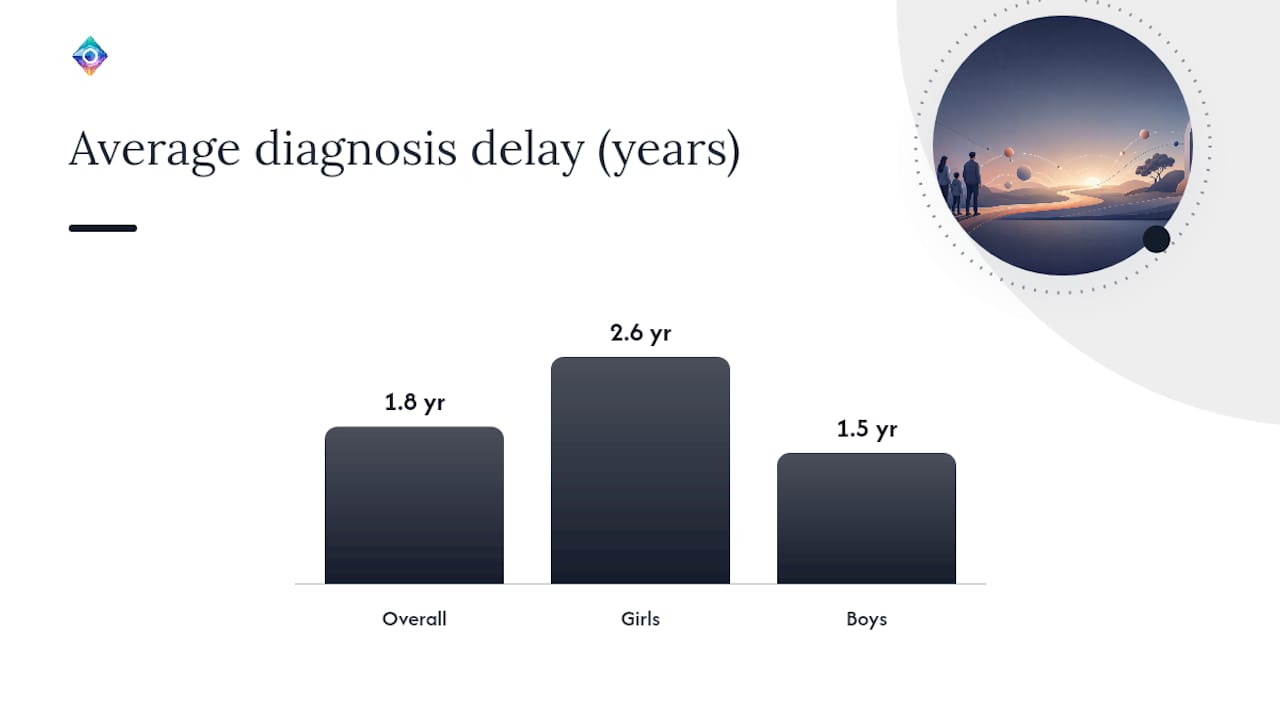
The scale of this delay is documented, not anecdotal. Children who received an ADHD diagnosis first went on to receive an autism diagnosis an average of 1.8 years later than children without a prior ADHD label, and the gap stretched even further for girls in some samples, averaging around 2.6 years compared to 1.5 years for boys.
That gap matters because it’s not just a paperwork delay. It’s roughly two years where intervention is aimed at the wrong target. Masking plays a documented role here too: clinical researchers studying the AuDHD overlap note that treating ADHD symptoms can sometimes make the underlying autism more visible, because a calmer child still struggles with the same social reciprocity and sensory demands that medication doesn’t touch. Girls carry a documented share of this recognition gap, which is worth reading about in more depth if autistic traits in women are part of your family’s story.
A Practical Path Forward: Screenings, Evaluations, and What to Ask
If your child has an ADHD diagnosis but something still feels unresolved, certain red flags should push you toward a second look, even if the ADHD diagnosis itself was accurate.
Watch specifically for: persistent difficulty with back-and-forth conversation despite medication, strong aversions to specific sounds or textures, a narrow set of intense interests that dominate free time, resistance to minor schedule changes that goes beyond typical frustration, and social struggles that don’t track with attention levels throughout the day.
Here’s a sequence that works well for building a case a clinician can actually act on:
- Start a running log. Note specific incidents at home, not just labels. Date, setting, what happened, how your child reacted.
- Collect teacher input in writing. Ask teachers for concrete classroom examples rather than a general checkbox form; specific anecdotes carry more diagnostic weight than a rating scale alone.
- Use structured parent questionnaires. Ask your pediatrician which validated screening tools they use for autism specifically, separate from ADHD rating scales.
- Request a multidisciplinary evaluation. This typically means more than one specialist weighing in rather than a single provider making the call alone.
- Ask directly about ADOS-2 or ADI-R. If your child’s presentation is ambiguous, these structured tools give the evaluation more rigor than an interview alone.
Different specialists bring different pieces to this puzzle. A developmental pediatrician typically coordinates the overall evaluation and rules out other medical contributors. A child psychologist or neuropsychologist runs standardized cognitive and behavioral testing, often including the ADOS-2. A speech-language pathologist (SLP) assesses pragmatic language and communication patterns that a general checklist won’t capture. An occupational therapist (OT) evaluates sensory processing and motor coordination, both of which factor heavily into an autism picture.
Pro Tip: In appointments, ask specifically: “Have you ruled out autism, or did we only screen for ADHD?” That single question forces a clinician to state explicitly what was and wasn’t assessed, which is easy to lose track of across multiple visits.
Bring your documentation to school meetings too. Requesting a school-based evaluation alongside a medical one gives you two independent data sources, which strengthens any case for additional support services. If you want a refresher on how ADHD itself is formally diagnosed, the DSM-5 criteria for ADHD are worth reviewing so you know exactly what’s being measured versus what still needs a closer look.
What Happens When Autism Stays Hidden Behind an ADHD Label
Treating only the ADHD side of the picture leaves real needs unaddressed. A child whose main struggle is sensory overload or social reciprocity won’t get relief from stimulant medication aimed at impulsivity and attention, no matter how well-dosed it is.
There’s also a medical dimension worth taking seriously:
- Co-occurring autism can change how a child responds to standard ADHD medications, sometimes with a higher rate of side effects or a less predictable response.
- Behavioral supports built around pure ADHD strategies (reward charts, timers, movement breaks) often don’t touch the sensory or social pieces an autistic child actually needs help with.
- Early, individualized intervention is consistently linked to better long-term outcomes than delayed diagnosis, which is exactly why the 1.8-year average gap discussed earlier carries real weight.
While you’re pursuing a formal re-evaluation, you don’t have to wait to act. Adjusting the environment (reducing sensory triggers, adding visual schedules, building in predictable routines) can help regardless of which label eventually sticks. Small accommodations now don’t require a diagnosis to justify them, and they rarely cause harm even if the picture turns out to be ADHD alone.
Using a Structured Self-Assessment to Prepare for a Clinical Evaluation
Before a formal evaluation, it helps to organize what you’re already noticing. Omniprism offers a self-assessment covering 14 domains, including autism, ADHD, sensory processing, and masking, with guided versions built specifically for children and teens. It generates a plain-language profile instantly, without tracking or lengthy questionnaires dragged out over weeks.
Families can use the results to put structure around scattered observations before a pediatrician visit, turning “he seems off somehow” into a concrete domain-by-domain summary. For appointments where more clinical detail helps, Omniprism’s optional Specialist Briefing report translates the results into a format built for sharing with a doctor or therapist.
It’s worth being direct about the limits here: this is a self-assessment, not a diagnosis. Autism and ADHD diagnoses require formal, multidisciplinary evaluation, ideally including tools like the ADOS-2, from qualified clinicians. Think of the assessment as a way to walk into that evaluation better prepared, not a replacement for it.
Why Careful Evaluation Is Worth the Extra Effort
Two years is a long time in a young child’s development. I think the biggest mistake parents make isn’t missing the signs. It’s assuming that because a diagnosis was given, the question is settled.
It isn’t. Diagnoses are working hypotheses, not verdicts. If your child’s ADHD treatment isn’t resolving the struggles you’re actually seeing at home and school, that’s information, not a failure of the treatment plan. The parents who get better outcomes tend to be the ones who keep documenting, keep asking specific questions, and aren’t afraid to request a second look even after a diagnosis is already on paper.
Being an effective advocate doesn’t require medical training. It requires specifics: dates, examples, patterns, and a willingness to ask “what wasn’t screened for?” out loud in an appointment. That question alone changes more outcomes than most parents realize.
— Valerio
Sources
For further reading, the Cleveland Clinic’s breakdown of ADHD versus autism, the CDC’s age-based autism red flags, and the peer-reviewed study on delayed autism recognition are all worth printing and bringing to a clinical visit or school meeting.
This article is general information, not a substitute for advice from a qualified doctor. Consult a qualified healthcare professional about your own circumstances before acting on anything here.
- ADHD vs. Autism: What’s the Difference? (Cleveland Clinic)
- Scientists are starting to understand how autism and ADHD can overlap | National Geographic