Up to 50% Coexist: How Adults Tell Autism vs Social Anxiety and Prepare

Social anxiety is driven by a fear of negative judgement, while autism involves persistent differences in social communication and sensory processing that are present from childhood. The two can also occur together, and when they do, childhood history and reports from people who know you well often become the deciding factor. The checklist below clearly lays out which features point where.
TL;DR:
- Social anxiety disorder involves a fear of negative judgment that can cause panic symptoms, avoidance, and rehearsal behaviors, often developing in adolescence.
- Autism in adults stems from differences in social information processing and sensory sensitivity, with traits present from childhood and often masked in social situations.
- Both conditions can overlap, but social anxiety tends to fluctuate with comfort levels, whereas autistic traits are often constant and linked to sensory or processing issues.
- Diagnostic overshadowing can lead clinicians to miss treatable social anxiety in autistic individuals, making separate assessment and history gathering essential.
- Self-assessments and detailed reports from trusted informants can help identify patterns and prepare for professional diagnosis and tailored treatment.
What is social anxiety disorder?
Social anxiety disorder centres on a marked, persistent fear of being judged, embarrassed or scrutinised in social or performance situations. The fear is out of proportion to the actual risk, and people with the condition usually recognise this, even if they cannot switch it off.
Common signs include:
- Blushing, trembling, sweating or a racing heart before or during social contact.
- Avoiding eye contact out of self-consciousness rather than disinterest.
- Rehearsing conversations in advance and replaying them afterwards, searching for mistakes.
- Avoiding specific situations, such as public speaking, eating in front of others or starting conversations.
- Physical panic symptoms, including nausea or a feeling of choking, in anticipated social contact.
Social anxiety disorder typically emerges in adolescence or early adulthood, often after a specific humiliating or stressful experience, though some people describe feeling this way for as long as they can remember. The social difficulty is situational: the same person can be relaxed and articulate with close friends and nearly silent with strangers, because the fear is tied to the possibility of judgement, not to the mechanics of social exchange itself.
Treatment is usually effective once the condition is correctly identified. Cognitive behavioural therapy, graded exposure and, in some cases, SSRIs are the standard approaches, and most people see meaningful improvement when the diagnosis is accurate from the start.
What is autism in adults?
Autism is a neurodevelopmental condition, not an anxiety disorder, and its social differences stem from how the brain processes social information rather than from fear of judgement. According to NHS guidance on signs of autism in adults, the core features cluster into a few domains:
- Social communication differences, such as finding small talk effortful, missing unspoken social rules or taking language literally.
- Restricted or repetitive patterns, including strong routines, intense focused interests and a need for predictability.
- Sensory differences, such as being overwhelmed by lights, sounds, textures or crowds, or seeking out specific sensory input.
- A social motivation that often exists but feels effortful or confusing to act on, rather than being absent.
A reliable autism diagnosis depends on evidence that these traits were present in childhood, usually gathered through developmental history and reports from parents, partners or old school records, since adults are not always able to recall or recognise their own early patterns. Masking, where a person consciously or unconsciously copies others’ social behaviour to blend in, is a major complicating factor, and the NHS notes that masking is especially common and well documented in autistic women and girls, who may appear sociable while feeling exhausted and overwhelmed underneath. Autistic adults also experience higher rates of co-occurring mental health difficulties, which is one reason adapted, trauma-aware assessment matters rather than a single symptom checklist.
Similarities and differences: a checklist
The overlap between the two conditions is real: both can involve avoiding social situations, appearing quiet in groups and dreading certain events. The underlying driver, however, tends to separate them clearly once you look closely.
- Reason for difficulty: social anxiety is driven by fear of negative evaluation; autism involves differences in processing social cues and sensory input, regardless of judgement.
- Eye contact: in social anxiety, avoidance is tied to self-consciousness and tends to fluctuate with comfort level; in autism, reduced eye contact is often constant and linked to sensory or processing load rather than fear.
- Social motivation: people with social anxiety usually want connection and feel frustrated by their own avoidance; autistic people often want connection too, but find the mechanics of reciprocal exchange, such as turn-taking or reading tone, genuinely harder to track.
- Avoidance pattern: social anxiety avoidance spikes around judgement risk, such as public speaking; autism-related avoidance often tracks sensory overload or unpredictability, such as noisy venues or last-minute plan changes.
- Crisis response: acute social anxiety tends to produce panic symptoms with a clear anxious narrative; according to Leicestershire Partnership NHS Trust, autistic distress can instead present as a shutdown or meltdown, which looks different from classic panic and is often misread by observers.
- Onset and history: social anxiety usually has a traceable onset in adolescence or later; autistic traits are present from early childhood, even if they were not named at the time.
Pro Tip: Write down three recent situations that felt hard, and for each one ask whether the discomfort came from “what will they think of me” or from “this was too loud, too unpredictable or too confusing to follow”. The pattern that repeats is your strongest clue.
Some people recognise both patterns in themselves, and that is a legitimate possibility rather than a sign of confusion: the two conditions frequently coexist, and the next section explains why that combination is so often missed.
Why autism and social anxiety get confused
Clinicians sometimes attribute every social difficulty in an autistic person to autism itself, a pattern known as diagnostic overshadowing. RCPSYCH report CR228 warns that this habit commonly causes clinicians to miss treatable co-occurring conditions, including social anxiety disorder, because the social withdrawal looks consistent with autism on the surface.
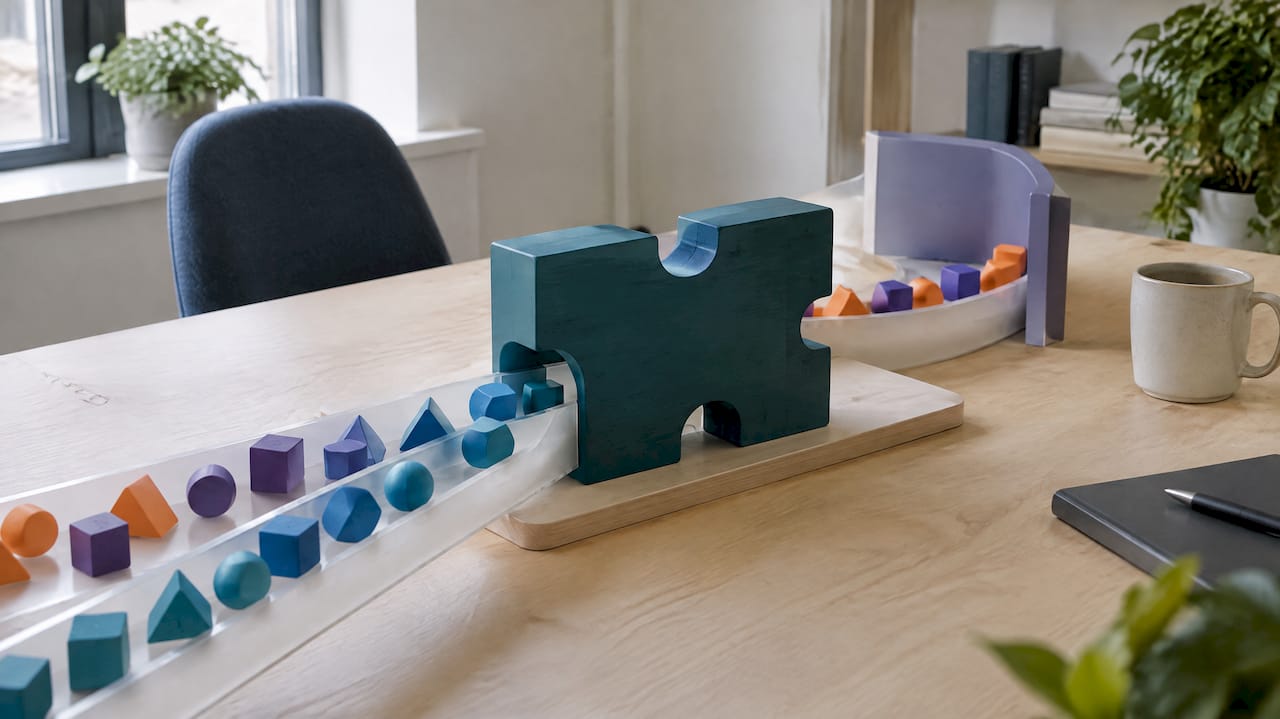
NICE guidance CG142 states plainly that anxiety symptoms are not an intrinsic part of autism and must be assessed and treated as a separate concern when present. This matters because the two conditions do co-occur at meaningful rates: a research summary from the Health Research Authority reports clinically significant social anxiety symptoms in up to about 50% of autistic samples in some cohorts, and peer-reviewed literature on autism and comorbidity documents substantial symptom overlap that complicates differential diagnosis.
Part of the difficulty is communication. RCPSYCH materials note that autistic people may describe distress as “not coping” or “overwhelmed” rather than “anxious”, which can hide a genuine anxiety disorder behind language that does not match clinical questionnaires. Related difficulties in identifying and naming internal emotional states, sometimes discussed under alexithymia and autism, add another layer: a person may be anxious without being able to label the feeling as such in the moment.
- Diagnostic overshadowing causes clinicians to stop investigating once autism is confirmed, missing a second, treatable condition.
- Autistic anxiety can present as shutdown, meltdown or physical exhaustion rather than the textbook worry and rumination of social anxiety.
- Clinicians should actively screen for anxiety even when autism is already diagnosed, rather than assuming one explains the other.
How to get a clearer assessment
A proper differential assessment usually follows a specific sequence, and knowing it in advance helps you prepare.
- Gather childhood evidence. Clinicians weigh developmental history heavily, so old school reports, baby books or memories from parents matter more than how you present today.
- Bring an informant if possible. A partner, parent or close friend who can describe your behaviour across different settings adds evidence that self-report alone cannot.
- List concrete trigger examples. Note specific situations, such as a particular noisy office or a work presentation, rather than general statements like “I find people hard”.
- Describe sensory responses separately from fear responses. Mention whether lights, sounds or textures cause distress independently of what others might think of you.
- Ask directly about adapted assessment tools. Standardised autism interviews and anxiety screens exist in adapted forms for people who mask well or describe emotions atypically.
- Request referral explicitly if needed. Ask for autism assessment services or adapted CBT for social anxiety by name, since generic mental health triage does not always route correctly on its own.
While waiting for an appointment, reducing sensory load (noise-cancelling headphones, predictable routines) and practising small, low-stakes social exposures can both help, without waiting for a formal label to start making life more manageable.
A structured self-assessment as a starting point
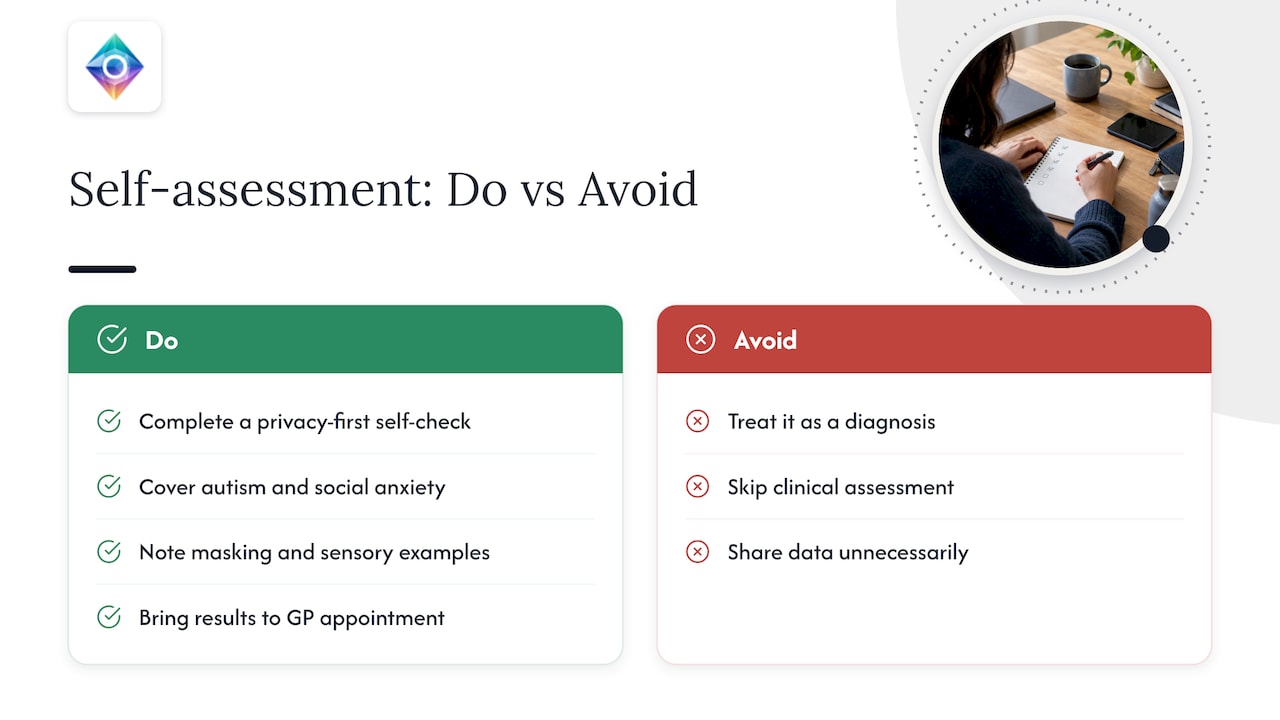
Before any clinical appointment, a free, privacy-first self-assessment can help organise what you have noticed about yourself. A digital tool can cover multiple domains, including autism, social anxiety traits, masking and sensory processing, and produce an instant plain-language profile with no account or data collection required.
This kind of structured profile is useful for spotting which patterns cluster together and for putting concrete examples into words before a GP visit, rather than trying to summarise years of experience on the spot. It is not a diagnosis, and it works best alongside, not instead of, a clinical assessment.
A personal note on getting it right
I was diagnosed with ADHD at 42, after decades of my own traits being read as something else entirely. I built Omniprism, in part, because I know what it feels like when the label attached to you doesn’t match what’s actually happening underneath, and how much relief comes from finally seeing clear, specific evidence instead of a vague impression.
— Valerio Cozzi
Getting clarity before your next appointment
If you recognise pieces of both descriptions in yourself, a free Omniprism self-assessment gives you a structured, plain-language profile across all 14 domains in minutes, with nothing to sign up for and nothing stored. For readers who want something to hand directly to a GP or therapist, the optional Specialist Briefing turns your results into a clinician-ready summary for a one-off 9.99 EUR. Parents wondering about a teenager’s social difficulties can also start with the children and young people’s assessment rather than guessing from the sidelines.
Sources
This article draws on NICE guidance CG142 on co-occurring disorders in autism, RCPSYCH report CR228 on diagnostic overshadowing, NHS guidance on autism signs in adults, an HRA research summary on comorbid social anxiety, Leicestershire Partnership NHS Trust guidance on autistic anxiety presentation, and a peer-reviewed review on autism and comorbidities. For parents comparing developmental presentations further, Edhed Learning’s guide to autism and ADHD in children offers additional context.
This article is general information, not a substitute for advice from a qualified doctor. Consult a qualified healthcare professional about your own circumstances before acting on anything here.
- NICE guidance CG142 — recommendations
- RCPSYCH report CR228: The psychiatric management of autism in adults
- NHS — Signs of autism in adults
- HRA research summary — social anxiety in autism-spectrum disorders
- Understanding anxiety in autistic people — Leicestershire Partnership NHS Trust
- Relevant peer-reviewed article on autism and comorbidities (NCBI PMC)
FAQ
Can autism be mistaken for social anxiety?
Yes. Autistic social withdrawal and avoidance can look similar to social anxiety on the surface, and clinicians sometimes miss the real driver without a careful developmental history. The reverse also happens, since masking can make autistic traits look like learned social caution rather than a different way of processing social information.
How do I tell if I have social anxiety or autism?
Look at what drives your discomfort: fear of being judged points to social anxiety, while difficulty reading cues, needing routine or sensory overload points to autism. Many people find a structured self-assessment a useful starting point before raising it with a clinician, since it helps organise examples rather than relying on memory alone.
Am I autistic or just socially awkward?
Social awkwardness on its own, without childhood-onset patterns in communication, routines or sensory processing, does not meet the threshold for an autism diagnosis. A reliable answer depends on evidence from childhood and from people who know you well, not from how you feel in a single conversation.
Do I have anxiety or am I just autistic?
Both are possible at once, and according to NICE guidance, anxiety should always be assessed and treated as a separate condition rather than dismissed as “just autism”. If your distress includes a strong fear of judgement on top of sensory or communication differences, raise both possibilities with whoever assesses you.
Can social anxiety and autism occur together?
Yes, and research summarised by the Health Research Authority reports clinically significant social anxiety symptoms in up to about 50% of autistic people in some cohorts studied. When both are present, treatment usually needs adapting, such as CBT that accounts for sensory sensitivities and communication differences rather than a standard anxiety protocol alone.
Recommended
- Autism vs. ADHD: Comparing Symptoms, Overlap, and Diagnosis
- Autistic Burnout vs Depression: How to Tell the Difference
- Autistic Traits in Women: Signs Often Missed or Masked
- Alexithymia and autism: why the two get confused so often
Written and edited by Valerio Cozzi, founder of Omniprism. Omniprism began after my own ADHD diagnosis at 42.
This article is educational. It is not medical advice, not a diagnosis, and not a substitute for assessment by a qualified clinician. The Omniprism self-assessment is free, needs no account and no email address, and runs entirely in your browser — your answers are never sent to a server. The optional Specialist Briefing report is a paid add-on.