How to Prepare for an Autism Assessment: A UK Guide
You prepare for an autism assessment by writing down the signs and difficulties you have noticed, collecting old records such as school reports, and choosing someone who knew you in childhood to act as an informant. Then ask the provider what their process involves, because assessments differ and the team carrying yours out is best placed to explain it. This guide covers adults first, then children, with the questions you are likely to be asked.
Key Takeaways
- Bring a written list of concrete examples from childhood, school, work and home, not general impressions.
- Gather existing reports and letters: school, paediatric, speech and language, occupational therapy, psychology or CAMHS.
- Pick an informant who knows your early development, and let them know they do not need every answer.
- Ask the provider about adjustments, forms to complete in advance and whether a supporter can attend.
- A self-assessment profile can organise your thoughts, but it is not a diagnosis.
How do I prepare for an autism assessment? Six steps
- Write down what you have noticed. Make a list of signs or difficulties, and for each one add a specific example. Concrete examples from different settings give the assessor more to work with than a summary such as “I find socialising hard”.
- Collect your records. The National Autistic Society suggests bringing information about childhood development and behaviour, existing health conditions, diagnoses and previous assessments, including childhood school reports.
- Choose your informant. Pick a parent, partner, sibling or long-term friend (details below) and tell them early.
- Ask the provider how it works. Find out the format, how long it takes, whether you can bring a supporter, and whether any forms or questionnaires must be completed beforehand.
- Request adjustments. Quiet rooms, breaks, written questions in advance or a familiar supporter are all reasonable things to ask for (see the adjustments section).
- Practise talking through your examples. Say a few aloud or write them as short notes, so that on the day you are not searching for words under pressure.
Pro Tip: Group your examples under headings such as childhood, school, friendships, work, sensory experiences and routines. The assessor’s questions tend to follow the same areas, so your notes will map onto them.
What documents should I bring to an autism assessment?
The most useful papers are reports or letters that summarise earlier diagnoses or assessments. The National Autistic Society lists school, paediatric, speech and language, occupational therapy, psychology and CAMHS reports as examples.
If you do not have any of these, that is common, particularly for adults who were never referred as children. Old school reports with teacher comments, a red book or health visitor notes from a parent’s loft, photographs, and family videos can all fill in the early picture. Write down anything your relatives remember, such as when you started speaking, how you played, or how you reacted to noise, food textures or changes of routine.
If you have previously had a diagnosis of anxiety, depression, ADHD or another condition, bring the letter. Conditions often overlap, and the assessor needs the full history to separate them. Our piece on how adults tell autism from social anxiety shows how one adult can sort examples into the right pile before an appointment.
What questions are asked in an adult autism assessment?
Expect questions about your early development and milestones, school experiences, social communication, repetitive behaviours, sensory differences, and how you manage daily tasks, work and stress. This is the pattern one UK provider describes, and it matches the areas covered by most services.
The National Autistic Society explains that the assessment looks at your experiences, strengths, challenges and needs, to decide whether you are autistic and what support would help. So the questions are not a test with right answers. Typical prompts include:
- What were you like as a young child, and how did you play?
- How did you get on with classmates, and did you have close friends?
- How do you cope with changes of plan or unexpected events?
- Are there sounds, lights, textures or crowds that you find hard?
- What does a difficult day at work or at home look like?
- Do you have interests that absorb you for long periods?
Answer with examples and say when you are unsure. If you have spent years hiding your difficulties, say so. We cover that in more detail in why masking hides adult autism signs, including how the NHS route works.
Who can be my informant, and what should they prepare?
An informant gives the assessor an outside view of your early years and your daily life. A parent or primary childhood carer is recommended where possible, and a family member, long-time friend or partner may also help, depending on what they know about your early development and how you function now.
They should expect to complete questionnaires and may be interviewed about your childhood, developmental history and current social or day-to-day presentation. Informants do not need to have all the answers: they can say when they are unsure, and photos, videos or old reports can jog their memory.
Give your informant notice, explain what the assessor will ask, and let them read your list of examples if you are comfortable with that. A conversation about childhood often brings out details you had forgotten.
What adjustments can I ask for during the assessment?
You can ask for reasonable adjustments. Quiet environments, breaks, written questions in advance, or a familiar supporter are the usual examples, and a good team will agree to them without fuss.
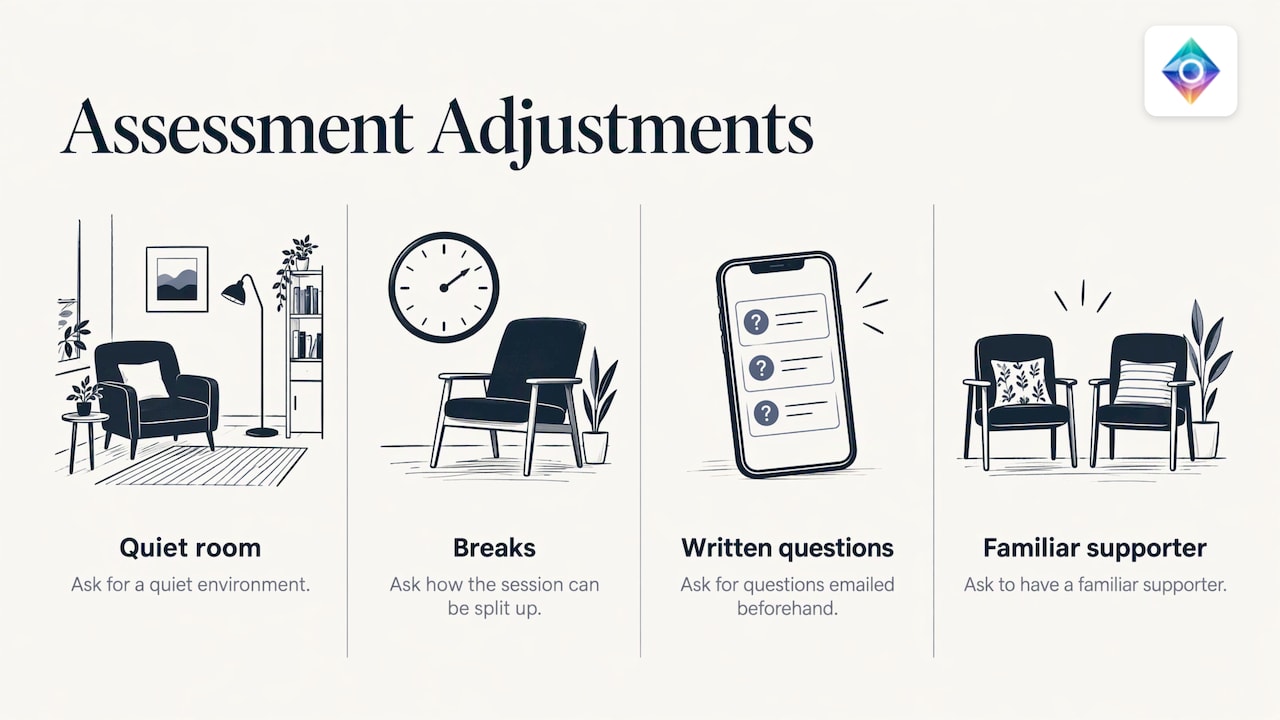
It helps to raise your needs when you book, not on the day. If you are sensitive to light or noise, say so, and ask whether the appointment is in person or online. If speaking for a long stretch is tiring, ask how the session is split up. Keep your requests short and specific: “I would like the questions emailed beforehand and a ten-minute break halfway” is easy for a clinic to act on.
If you are a parent, the same applies to your child. Our guide to the sensory processing checklist for UK children helps you describe what overwhelms them so that the team can set up the room accordingly.
How do I prepare my child for an autism assessment?
For children, the assessment may include gathering developmental history from parents or carers and direct observation of the child, sometimes in different settings. Your job is to supply an accurate history and to make the day as calm as possible.
Before the appointment:
- Write a timeline: first words, first steps, play, friendships, changes at school.
- Note examples from home and from school, because the picture often differs between the two.
- Ask the school for a short summary from the teacher or SENCo. Our page on school autism adjustments explains what schools can put in place.
- Collect any speech and language, occupational therapy or paediatric letters. If you are unsure whether early speech differences matter, this guide to recognising speech delays in children lists what parents commonly notice.
- Tell your child, in plain words that suit their age, that they will meet someone who wants to understand how they think and what helps them. Avoid framing it as a test.
- Bring snacks, a comfort item and something to do between activities.
If your child is a preschooler, clinician-ready notes on ADHD symptoms in preschoolers show how to record observations in a form a professional can use, and the same habit works for autism.
What does NICE say about autism assessment?
In England, the NICE guideline on autism spectrum disorder in adults sets out recommendations on identifying, assessing and meeting the needs of autistic adults. It is the reference NHS services work from, and you can read it to see what a thorough assessment should cover. Scotland, Wales and Northern Ireland have their own pathways, so check with your GP about local arrangements.
If you pay for a private assessment, the same standard applies. Ask the provider which guidance it follows and who will carry out the assessment, so you know what to expect.
Perspective: why preparation matters
I was diagnosed with ADHD at 42, and that experience is why I built Omniprism. Looking back on your life to answer a clinician’s questions is easier when you have already put your experiences into words.
We built our self-assessment to give you an instant profile across 14 areas, in plain language, with no email, account or data collection. For many people, seeing traits laid out across areas such as autism, ADHD, masking, sensory processing and dyslexia gives them a starting vocabulary for the appointment. It also shows which areas are worth raising first.
A self-assessment is not a diagnosis, and we say so. What it does is turn “something feels different” into organised notes you can bring to a clinician. Our optional Specialist Briefing is designed to summarise your results in a format that is easy for healthcare professionals to read, so the conversation can start from your own words.
Valerio Cozzi
Can Omniprism help me get ready?
Yes. Our self-assessment is free, takes you through 14 areas, and gives you plain-language results immediately, with nothing to sign up for. If you want something to hand a clinician, the Specialist Briefing is a one-off €20 report that summarises those results.
Parents can use our guided assessments for children and teens, including the Children’s Assessment for ages 7 to 10 and the Young Person’s Assessment for ages 11 to 13. The Youth Briefing is also €20 one-off. To understand where a quiz ends and a diagnosis begins, read self-assessment versus diagnosis.
What happens on the day and afterwards?
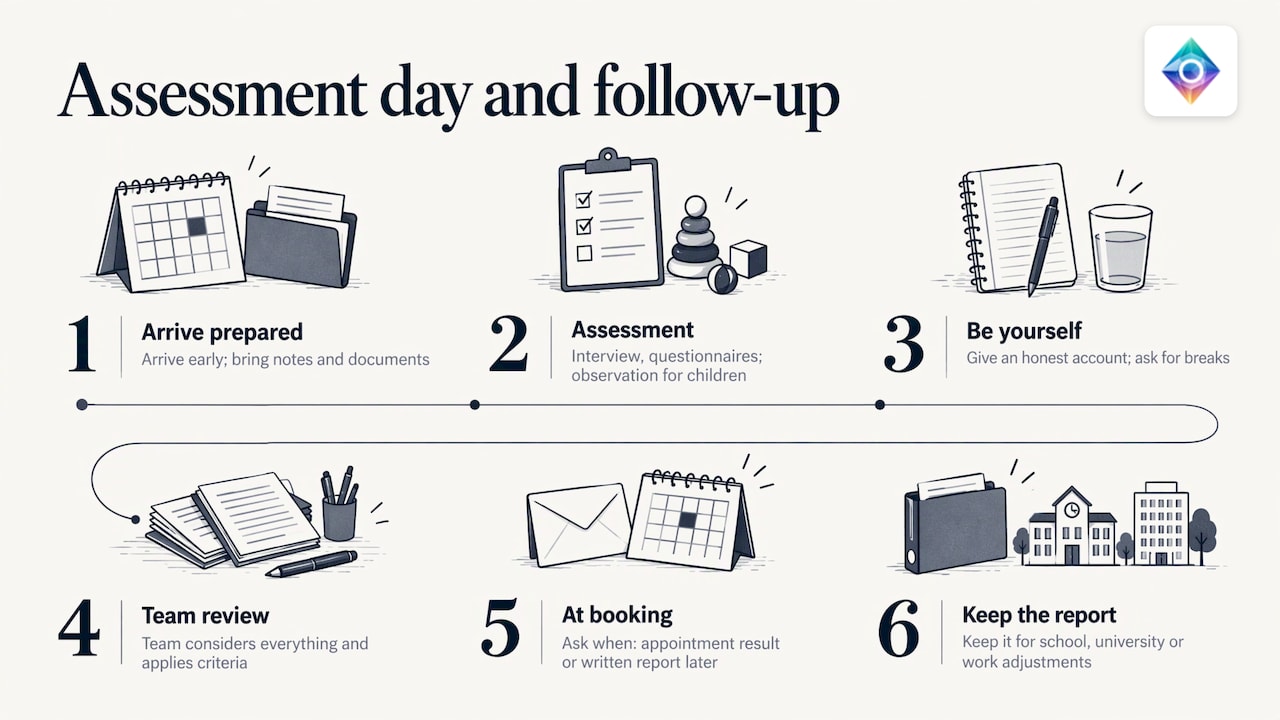
On the day, expect a mix of interview, questionnaires and, for children, observation. Arrive early, bring your notes and documents, and ask for a break if you need one. Nobody expects a polished performance; the assessor wants your honest account.
Afterwards, the team considers everything and decides whether you meet the criteria for autism, then discusses the support you might need. Some services give the outcome at the end of the appointment, others send a written report later. Ask at booking how and when you will hear. If the outcome is that you are not autistic, ask what else the team thinks may explain your difficulties, since traits can overlap with ADHD, anxiety and other conditions. Our article on autism misdiagnosed as ADHD explains why that overlap matters for parents.
If you have a diagnosis of any kind, keep the report safe. Employers, universities and schools often ask for it when you request adjustments.
FAQ
How long should I spend preparing for an autism assessment?
A few weeks is enough for most people, mostly to gather documents and talk to your informant. Spend the first week listing examples, the second gathering reports, and the last confirming logistics with the provider. Start earlier if you need to request old school or medical records.
Do I need an informant for an adult autism assessment?
Many services ask for one, because a parent or primary childhood carer is recommended where possible. If no parent is available, a sibling, partner or long-term friend may help. Ask your provider what they accept if your situation is unusual.
Can I bring someone with me to the assessment?
Often yes, but policies vary, so ask when you book. Having a familiar supporter present is one of the standard adjustments teams can offer. Tell the provider whether you want them in the room throughout or only for part of it.
What if I do not have school reports or childhood records?
You can still be assessed. Use what you do have: your informant’s memories, photos, videos, and your own examples from different settings. Tell the assessor which records are missing so they know where the gaps are.
Is an online self-assessment enough to get diagnosed?
No. A self-assessment helps you understand your traits and organise your thoughts, but a diagnosis comes from a qualified clinical team. Bringing your profile to that team can make the conversation more focused.
Sources
- NICE: Autism spectrum disorder in adults, diagnosis and management (CG142)
- National Autistic Society: What happens during an autism assessment
- National Autistic Society: Preparing for your autism assessment, adults
- Sycamore Trust: Questions to ask at your adult autism and ADHD assessment
- ProblemShared: Understanding informants for autism and ADHD assessments
- Clinical Partners: Your informant and your assessment
- Xyla Health: What questions are asked in an adult autism assessment
- Vianova: Preparing for an autism assessment
- Cleveland Clinic: What to expect at an autism screening
Recommended
- Masking Hides Adult Autism Signs: UK NHS Steps to Assess
- Sensory Processing Checklist for UK Children: Prepare for NHS Meetings
- Parents & Teachers: Legal School Autism Adjustments That Work
- Unmasking Autism Safely for Adults & Allies NHS Steps, 14 Domain Check
Written and edited by Valerio Cozzi, founder of Omniprism. Omniprism began after my own ADHD diagnosis at 42.
This article is educational. It is not medical advice, not a diagnosis, and not a substitute for assessment by a qualified clinician. The Omniprism self-assessment is free, needs no account and no email address, and runs entirely in your browser — your answers are never sent to a server. The optional Specialist Briefing report is a paid add-on.