Neurodivergence Self-Assessment Guide: What It Can and Can't Tell You
A neurodivergence self-assessment is a structured way to notice and name traits such as ADHD, autistic or dyslexic patterns in yourself or your child. It can point towards a conversation with a professional, but it cannot diagnose anything. This guide covers how to do one well, how far to trust the result and what to do next in the UK.
Key takeaways
- A self-assessment is a screening and reflection exercise. No screening tool is 100% accurate, and the result tells you whether further assessment may be worth seeking.
- Self-identification is a recognised route to understanding yourself, but UK clinical guidelines do not formally recognise it as a diagnosis.
- Write down specific examples from daily life. They are worth more to a clinician than a score.
- In the UK, autism assessment referrals usually come through a GP or another healthcare professional.
- Overlapping traits are common, so read results as patterns to explore rather than labels.
What is neurodivergence?
Neurodivergence describes neurocognitive functioning that differs from the neurological majority. The APA Dictionary of Psychology lists autism spectrum disorder, ADHD, dyslexia and dyspraxia among the common examples, and notes that the term is not limited to formal diagnoses.
Neurodiversity is the wider fact that human brains differ. The National Autistic Society describes it as a biological fact, which is why most self-assessment guidance avoids framing differences as faults.
A clinical definition exists alongside this one. Scotland’s National Autism Implementation Team defines neurodevelopmental disorders as conditions in which neurocognitive function lies at an extreme for a given age, with significant functional impairment. That distinction explains why you can recognise neurodivergent traits in yourself without meeting the threshold for a diagnosis.
How do I self-assess neurodivergence?
The steps below work for an adult and, with changes, for a parent assessing a child.
- Collect your reasons. Note what made you ask the question: a comment from a colleague, a child’s school report, years of exhaustion at work. Self-identification often follows extensive searching, reading and reflection, so your list is part of the process.
- Pick a structured tool. Choose one that covers more than one condition, because traits overlap. Omniprism’s free self-assessment covers 14 domains and returns a plain-language profile instantly, with no email, account or data collection.
- Answer for your typical self. Think about how you function across ordinary weeks rather than your best or worst day. For a child, answer for the last six months, and ask a second adult who sees them in a different setting, such as a teacher.
- Read the profile by domain. Look at which areas stand out and which sit together, rather than hunting for a single verdict.
- Add examples. For each standout area, write one or two real situations: missed deadlines, sensory overload in shops, years of rereading the same paragraph.
- Decide on next steps. Use the later sections of this guide to choose between self-understanding, workplace or school adjustments and a request for professional assessment.
What traits can a self-assessment cover?
Autism and ADHD traits can include differences in social communication, sensory processing, executive functioning, repetitive behaviours and interests, attention, activity and impulsivity, according to Nottinghamshire Healthcare NHS Foundation Trust.
A broad tool goes further than those two conditions. Omniprism’s 14 domains include ADHD, autism, dyslexia, masking, dyspraxia, dyscalculia, sensory processing, high sensitivity, OCD traits and synesthesia. Looking across all of them helps because many people recognise themselves in more than one area.
Masking deserves its own mention. Adults who have spent years hiding difficulties can score lower on obvious items while feeling drained. Our article on how masking hides adult autism signs explains the NHS steps for assessment in that situation.
Strengths belong in the picture too. A profile that lists only difficulties is half a profile, and you can see how we approach this in our piece on mapping neurodivergent strengths.
How accurate are online neurodivergence tests?
Online tests are screening tools, so they are designed to flag possibilities rather than confirm them. Nottinghamshire Healthcare NHS Foundation Trust says tools such as the AQ-10, ASRS and BFIS act as indicators of whether further professional assessment is warranted, and that no tool is fully accurate.
There are two main reasons for caution:
- Self-report has limits. Cleveland Clinic clinicians point out that self-reporting is unreliable and that providers draw on several sources of information rather than one test result.
- No single instrument decides a diagnosis. The National Autistic Society states that a diagnosis should be informed by multiple sources and clinical judgment.
A diagnosis itself rests on defined criteria. According to NICE guidelines as summarised by the National Autistic Society, an autism diagnosis should be based on DSM-5 or ICD-11 criteria. A self-assessment does not apply those criteria, so treat it as preparation for that stage.
We go further into this in why quizzes are not diagnoses.
What do my results mean?
Read them cautiously. The Nottinghamshire trust advises that difficulties resembling autism or ADHD may have other causes, and that co-occurring conditions can have overlapping symptoms. Anxiety, sleep problems, trauma and depression can all produce attention or sensory difficulties.
Three questions help you interpret a profile:
- Is it lifelong? Neurodevelopmental traits usually show up in childhood, even if nobody noticed them then.
- Does it appear in more than one setting? Difficulties at home, work and in friendships carry more weight than one stressful context.
- Does it cost you something? Impact on daily life is what separates a trait from a difficulty that needs support.
Overlap between conditions is also worth understanding before you decide anything. Our article on autism and ADHD overlap covers why a high score in both areas is common. Parents who suspect a child’s ADHD might be something else can read about autism misdiagnosed as ADHD.
What should I do after a self-assessment?
Your options depend on what you want from the result.
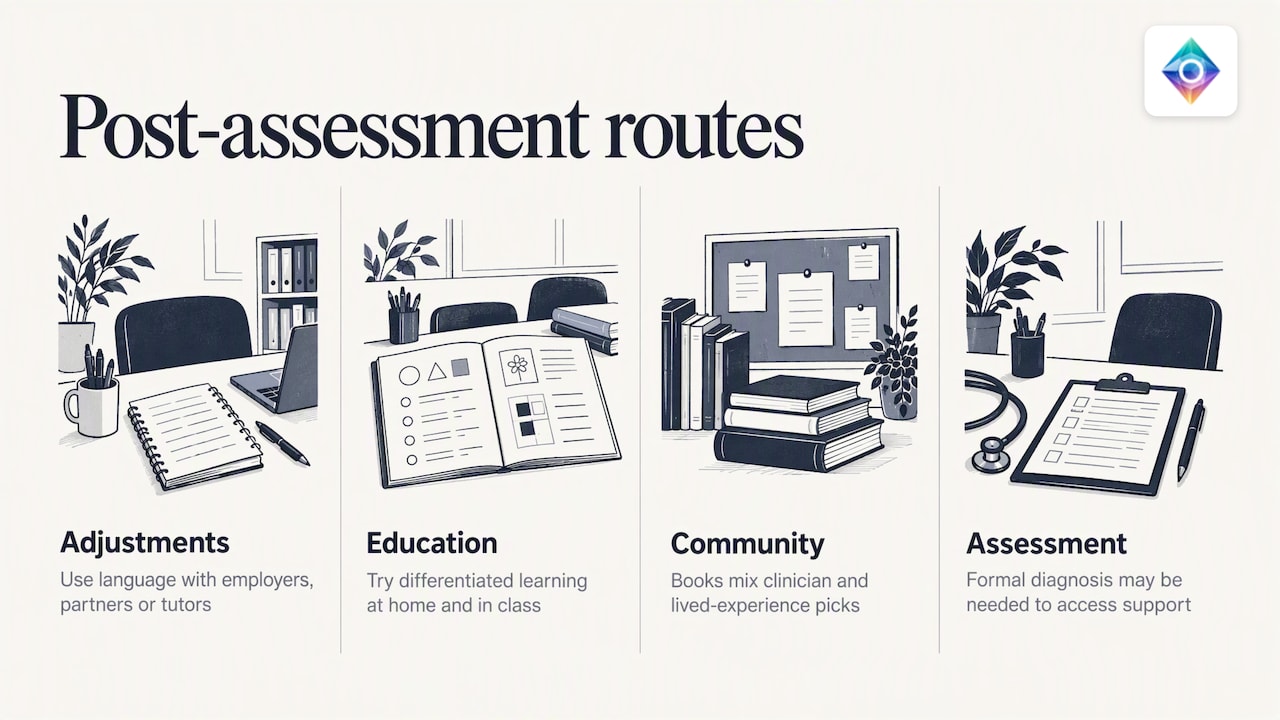
Self-understanding and adjustments. The Neurodivergence Identification and Diagnosis guide from NAIT suggests self-identification is most relevant for adults seeking information and adjustments rather than medical treatment. Many people stop here, and use the language to explain themselves to employers, partners or tutors.
Support in education. If the result concerns a child or student, ideas such as differentiated learning at home and in class show what adjustments can look like in practice, before any formal diagnosis.
Reading and community. Many adults find that lived-experience accounts help them make sense of a profile. This list of books about ADHD mixes clinician and lived-experience picks.
Professional assessment. If your traits affect work, education, relationships or wellbeing, or you need a formal diagnosis to access support, ask for an assessment. For ADHD in particular, see our guide to when to seek an ADHD diagnosis in the UK.
How do I prepare for a GP appointment?
In the UK, autism assessment referrals are usually made by a GP or another healthcare professional. Some education professionals can refer, and very few services accept self-referral.
The National Autistic Society suggests taking a partner or friend, notes or a list of the signs you have noticed, and questions for your GP. Your self-assessment profile and your written examples fit naturally into that list.
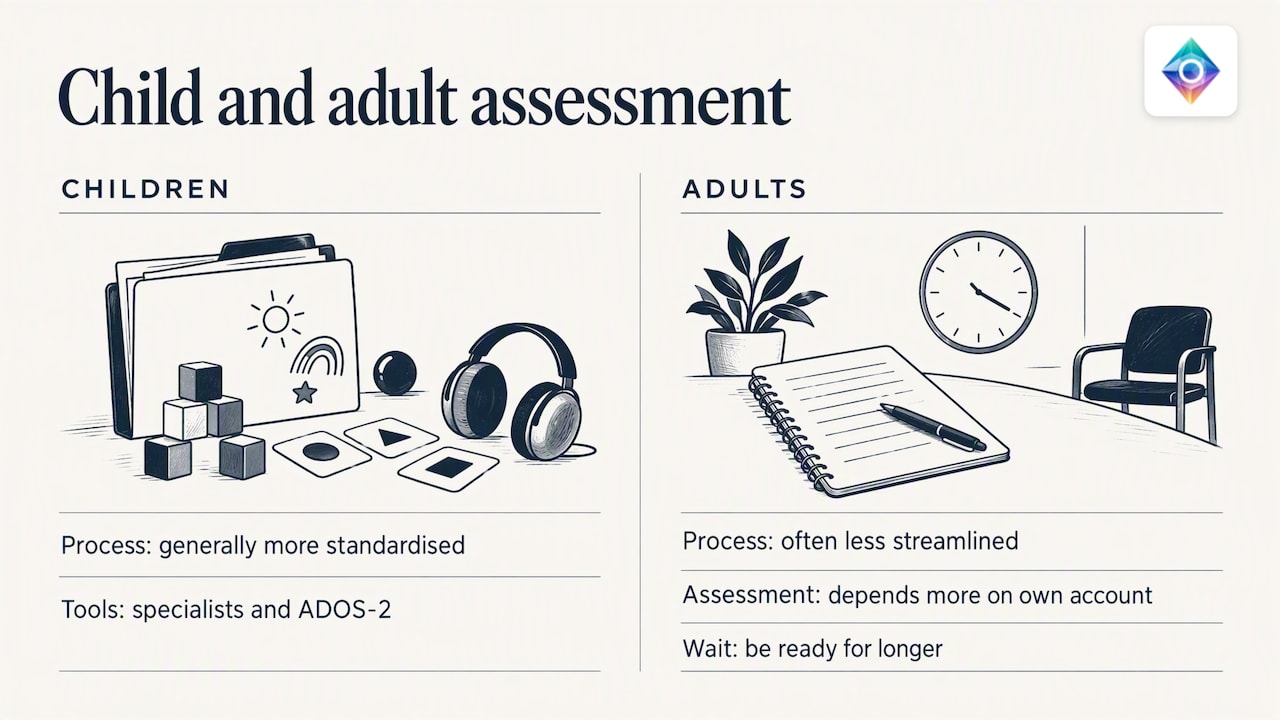
Expect the process to differ by age. Cleveland Clinic notes that children’s diagnosis is generally more standardised, using specialists and tools such as the ADOS-2, while adult assessment is often less streamlined. Adults should be ready for a longer wait and a process that depends more on their own account.
Pro Tip: Bring one page, not ten. Name the three areas that affect your life most, give two dated examples for each and say what you are asking for: an assessment, a referral or workplace adjustments.
Our copyable one-page report examples for GP appointments show how that page can look.
Why did we build Omniprism this way?
I am Valerio Cozzi, the founder of Omniprism, and I was diagnosed with ADHD at 42. That is the only part of my story I will tell here, because it explains why I care that people can understand their own patterns without waiting for a diagnosis to start.
Our view as a team is simple. Self-assessment is useful when it stays honest about what it is. That is why Omniprism asks for no email or account and collects no data: a person exploring something this personal should not have to hand over an identity first. It is also why the results arrive in plain language, across 14 domains, instead of a single yes or no.
We also think a profile should serve the next conversation. Clinicians work with limited appointment time, so a short, structured summary helps them see what you are describing. Families need the same clarity, which is why we include guided assessments for children and teens. Whatever the result, the aim is a better-informed discussion with a healthcare professional, never a replacement for one.
— Valerio Cozzi
Can Omniprism help me get started?
The Omniprism self-assessment is free and returns your profile immediately, with no account. Parents can use the guided versions for children aged 7 to 10 and young people aged 11 to 13, and you can see everything for families on our children and young people page.
If you decide to see a clinician, the optional Specialist Briefing turns your results into a summary written for healthcare professionals. It costs €9.99 as a one-off payment. Psychologists, coaches and companies can see how we work with them on our page for professionals. Please also read our disclaimer before you start.
Frequently asked questions
Can I diagnose myself as neurodivergent?
You can identify yourself as neurodivergent, but you cannot give yourself a clinical diagnosis. UK guidelines from NICE and SIGN do not formally recognise self-identification, though they acknowledge it where people face barriers to diagnosis. Many adults find it valuable for understanding themselves and asking for adjustments.
Is a free online neurodivergence test reliable?
Treat it as a prompt rather than a verdict. Screening tools indicate whether further assessment might be warranted, and none is fully accurate. A tool that covers several domains and gives you plain-language detail is more useful than one that returns a single score.
Should I do a self-assessment for my child?
A guided assessment can help you organise what you see at home before you speak to a GP, school SENCO or paediatric service. Ask another adult who knows your child to give their view too. The diagnostic process for children is more standardised, so your notes support it rather than replace it.
Do I need a diagnosis to ask for support?
Not always. Self-identification can be relevant for adults seeking information and adjustments, and some workplaces and colleges respond to a described need. A formal diagnosis is usually required for medical treatment and for some services.
Sources
- APA Dictionary of Psychology: neurodivergent
- Neurodevelopmental disorders and neurodiversity: definition of terms from Scotland’s National Autism Implementation Team (British Journal of Psychiatry)
- NAIT: Identification and diagnosis for neurodivergent people (2025)
- Nottinghamshire Healthcare NHS Foundation Trust: How to screen for neurodiversity
- National Autistic Society: Autism and neurodiversity
- National Autistic Society: Criteria and tools used in an autism assessment
- National Autistic Society: How to request an autism assessment
- Cleveland Clinic: Am I autistic? Don’t diagnose with a quiz
- Differentiated learning in both classroom and at home
- Books about ADHD: clinician and lived experience picks
Recommended
- Self Assessment vs Diagnosis: ADHD and Autism Quizzes Aren’t Diagnoses
- Copyable One Page Neurodiversity Report Examples for GP Appointments
- Map Neurodivergent Strengths in 14 Domains Without a Diagnosis
- Turn an Online ADHD Test Covering 14 Domains Into Clinician Ready Evidence
Written and edited by Valerio Cozzi, founder of Omniprism. Omniprism began after my own ADHD diagnosis at 42.
This article is educational. It is not medical advice, not a diagnosis, and not a substitute for assessment by a qualified clinician. The Omniprism self-assessment is free, needs no account and no email address, and runs entirely in your browser — your answers are never sent to a server. The optional Specialist Briefing report is a paid add-on.