50–70% Overlap in Autism and ADHD: What Families and Clinicians Need

Autism and ADHD overlap far more than most people expect, and when both are present, they interact rather than simply add up. The two remain distinct diagnoses with different core mechanisms, but shared traits in attention, sensory processing, and emotional regulation mean a careful evaluation matters more than a quick label. This article walks through the actual numbers, where the conditions blur together, how clinicians tell them apart, and what to do next.
TL;DR:
- About 50 to 70 percent of autistic individuals display significant ADHD traits, but diagnostic overlap varies due to assessment methods and gender biases.
- Overlapping traits primarily involve executive function challenges, attention regulation, sensory processing behaviors, and social functioning differences.
- Accurate co-diagnosis requires comprehensive evaluations, multi-informant reports, and consideration of masking, especially in females and adults.
- Treatment plans must be calibrated carefully, often starting with low medication doses and incorporating flexible support strategies for attention, sensory needs, and emotional regulation.
- Recognizing the dual nature of symptoms helps prevent misinterpretation in school and work environments, supporting better accommodations and long-term outcomes.
Table of Contents
- How Common Is the Autism and ADHD Overlap?
- Where Autism and ADHD Traits Actually Overlap
- Getting an Accurate Diagnosis When Autism and ADHD Overlap
- Treatment Changes When Both Conditions Are Present
- Living With AuDHD: The Walking Contradiction
- What the Latest Research Actually Shows
- How a Structured Self-Assessment Supports Better Conversations
- School, Work, and the Long Reach of Overlap
- Supporting Families Through the Overlap
- What Long-Term Outcomes Actually Look Like
- Diagnosis Looks Different at Every Age
- A Note on Function Over Labels
- Preparing for a Clinical Evaluation? Start With Structure
- Sources
How Common Is the Autism and ADHD Overlap?
The numbers surprise a lot of parents who assumed autism and ADHD were separate lanes. Research cited in a PMC review of co-occurrence data puts the figure between 50% and 70% of autistic people showing significant ADHD traits. Among people diagnosed with ADHD, autistic traits show up less often in formal dual diagnoses, largely because clinicians historically weren’t looking for them or didn’t have permission to name both.
That gap between “shows traits” and “gets diagnosed” is the whole story of why estimates swing so widely across studies.
Statistic to know: Estimates in the reviewed literature place autism-ADHD co-occurrence in a broad range, commonly cited around 50 to 70 percent for ADHD traits among autistic people, according to the PMC review.
A few methodological factors drive the variation between studies:
- Self-report versus clinical diagnosis. Surveys that ask people to rate their own traits tend to produce higher overlap numbers than studies relying on formal diagnostic records.
- Sample age. Adult samples often show different patterns than childhood samples, partly because adults have had more time to develop compensatory strategies that mask traits.
- Diagnostic rule changes. The DSM-5 lifted the old prohibition on diagnosing autism and ADHD in the same person, so older studies systematically undercounted co-occurrence.
- Underrecognition in females. Autistic girls and women, and women with ADHD, are diagnosed later and less often, which skews population estimates downward for both conditions individually and for their overlap.
For families, the practical takeaway is straightforward: a “clean” diagnosis of just one condition doesn’t rule out meaningful traits of the other. If a clinician diagnosed ADHD five years ago and something about social communication or sensory reactivity still doesn’t fit, that’s worth raising again, not dismissing as unrelated.
Where Autism and ADHD Traits Actually Overlap
The overlap isn’t random. It clusters in specific cognitive and behavioral domains, and understanding which ones helps you separate what’s shared from what’s condition-specific.
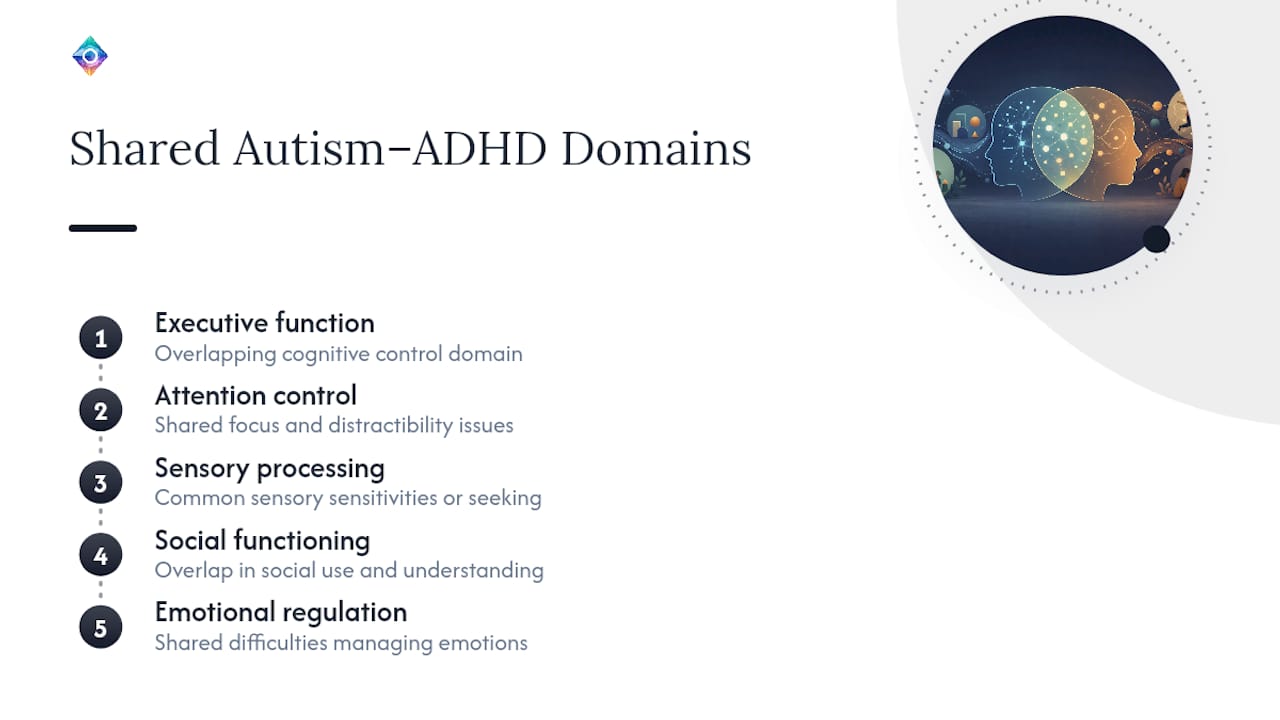
Executive function
ADHD is classically tied to weak sustained attention and poor response inhibition, the ability to stop yourself from blurting something out or abandoning a task midway. Autism more often shows up as rigid cognitive flexibility, difficulty shifting between tasks or tolerating a change in plan. When both are present, the combination tends to compound rather than cancel out: a child might struggle to start a task (ADHD-driven) and then, once started, struggle to stop or transition away from it (autism-driven). Parents often describe this as “he can’t get going, and then he can’t stop.”
Attention control as a shared thread
Large-sample research adds an important nuance here. A multi-method study of autism and ADHD traits in adults, using network analysis across samples of more than 5,000 people, found that autism traits and ADHD traits each cluster tightly within their own condition, supporting the idea that they’re genuinely separable. But attention-control traits bridged the two networks, acting almost like a connector between them. That points to attention regulation as a transdiagnostic process, something that cuts across diagnostic boundaries rather than belonging cleanly to one condition. Cognitive testing in the same research showed this bridging effect held up even when self-report bias was accounted for, though the researchers noted that lab-based attention tasks don’t always predict real-world attention struggles well.
Sensory processing
Sensory sensitivity and overload show up in both conditions, but the behavioral response often diverges. Autistic sensory differences frequently involve avoiding input, covering ears, refusing certain textures, withdrawing from bright or loud environments. ADHD-linked sensory issues more often involve seeking input, fidgeting, craving movement, needing background noise to concentrate. A person with both can look contradictory: seeking stimulation in one moment and fleeing it in the next, depending on the specific sense and context involved.

Social functioning
This is where the overlap gets clinically tricky. Autism affects social communication at the level of social motivation and pragmatic language, reading unspoken rules, matching tone to context, intuiting what a listener already knows. ADHD affects social functioning differently: impulsive interruptions, missing social cues because attention wandered, talking over others without intending disrespect. Combined, these present as a young person who wants connection but consistently misreads timing, tone, and turn-taking, which often gets mislabeled as simple rudeness or disinterest.
Emotional regulation and rejection sensitivity
Both conditions carry elevated rates of emotional dysregulation, and both frequently come with heightened rejection sensitivity, a tendency to feel intense hurt or anger in response to perceived criticism or exclusion. Autistica’s guidance on ADHD and autism notes this shared pattern shows up often enough in lived-experience accounts that it’s become a recognized part of how people describe living with both conditions. The clinical impact is real: emotional outbursts that look “excessive” for the triggering event are often the visible tip of a much larger regulation struggle happening underneath.
Pro Tip: Keep a simple log for two weeks noting what triggered a meltdown or shutdown, what sensory or social factors were present, and how long recovery took. That pattern data is often more useful to a clinician than a list of diagnoses you suspect.
Getting an Accurate Diagnosis When Autism and ADHD Overlap
Diagnosing autism and ADHD together used to be officially off-limits. The DSM-5 changed that, formally permitting co-diagnosis, which matters enormously because it means a clinician can no longer wave away autism traits as “just the ADHD talking” or vice versa. Older diagnostic habits still linger in some practices, though, so it helps to know what a thorough evaluation should actually include.
A robust assessment for suspected overlap typically involves:
- Full developmental history. Not just current symptoms, but early milestones, early sensory reactions, and early social patterns going back to toddlerhood when possible.
- Multi-informant reporting. Input from parents, teachers, partners, or employers, not just the person’s own self-report, since masking can hide traits from a single observer.
- Standardized scales for both conditions. Using validated ADHD and autism measures side by side rather than screening for only one.
- Observation across multiple settings. Behavior at school, at home, and in unstructured social settings can look different enough that single-setting observation misses real patterns.
- Screening for internalizing conditions. Anxiety and depression correlate with co-occurring autism and ADHD at elevated rates, and untreated anxiety can mimic or amplify traits of both.
A 2024 review in Frontiers in Psychiatry makes a point that deserves more attention than it usually gets: co-occurrence commonly intensifies deficits across executive, social, and emotional domains rather than simply layering two separate symptom lists. That’s part of why differential diagnosis takes real skill, not a checklist tally.
Two pitfalls come up constantly in clinical practice. The first is double-counting, where a single behavior, say, difficulty following multi-step instructions, gets attributed separately to both ADHD-related attention lapses and autism-related communication differences, inflating the apparent severity of each. Clinicians at Children’s Hospital of Philadelphia recommend timeline-based evidence and setting-specific reports specifically to avoid this trap. The second pitfall is masking, particularly among autistic girls and women, and among adults of any gender who learned early to suppress visible traits. Masking doesn’t erase the underlying cognitive load; it just hides the evidence a clinician would normally rely on. Our guide on autistic traits often missed in women covers this pattern in more depth.
If you’re preparing for an evaluation, bring concrete material rather than impressions. Report cards or performance reviews spanning several years, a few specific incidents described in detail rather than generalities, and any prior screening results all give a clinician far more to work with than “she’s always been anxious and disorganized.”
Pro Tip: If a clinician diagnoses one condition and dismisses questions about the other in under ten minutes, that’s a reasonable moment to ask for a referral to someone with dual-diagnosis experience. Our ADHD red flags guide also breaks down which signs are worth raising even after an existing diagnosis.
On medication: for anyone starting stimulant or non-stimulant ADHD medication alongside an autism diagnosis, clinicians generally advise starting at a lower dose and titrating slowly, since autistic patients often show heightened sensitivity to side effects. Close monitoring in the first weeks matters more here than in ADHD-only cases.
Treatment Changes When Both Conditions Are Present
Managing co-occurring autism and ADHD isn’t just running two treatment plans side by side. The interactions between conditions change how each piece needs to be calibrated.
On medication, AACAP guidance for treating ADHD alongside autism spectrum conditions recommends the “start low, go slow” approach mentioned earlier, paired with more frequent follow-up visits early in treatment. Smaller dose increments and closer tracking of side effects catch problems before they derail the whole treatment attempt, since a bad first experience with medication often makes families reluctant to try again later.
Statistic to know: Guidance from AACAP notes that autistic patients may have increased sensitivity to stimulant side effects, leading clinicians to often use slower titration schedules than standard ADHD protocols.
Behavioral and educational supports need a similar recalibration. Structured attention supports, visual schedules, timers, broken-down task steps, work well for ADHD-driven attention gaps. But if cognitive flexibility is also a struggle, those same supports need built-in buffer time for transitions, since rigid adherence to a schedule can itself become a source of distress when something shifts unexpectedly. Effective plans usually combine:
- Attention scaffolds (checklists, timers, movement breaks) adapted with flexibility buffers built in.
- Social skills support that targets pragmatic language explicitly, rather than assuming impulsivity is the only social barrier.
- Sensory accommodations addressing both seeking and avoiding behaviors, sometimes within the same day.
- Emotional regulation therapy, often cognitive behavioral approaches adapted for neurodivergent thinking styles, targeting rejection sensitivity directly.
The single most useful shift in mindset here is measuring quality-of-life outcomes rather than symptom counts alone. A treatment plan that reduces “off-task” incidents at school but leaves a child chronically anxious and socially isolated hasn’t actually succeeded. Functional goals, can this person sleep through the night, maintain a friendship, complete a work shift without a shutdown, give everyone involved a clearer sense of whether the plan is working.
Living With AuDHD: The Walking Contradiction
People who have both conditions often describe themselves, half-jokingly, as walking contradictions. And the description fits. AuDHD, the informal term the community uses for this combination, captures something clinical language struggles with: two trait sets that genuinely pull in opposite directions inside one person.
Hyperfocus is a good example. Someone might lock onto a special interest for six hours straight, classic autistic intensity, and then completely forget to eat, an ADHD-driven lapse in the executive function needed to notice bodily cues. Or consider routine versus novelty: the same person might need rigid predictability in their morning schedule while simultaneously craving new stimulation to avoid boredom by afternoon. Neither preference is fake. They just operate on different clocks.
Practical strategies that tend to help:
- Chunk tasks into smaller pieces with visible progress markers, satisfying the ADHD need for momentum without overwhelming the need for structure.
- Build sensory “reset” breaks into the day rather than waiting for overload to force a shutdown.
- Use external reminders (phone alarms, visual timers) instead of relying on internal time sense, which both conditions can disrupt in different ways.
- Negotiate flexible routines at school or work: predictable structure with built-in room for a preferred variation.
Workplaces and schools that understand this combination tend to offer accommodations that would look contradictory in isolation, quiet workspace and permission to take walking breaks, for instance, but make complete sense together. Clear, direct communication about which specific accommodation addresses which specific trait helps supervisors and teachers stop treating requests as arbitrary.
What the Latest Research Actually Shows
The strongest recent evidence comes from the multi-method adult study using network analysis referenced earlier. Its central finding deserves repeating in plain terms: autism and ADHD traits form separable clusters, meaning they aren’t just one condition wearing two names, but attention-control traits act as a bridge between the clusters. That’s a genuinely useful finding for both diagnosis and treatment design, since it suggests attention regulation might be a productive shared target for intervention regardless of which primary diagnosis someone carries.
“Attention control traits bridged both networks even when accounting for self-report bias, though lab-based cognitive tests didn’t always track with real-world attention difficulties,” is the practical caveat researchers attached to their own network findings, a reminder that testing rooms and real life don’t always agree.
The 2024 Frontiers review reinforces the clinical picture: co-occurrence worsens executive, social, and emotional outcomes more often than it leaves them unchanged, and integrated assessment beats sequential single-condition testing.
Where the evidence genuinely thins out:
- Long-term adult longitudinal data tracking the same people across decades remains sparse.
- Female and gender-diverse representation in study samples still lags, skewing what “typical presentation” even means.
- Cultural variability in how traits are recognized and reported is barely studied outside a handful of countries.
- Validated instruments designed specifically to measure comorbidity, rather than each condition separately, are still in early development.
None of that undermines the core picture. It just means clinicians working with adults, especially adult women and people outside the most-studied populations, are operating with a thinner evidence base than the confident tone of most guidance implies.
How a Structured Self-Assessment Supports Better Conversations
Getting a formal diagnostic evaluation can take months, and a lot of useful groundwork happens before that first appointment. Omniprism built its self-assessment around that gap: a tool that maps traits across 14 domains, including ADHD, autism, sensory processing, and emotional regulation patterns relevant to the overlap discussed throughout this article, and returns results instantly in plain language.
The assessment doesn’t collect or store personal data, and results can be printed or shared directly, which matters for anyone nervous about handing over information before they’ve even chosen a clinician. For readers weighing whether a free screen is enough or whether a paid report adds value, our breakdown of ADHD assessment costs walks through that decision in more detail.
For readers who want to bring something more formal into a clinical conversation, Omniprism offers an optional paid Specialist Briefing report that summarizes results in a format clinicians can use directly. That’s useful precisely because of the double-counting and multi-informant issues covered earlier: a structured summary spanning multiple domains gives a clinician a starting map instead of a scattered verbal history.
Two things worth saying plainly:
- The assessment supports triage and conversation. It doesn’t replace formal diagnostic evaluation, and Omniprism doesn’t present it as one.
- It’s built for the full family context, with guided versions for children and teens alongside the adult version, since the overlap discussed in this article shows up across age groups differently.
Author Valerio, who writes on neurodivergence assessment for Omniprism, has emphasized in the tool’s development that the goal is organizing evidence, not replacing the clinicians who interpret it.
School, Work, and the Long Reach of Overlap
Educational and occupational outcomes tell a clear story about why the overlap matters beyond diagnosis. In school settings, a child with both conditions often gets misread twice over: attention lapses read as defiance, and social missteps read as deliberate rudeness, when both usually trace back to the same underlying combination of executive and pragmatic-language differences.
In the workplace, the pattern shifts but doesn’t disappear. Adults with co-occurring traits frequently describe cycling between periods of intense productivity during hyperfocus and periods of struggling to start basic tasks, a pattern coworkers and managers often misread as inconsistency or lack of effort. Sensory-unfriendly open offices compound this further, adding overload on top of attention regulation demands that are already taxed.
The outcomes gap isn’t inevitable. Structured accommodations, extended deadlines paired with clear task breakdowns, quiet workspace options, direct rather than implied communication about expectations, address both trait sets simultaneously rather than treating them as competing needs. Schools and employers that understand the overlap tend to build more effective accommodation plans than those treating autism and ADHD as entirely separate boxes to check.
Supporting Families Through the Overlap
Parents and caregivers navigating a dual presentation often describe a specific kind of exhaustion: the sense that strategies for one condition sometimes undercut strategies for the other. A rigid routine that helps with autism-related predictability can clash with an ADHD-related need for novelty and movement.
A few things consistently help caregivers manage this tension. Connecting with other families managing the same combination, whether through local support groups or online communities, normalizes the contradictions rather than treating them as parenting failures. Prioritizing sleep and consistent daily rhythms, even loose ones, reduces the baseline dysregulation that makes everything else harder to manage. And caregivers benefit from tracking what actually works for their specific child rather than applying generic advice written for autism alone or ADHD alone, since combined presentations often need blended, individualized solutions.
Respite matters too, and it’s underdiscussed. Managing a child whose needs shift depending on time of day, sensory environment, and social demands is genuinely more taxing than managing either condition in isolation, and caregivers who build in their own recovery time sustain better support over the long run.
What Long-Term Outcomes Actually Look Like
The developmental trajectory for co-occurring autism and ADHD varies enormously, but a few patterns hold up across the research. Executive function challenges often persist into adulthood for both conditions, though the specific manifestations shift, hyperactivity frequently becomes internal restlessness rather than visible movement, for instance.
Early, integrated intervention tends to produce better functional outcomes than treating one condition first and revisiting the other later. That’s consistent with the Frontiers review’s point about combined deficits compounding each other: addressing them together, rather than sequentially, seems to interrupt that compounding earlier.
Anxiety and depression risk rises with age for many people in this group, which makes ongoing mental health screening, not a one-time evaluation, a more realistic long-term plan than treating diagnosis as a single event. The trajectory isn’t fixed at diagnosis. People with co-occurring autism and ADHD who get consistent, adapted support often see meaningful gains in independence and social connection well into adulthood, even when early childhood presentations looked severe.
Diagnosis Looks Different at Every Age
The challenges of spotting this overlap shift dramatically depending on when someone is evaluated. In early childhood, hyperactivity and social withdrawal are both visible enough that clinicians often catch one condition quickly, then stop looking, assuming the full picture is explained.
School-age evaluation tends to surface more nuance, since academic demands expose executive function gaps that weren’t obvious at home. But this is also where masking often begins, especially for girls socialized to suppress visible differences, making the school-age window a critical but easily missed opportunity.
Adult diagnosis carries its own distinct problems. Many adults seeking evaluation for the first time have spent decades compensating, which means standardized scales calibrated on childhood presentations sometimes miss adult-adapted symptoms entirely. Add in the underrecognition patterns affecting women and gender-diverse adults discussed earlier, and it’s not surprising that adult diagnosis often takes longer and requires a clinician specifically experienced with dual presentations, not just general adult ADHD or autism expertise. Our comparison of autism and ADHD symptoms and diagnosis breaks down how presentations shift between these life stages in more detail.
A Note on Function Over Labels
The label matters less than most people assume once you’re actually living with the traits day to day. What matters is whether someone can sleep, sustain a friendship, get through a workday without shutting down. Chasing a perfectly precise diagnostic category sometimes distracts from the more urgent work of stabilizing the basics.
If you’re at the start of this process, the most useful thing you can do is gather concrete examples across settings, home, school, work, before you ever sit down with a clinician. Prioritize immediate supports first: consistent sleep, predictable routines with room for flexibility, and sensory adjustments that reduce daily friction. Seek out a clinician with actual experience in dual presentations rather than someone who specializes in only one condition. The formal evaluation matters, but it works best once you’ve already done some of that legwork yourself.
— Valerio
Preparing for a Clinical Evaluation? Start With Structure
If you’re heading toward a formal evaluation and want to walk in with organized evidence instead of scattered memories, Omniprism’s free self-assessment gives you a structured starting point across all 14 domains discussed throughout this piece, including the ADHD, autism, and sensory patterns that tend to overlap.
The assessment takes minutes, collects no personal data, and hands you plain-language results you can print or bring straight into an appointment. Families evaluating a child or teen can use the guided assessment for ages 11 to 13 or the assessment built for ages 7 to 10, both designed around the same domain framework detailed in Omniprism’s assessment methodology. If you want a document a clinician can actually use, the optional Specialist Briefing report translates your results into a clinical summary that supports the conversation without pretending to replace it. Start the free assessment today and walk into your next appointment with real evidence instead of a vague sense that something doesn’t add up.
This article is general information, not a substitute for advice from a qualified doctor. Consult a qualified healthcare professional about your own circumstances before acting on anything here.
Sources
- Unraveling the spectrum: overlap, distinctions, and nuances of ADHD and ASD in children (Frontiers, 2024)
- Unpacking the overlap between Autism and ADHD in adults: A multi-method approach
- PMCID article on co-occurrence