Copyable One Page Neurodiversity Report Examples for GP Appointments

A personal neurodiversity report is a self-assessment summary covering traits like attention, sensory processing, and masking, built to support a conversation with a clinician, not to replace one. Paired with childhood history and a short impact summary, it gives GPs the structured detail the Royal College of General Practitioners says speeds up referral decisions.
TL;DR:
- A neurodiversity report features an uneven profile of skills, highlighting specific strengths and difficulties that are often hidden in standard assessments.
- Including sensory overload triggers, masking efforts, and concrete examples across settings helps clinicians understand the individual’s daily functional impact.
- Gathering childhood history and collateral evidence, like school reports or diaries, strengthens the report’s usefulness for referral decisions.
- The report is support, not a diagnosis, and formal assessment still requires a clinical interview, with screening tools providing helpful but non-definitive data.
- Sharing sensitive information requires careful consideration of privacy, tailoring content to the recipient’s needs, and informing young people about what is shared.
What does a personal neurodiversity report actually contain?
A well-built report reads like a short clinical letter, not a personality quiz printout. It has five recognisable parts, and each one earns its place by answering a question a clinician will actually ask.
- A summary paragraph stating the domains scored highest and the functional pattern behind them.
- Domain scores, usually presented as a spiky profile rather than one flat number, since uneven cognitive profiles are the norm in neurodivergent assessment, not the exception.
- A sensory and masking note, describing overload triggers and any effort spent hiding traits in public settings.
- Strengths statements, naming what the person does well alongside what they struggle with.
- Functional impact examples, showing how traits play out at work, school, or home.
A spiky skills profile is simply an uneven spread of ability across domains rather than one consistent level. Someone might score in the 90th percentile for pattern recognition and struggle significantly with working memory. That gap is often more informative to a clinician than either score alone, because it points to a specific pattern of neurological difference rather than general difficulty.
Three snippets show how this reads in practice. A summary line might state: “Scores highest in sensory sensitivity and social camouflaging; lowest in working memory and task initiation.” A sensory note might read: “Reports frequent overwhelm in fluorescent-lit open offices, managed by wearing sunglasses indoors and taking unscheduled breaks.” A strengths line might say: “Strong pattern recognition and hyperfocus on high-interest tasks, evidenced by completing complex spreadsheets others avoid.”
Many reports also reference recognised screening instruments, since naming the tool gives a clinician a frame of reference. The AQ-10 is a short autism screening questionnaire; the ASRS screens for adult ADHD traits; the CAT-Q measures how much effort someone spends masking social difficulty; and WHODAS 2.0 scores disability and functional impact across six life domains. None of these confirm a diagnosis on their own, but naming them signals the report followed a recognised structure rather than an informal checklist.
How do you use a self-assessment report with a GP?
Three steps turn a personal report into something a GP can act on inside a ten-minute appointment.
- Write a one-page impact summary first. List three to five concrete examples of how traits affect daily function, then state plainly what you are asking for, whether that is a referral, a screening discussion, or an interim management plan.
- Gather developmental history and collateral evidence. School reports, old parents’ evenings notes, a two-to-four week diary of specific incidents, and comments from a partner or colleague all carry weight, since GPs value evidence that spans more than one setting.
- Bring the report but lead with the summary. Hand over the one-pager first, let the GP ask questions, and be ready to describe patterns rather than single bad days. Clinicians are trained to weigh repeated, cross-setting patterns far more heavily than an isolated incident.
NHS England’s operational guidance is explicit that screening tools and digital reports provide useful data, but a formal diagnosis still requires a clinical interview by a qualified professional. Your report is the evidence that opens that door, not the verdict itself.
Pro Tip: Keep the diary in your phone’s notes app and log the moment something happens, not the next morning. Same-day entries hold up far better under a clinician’s questions than a recollection written a week later.
One-page impact summary template you can copy
This is the structure worth pasting into a blank document before your appointment. It mirrors what Right to Choose guidance recommends including in referral paperwork, which reduces the chance a GP bounces the request back for missing detail.
- Name, date of birth, and date of report.
- One-line request: state exactly what you want, e.g. “Requesting referral for ADHD assessment via NHS pathway or Right to Choose.”
- Three to five impact bullets: short, concrete, dated where possible. “Missed three work deadlines in the last two months despite reminders.” “Struggles to follow multi-step instructions at school without written backup.”
- Childhood indicators line: one or two sentences noting traits present before age 12, since developmental history is central evidence for neurodevelopmental conditions.
- Attached evidence list: name what’s attached, such as a self-assessment summary, screening scores, school reports, or a diary excerpt.
- Requested pathway line: name the specific route, whether standard NHS referral, Right to Choose provider, or a private assessment already booked.
For adults, keep the language first person and workplace focused. For a child or teenager, write from the parent’s perspective and centre it on school and home behaviour, drawing on notes from teachers where possible. A young person’s guided assessment can help structure that childhood evidence into language a GP recognises, rather than a parent’s raw description of a difficult term.
What a neurodiversity report can and cannot do
A report is supporting evidence, not a verdict. Screening tools and self-assessment summaries flag patterns worth investigating, but NICE guidance treats a full diagnostic write-up as something produced after clinical interview, not before it.
Clinicians are looking for lifelong patterns and impairment that shows up across more than one setting, not a single stressful month. A report that only covers work stress from the last fortnight carries less weight than one showing the same difficulties at school fifteen years earlier and at work today.
While waiting for a formal assessment, practical steps still help. Managing co-occurring anxiety or sleep problems, trying reasonable workplace adjustments early, and continuing to log incidents all build a stronger case and improve daily life regardless of the eventual diagnosis. Comparing traits against a related condition, such as reading about how autism and ADHD overlap, can also help you describe your pattern more precisely before the appointment.
What about privacy when sharing a neurodiversity report?
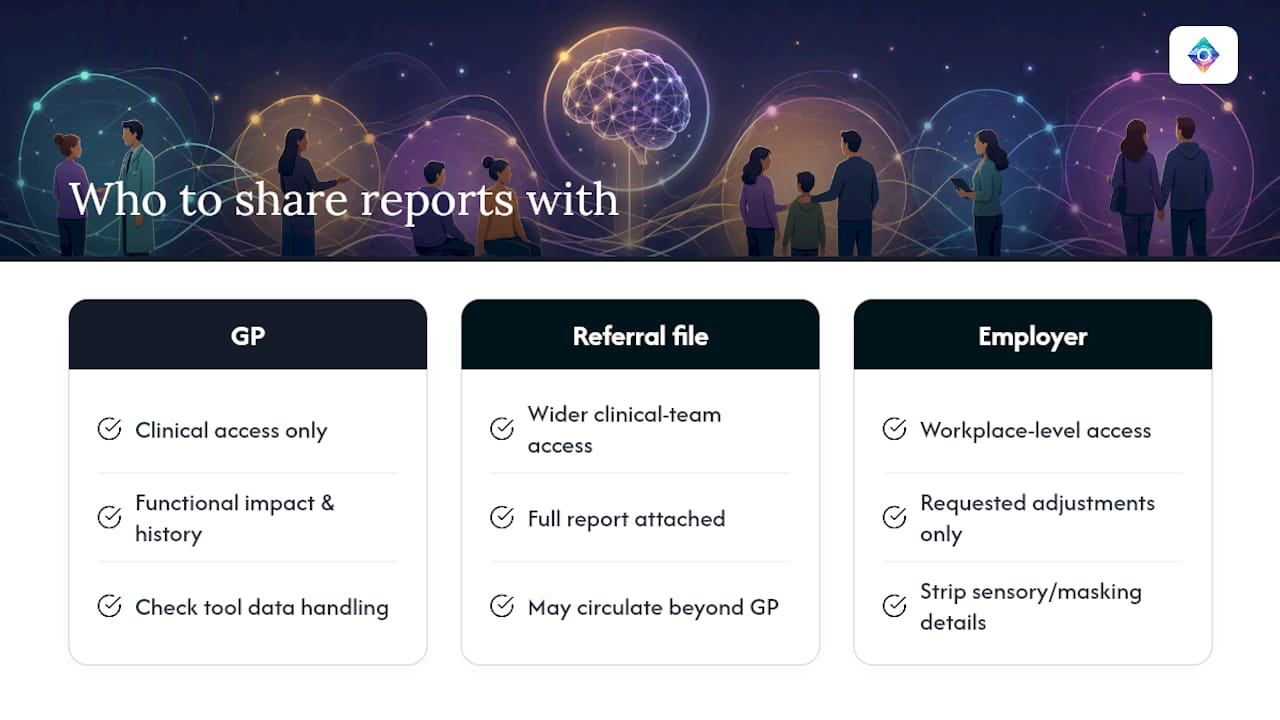
A personal report often contains sensitive detail about mental health, family relationships, and childhood struggles, so think about who sees it before you hand over a copy. Decide in advance whether the report goes to a GP only, gets attached to a wider referral file, or is shared with an employer for workplace adjustments, since those are three very different levels of exposure.
Strip out anything not relevant to the request. A GP needs functional impact and developmental history; an employer generally needs only the adjustments you’re asking for, not a full sensory and masking breakdown. If a report was generated through a digital tool, check what that tool does with your answers. A service that produces results instantly without storing personal data on a server gives you more control over where your information ends up than one that keeps a permanent account record.
Consent matters just as much when the report involves a child. A young person old enough to understand the process should know what’s being shared and with whom, even when a parent is managing the paperwork. If the report will be forwarded to a school as well as a GP, say so upfront rather than letting it circulate without the young person’s knowledge. Keep a copy for yourself too, since referral pathways are frequently slow and having your own record avoids repeating the whole process from scratch if a file goes missing.
How should you tailor a report for ADHD, autism, or dyslexia?
The core structure stays the same across conditions, but the impact examples should shift to match what each clinician is actually screening for.
For ADHD, focus on task initiation, time blindness, and inconsistency, such as excelling at short bursts of high-interest work while struggling to start routine admin. Note any history of underachievement relative to ability, since that gap is often more persuasive than either extreme alone.
For autism, sensory detail and masking carry more weight. Describe specific environments that cause overload, routines that provide stability, and social contexts where camouflaging effort is highest. Spiky profiles are especially common here, where verbal skills might be strong while social inference or sensory tolerance sit far lower.
For dyslexia, anchor examples in reading and writing under time pressure rather than general intelligence. Note whether difficulties appeared early in schooling, since a childhood pattern of slow reading despite strong verbal comprehension is a classic marker worth flagging explicitly. Cross-setting evidence, again, does more work than a single school report from one difficult year.
A founder’s perspective on strength-based reporting
Valerio Cozzi was diagnosed with ADHD at 42, after decades of assuming his scattered focus and burnout cycles were simply personal failings. That late diagnosis is why he built Omniprism around clarity rather than clinical jargon: a report that names strengths alongside struggles gives people language they can actually use, both for themselves and for the GP sitting across the desk. A report that only lists deficits tells half the story and helps no one plan around what they’re good at.
— Valerio Cozzi
Omniprism’s assessments and the Specialist Briefing
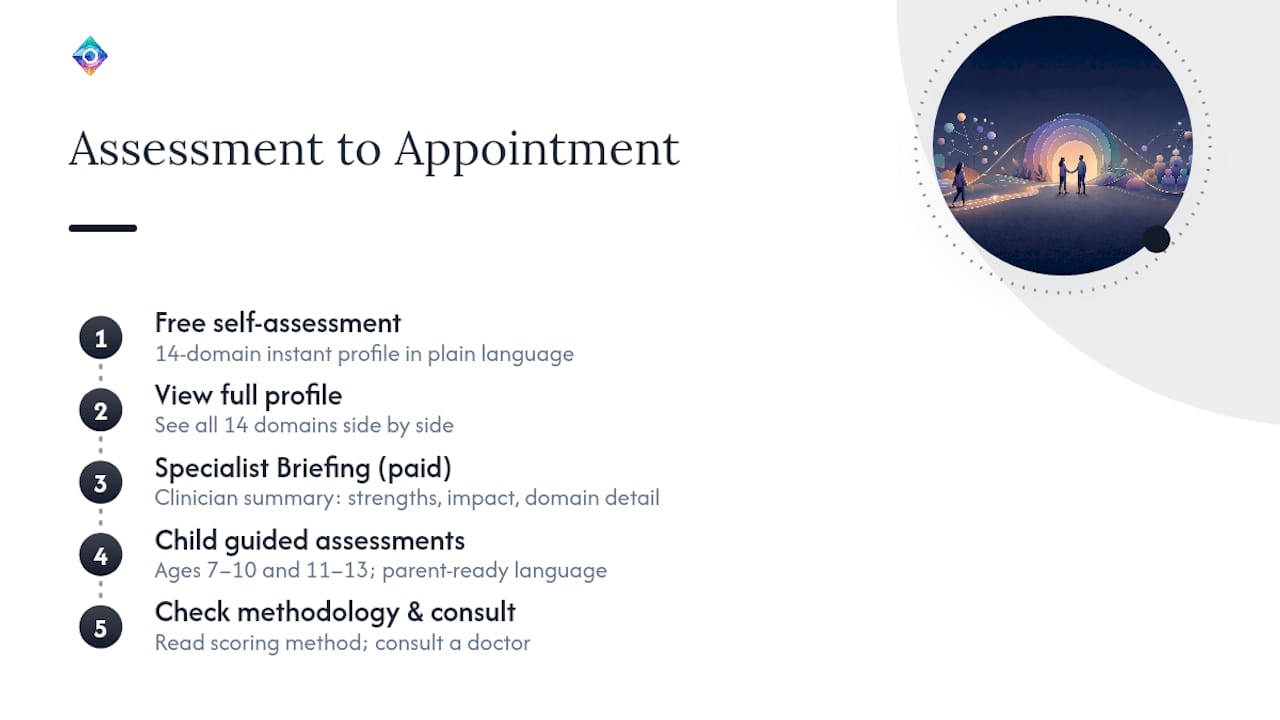
Omniprism’s self-assessment tool generates an instant profile across 14 domains, including ADHD, autism, dyslexia, masking, dyspraxia, and sensory processing, with results delivered in plain language and no data collection required. That instant breadth is useful precisely because a spiky profile only becomes meaningful when you can see all 14 domains side by side, rather than guessing which single trait explains everything.
For readers who want a document built for a GP appointment, an optional paid Specialist Briefing can turn domain results into a summary shaped around the same components clinicians expect: strengths, functional impact, and domain-level detail rather than a raw score dump. It maps closely onto the one-page template outlined earlier, giving you a starting draft rather than a blank page the night before your appointment.
Families assessing a child or teenager can use the guided assessment for ages 7 to 10 or the version built for ages 11 to 13, both designed to translate a young person’s answers into language a parent can bring to a paediatrician. Readers who want to understand exactly how the 14-domain scoring works before buying a report can check the methodology page first. Start with the free self-assessment, then decide whether the Specialist Briefing is worth adding before your next GP appointment.
This article is general information, not a substitute for advice from a qualified doctor. Consult a qualified healthcare professional about your own circumstances before acting on anything here.
Sources
- Operational guidance to deliver improved outcomes in all‑age autism assessment pathways — NHS England
- Childrens neurodevelopmental pathway practice framework — NAIT (2024)
- Neurodevelopmental conditions and neurodiversity — RCGP (2025)
- Autism: recognition, referral, diagnosis and management — NICE guidance (CG128)
- Right to Choose: LMC guidance for practices — Beds & Herts LMC (2025)
FAQ
What is a spiky profile in neurodiversity assessment?
A spiky profile is an uneven spread of scores across cognitive domains, such as high pattern recognition alongside low working memory, rather than one flat ability level.
Can a self-assessment report replace a clinical diagnosis?
No. NHS England guidance is clear that screening tools and reports provide useful data, but a formal diagnosis requires a clinical interview by a qualified professional.
What should go in a one-page impact summary for a GP?
Include a clear request line, three to five concrete impact examples, a childhood indicators note, and a list of attached evidence such as screening scores or school reports.
Does Omniprism provide a report I can give to a doctor?
Omniprism’s free assessment gives an instant 14-domain profile, and the optional paid Specialist Briefing formats those results into a summary aligned with what clinicians expect to see in a referral conversation.
Which screening tools commonly appear in neurodiversity reports?
The AQ-10 screens for autistic traits, the ASRS screens for adult ADHD, the CAT-Q measures masking effort, and WHODAS 2.0 scores functional impact across daily life domains.
Recommended
Written and edited by Valerio Cozzi, founder of Omniprism. Omniprism began after my own ADHD diagnosis at 42.
This article is educational. It is not medical advice, not a diagnosis, and not a substitute for assessment by a qualified clinician. The Omniprism self-assessment is free, needs no account and no email address, and runs entirely in your browser — your answers are never sent to a server. The optional Specialist Briefing report is a paid add-on.