Map Neurodivergent Strengths in 14 Domains Without a Diagnosis

Neurodivergent strengths are the specific cognitive advantages, such as creativity, pattern recognition, hyperfocus, and visual reasoning, that show up more reliably in ADHD, autistic, dyslexic, and other neurodivergent minds. These aren’t universal traits every neurodivergent person has equally. They cluster in a “spiky profile”, with real peaks in some areas and real troughs in others, and the research behind them is stronger than most people assume.
TL;DR:
- Neurodivergent strengths tend to form a spiky profile, with peaks in areas like divergent thinking, pattern recognition, hyperfocus, and visual reasoning, but these vary widely among individuals.
- Research shows that higher ADHD traits correlate with stronger divergent thinking, especially at moderate levels, and mixed neurotype pairs tend to produce more innovative solutions.
- Self-mapping tools and structured assessments help individuals identify their specific peaks and troughs, enabling better task matching and environment optimization.
- Supporting environments should craft roles around existing strengths, provide explicit instructions, and offer flexible or sensory-friendly spaces to maximize neurodivergent potential.
- Recognizing that strengths are environment-dependent and often unrecognized until the right context emerges is key to leveraging neurodivergent capabilities effectively.
What are the main neurodivergent strengths?
Strengths cluster into recognisable groups rather than sitting as one long, undifferentiated list. Grouping them makes them usable, because you can match a strength to a task instead of just admiring it in the abstract.
Thinking style strengths
- Divergent thinking — generating many original ideas from one starting point. Shows up as brainstorming that won’t stop, or seeing three unrelated solutions to a problem colleagues thought had one answer. Useful in product design, strategy, and any role that rewards novel angles rather than repetition.
- Pattern recognition — spotting structure, anomalies, or trends others miss. Common in dyslexic and autistic profiles, and genuinely valuable in data analysis, quality control, and cybersecurity work where the job is finding the one thing out of place.
Focus and memory strengths
- Hyperfocus — sustained, high-intensity concentration on a task that holds genuine interest. Not the same as ordinary focus; it can run for hours past the point most people would need a break. Best used by deliberately front-loading complex, high-value work into the windows when it appears.
- Deep procedural memory — for routines, sequences, or systems once learned. Shows up as never forgetting a process once it’s internalised, even under pressure.
Perceptual strengths
- Visual and spatial reasoning — thinking in pictures, layouts, or three-dimensional structures rather than words. Common in dyslexic profiles and often underestimated because it doesn’t show up on text-based tests.
- Sensory sensitivity — noticing detail in sound, texture, or visual field that others filter out. A double-edged strength: the same sensitivity that overwhelms in a noisy office also catches the misaligned pixel or the wrong note.
Social and ethical strengths
- Directness and fairness-orientation — a strong, consistent preference for honesty and rule-consistency, common in autistic profiles. Useful in auditing, compliance, and any context where saying the uncomfortable true thing matters more than social smoothing.
Specialist knowledge strengths
- Deep-dive expertise via special interests — the capacity to build genuine mastery in a narrow domain fast, driven by intrinsic interest rather than external reward. This is arguably the most underused strength on this list, because schools and workplaces often treat a narrow obsession as a distraction rather than a training ground.
None of these are guaranteed. A spiky profile in autism means genuine strength in one domain can sit right next to genuine difficulty in another, sometimes within the same person, sometimes within the same afternoon.
Does research actually support neurodivergent strengths?
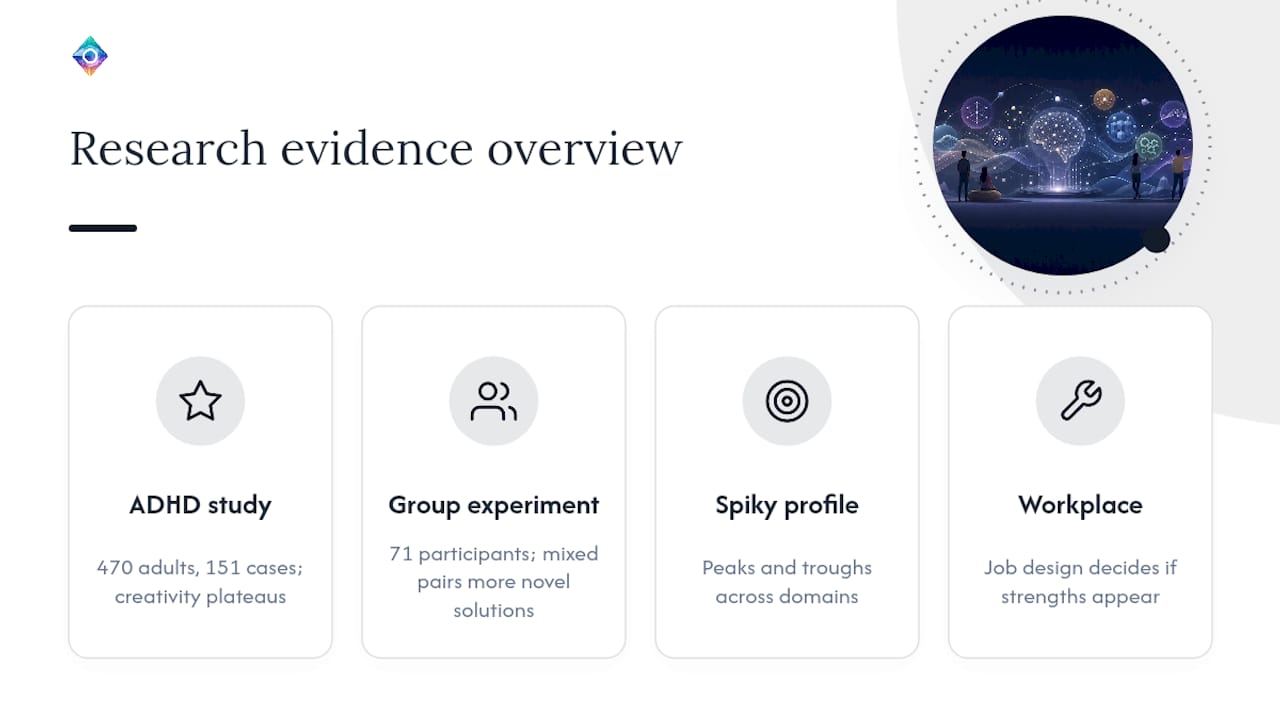
Yes, though the evidence is more specific and more limited than most popular accounts suggest. A 2022 study of 470 adults and 151 clinical cases found that higher ADHD symptoms associate with stronger divergent thinking, measured across fluency, flexibility, and originality. The effect isn’t linear all the way up, though: it plateaus within clinical symptom ranges, so “more ADHD traits” doesn’t simply mean “more creativity” once symptoms become severe enough to be diagnostically significant.
Separate experimental work strengthens the case for neurodiversity at the group level. In a tower-building task with 71 participants, neurodiverse pairs produced more diverse, novel solutions than pairs of the same neurotype. Mixed thinking styles, not just individual brilliance, appear to drive the innovation gain.
The most useful framing isn’t “neurodivergent people are gifted” or “neurodivergent people struggle.” It’s a spiky profile: real peaks in specific domains, real troughs in others, with environment deciding how much of that peak gets expressed.
That biopsychosocial model matters because it explains why the same person can look brilliant in one job and stuck in another. A 2020 review of neurodiversity at work argues that job design and environment, not just individual traits, determine whether a strength surfaces at all.
How do I find and use my own strengths?
Most people never map their own spiky profile because nobody asks them to. Three habits change that, and none of them require a diagnosis first.
- Track wins for two weeks. Note what you were doing every time work felt effortless or you produced something you were proud of. Patterns emerge fast.
- Journal the troughs too. Write down what consistently drains you, not to fix it immediately, but to see where it clusters. Time management often shows up here, and it’s worth reading specifically about managing time blindness in ADHD if that’s a recurring theme.
- Map peaks against troughs on one page. A simple two-column list, strengths on one side and struggles on the other, turns a vague sense of “I’m good at some things” into something you can actually act on.
Once you’ve got a rough map, use it. Structure your hardest, most creative tasks around whichever hours reliably produce your best focus, not the hours a calendar says are “working hours.” Let special interests become genuine expertise rather than a guilty hobby; that deep-dive capacity is a real professional asset. Partner with someone else, or use a tool, for the trough areas rather than white-knuckling through them.
Pro Tip: Don’t just self-report your strengths from memory. Most people underestimate strengths they’ve had so long they assume everyone has them, and overestimate struggles that just happened recently. A structured assessment across multiple domains catches blind spots a journal alone won’t.
A structured self-assessment is particularly useful when you want to bring findings into a conversation with an employer or a clinician, since a clear written profile carries more weight than personal impressions alone.
How can managers or educators support neurodivergent strengths?
Organisations that actively design around strengths, rather than just tolerating difference, see the benefit twice: once from individual output, once from team-level innovation. The innovation-through-neurodiversity study found mixed-neurotype pairs consistently outproduced homogeneous ones on novel problem-solving.
Turning that into practice doesn’t require a large programme:
- Craft roles around what someone already does well, rather than forcing every employee through an identical generic job description.
- Give clear, written briefings instead of vague verbal instructions that rely on reading between the lines.
- Offer flexible scheduling around genuine peak-focus hours rather than a fixed 9-to-5.
- Provide low-sensory spaces or noise-cancelling options for anyone whose sensitivity is a double-edged strength.
- State expectations explicitly rather than assuming social norms are self-evident.
None of this works without psychological safety. A 2024 CIPD report on neuroinclusion found many organisations still lack basic manager training, which limits how much of an employee’s strength ever actually gets used.
A personal reflection on recognising your own strengths
I was diagnosed with ADHD at 42. What changed wasn’t my behaviour, it was the language for it. Once I could name the hyperfocus and the pattern recognition as strengths rather than just quirks, I stopped fighting them and started building my work around them. That single shift did more for my output than any productivity system I’d tried before.
How do you manage the difficulties that come with these strengths?
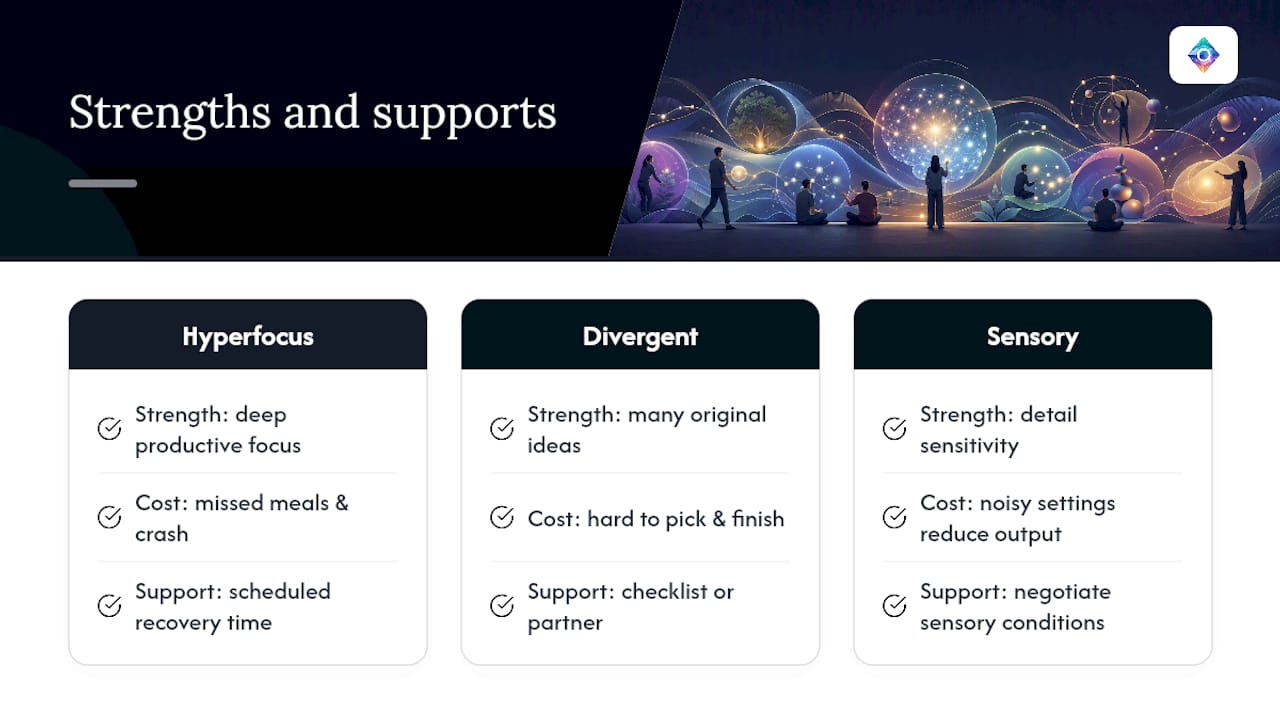
Nearly every strength on this list has a matching cost, and pretending otherwise sets people up to fail. Hyperfocus that produces brilliant work for six hours can also mean missed meals, missed messages, and a crash the next day. Sensory sensitivity that catches the misplaced detail also means a loud office can shut down the same person’s output entirely. Divergent thinking that generates ten original ideas can make it genuinely hard to pick one and finish it.
The management approach that actually works is structural, not willpower-based. Build recovery time into a schedule after a known hyperfocus session, rather than assuming the next task will start on time. Use external checklists or a partner for follow-through on ideas, so divergent thinking gets a landing pad instead of drifting into ten unfinished projects. Negotiate sensory conditions before they become a crisis, not after a bad week.
This is where the spiky-profile model earns its keep again: instead of treating the trough as a personal failing to fix, you treat it as the known other side of a strength you’d never trade away. A dyslexic pattern-recogniser who struggles with fast verbal instructions isn’t failing at communication; they’re a visual thinker in a verbal-first meeting. Change the meeting format, and the “difficulty” often shrinks without anyone doing extra emotional labour.
Where else do neurodivergent strengths show up beyond work and school?
Entrepreneurship is one of the clearest examples. The capacity to hyperfocus on a single problem for months, combined with divergent thinking that keeps generating new angles when a first approach fails, maps closely onto what early-stage founders actually need. Plenty of small business owners describe their business as effectively one very large special interest that happened to find paying customers.
Community and volunteer work is another underexamined space. Fairness-orientation and directness, often strongest in autistic profiles, translate well into advocacy, campaigning, and any community role that depends on someone being willing to say the uncomfortable true thing when a group would rather avoid it. Pattern recognition shows up in unpaid roles too, from spotting a flaw in a local charity’s process to noticing a trend in a neighbourhood nobody else has tracked yet.
None of this requires a formal title or a job description. Strengths expressed outside institutional structures, in a hobby, a side project, a campaign, often surface earlier and more visibly than strengths inside a rigid workplace role, precisely because there’s less pressure to conform to one narrow way of doing the task.
What do people get wrong about neurodivergent strengths?
The biggest misconception is treating strengths as universal: assuming every autistic person is a pattern-recognition savant, or every ADHD adult is bursting with untapped creativity. The 2022 divergent-thinking study is a useful corrective here, because its effect plateaued within clinical ranges. Traits and strengths correlate; they don’t guarantee each other.
A second misconception runs the opposite direction: “strengths talk” is sometimes dismissed as sugar-coating a disability, a way of avoiding real support needs. That’s a false choice. The biopsychosocial model explicitly holds both truths at once: genuine difficulty in some domains, genuine advantage in others, both shaped heavily by environment. Naming a strength doesn’t erase a struggle sitting right next to it.
A third, quieter misconception is assuming strengths are fixed and visible from birth. Many people only discover a strength, like sustained hyperfocus or deep pattern recognition, once they land in an environment that actually rewards it. Someone who looked “unfocused” in a rigid school setting can look exceptional in a role built around their actual thinking style. The strength didn’t appear; the environment finally let it show.
What do real applications of these strengths look like?
Concrete cases make the abstract list useful. A dyslexic architect who thinks natively in three-dimensional space can spot structural issues on a drawing that a text-first colleague would only catch in a physical model. A software tester with strong pattern recognition and sensory sensitivity to visual inconsistency can catch UI bugs that pass every automated check. A campaign volunteer whose fairness-orientation makes small talk exhausting can be the single most effective person in the room at holding an organisation to its own stated values.
None of these are hypothetical archetypes pulled from a stock list; they’re the practical shape the strengths above actually take when matched to the right task. The pattern across all of them is the same: the strength was already there, and the only thing that changed was whether the surrounding task or role gave it room to operate. That’s the spiky-profile argument in miniature, one peak, correctly placed, doing work that would take a differently-wired person much longer.
How do culture, gender, and age change how these strengths show up?
Neurodivergent strengths don’t exist in a vacuum; they’re read through whatever identity lens a person is already carrying. Girls and women with ADHD, for instance, are frequently praised for being “quiet” or “creative daydreamers” through childhood, which can delay recognition of both the diagnosis and the strength underneath it, since the same trait gets labelled differently depending on the gender of the person showing it.
Culture shapes expression too. A direct, fairness-first communication style that reads as a genuine strength in one workplace culture can be read as rude or confrontational in another that prioritises social harmony over stated accuracy. That’s not the strength changing; it’s the surrounding norms deciding whether the strength is legible as a strength at all.
Age adds another layer. Many adults are only diagnosed, and only start naming their strengths deliberately, in their thirties, forties, or later, often after decades of assuming a trait was a personal failing rather than a specific cognitive pattern with a name. Older adults sometimes carry more masking habits built up over years of compensating, which can obscure a strength even from the person who has it. None of this makes the strength less real. It makes the recognition of it more dependent on context than most strengths-based advice admits.
What actually matters when talking about neurodivergent strengths
The conventional strengths narrative has a problem: it treats the list itself as the point, as if naming “creativity” and “hyperfocus” is the finish line. It isn’t. The 2022 divergent-thinking data and the tower-building experiment both point somewhere more specific: strengths are real, but they’re conditional on environment and they plateau rather than scale infinitely with symptom severity.
That means the useful move isn’t collecting more strength labels. It’s matching a small number of genuine peaks to the right task, structure, or role, and building deliberate support around the troughs instead of pretending they’ll resolve themselves. Most advice on this topic skips the second half. A young person’s assessment or an adult self-assessment earns its place here precisely because it forces that matching exercise onto paper instead of leaving it as a vague feeling.
What I’d prioritise first, before job crafting, before workplace policy, is simply getting an accurate map of your own spiky profile. Everything else downstream works better once you know what you’re actually working with.
— Valerio Cozzi
How can I map my own strengths right now?
If you want a starting point rather than a guess, a structured self-assessment gives you an instant profile across 14 domains, including ADHD, autism, dyslexia, dyspraxia, sensory processing, and masking, without months of tracking or a clinical waiting list. Omniprism’s free self-assessment generates that profile in plain language, with no data collection, so you can see your own peaks and troughs in one sitting rather than piecing them together from memory.
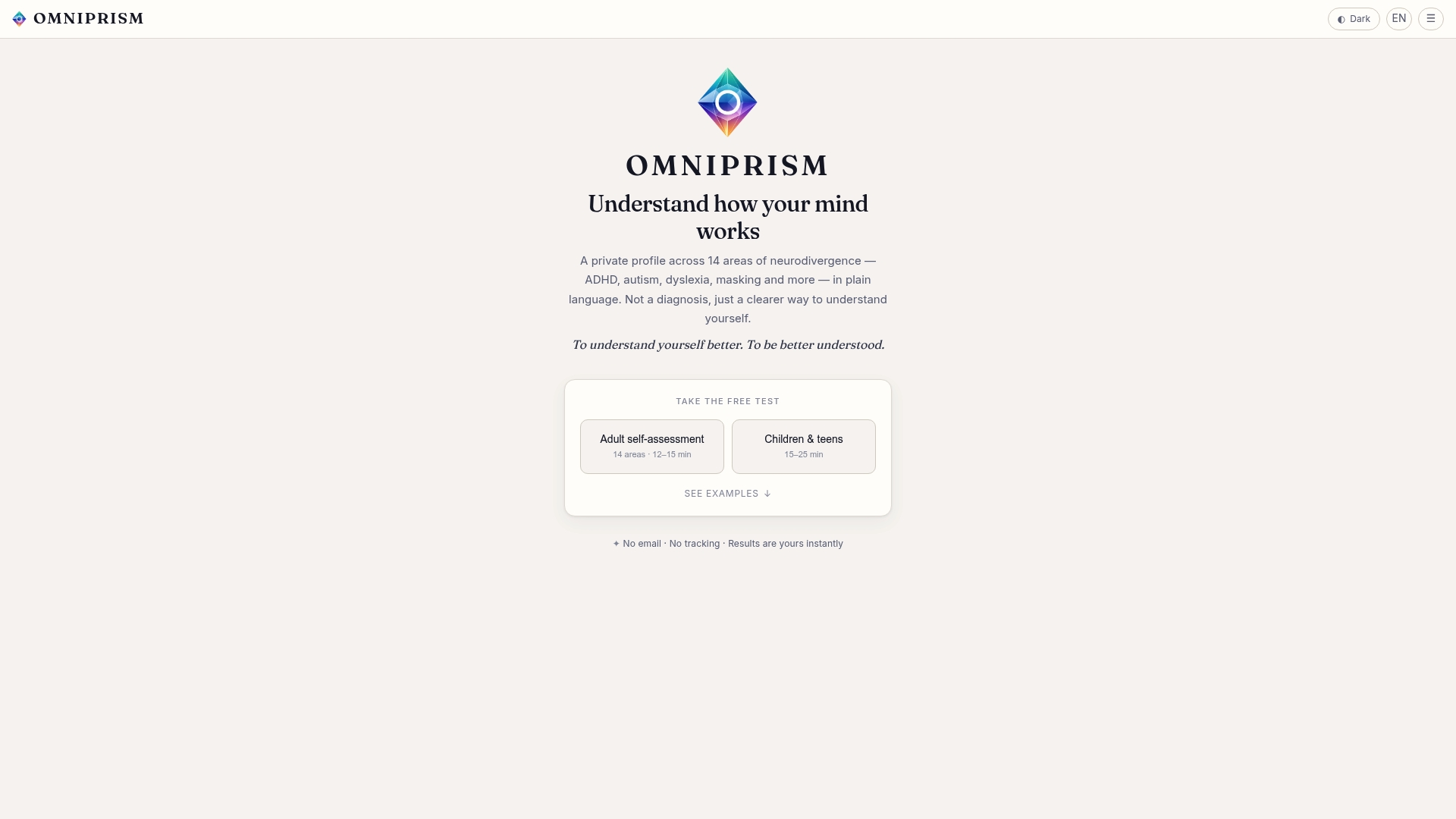
The tool doesn’t replace a clinician, but it gives you language and structure to bring into that conversation, which is exactly what a written spiky profile is for. Parents and guardians can use the guided children’s assessment or the young person’s assessment to start that process earlier, in an age-appropriate format. If you want to understand exactly what’s being measured before you start, the methodology page breaks down all 14 domains. For anyone who wants a formal summary to hand to a specialist, the optional Specialist Briefing report turns your results into a clear, shareable document. Start with the free assessment, see your own spiky profile, and decide from there whether a Specialist Briefing is worth adding.
Sources
- ADHD traits and divergent thinking (2022)
- Neurodiversity at work: a biopsychosocial model (2020)
- Innovation through neurodiversity (Crompton et al., 2023)
- Neuroinclusion at work (CIPD report, 2024)
FAQ
What are neurodivergent people typically good at?
Common strengths include divergent thinking, pattern recognition, hyperfocus, visual and spatial reasoning, and deep expertise built through special interests, though not every neurodivergent person has all of these, and they follow a spiky profile rather than a uniform pattern.
What is a neurodivergent person?
A neurodivergent person has a brain that processes information, attention, or sensory input differently from the statistical norm, covering conditions like ADHD, autism, dyslexia, and dyspraxia, among others.
How does neurodivergence affect social skills?
It varies widely: some neurodivergent people communicate with unusual directness and fairness-orientation that reads as a strength in the right context, while others find certain social conventions genuinely draining, and both can be true of the same person depending on the setting.
How do you motivate a neurodivergent person?
Motivation tends to follow genuine interest and clear structure rather than generic incentives; matching tasks to a person’s actual peak-focus strengths, using special interests as a driver, and giving explicit rather than implied expectations, works better than one-size-fits-all motivation tactics.
How can I find out which strengths I actually have?
A structured self-assessment across multiple cognitive domains, like the one Omniprism offers, gives a faster and more complete starting map than self-reflection alone, since it’s designed to catch strengths people have had so long they no longer notice them.
Recommended
- Spiky Profile Autism: Strengths, Challenges, and Supports
- Spot Twice Exceptional Autism: Use a 14 Domain Self Check to Build Evidence
- Autistic Traits in Women: Signs Often Missed or Masked
- Autism vs. ADHD: Comparing Symptoms, Overlap, and Diagnosis
Written and edited by Valerio Cozzi, founder of Omniprism. Omniprism began after my own ADHD diagnosis at 42.
This article is educational. It is not medical advice, not a diagnosis, and not a substitute for assessment by a qualified clinician. The Omniprism self-assessment is free, needs no account and no email address, and runs entirely in your browser — your answers are never sent to a server. The optional Specialist Briefing report is a paid add-on.