What Is a Neurodivergence Profile? What It Covers and How to Use One
A neurodivergence profile is a structured summary of how your mind works: your strengths, the things that feel hard, and what helps. It is not a diagnosis, and in the UK it is used to describe needs and start conversations with schools, employers and clinicians, with or without a formal label.
Below you will find what a profile contains, a worked example for an adult and a child, a short method for building your own, and the point at which a professional assessment becomes the right next step.
Key Takeaways
- A profile describes strengths, challenges and support needs in everyday language. It does not name a condition on its own.
- NHS profiling tools for children cover areas such as attention, sensory processing, communication, emotions and flexibility.
- Seek a specialist assessment if you want a diagnosis, ADHD medication or Disabled Students’ Allowance.
- The best profiles are written with the person, kept current and shared only with consent.
- Omniprism gives you a free profile across 14 domains, with no email, account or data collection.
What is a neurodivergence profile?
A profile is a snapshot of one person’s cognitive style. It sits between a personal statement and a clinical report: more structured than the first, far less formal than the second.
The vocabulary matters because profiles rest on it. Neurodiversity is a biological fact describing the variety of all human brains, while neurodivergence means having a neurocognitive experience that differs from what is considered typical. The terms were coined in 2000 by activist Kassiane Asasumasu, according to the Baker Center, which also describes the framing as a social model in which disability arises from a mismatch with the environment rather than from individual deficit.
That social model is why profiles focus on what helps as much as on what is difficult. If you want to see how the idea plays out in practice, the social model of disability explains how barriers come from the setting a person is placed in.
One grammar point is worth knowing. Think Local Act Personal notes that ‘neurodiverse’ describes a group, so an individual is either neurotypical or neurodivergent. It also advises using ‘autistic’ rather than ‘neurodivergent’ when you mean autism specifically, because autism is only one type of neurodivergence. Our neurodiversity language guide goes through the wording in more detail.
How common is it? The Brain Charity states that at least 20% of the UK’s adult population are not seen as neurotypical and may be diagnosed with conditions such as autism, dyslexia or ADHD.
What does a neurodivergence profile include?
There is no single national template, and that is the first thing to understand. Different services choose different headings, but the content overlaps heavily.
A person-centred profiling manual from Bracknell Forest lists strengths, hopes for the future, background, things that stop or slow progress, things that help, plans to help, who will carry out the plans and a review date. It aims to meet children’s needs as early as possible, whether or not they have a diagnosis.
NHS services in England use their own versions for children and young people:
| Tool | Areas covered | How it is used |
|---|---|---|
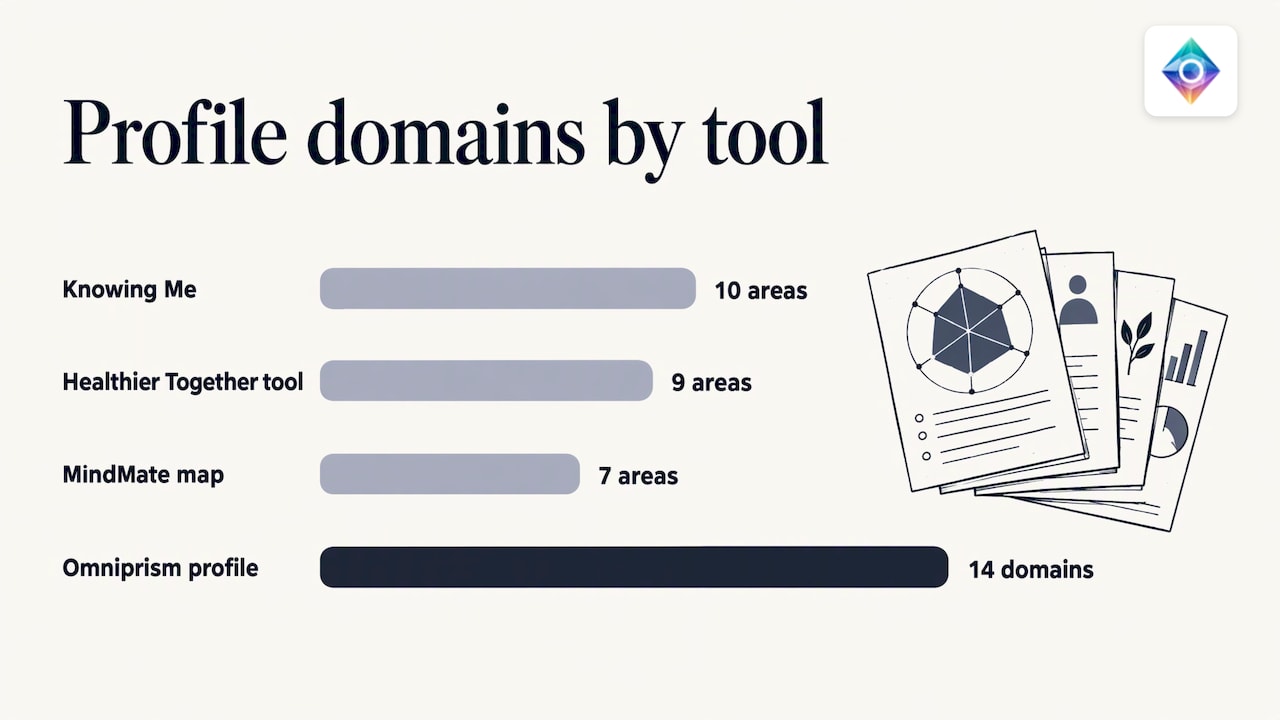
| Knowing Me (NHS Cheshire and Merseyside) | 10: Self, Emotion, Energy, Coordination, Sensory, Attention, Communication, Flexibility, Impulsivity, Future | A conversation between parent or carer, professional and child, producing a visual record. Not an assessment |
| Healthier Together profiling tool | 9: speech and language, energy and activity, attention and impulse control, emotional regulation, motor skills, senses, flexibility, social connection, cognitive skills | Completed by parents or carers with a professional, always including the young person’s views |
| MindMate profile map | 7: speech and language, social communication and play, sensory processing, emotions, executive functioning, hyperfocus or monotropism, mental health | Helps identify support needs with or without a formal diagnosis |
The pattern is consistent: attention, sensory experience, communication, emotion and flexibility appear almost everywhere. Omniprism’s own profile covers 14 domains, including ADHD, autism, dyslexia, masking, dyspraxia, dyscalculia, sensory processing, high sensitivity, OCD traits and synesthesia. Our guide to mapping neurodivergent strengths in 14 domains shows how those areas fit together.
Profiles are often described as ‘spiky’, meaning strong in some areas and demanding in others. If that describes your pattern, read about the spiky profile in autism.
What does a neurodiversity profile example look like?
Examples help more than definitions, so here are three. The adult one is an invented illustration, not a real person.
An adult at work (illustration)
- Strengths: spots patterns in data quickly, thrives on urgent problems, generates ideas in meetings.
- Tricky bits: starting tasks without a clear first step, losing track of time, background noise in an open-plan office.
- What helps: written follow-up after meetings, a fixed block of focus time, noise-cancelling headphones.
- Communication: prefers direct feedback by message first, then a conversation.
- What I am doing myself: using a daily task list and calendar alerts.
This follows the same shape as the workplace statement structure of strengths, how your brain works, tricky bits, what helps and what you are doing yourself. Keep it to one page.
A child in the early years
A Bristol early years team’s example ‘All About Me’ profile is completed with parent carers and reflects the child’s interests and difficulties. It records signs of overwhelm and the strategies that work, including a First/Then board, a calmer corner and sensory toys.
A student
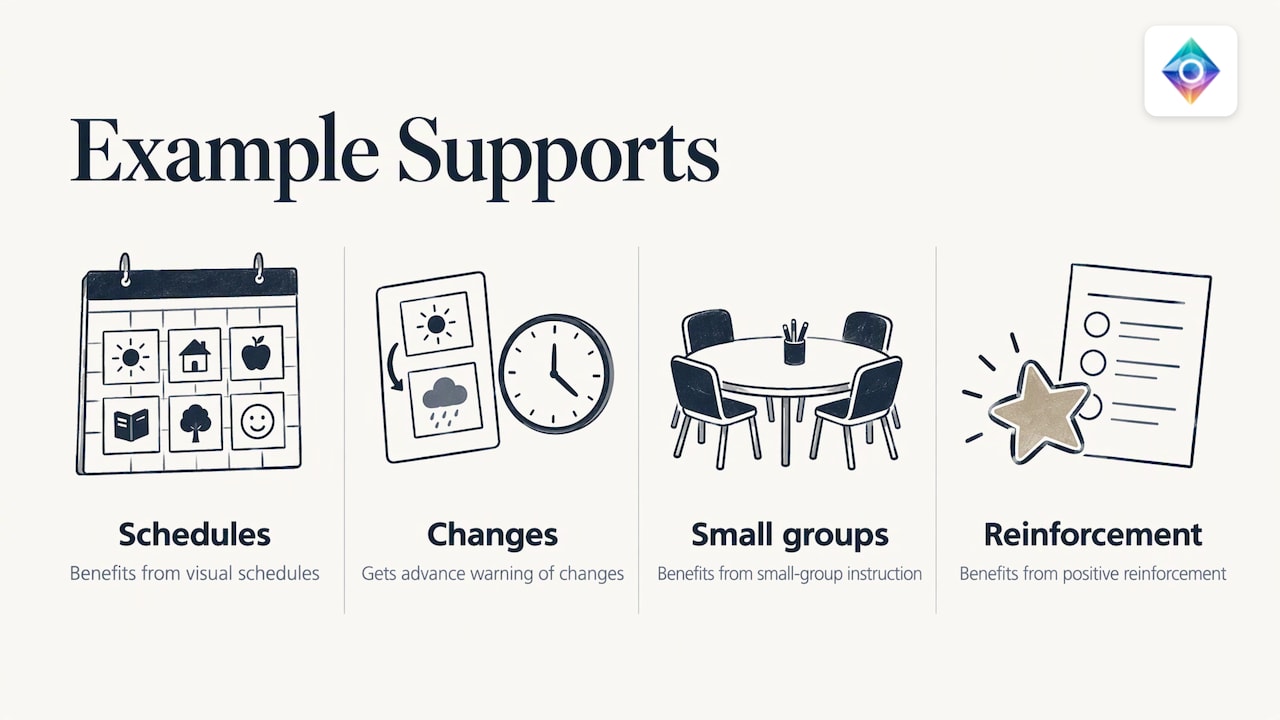
A US special education resource, PEATC’s Student Profile, covers likes and dislikes, strengths, challenges, accommodations, successes, dreams and yearly goals. Its worked example describes a learner who benefits from visual schedules, advance warning of changes, small-group instruction and positive reinforcement.
If you are a teacher or parent planning adjustments from a profile like this, our articles on classroom adjustments for ADHD in UK schools and school autism adjustments turn the findings into specific requests.
How do you create your own neurodivergence profile?
Follow these steps in order. The whole process can take an hour.
- Start with strengths. Write down what you do well and what people ask you for help with. Starting here sets the tone for everything after.
- List what feels hard, specifically. ‘Struggling with focus’ is vague. ‘Cannot start emails without a deadline’ gives someone something to act on.
- Note the triggers and early signs. Record what overloads you (noise, sudden change, time pressure) and how it shows, such as going quiet or withdrawing.
- Record what helps. Include adjustments, tools and the way you prefer to be spoken to.
- Decide who sees which version. Inclusion Rules’ portfolio guidance suggests separating an ‘about me’ section from a ‘help for my teachers’ section, and keeping a fuller version private when you prefer.
- Set a review date. Needs change, so a profile that is a year old may no longer describe you.
For children, build the profile with them. The Sheffield Children’s NHS Foundation Trust sensory profile is designed to be completed with the person in their own words and updated over time, with consent before it goes to the support network. Our sensory processing checklist helps you prepare for NHS meetings.
Pro Tip: Use the person’s own phrases. ‘Too loud in the canteen’ tells a teacher more than ‘sensory sensitivity’.
Can a neurodivergence profile diagnose ADHD, autism or dyslexia?
No. A profile describes patterns and needs, and the NHS Cheshire and Merseyside page states plainly that Knowing Me does not result in a diagnosis. The same is true of any screening or self-assessment result.
A professional assessment is the route when you want a diagnosis. The University of Cambridge’s neurodiversity screening service recommends considering an external specialist assessment if you are seeking a diagnosis, ADHD medication, Disabled Students’ Allowance, or support outside the university. For ADHD medication, speak to your GP about referral.
A profile can still make that appointment more productive. Arriving with specific examples, rather than a general sense that something is different, gives the clinician more to work with. Our self-assessment guide explains what a self-assessment can and cannot tell you.
How reliable are neurodiversity profiling tools?
For children’s educational profiling, the evidence is still developing. A March 2026 systematic review and qualitative study found that no published studies assessed cost-effectiveness. It also found that the five most-studied tools conceptualise need differently and do not meet the Neurodiversity Task and Finish Group criteria. Some English tools, including the Portsmouth Neurodiversity Profiling Tool, have early positive findings on acceptability and perceived usefulness, while others have little or no published evaluation.
The review recommends that profiling be strengths-based and needs-led, and that it should never act as a diagnostic substitute or a gatekeeping mechanism. That is a useful rule for any profile you create or are given: it should open doors to support, and it should not be a condition for receiving it.
Why use a neurodivergence self-assessment?
I was diagnosed with ADHD at 42, and I built Omniprism because understanding how my own mind worked would have been valuable long before then.
We believe a profile should be something you can get in minutes, in plain language, without handing over an email address. That is why our free self-assessment gives an instant profile across 14 areas, with no account and no data collection. You can look at your results without the pressure of being tracked.
We also believe a profile earns its keep in the room with a professional. Our optional Specialist Briefing is designed to summarise your results in a form clinicians can read quickly, so the appointment starts from specifics. For families, our guided assessments for children and teens are designed to lay a foundation for clearer conversations with healthcare professionals.
Valerio Cozzi
How can you share a profile with school, work or a clinician?
Share it deliberately. Person Centred Plans advises that a completed one-page profile can go to new support staff or caregivers, into care plans and educational documents, and be used at transitions and in team meetings. It also stresses that the profile contains personal information, so appropriate consent must be obtained before sharing.
Three practical habits make a profile land well:
- Describe needs as access, not effort. ‘Needs instructions rephrased and a private check-in’ is clear and actionable.
- Keep it short. One or two pages gets read.
- Say what you are not asking for. It helps the reader focus on the adjustments that matter.
If you work with clients, our page for psychologists, coaches and companies explains how profiles can fit your practice.
Where can you get a free neurodivergence profile?
Our free self-assessment gives you an instant profile in plain language across 14 domains, with no email or account needed. If you want something to hand to a GP or specialist, the Specialist Briefing is a one-off €20 report that summarises your results for clinicians.
For children and teens we offer guided assessments for ages 7 to 10 and ages 11 to 13. A Youth Briefing is available for €20 as a one-off.
FAQ
What is the difference between a neurodivergence profile and a diagnosis?
A profile describes your strengths, challenges and support needs. A diagnosis is a clinical decision made by a qualified professional after assessment. Many people use a profile to prepare for that assessment or to get support while they wait.
Do I need a diagnosis to ask for adjustments?
Not necessarily. The Bracknell Forest profiling manual aims to meet children’s needs as early as possible, whether or not a diagnosis has been received. Some formal support routes do require evidence, so ask the school, employer or university what they accept.
Can I make a neurodivergence profile for my child?
Yes, and it works best when your child contributes in their own words. NHS tools such as Knowing Me are designed as a conversation involving the parent or carer, a professional and the child. Omniprism also offers guided assessments for children and teens.
How often should I update a profile?
Review it at least once a year, and after any major change such as a new school, job or health circumstance. Sensory and support needs shift over time, and the Sheffield Children’s tool is designed to be updated as they do.
Sources
- Autism and neurodiversity, National Autistic Society
- An Introduction to Neurodiversity and Neurodivergence, Baker Center
- Neurodivergent, neurodiversity and neurotypical, The Brain Charity
- Communicating about neurodiversity, Think Local Act Personal
- Person Centred Profiling Manual, Bracknell Forest
- What is the Knowing Me profiling tool, NHS Cheshire and Merseyside
- About Profiling Tool, Healthier Together NHS
- Characteristics of neurodivergence, MindMate
- Student Profile, PEATC
- Transfer pack example, Bristol Early Years
- Sensory profile, Sheffield Children’s NHS Foundation Trust
- Creating Personal Portfolios, Inclusion Rules
- Neurodiversity Screening Service, University of Cambridge
- Educational learning needs assessment (‘profiling’) for neurodivergent children, systematic review, March 2026
- Printable One Page Profile, Person Centred Plans
- The Social Model of Disability, Inclusive-AF
Recommended
- Neurodivergence Self-Assessment Guide: What It Can and Can’t Tell You
- Copyable One Page Neurodiversity Report Examples for GP Appointments
- Executive Function Profile: What It Shows and How to Use It
- Map Neurodivergent Strengths in 14 Domains Without a Diagnosis
Written and edited by Valerio Cozzi, founder of Omniprism. Omniprism began after my own ADHD diagnosis at 42.
This article is educational. It is not medical advice, not a diagnosis, and not a substitute for assessment by a qualified clinician. The Omniprism self-assessment is free, needs no account and no email address, and runs entirely in your browser — your answers are never sent to a server. The optional Specialist Briefing report is a paid add-on.