Neurodiversity Language Guide: Which Words to Use and Why
The safest way to talk about neurodiversity is to use the terms in their precise senses (neurodiverse for a group, neurodivergent for one person), to follow the wording a person uses for themselves, and to ask when you do not know. Official UK guidance now leans towards identity-first phrasing such as “autistic person”, yet it also says preferences differ and change, so no single list of words settles every case.
Key takeaways
- Neurodiversity describes variation across all brains; neurodivergent and neurotypical describe individuals.
- Most UK guidance favours identity-first language for autism (“autistic person”), but the individual’s own choice always outranks a style guide.
- Avoid functioning labels, “suffers from” and wording that frames a neurotype as an illness to be cured.
- When you are unsure, ask, and accept that the answer may change over time.
What do neurodiversity, neurodivergent and neurotypical mean?
The three words are often swapped as if they were synonyms, which is where most errors start. Neurodiversity refers to variation among brains, while neurodivergent and neurotypical describe individuals. A neurotypical person’s brain functions in ways that meet societal expectations of what is typical; a neurodivergent person’s brain works differently from that.
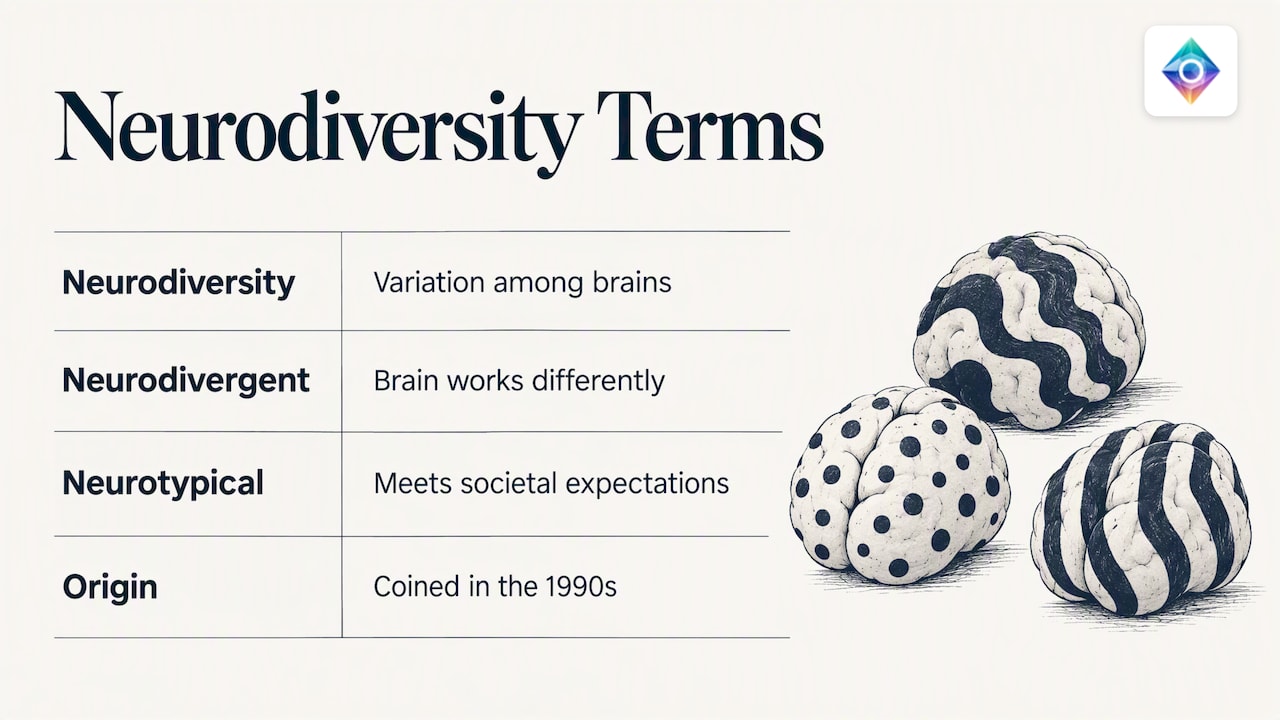
The concept itself is recent. The Brain Charity notes that it was coined in the 1990s to describe brain differences as natural variation rather than disorder. That origin explains why the vocabulary resists medical framing.
Neurodiverse or neurodivergent?
This is the slip readers ask about most. UCL’s guidance says neurodiverse should describe a group of people, while neurodivergent should be used for an individual. GOV.UK guidance on inclusive language likewise advises neurodivergent for individuals rather than neurodiverse. So “a neurodiverse classroom” is fine, and “my neurodiverse son” is better written as “my neurodivergent son”.
Some institutions are looser. The University of Edinburgh’s style guide uses neurodiverse or neurodiversity in general and neurodivergent or neuro-atypical for individuals, depending on preference. Treat that as a reminder that house styles differ, and that the group/individual distinction is the most widely repeated rule.
Is “neurodivergent” a diagnosis?
No. The Cleveland Clinic describes it as a nonmedical term covering people whose brains develop or work differently, whether or not they have an identified condition or diagnosis. That matters for people who recognise themselves in the description but are still waiting for an assessment: they can use the word without anyone’s permission.
Person first vs identity first language
Person-first language puts the person ahead of the condition (“a person with autism”). Identity-first language treats the trait as part of who someone is (“an autistic person”). Both are legitimate, and the argument is about who gets to choose.
The evidence from UK autistic communities is mixed rather than one-sided. A study of the UK autism community by Kenny and colleagues, published in Autism in 2016, found that “autism” and “on the autism spectrum” were the most widely endorsed terms, while community members disagreed on several others. More recently, Autism Central cites a UK study reporting that the majority of autistic people prefer identity-first language, describing themselves as an autistic person rather than a person with autism.
Other bodies take a more split view:
- The NIH advises asking for an individual’s preference. For general writing it suggests person-first language for children, and a mix of both for adults or autistic people generally.
- Autism NI recommends identity-first language most often while respecting anyone who prefers person-first wording.
- The American Academy of Pediatrics notes that some parents and individuals still favour person-first language because it humanises the person before the condition.
How to choose when you are writing about a group
A workable rule, drawn from these sources: use identity-first for autistic people as a group, mix the two forms for other neurotypes in the same piece if that reads naturally, and switch to whatever an individual tells you they use. A 2024 New York State glossary adds that if a preference is unclear, using either form is acceptable until it is defined.
Where identity-first is not a good fit, the reason is usually the condition rather than the person. The NIH says person-first language remains best practice for some defined diseases and mental health disorders, while identity-first is often preferred by communities who see their difference as core to identity. ADHD, dyslexia and dyspraxia sit in a grey area, which is another reason to ask.
Neurodiversity terminology: words to use and words to avoid
Terms to avoid
Several phrases keep appearing in schools, workplaces and appointments, and the guidance is consistent about them.
- Functioning labels. Autism Central avoids “high” or “low functioning” and “mild” or “severe” autism, along with words implying autism is an illness or disease that can be treated or cured. These labels describe how visible someone’s needs are to others, not how much support the person needs on a bad day.
- Suffering language. GOV.UK advises against medical labels and passive, negative phrases such as “suffers from” or “confined to”, and recommends neutral wording such as “has an impairment” or “uses a wheelchair”.
- “The disabled”. The same guidance prefers “disabled people”.
- Researcher-style deficit wording. A paper in Autism in Adulthood, Avoiding Ableist Language: Suggestions for Autism Researchers, makes the case that terms common in clinical writing can carry ableist assumptions, and offers alternatives.
Terms you will meet
A few terms are community vocabulary rather than clinical ones. Masking is the best known: Just One Norfolk explains that neurodivergent people may use it for a strategy to appear neurotypical and blend in so as to be accepted. If you are curious how masking and other traits show up for one person, our piece on mapping neurodivergent strengths across 14 domains walks through it.
Related words such as “neuro-affirming” describe approaches that treat difference as a variation to understand. They are not synonyms for “nice” or “positive”, and they do not require anyone to pretend that disability or support needs do not exist.
How to ask about someone’s language preferences
The single most repeated line in the guidance is to ask. Autism Central stresses that there is no universally accepted language around autism, and that the most respectful practice is to ask individuals and use their words. In practice that can be a plain question: “How do you like to describe yourself?” works in a classroom, a team meeting or a first appointment.
Two cautions help:
- Use the person’s words only for that person. New York State guidance cautions that insiders of a community may use terms with one another that are often inappropriate for outsiders. If someone calls themselves a “spicy brain” or similar, that does not licence you to say it about them or others.
- Let preferences move. A neuro-affirming language guide from Shropshire and Telford & Wrekin notes that identity-first language is one way to be neuro-affirming, but that neurodivergent individuals should always be free to dictate the language for their own experiences. Someone who said “person with ADHD” last year may say “ADHDer” now.
Language for families, schools and professionals
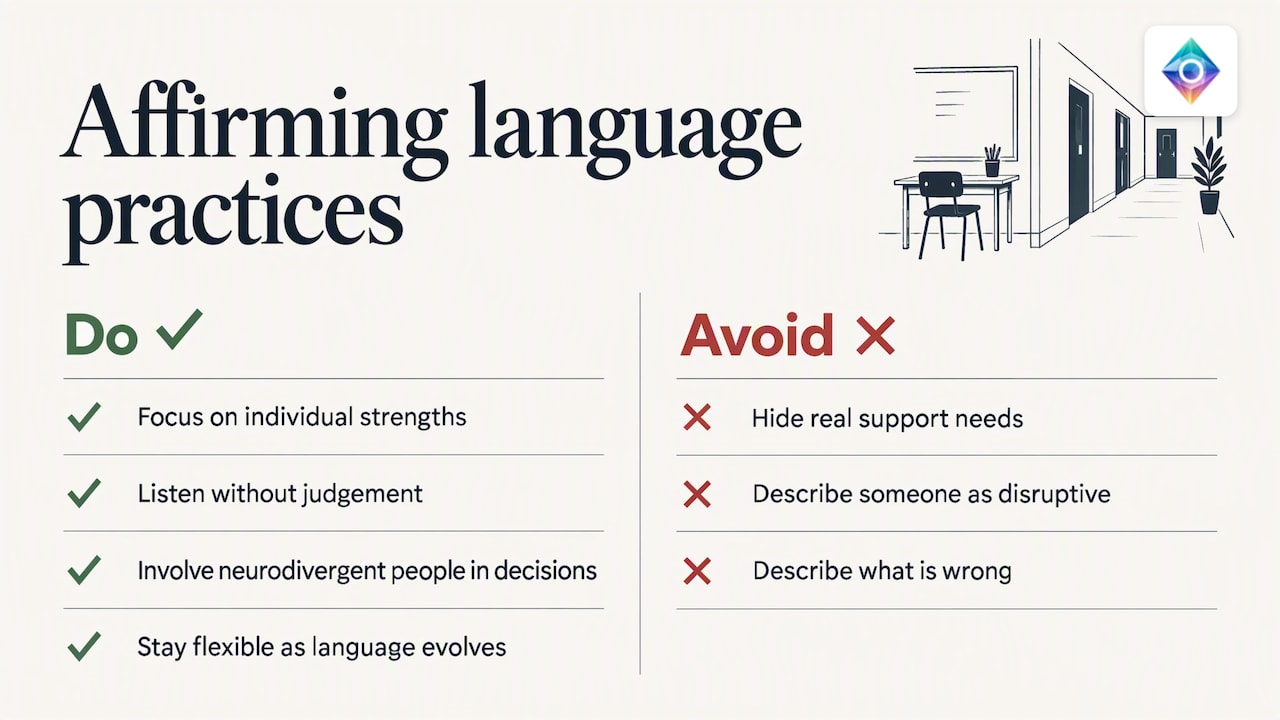
Parents, teachers and clinicians have an extra task: using affirming words without hiding real support needs. The 2025 NAIT Terminology Guide prepared for the Scottish Parliament recommends focusing on individual strengths, listening to lived experience without judgement, involving neurodivergent people in decisions and staying flexible as language evolves. It frames neuro-affirming practice around five values, including “Nothing about us without us” and “Difference, not deficit”.
In a classroom that can mean replacing “he is disruptive” with a description of what happened and what helped: “he left the room when the hand dryers started, and returned calmly once he had a quieter route”. The same approach applies to early development, where parents often meet checklists written in deficit terms; a calmer starting point is to learn what to look for when recognising speech delays and then describe what your child needs rather than what is wrong. For school settings, our guides on school adjustments for autism and classroom adjustments for ADHD in UK schools show how to put needs in plain, specific words.
Affirming language does not mean avoiding the word “disability”. GOV.UK guidance says language about disability changes over time, and in the UK the Equality Act framework still relies on that word to unlock adjustments, so many people use both “neurodivergent” and “disabled” for themselves depending on the setting.
Perspective: why we care about the words
I was diagnosed with ADHD at 42, and before that I had no vocabulary that felt like mine; the clinical terms I met described deficits, and the casual ones described character flaws. That experience shapes how we build Omniprism: results come back in plain language, as a profile across 14 areas rather than a verdict, and we do not collect your data, so the words describing you stay private to you.
We think the most useful language is specific. “Neurodivergent” is a good umbrella, but a clinician, teacher or employer needs to know whether you mean difficulty with sustained attention, sensory overload or masking. Our self-assessment is a starting point for that conversation, never a diagnosis, and the Specialist Briefing exists so you can hand a clinician a summary in their own register instead of searching for phrases under pressure.
— Valerio Cozzi
Put your own words on paper
If you are preparing for a GP or specialist appointment, the Omniprism self-assessment gives an instant profile across 14 areas with no email or account. The optional Specialist Briefing is a one-off €9.99 report that summarises your results for clinicians. For an idea of what a concise summary looks like, see our one-page neurodiversity report examples for GP appointments.
FAQ
Is it “autistic person” or “person with autism”?
There is no single correct answer, but UK sources lean towards “autistic person”. Autism Central cites a UK study in which most autistic people preferred it. If someone tells you they prefer “person with autism”, use that for them.
Can I call myself neurodivergent without a diagnosis?
Yes, because the term is nonmedical. The Cleveland Clinic describes it as applying to people whose brains develop or work differently, with or without a diagnosis. Keep in mind that a formal diagnosis is what opens up many services, so self-identification and assessment can sit side by side.
Is “neurodiverse” wrong for an individual?
Most UK guidance says so. UCL reserves neurodiverse for groups and uses neurodivergent for a person. Using the wrong one is common and rarely offensive, but the correct form signals that you have read up.
What should I do if I get someone’s preference wrong?
Correct yourself briefly, use their wording from then on, and move on. Guidance such as the New York State glossary accepts either form until a preference is known, so an honest mistake made in good faith is easy to repair.
Sources
- Kenny et al., Which terms should be used to describe autism? (Autism, 2016)
- Bottema-Beutel et al., Avoiding Ableist Language: Suggestions for Autism Researchers
- GOV.UK, Inclusive language: words to use and avoid when writing about disability
- Autism Central (NHS), How we talk about autism
- NIH, Writing Respectfully: Person-First and Identity-First Language
- NAIT Terminology Guide for the Scottish Parliament 2025
- UCL, Supporting neurodiversity in education
- Open University, What is neurodiversity?
- University of Edinburgh, Disability editorial style guide
- The Brain Charity, Neurodivergent, neurodiversity and neurotypical explained
- Cleveland Clinic, Neurodivergent
- Autism NI, Autism Language Guide
- American Academy of Pediatrics, A Primer on the Words We Use to Describe Autism
- New York State OGS, Person-First and Identity-First Language Glossary
- Shropshire and Telford & Wrekin, Neuro-Affirming Language Guide
- Just One Norfolk, What is Neurodiversity?
Recommended
- Map Neurodivergent Strengths in 14 Domains Without a Diagnosis
- Copyable One Page Neurodiversity Report Examples for GP Appointments
- Sensory Overload vs Meltdown: Map Episodes for Neurodivergent Adults
- Spiky Profile Autism: Strengths, Challenges, and Supports
Written and edited by Valerio Cozzi, founder of Omniprism. Omniprism began after my own ADHD diagnosis at 42.
This article is educational. It is not medical advice, not a diagnosis, and not a substitute for assessment by a qualified clinician. The Omniprism self-assessment is free, needs no account and no email address, and runs entirely in your browser — your answers are never sent to a server. The optional Specialist Briefing report is a paid add-on.