Executive Function Profile: What It Shows and How to Use It
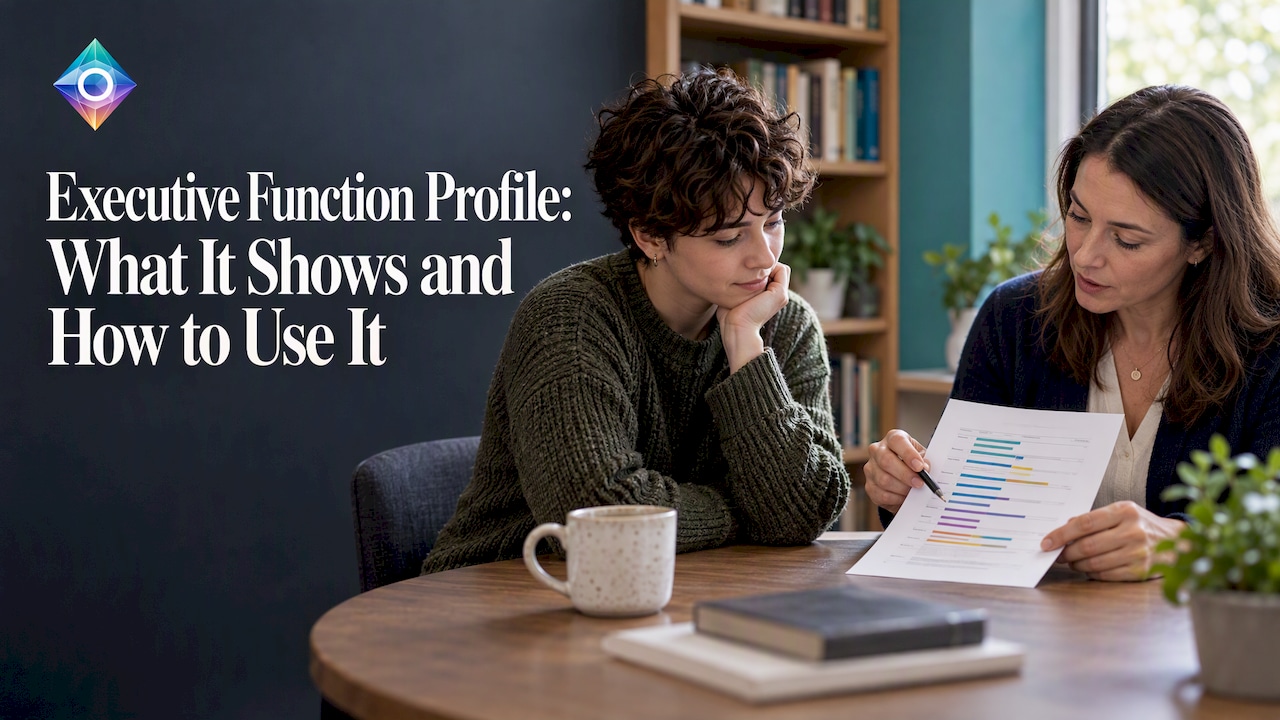
An executive function profile is a map of how you handle planning, starting tasks, holding information in mind, regulating emotion and switching between demands, showing where you are strong and where daily life takes extra effort. It is not a diagnosis: it describes patterns, and a clinician decides what those patterns mean.
Key Takeaways
- A profile describes strengths and difficulties across several skills. It is a self-awareness and support-planning tool, not a clinical or diagnostic one.
- Different models carve executive function into different domains, so two questionnaires can give you differently shaped results.
- Executive function differences appear across ADHD, autism and other neurodevelopmental conditions, so a profile alone cannot tell them apart.
- The most useful profile is one you bring to a GP or specialist with real examples attached.
What is an executive function profile?
Executive function is an umbrella term. A 2024 systematic review in Nature Human Behaviour lists the processes it covers: planning, working memory, attention, inhibition, self-monitoring, self-regulation and initiation. A profile takes those processes and shows how you rate on each, instead of giving you one score for “organisation”.
That shape matters. Someone can plan beautifully and still lose the thread of a conversation, or hold a lot in working memory and find it nearly impossible to begin a dull email. A single label such as “disorganised” hides this. A profile separates the pieces so you can see which ones to support.
The guidance that accompanies the Adult Executive Skills Profile says its purpose is to help people identify existing strengths and opportunities for improvement and to set priorities. The same guidance advises balancing the two: naming what you do well gives you a base for building strategies for the harder areas.
What are the executive function domains?
There is no single agreed list. The domains you see depend on which model the questionnaire follows. Three of the most common are below.
| Model | Domains it names |
|---|---|
| Miyake’s model | Inhibition, working memory and cognitive flexibility, with planning, reasoning and problem-solving treated as higher-order functions |
| Barkley’s model | Time management, organisation and problem-solving, restraint, self-motivation and emotion regulation |
| CEFI Adult (2022) | Attention, inhibitory control, planning, emotion regulation, initiation, self-monitoring, flexibility, working memory and organisation |
The Adult Executive Skills Profile takes a more practical route, using a cluster of 12 skills grouped around getting things done, organising and planning, and emotional reaction.
Researchers also disagree about how separate these skills really are. A 2018 review of the unity and diversity debate describes one camp arguing for a shared cognitive control process and another focusing on distinct but correlated components such as shifting and inhibition. For you, this means domain scores are useful descriptions, not hard biological compartments.
Two further distinctions are worth knowing. Researchers separate “cool” executive function, which works independently of feeling, from “hot” executive function, which is shaped by motivation and emotion. A profile that includes emotion regulation is touching the hot side. Executive skills also become more specialised from early childhood through adolescence, so a child’s profile is a snapshot that will keep shifting.
What do executive profile examples look like?
The following are illustrative shapes, not clinical categories and not real people.
- Strong planner, weak starter. High scores for planning and organisation, low for initiation and time management. The to-do list is perfect and the first step still does not happen. Our guide to ADHD task paralysis and how to start covers this pattern.
- Quick thinker, leaky memory. Good flexibility and problem-solving, but working memory and self-monitoring dip under pressure, so details drop out of multi-step jobs.
- Steady and rule-bound, thrown by change. Reliable organisation and inhibition, with low flexibility and strong emotional reactions when plans shift.
- Impulsive but organised. Systems are in place, yet restraint and emotion regulation are the weak spots, especially when tired.
A 2019 data-driven study found something close to this in real data. It identified three transdiagnostic subtypes: one defined by flexibility and emotion regulation, one by inhibition, and one by working memory, organisation and planning. They appeared across typical development, ADHD and autism alike. The authors suggest such subtypes may be more useful for personalising support than diagnostic categories alone.
Is there an ADHD subtype profile?
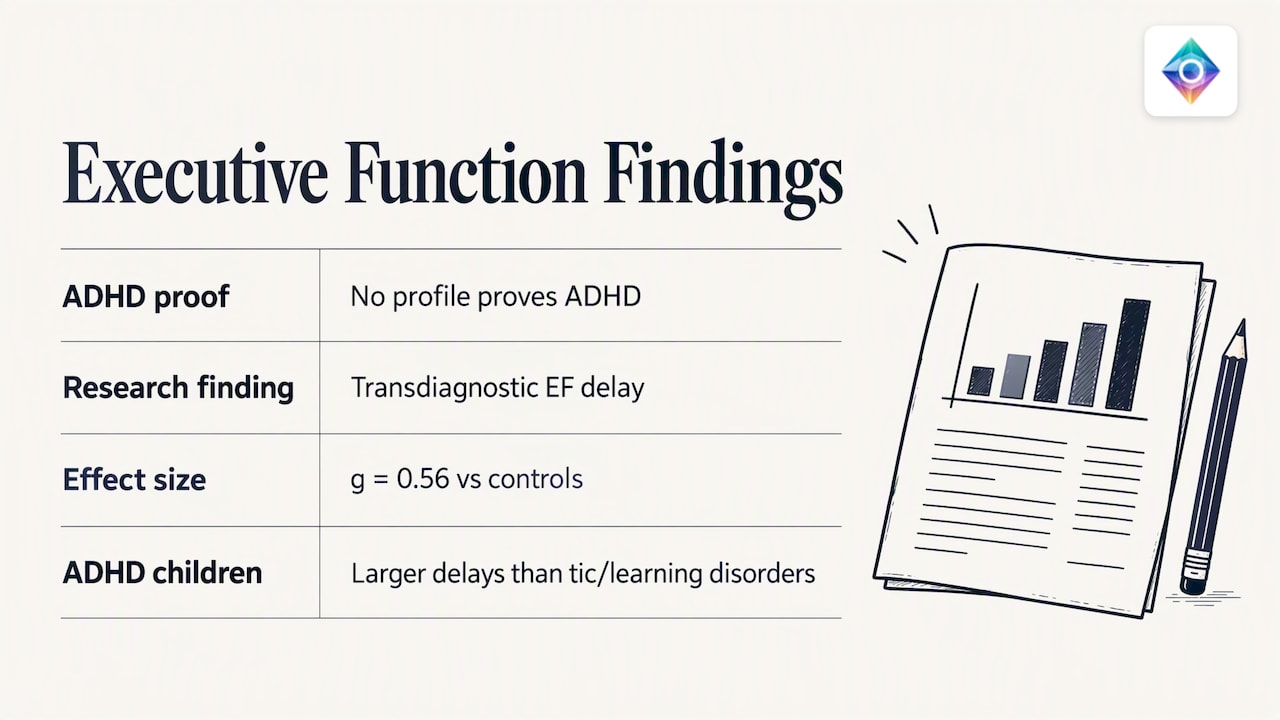
There is no executive function profile that proves ADHD. What research shows is a tendency. The 2024 Nature Human Behaviour meta-analysis found that executive function delay is a transdiagnostic feature of neurodevelopmental conditions, with a moderate effect size of g = 0.56 against neurotypical controls. The same review reported that children with ADHD showed larger delays in attention, response inhibition, planning and working memory than children with tic disorders or specific learning disorders.
So a profile with low inhibition, working memory and planning is consistent with ADHD, but it is also consistent with other things, including sleep loss, anxiety and stress. The diagnostic route in England rests on more than a questionnaire. NICE says adults should be referred to a mental health specialist trained in ADHD when symptoms began in childhood, persist and cause moderate or severe impairment. If you are weighing up whether to seek that referral, our piece on when impairment spans two areas of life sets out what clinicians look for.
How does executive function work in autism?
Executive function differences are common in autism too, and flexibility, planning and emotion regulation are often the areas people describe. Researchers have increasingly looked at the “hot” side, where emotion and motivation interact with control, in autistic groups.
The overlap with ADHD complicates the picture. The authors of a 2024 review in Nature Reviews Psychology note that research on ADHD and autism executive profiles is limited, because most studies have not accounted for the other condition occurring alongside. That is why a profile cannot sort a person into one box. If you suspect both, our articles on the overlap between autism and ADHD and on autism versus ADHD symptoms explain how clinicians separate them, and the guide for parents on autism misdiagnosed as ADHD is worth reading if a child is involved.
How do you read your own profile?
Follow these steps once you have results from any questionnaire:
- Find your two or three lowest areas. Ignore small differences. Look for the domains that clearly stand out.
- Find your highest areas. These are the skills you can lean on when building workarounds.
- Attach a real example to each. “Initiation is low” is vague. “I put off a three-minute form for two weeks” is something a clinician can use.
- Check for context. Poor sleep, burnout, low mood and a chaotic environment all depress executive function. Note whether your difficulties are lifelong or recent.
- Choose one change per low area. A reminder, a body-double session, or a smaller first step. If decisions drain you, matching tactics to your brain helps.
- Take it to a professional if the impact is serious. Bring the profile and your examples to your GP.
A caution on interpretation: a single test result is not enough to evaluate executive function. Assessments need to sit within a full evaluation covering several domains.
How can parents and teachers use an executive function profile?
For children and teenagers, the profile is best used as a conversation starter with school. Instead of reporting “he can’t focus”, you can say that working memory and organisation look low while flexibility is a strength. That points to specific supports: written instructions, checklists, visual timetables, chunked tasks.
Behaviour and emotion are tied up in this. Skills like naming and managing feelings affect participation and schoolwork as much as planning does, and routines such as emotion check-in scripts for teachers show how a short daily practice can be built into a classroom.
If your child is dyslexic, executive function and reading load interact heavily. Our list of study strategies for dyslexic students gives concrete starting points. For related traits that can look like executive difficulty, such as compulsive checking, see ADHD versus OCD.
To understand the broader picture of what is going on when these skills break down, our guide to executive dysfunction, its causes and what helps is the natural next read.
Our perspective
I was diagnosed with ADHD at 42, and what I would have wanted earlier was not a label but a clear description of how my own attention and planning behave.
That is how we think about profiles at Omniprism. Executive function is one slice of a wider picture, and we look at it alongside other traits across 14 areas, including ADHD, autism, dyslexia, masking, dyspraxia, dyscalculia and sensory processing. We think a profile earns its place when it makes the next conversation easier: with a clinician, a teacher or yourself.
We built the tool so that you need no email, no account, and no data collection to use it, because people reflecting on their own minds should not have to hand over personal details first. Results arrive instantly in plain language. We also treat the profile as a starting point and never as a verdict, which is why we point people towards clinical assessment when the impact on daily life is significant.
— Valerio Cozzi
Where can you get an executive function profile with Omniprism?
Our free self-assessment gives you an instant profile across 14 areas, with guided versions for children and teenagers. If you want something to hand to a clinician, the optional Specialist Briefing summarises your results for them as a one-off purchase at €9.99. Professionals can see how we work on our page for psychologists and coaches, and our disclaimer explains what the tool can and cannot do.
FAQ
Can an executive function profile diagnose ADHD or autism?
No. A profile describes how you function across skills, and the guidance behind the Adult Executive Skills Profile states that it is not a clinical or diagnostic tool. Diagnosis involves a specialist reviewing your history and the impact on your life. The profile can make that appointment more focused.
How many executive function domains are there?
It depends on the model. Miyake’s framework names three core components, Barkley’s names five, and CEFI Adult measures nine. The Adult Executive Skills Profile uses 12 skills. They overlap heavily, so the number says more about how finely a tool slices the same territory than about biology.
Does everyone with ADHD have the same executive function profile?
No. Research shows executive function delay is common across neurodevelopmental conditions, and the 2019 data-driven study found subtypes that cut across ADHD, autism and typical development. Two people with the same diagnosis can have quite different strengths. That is why looking at your own domain-by-domain pattern is more useful than relying on the label.
Can a child complete an executive function profile?
Children can take part, usually with a parent or guardian helping, and age-appropriate versions exist. Because executive skills keep developing through adolescence, treat a child’s profile as a current snapshot. Our guided assessments cover ages 7 to 10 and ages 11 to 13.
Sources
- Executive function in children with neurodevelopmental conditions, Nature Human Behaviour (2024)
- Executive function deficits in ADHD and autism, Nature Reviews Psychology (2024)
- Data-driven identification of subtypes of executive function (2019)
- Executive Function in Autism Spectrum Disorder: History, Theory and Findings (2019)
- Comparing Executive Functions in Children and Adolescents
- The Unity and Diversity of Executive Functions (2018)
- A Developmental Perspective on Executive Function
- NICE guideline NG87: ADHD recommendations
- Guidance for Administering the Adult Executive Skills Profile (2015)
- CEFI Adult brochure, MHS (2022)
- Types of tests for executive function challenges, Understood
Recommended
- Executive Dysfunction: Causes, Signs, and What Helps
- 5 Clinician Backed Ways to Harness Hyperfocus in ADHD
- Turn an Online ADHD Test Covering 14 Domains Into Clinician Ready Evidence
- Families and Adults: Make Online Dyspraxia Tests Clinician Ready
Written and edited by Valerio Cozzi, founder of Omniprism. Omniprism began after my own ADHD diagnosis at 42.
This article is educational. It is not medical advice, not a diagnosis, and not a substitute for assessment by a qualified clinician. The Omniprism self-assessment is free, needs no account and no email address, and runs entirely in your browser — your answers are never sent to a server. The optional Specialist Briefing report is a paid add-on.