6 Evidence Backed Study Strategies Dyslexic Students Can Try This Week

Use multisensory study, active self-testing and assistive technology together to cut cognitive load and improve what sticks in memory. This combination is what university support services, including guidance from LSE’s SpLD study guide, and the British Dyslexia Association recommend to students with dyslexia. The numbered list below sets out exactly how to put each piece into practice this week.
TL;DR:
- Using a combination of multisensory chunking, active retrieval, spaced studying, and assistive technology significantly enhances memory and understanding for dyslexic learners.
- Breaking large tasks into smaller steps with mini-deadlines and working in short, focused bursts reduces anxiety and improves task management.
- Converting notes into question-and-answer formats within 24 hours boosts long-term retention and minimizes the risk of notes fading, but many students skip this step.
- Active recall through self-testing and spaced repetition leads to stronger exam performance compared to passive review or re-reading.
- Securing formal exam adjustments, like extra time and accessible formats, is essential since strategies alone often cannot compensate for assessment demands.
1. The most effective study strategies for students with dyslexia
Some approaches carry more weight than others, and the ones below are the strategies that appear consistently across university SpLD guidance and classroom practice.
- Chunk and multisensory learning: split a topic into small labelled chunks, then study each one using sight, sound and movement together to enhance memory and understanding.
- Active retrieval: write your own questions from a topic, then answer them from memory before checking your notes, a method the Open University’s dyslexia guidance treats as central to moving facts into long-term memory.
- Spacing and interleaving: study a topic in short sessions spread across days and mix subjects within a week to promote better recall and understanding.
- Structured note-making: use Cornell notes or mind maps, and revisit them within 24 hours of the lecture or reading session to convert fragile short-term notes into something durable.
- Assistive technology: text-to-speech, dictation and mind-mapping apps lower the reading and writing load so more attention goes to understanding the material itself.
- Self-advocacy: keep a short record of which adjustments and strategies worked for you in the past so you can request them again without starting from scratch.
Each of these works better in combination than alone. A student who chunks a topic, then tests themselves on it two days later using a mind map they built the same day, is stacking three separate memory advantages rather than relying on one.
2. Organisation and time management strategies for dyslexic learners
Dyslexia often makes large, undefined tasks feel paralysing, so the fix is structural rather than motivational.
- Break every assignment into labelled steps with its own mini-deadline, so “write the essay” becomes four or five smaller jobs you can tick off.
- Work in short, focused bursts of 20 to 30 minutes rather than long unbroken sessions, matching study blocks to your own processing speed instead of a generic timetable.
- Set up one folder or notebook per topic, colour-coded consistently, so finding material never costs you working memory you need for the actual studying.
- Review new material within 24 hours of first meeting it, then do a short cumulative check once a week to catch anything slipping.
This routine does double duty: it reduces the anxiety of an open-ended task list, and it builds in the spacing that memory research consistently favours over cramming.
3. Note-taking and note-making: how to capture and convert information into study material
Capturing information and turning it into study material are two different jobs, and treating them separately is what makes notes useful later.
- Before the lecture or reading: preview slides or chapter headings and highlight unfamiliar terms, so your brain meets new vocabulary once before it meets it at speed.
- During the lecture: use your own abbreviations and visual markers rather than full sentences, or record audio with the lecturer’s permission if typing or handwriting can’t keep pace.
- Within 24 hours afterwards: convert the raw notes into question-and-answer pairs and tidy them into a Cornell layout or mind map. The LSE SpLD guide specifically recommends this conversion step to improve encoding, and the Open University points to the same 24-hour window as the point where notes either get fixed into long-term memory or start to fade.
- Compare notes with a classmate once a week to fill gaps and check spelling or terminology you might have misheard or misread.
The conversion step is the one students skip most often, and it’s the one that actually does the work. Notes that sit untouched in a notebook rarely survive to exam season.
4. Memory and revision: active recall, spacing and low-friction testing
Re-reading feels productive because it’s familiar, but it teaches recognition, not recall, which is the skill exams actually test. A systematic review of active recall strategies links retrieval practice to stronger academic performance, and the mechanism is simple: forcing your brain to produce an answer, rather than just recognise one, strengthens the memory pathway far more than passive review does.
- Turn every topic into a short set of questions and answer them from memory before checking.
- Space your revisits: see a topic on day one, again on day three, then again a week later, rather than repeating it five times in one sitting.
- Take an old past paper or mark scheme and rewrite its questions as retrieval prompts, so your practice matches what the exam will actually ask.
A practical, STEM-friendly breakdown of this approach is available from AnyLearns’ guide to active recall, and students tackling maths specifically may find Math Vault’s active recall guide useful for problem-based subjects.
Pro Tip: At the end of each study session, close your notes and write down everything you remember on a blank page before checking what you missed.
5. Assistive technology: built-in and specialist tools to reduce cognitive load
Most of the useful tools are already on the devices you own, which makes this the cheapest strategy to trial.
- Text-to-speech: both Windows and Mac have built-in screen-reading features, and most browsers support extensions that read web pages and PDFs aloud.
- Dictation: voice-to-text tools let you draft essays by speaking, which separates the thinking from the spelling and typing.
- Mind-mapping apps: digital mind maps make it easy to rearrange ideas without rewriting, which suits a non-linear way of organising information.
- Trial before you buy: many institutions run assistive technology lending libraries, and a recent UK government programme specifically backs this approach so learners can test a device against their own needs before anyone commits to buying it.
The British Dyslexia Association names text-to-speech and mind-mapping tools specifically as ways to reduce the cognitive overload that comes from reading and writing demands competing with comprehension.
6. How to secure reasonable adjustments and exam access arrangements
Reasonable adjustments exist precisely because the strategies above only go so far without extra time or format changes in formal assessment.
- Common adjustments include extra time, alternative formats such as larger print or digital papers, and permission to use assistive technology in exams.
- In the UK, the Equality Act 2010 places an anticipatory duty on education providers to make reasonable adjustments, though the exact arrangements still depend on the exam board’s own rules, so check those directly.
- Bring a diagnostic report to your institution’s disability service, and notify them as early as possible since processing takes time.
- A short script to start the conversation: “I have a dyslexia diagnosis and I’d like to discuss what adjustments are available before my next assessment.”
7. Research-backed takeaways: what the evidence says and two trial actions
- University SpLD guides from LSE and the Open University both point to structured, multisensory approaches and 24-hour note review as practical wins.
- A modality study on learners with dyslexia found that pairing onscreen text with images sometimes improves comprehension, though the effect depends on the individual and the material.
- Trial one: convert your notes to Q&A format within 24 hours for a week and see whether recall at the end of the week feels noticeably easier.
- Trial two: swap one re-reading session for a closed-book self-test and compare how much you can recall unprompted afterwards.
Strategies for improving reading fluency and decoding skills
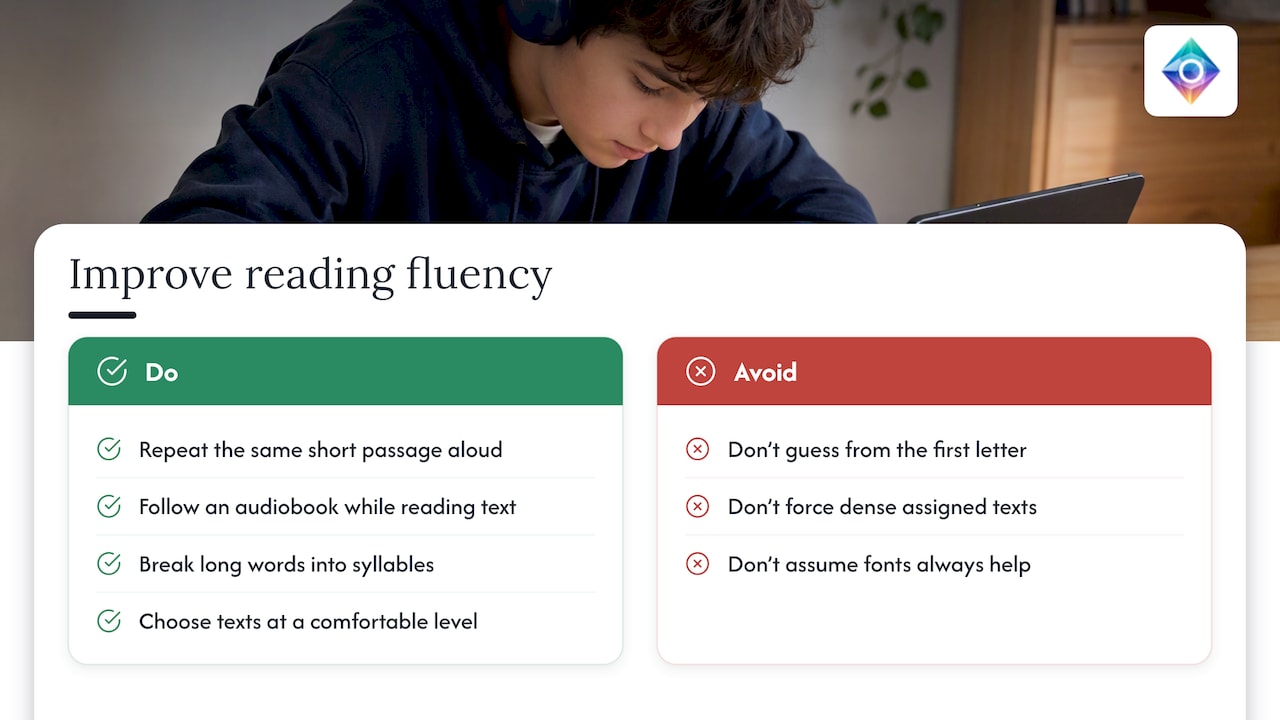
Fluency problems in dyslexia usually sit at the level of decoding, meaning the brain is working harder than it should to turn letters into sounds, which leaves less capacity for actual comprehension. Reading the same short passage aloud several times, a technique sometimes called repeated reading, gives the brain practice at recognising the same word patterns without the pressure of new material every time.
Following along with an audiobook while reading the printed or digital text pairs the sound of the word with its shape on the page, reinforcing the two together rather than asking the eyes to do all the work alone. Breaking long words into syllables before attempting them, rather than trying to read the whole word in one go, reduces the chance of guessing from the first letter alone, which is a common dyslexic reading pattern.
Choosing texts that are genuinely at a comfortable level, rather than the assigned reading level, builds fluency faster than struggling through material that’s too dense. A dyslexia-friendly font such as those with wider letter spacing can also reduce the visual crowding that makes some letters harder to distinguish from each other, though the benefit varies from person to person and is worth testing rather than assuming.
Fluency work pays off beyond reading itself, because the less effort decoding takes, the more working memory is free for actually understanding and remembering the content, which connects directly to the active recall strategies covered earlier.
Approaches to phonemic awareness and phonics tailored for dyslexic learners
Phonemic awareness, the ability to hear and manipulate individual sounds within words, often needs more explicit and structured teaching for dyslexic learners than it does for other readers. Structured, cumulative phonics programmes that build one sound-letter relationship on top of another, rather than assuming earlier patterns are already secure, tend to suit dyslexic learners better than programmes that move quickly through content.
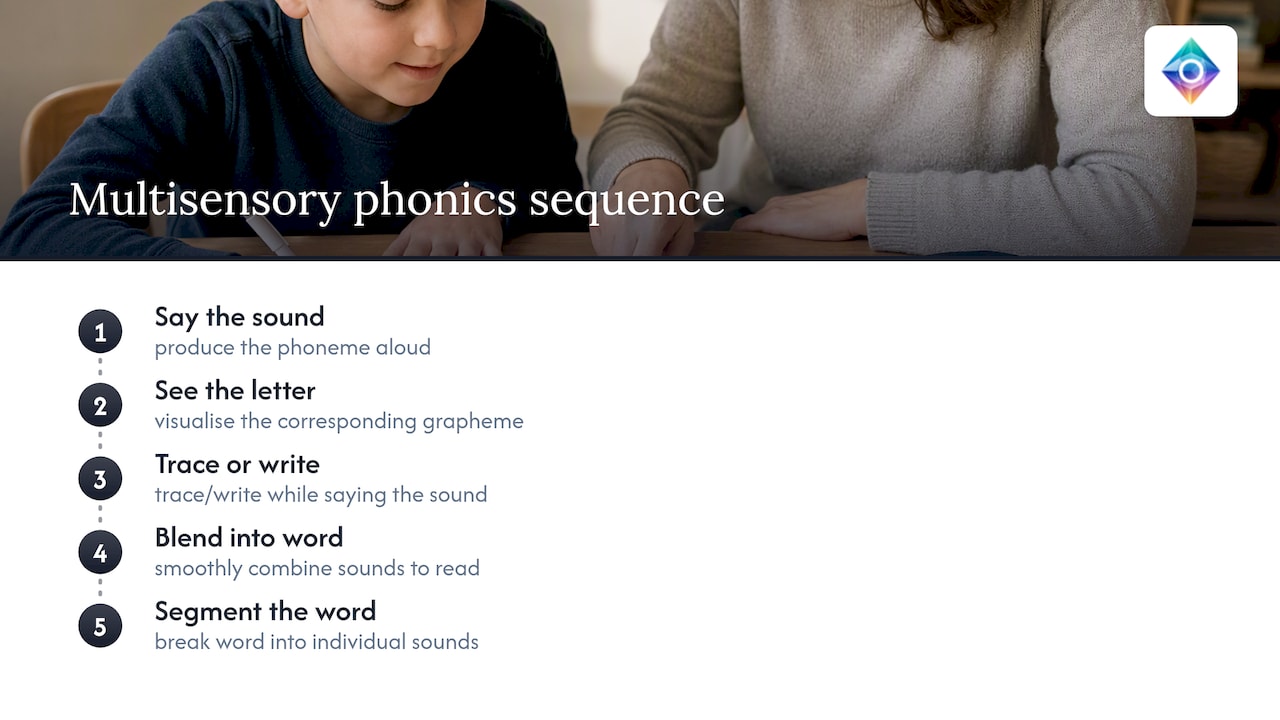
Multisensory phonics, where a student says a sound, sees the letter and traces or writes it at the same time, reinforces the sound-symbol link through more than one pathway, which matches the multisensory principle covered in the strategies list above. Breaking words into their smallest sound units, blending them, then practising segmenting them back apart, gives repeated low-stakes practice at the skill that underlies both reading and spelling.
For older students who have already had phonics instruction at school, a brief refresher on specific sound patterns that still cause trouble, rather than a full programme, is usually a more realistic use of time. This is also an area where working with a specialist tutor or support service makes a genuine difference, since diagnosing exactly which sound patterns are weak takes a trained ear.
Tips for managing and reducing anxiety related to study and exams
Anxiety and dyslexia feed each other: the fear of being caught out by a reading or spelling mistake adds pressure on top of the processing demands dyslexia already creates, and the two together can shut down performance before the actual knowledge gap is the problem. Naming the specific worry, whether it’s running out of time, misreading a question, or freezing on a word, makes it easier to address directly rather than letting it stay as a vague sense of dread.
Practising under exam-like conditions, including timed past papers with the same access arrangements you’ll have on the day, removes some of the uncertainty that drives anxiety, since the exam format becomes familiar rather than unknown. A short, consistent pre-exam routine, even something as simple as five minutes of slow breathing or a short walk, gives the nervous system a predictable cue that it’s time to settle rather than panic.
Reframing a reasonable adjustment as a levelling tool rather than a special favour also helps: extra time or a reader isn’t an advantage, it’s parity with how other students experience the same test. Students who have already gathered evidence of what adjustments work for them, as covered in the earlier section on exam access arrangements, tend to walk into exams with less uncertainty about what support will actually be there.
Parental and teacher support techniques to reinforce study strategies
Parents and teachers do the most good by reinforcing the structures a dyslexic student is already building rather than introducing new systems that compete with them. Checking in briefly on whether notes got converted to Q&A format within the 24-hour window, rather than checking the content itself, supports the habit without taking over the learning.
Modelling the chunking approach when helping with homework, breaking a task into labelled steps together rather than simply pointing out what’s left to do, teaches the skill rather than just managing the task on the student’s behalf. Teachers can support the same goal by making slides and reading lists available in advance, so a student has time to preview unfamiliar vocabulary before the lesson rather than meeting it cold.
Encouraging a student to keep their own record of which adjustments and strategies have worked builds the self-advocacy skill covered earlier in a low-pressure way, since it becomes a shared project rather than a confrontation. Praising the process, such as sticking to a spaced revision schedule, rather than only the outcome, also matters, since dyslexic students often receive more correction than encouragement across a school career, and that balance is worth actively redressing at home and in the classroom.
A short note on why this matters to me
I was diagnosed with ADHD at 42, and that late diagnosis shaped why clear, practical frameworks like the checklist above matter so much to me: understanding how your own brain works changes which strategies are worth trying first, rather than everyone guessing in the dark.
— Valerio Cozzi
Where a self-assessment can help you choose faster
Reading a list of strategies is useful, but working out which ones matter most for your own profile is a different task entirely. Our self-assessment gives you an instant, plain-language profile across 14 areas, including dyslexia, without any account, email or data collection, so you can see which traits are shaping your study challenges before you commit time to one approach over another. For students who want to take that further, our Specialist Briefing turns your results into a clinician-friendly summary for 9.99 EUR, useful if you’re heading into a conversation with a tutor, disability adviser or healthcare professional. Parents exploring this for a child or teenager can start with our guided assessments for young people.
This article is general information, not a substitute for advice from a qualified doctor. Consult a qualified healthcare professional about your own circumstances before acting on anything here.
FAQ
What are the four D’s of dyslexia?
The “four D’s” isn’t a standard clinical term, and definitions vary depending on the source. Most informal versions point to difficulties with decoding, directionality, dates or sequencing, and discrepancy between ability and performance, but this framing isn’t used in formal diagnostic guidance.
What are the top five study techniques?
The strongest evidence-backed techniques are active recall, spaced and interleaved revision, multisensory learning, structured note-making converted into question-and-answer format, and the use of assistive technology such as text-to-speech. A systematic review of active recall links retrieval-based study specifically to stronger academic outcomes.
What strategies work well for dyslexic students specifically?
Chunking material into smaller sections, using multisensory input, converting notes to Q&A within 24 hours, and trialling assistive technology such as mind-mapping apps all appear consistently in university SpLD guidance from LSE and the British Dyslexia Association. Reasonable adjustments in formal assessments also matter alongside day-to-day study habits.
Can dyslexic students do well academically?
Yes, dyslexia affects how certain information is processed, not underlying intelligence, and with the right combination of study strategies and, where relevant, exam adjustments under the Equality Act 2010, many dyslexic students perform strongly at school and university level.
Sources
- British Dyslexia Association — reasonable adjustments in education
- LSE — Studying at LSE: SpLD study guide (Aug 2021)
- Open University — Studying with dyslexia
- Multimedia/modality study on dyslexic learners (PubMed)
- Systematic review: active recall and academic achievement (PubMed)
- Gov
Recommended
- Parents & Teachers: Four Steps to Tell Dyscalculia From Dyslexia
- 25–50% Overlap: Parents & Teachers’ Action Plan for ADHD and Dyslexia
- Three Fixes Teachers Can Use to Make a Sensory Friendly Classroom
Written and edited by Valerio Cozzi, founder of Omniprism. Omniprism began after my own ADHD diagnosis at 42.
This article is educational. It is not medical advice, not a diagnosis, and not a substitute for assessment by a qualified clinician. The Omniprism self-assessment is free, needs no account and no email address, and runs entirely in your browser — your answers are never sent to a server. The optional Specialist Briefing report is a paid add-on.