5 Clinician Backed Ways to Harness Hyperfocus in ADHD

Hyperfocus is an intense, prolonged absorption in a task that shows up in most people with ADHD at some point, and it can run for hours without the person noticing. It boosts output on the right project and wrecks a schedule on the wrong one. Understanding what triggers it, what it costs, and how to redirect it is the real skill, and that’s what the rest of this guide covers.
TL;DR:
- Hyperfocus is triggered by novelty, high personal interest, low external structure, and high stimulation, often occurring during work, gaming, or creative activities.
- It can last hours to days, with signs like losing track of time, neglecting self-care, and difficulty switching tasks, predominantly affecting activities with high engagement.
- Managing hyperfocus effectively involves external cues like alarms, scheduled focus windows, and preparing return notes, since it cannot be controlled by willpower alone.
- Hyperfocus may enhance productivity in specific work scenarios but often leads to missed responsibilities and strained relationships, especially in rigid schedules or caretaking roles.
- Self-assessments can help identify attention patterns and guide decisions for professional support, with notable differences in hyperfocus detection between genders and across age groups.
Table of Contents
- What Hyperfocus in ADHD Actually Means
- What Hyperfocus Feels Like Day to Day
- Why Hyperfocus Happens in the ADHD Brain
- The Double Edge: Benefits, Harms, and What the Data Shows
- How to Manage, Interrupt, or Put Hyperfocus to Work
- When Hyperfocus Signals It’s Time to Get Help
- Where a Self-Assessment Fits Into the Picture
- Hyperfocus Looks Different by Age and by Gender
- The Ripple Effect: Work, Relationships, and School
- Living With Hyperfocus: An Editorial Take
- Try Omniprism’s Free Self-Assessment First
- Sources
What Hyperfocus in ADHD Actually Means
Hyperfocus describes intense, prolonged concentration on a single activity, usually one the brain finds highly stimulating or rewarding. The Child Mind Institute describes it as a state where time perception fades and shifting attention away from the task becomes genuinely difficult, not just inconvenient. You’ve probably lived this: three hours disappear into a coding problem, a novel, or a home renovation project, and lunch never happened.
Hyperfocus is not listed in the DSM-5 as a diagnostic symptom of ADHD, but clinicians and researchers observe it constantly in people who have the condition. It sits alongside inattention and impulsivity as a kind of mirror image, the same attention-regulation glitch showing up as too much focus instead of too little.
Where it differs from flow matters more than people realize. Flow, as described in the psychological literature, involves a clear goal, a task matched to skill level, and preserved awareness of your surroundings. Research comparing the two states finds hyperfocus lacks that controllability. You don’t choose to enter it and you often can’t choose to exit.
Three things separate the two states in practice:
- Flow keeps you aware of time passing; hyperfocus often erases it entirely.
- Flow is something you can enter and leave deliberately; hyperfocus tends to grab hold and not let go.
- Flow requires a task that stretches your skill; hyperfocus can happen on something with zero challenge, like scrolling.
What Hyperfocus Feels Like Day to Day
Hyperfocus rarely announces itself. It creeps in through a task that feels interesting enough to swallow every other signal your body is sending. The most common signs include:
- Losing track of time to the point where hours vanish and meals, texts, or appointments get skipped entirely.
- Tunnel vision on one task while everything else, including physical needs like thirst or the need to use the bathroom, gets ignored.
- Irritability or a sharp startle response when someone interrupts, similar to being pulled out of a dream.
- Difficulty switching gears even after recognizing the task needs to end.
- Neglected self-care, including skipped showers, missed medication doses, or ignored fatigue.
The activities that pull people in tend to share a trait: high stimulation or high personal interest. Video games, creative writing, coding, research rabbit holes, and even cleaning binges show up often. A child might hyperfocus on building an elaborate Lego world and miss a parent calling from the next room three times. An adult might sit down to “quickly check” a work email and resurface five hours later having redesigned an entire spreadsheet system nobody asked for.
Why Hyperfocus Happens in the ADHD Brain
Hyperfocus isn’t a discipline problem. It traces back to how the ADHD brain handles reward and attention switching. Some experts reframe attention deficit itself as a deficit in attention control, not attention capacity. The brain can focus intensely. It just struggles to redirect that focus once it locks on, which is why ADHD hyperfocus so often looks like the opposite of the “can’t concentrate” stereotype.
Certain conditions make hyperfocus more likely to fire:
- Novelty: a new game, a new project, a new obsession.
- High personal interest: topics tied to a hobby or a special interest.
- Low external structure: no deadline, no one checking in, an open afternoon.
- High stimulation: fast feedback loops, like gaming or social media.
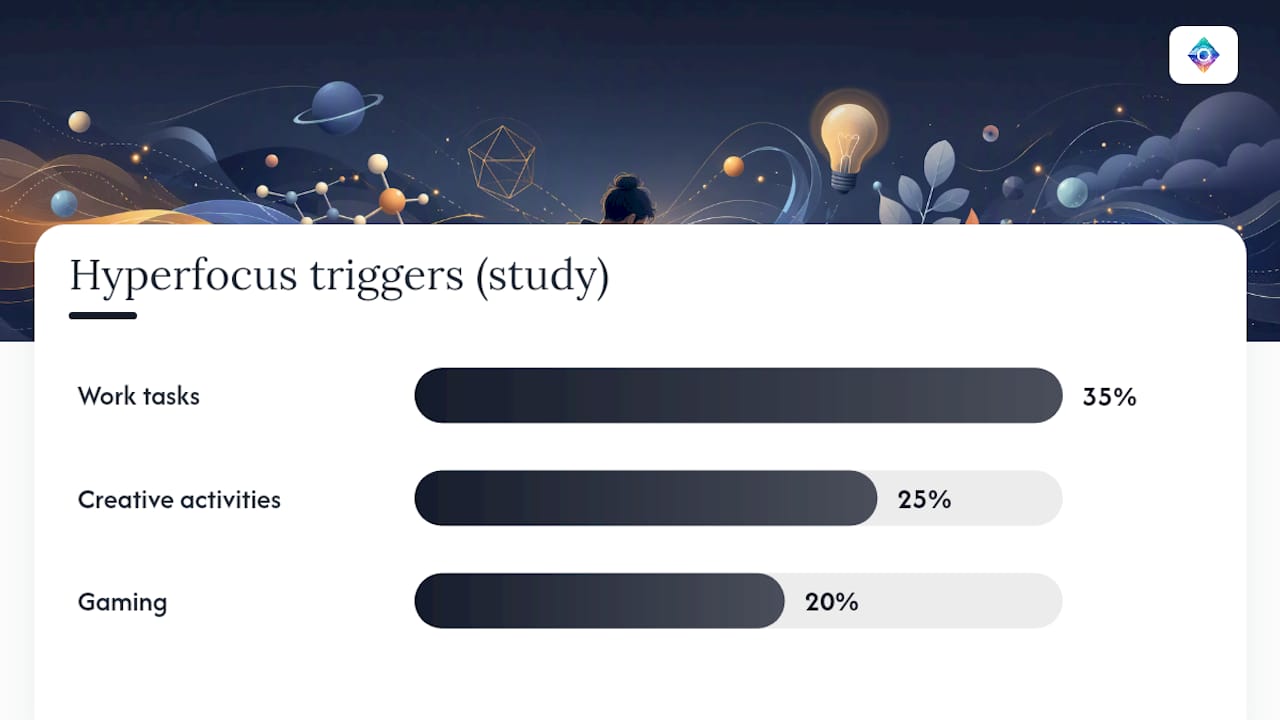
A 2025 mixed-methods study of 50 adults with ADHD found work tasks triggered hyperfocus in 35% of cases, creative activities in 25%, and gaming in 20%. That spread tells you something useful: hyperfocus isn’t just a distraction magnet. It attaches to whatever offers the strongest reward signal at that moment, work included.
Autism spectrum overlap changes the picture too. Reviews of attentional strengths across ASD and ADHD find similar intense-focus patterns in both conditions, sometimes framed as a strength rather than a symptom. When ADHD and autistic traits co-occur, hyperfocus can present with more rigid or narrow interests and less flexibility around interruptions.
The Double Edge: Benefits, Harms, and What the Data Shows
Hyperfocus cuts both ways, and the research backs that up with real numbers instead of vague impressions. In that same 2025 study of adults with ADHD, many reported frequent hyperfocus episodes lasting anywhere from hours to days. Among those, some linked hyperfocus to increased work productivity. However, others reported neglecting responsibilities during episodes and described negative social impacts, including canceled plans and strained relationships. The sample is small, just 50 people, so treat the percentages as a signal rather than a settled fact, but the pattern lines up with what clinicians report anecdotally.
| Effect Type | Example | Reported Impact |
|---|---|---|
| Benefit | Deep work on a work project | 30% linked hyperfocus to higher productivity |
| Harm | Missed responsibilities | others reported neglecting responsibilities during episodes |
| Harm | Strained relationships | 55% reported negative social effects |
| Risk factor | Screen-based hyperfocus | Can become nonproductive “screen sucking” with no real cognitive payoff |
That last row matters. The Child Mind Institute draws a real distinction between productive hyperfocus and the kind that happens on a phone feed, where the brain is stimulated but nothing is actually being built or learned.
Job type and daily structure change the math substantially. A freelance designer whose hyperfocus lands on client work gets rewarded for it. A parent whose hyperfocus lands on an online forum while a child needs attention pays a real cost. People in flexible, self-directed roles tend to report hyperfocus as a net asset. People with rigid schedules or caretaking duties report it more often as a liability. The activity itself isn’t the deciding factor. Where and when it happens is.
How to Manage, Interrupt, or Put Hyperfocus to Work
You can’t switch hyperfocus off through willpower alone, because it isn’t a willpower problem in the first place. Cleveland Clinic clinicians frame the fix around external, environmental cues rather than internal self-control, since hyperfocus is often driven by automatic attention rather than a decision you’re making in real time.
Tactics that actually hold up:
- Set a timer or alarm before starting a task you know can absorb you, using something like the Pomodoro method (25 minutes on, 5 off) to force a checkpoint.
- Ask someone nearby to physically interrupt you at a set time; a text or verbal nudge works better than relying on your own sense of “I’ll stop soon.”
- Build a dedicated hyperfocus window into your schedule for high-value work, so the same intensity that derails a Tuesday afternoon gets pointed at a project that actually needs it.
- Use “when-then” contingencies (“when the timer goes off, then I stand up and refill my water”) to create an automatic exit ramp instead of relying on a fresh decision each time.
- Keep water, snacks, and medication visible and within reach, since hyperfocus tends to override basic body signals.
The tactic that tends to surprise people the most is the return note.
Pro Tip: Before you get pulled into a hyperfocus session, jot a one-line “return note”: what you were about to do next, and where you left off. When the timer breaks the spell, that note does the mental work of re-orientation for you, so you’re not staring at a screen trying to remember what you were even doing an hour ago.
Structuring study or work blocks around fixed intervals rather than “however long it takes” also pairs well with general time management strategies built for high-stakes, time-boxed performance, even outside the ADHD context. On the workplace side, negotiating flexible deadlines or a heads-up system with a manager can turn hyperfocus from a liability into a scheduled asset.
When Hyperfocus Signals It’s Time to Get Help
Hyperfocus on its own isn’t a red flag. It becomes one when the pattern starts costing you relationships, your job, or your health on a regular basis.
Watch for:
- Hyperfocus episodes that repeatedly cause missed work deadlines or job warnings.
- Skipped meals, medication, or sleep that happen often enough to affect physical health.
- Repeated conflict with a partner, family member, or friend over being “checked out.”
- A pattern that started or worsened alongside other ADHD signs, like chronic disorganization or time blindness.
A clinical evaluation typically checks hyperfocus against broader DSM-5 ADHD criteria, since hyperfocus alone doesn’t diagnose anything. Support options range from behavioral coaching and environmental changes to, in some cases, medication targeting the underlying ADHD rather than hyperfocus itself, since no medication specifically targets hyperfocus. A clinician can also help rule out overlapping red flags worth tracking alongside it.
Where a Self-Assessment Fits Into the Picture
A structured self-assessment gives you language for what’s happening before you ever sit down with a clinician. A free self-assessment tool can map attention patterns, along with various other cognitive domains, into a plain-language profile you can read in minutes.
That profile won’t diagnose hyperfocus or ADHD. What it does is give you a clearer sense of where your attention regulation sits relative to common patterns, which makes the conversation with a doctor or therapist far more specific than “I think I space out a lot.” Think of it as a starting map, not a destination.
Hyperfocus Looks Different by Age and by Gender
A seven-year-old hyperfocused on Legos looks nothing like a 45-year-old hyperfocused on a work spreadsheet, but the underlying mechanism is the same attention-switching difficulty. Kids tend to show hyperfocus around play, screens, and special interests, and because their schedules are managed by someone else, the consequences show up fast: a missed dinner call, an unfinished homework assignment, a meltdown when a tablet gets taken away.
Teenagers often redirect that same intensity toward gaming, social media, or a single academic subject they find genuinely engaging, while other classes suffer from the inattentive side of the same coin. Adults carry more responsibility and more consequence. A missed work deadline or a forgotten anniversary lands harder than a skipped snack.
Gender differences show up less in the mechanism and more in how hyperfocus gets noticed. Boys and men with ADHD are diagnosed more often in childhood, partly because hyperactive and disruptive behavior draws attention faster than quiet absorption. Girls and women often get missed for years, and their hyperfocus, frequently directed at reading, organizing, or a specific relationship, gets mislabeled as diligence or introversion rather than flagged as a symptom worth evaluating. That delay means many women don’t get a name for the pattern until adulthood, often after a partner or employer points out the swings between total absorption and total distraction.
The Ripple Effect: Work, Relationships, and School
Hyperfocus at work can look like a superpower right up until it isn’t. An employee who disappears into a report for six straight hours might produce brilliant work and also miss two meetings, a client call, and a deadline on an unrelated task. Managers who understand this can build in checkpoints; those who don’t tend to read the missed meetings as a lack of commitment. Reasonable workplace accommodations, like flexible scheduling around deep-work blocks, turn this from a liability into a genuine asset.
Relationships absorb a quieter version of the same cost. A partner who hyperfocuses on a hobby for an entire weekend isn’t choosing the hobby over the relationship, but it can feel that way to the person left waiting for a text back. It’s canceled dinners, unanswered calls, and a partner who eventually stops asking where you’ve been.
In school, hyperfocus can mean a student aces the one subject that grabs them and falls behind everywhere else. A kid obsessed with dinosaurs might write a flawless research report and completely blank on a math assignment due the same day. Teachers who spot the pattern early can redirect it, offering choice in assignments where possible, instead of treating the uneven performance as laziness.
Living With Hyperfocus: An Editorial Take
Hyperfocus is genuinely confusing to live with, because the same trait that gets you praised one week gets you in trouble the next. A simple framework helps more than trying to white-knuckle your way through it: notice when you’re sliding in, tag the activity honestly (“this is hyperfocus, not just interest”), then plan an exit before you start. Experiment with what actually interrupts you. Not every trick works for every brain.
— Valerio
Try Omniprism’s Free Self-Assessment First
If any of this sounds familiar, Omniprism gives you a faster starting point than guessing alone or waiting months for a clinical appointment. The free self-assessment delivers an instant profile across 14 domains, including attention regulation, time perception, and sensory processing, with no account tracking and no data collection required.

The results won’t diagnose anything, but they translate a vague sense of “I think I hyperfocus a lot” into a plain-language profile you can actually act on. If you’re preparing for a doctor’s visit, optional paid reports condense self-assessment results into a clinician-friendly summary, to help explain patterns more clearly during appointments. Parents can run guided assessments for children and preteens too, built for that age group specifically rather than adapted from an adult version. Curious readers can also check the assessment methodology to see how the domains were built. Start the free assessment today and see where your attention patterns actually sit.
Sources
- Hyperfocus in ADHD: A Misunderstood Cognitive Phenomenon
- ADHD Hyperfocus: The Flip Side of Inattention — Child Mind Institute
- Understanding Hyperfocus and ADHD — Cleveland Clinic
This article is general information, not a substitute for advice from a qualified doctor. Consult a qualified healthcare professional about your own circumstances before acting on anything here.