Families and Adults: Make Online Dyspraxia Tests Clinician Ready
Omniprism is a privacy-first self-assessment that gives adults, parents and teens a useful starting point for understanding dyspraxia traits. It is not a clinical diagnosis. No online screen can tell you definitively whether you have developmental co-ordination disorder (DCD), so treat the result as a prompt to gather evidence, not a verdict, and take it to a GP or occupational therapist if it points to a real pattern.
TL;DR:
- Online dyspraxia screens are useful as initial filters but cannot replace standardized clinical assessments, especially for adults where tools are limited.
- Self-report questionnaires and brief activity prompts are common formats, producing profiles rather than definitive diagnoses, and require corroboration from multiple sources.
- Typical testing focuses on motor skills, organization, spatial awareness, and developmental history, with adult assessments relying more heavily on self-report and functional observation.
- Regional NHS availability for adult DCD assessment varies, often leading adults to seek private evaluations or occupational therapy support for practical guidance.
- A positive self-assessment result should prompt gathering specific examples and evidence beforehand, as a diagnosis ultimately depends on comprehensive clinical judgement.
What is an online dyspraxia self-assessment and who should use one?
An online dyspraxia self-assessment is a structured questionnaire that asks about co-ordination, balance, handwriting, organisation and daily tasks that rely on motor planning. It is a screen, meaning it flags traits worth investigating, not an instrument that produces a diagnosis. Clinical diagnosis still requires a practitioner using standardised assessments such as the Movement ABC, and there is no single home test that replaces that process, according to NHS guidance on DCD diagnosis.
Most online screens take one of two formats:
- Self-report questionnaires, where you rate how often certain difficulties occur, such as dropping objects or struggling with sequencing tasks.
- Brief task-based prompts, which ask you to reflect on specific activities like handwriting speed, cutlery use or sports co-ordination.
The output is usually a plain-language profile or a set of scores across relevant domains, rather than a pass or fail result.
Adults with lifelong, unexplained co-ordination difficulties are the clearest fit for this kind of tool, particularly those who were never assessed as children. Teens who struggle with handwriting, PE or organisation, and parents trying to put words to a pattern they have noticed in a child, also benefit; our guide for East London parents can help clarify developmental milestones. The goal at this stage is clarity and language, not a label.
How reliable are online dyspraxia screens and what are their limits?
Online screens are a reasonable first filter, but they carry real limits that matter before you act on a result. NHS guidance is clear that diagnosis is a clinical process: there is no single “best” home test, and practitioners rely on standardised tools such as the Movement ABC precisely because self-report alone is not enough, as set out in NHS guidance on DCD diagnosis.
Clinicians are advised to gather information from multiple sources rather than rely on a single questionnaire, a point the Royal College of Occupational Therapists makes directly in its guidance on assessing adults with DCD. That multi-source approach exists because a single screen, taken in isolation, tends to miss context: how long difficulties have lasted, whether they appear across settings, and whether another condition explains them better.
The practical limitations worth knowing before you start:
- False positives are common when traits overlap with anxiety, fatigue or low confidence rather than a genuine motor planning difference.
- Co-occurring conditions blur the picture, since traits linked to ADHD or dyslexia can resemble dyspraxia on a short questionnaire.
- Age changes the presentation, so a screen written with children in mind may miss how adults compensate for coordination difficulties through routine and avoidance.
None of this makes a screen useless. It makes it a starting point that needs corroboration, which is exactly what occupational therapists are trained to gather once you take a result further.
How to take a dyspraxia self-assessment and prepare evidence for a clinician
Follow this sequence if your goal is a screen that actually leads somewhere useful.
- Choose a privacy-first assessment and set up properly. Pick a tool that does not require an account or email address, find a quiet space with no distractions, and set aside enough time to answer honestly rather than quickly.
- Complete the assessment and record concrete examples as you go. Note specific incidents, such as the last time you struggled to follow a recipe, missed a step in a work task, or dropped something while carrying two items, because specific examples carry more clinical weight than general impressions.
- Collect corroborating evidence from people who know you well. Ask a parent, partner or employer whether they have noticed similar patterns, and dig out any old school reports or childhood records that mention clumsiness, handwriting problems or missed developmental milestones.
- Save or export your assessment output and bring copies to your appointment. A printed or digital summary saves time during triage and gives the clinician a structured starting point instead of a verbal account under pressure.
- Decide your next step based on what the result and evidence show. Significant, longstanding traits with corroborating evidence point towards a GP referral or private assessment; milder or situational traits may be better served by occupational therapy support without a formal diagnostic pathway.
Pro Tip: Keep a short, dated symptom diary for two to three weeks before your appointment, noting specific tasks affected like tying laces or using cutlery, since this is a recommended step that speeds up clinical triage, as 111 Wales/) advises.
What happens after a screening: NHS routes, private assessments and occupational therapy
A self-assessment result is the beginning of a conversation, not the end of one. What happens next depends on your age, location and how strongly the result points to DCD.
- NHS pathways differ by age and region. Children are more likely to have an established referral route through school or a paediatrician, while NHS guidance for adults notes that commissioning for adult DCD services varies regionally, and some areas have no dedicated NHS service for adults at all.
- Private assessments fill that gap for many adults. They typically involve a structured interview, standardised movement or co-ordination measures, and a written report, and families often choose this route when NHS waiting times or service gaps make a diagnosis difficult to reach otherwise.
- Occupational therapy focuses on function rather than labels. Therapy often centres on goal setting and structured home programmes, using approaches such as the Canadian Occupational Performance Measure or the CO-OP method, delivered through regular coaching and follow-up sessions, according to RCOT materials on therapy approaches.
Diagnosis in adulthood has value beyond the label itself: it can explain long-standing difficulties and open access to support even where services are thin on the ground, a point the RCOT quick guide makes for working adults specifically.
Why Omniprism’s self-assessment is a useful option for adults, parents and teens
Omniprism gives you an instant, plain-language profile across 14 areas, covering dyspraxia alongside related traits such as ADHD, autism and sensory processing, without requiring an account, an email address or any data collection. That matters for a topic many people hesitate to look into: you get a result to sit with privately before deciding whether to act on it.
The features map directly onto the evidence-gathering steps above:
- No account or email means you can explore traits without a record anywhere, lowering the barrier to simply starting.
- Plain-language output across 14 areas gives you specific, named traits to compare against your own examples and diary entries.
- Guided assessments for children and teens support parents trying to put structure around concerns noticed at home or school.
- An optional Specialist Briefing report summarises results in a format designed for clinicians, so you arrive at a GP or occupational therapy appointment with something documented rather than a verbal description.
None of this replaces the standardised tools a clinician uses, but it gives you a structured, private way to decide whether that appointment is worth booking.
Overview of the most recognized formal clinical dyspraxia tests used by professionals
Clinicians diagnosing DCD typically draw on a small set of standardised tools rather than a single test. The Movement ABC (Movement Assessment Battery for Children) is the instrument NHS guidance names directly as part of professional assessment, used to measure manual dexterity, ball skills and balance against age-based norms, as described in NHS guidance on DCD diagnosis. Alongside direct motor testing, practitioners commonly use structured questionnaires completed by parents, teachers or the individual themselves, which help build the developmental history a diagnosis depends on.
For adults, where standardised movement batteries are less established, occupational therapists lean more heavily on self-report questionnaires and structured observation, combined with a detailed developmental history, because dedicated adult movement assessments are comparatively limited, a gap the NHS guidance on DCD diagnosis acknowledges directly.
Parent-completed developmental questionnaires also feature in broader surveillance pathways. NICE evidence summaries point to tools such as the Strengths and Difficulties Questionnaire and the Ages and Stages Questionnaire being used as part of routine developmental follow-up, which can surface co-ordination concerns before a formal DCD-specific assessment is even considered.
None of these instruments are designed for unsupervised home use. They are scored and interpreted by trained practitioners against normative data, which is precisely why an online self-assessment and a clinical test serve different purposes rather than competing versions of the same thing.
Differences in testing approaches for children versus adults
Testing a child for DCD and assessing an adult for the same traits look quite different in practice, mainly because the evidence base and the available tools differ by age. Children benefit from a more established pathway: school observations, paediatrician referral, and standardised motor batteries like the Movement ABC, which has normative data built specifically around childhood development.
Adults face a thinner set of standardised options. The NHS page on dyspraxia in adults recommends starting with a GP, but notes that NHS provision for adult DCD assessment varies by region, with some areas lacking a dedicated service entirely. In practice, this means adult assessment often relies more on structured interviews, self-report questionnaires and corroborating history from people who knew the person as a child, since many adults seeking assessment were never evaluated when they were young.
Age also changes what the assessment is looking for. A child’s assessment usually asks whether motor skills are developing in line with expected milestones. An adult assessment instead asks whether a lifelong pattern of co-ordination difficulty has shaped work, relationships and daily functioning, since the comparison point is not a developmental norm but the person’s own history. This is one reason school reports and childhood records carry real weight in adult assessments: they supply the developmental evidence that a standardised child test would otherwise provide directly.
Symptoms and signs that these tests specifically measure
Formal and informal dyspraxia tools both tend to focus on a consistent set of domains, even though they measure them differently. Gross motor co-ordination covers balance, running, catching and whole-body movement, typically assessed directly in children through tasks like the Movement ABC and reported retrospectively by adults.
Fine motor skill is another core domain, covering handwriting legibility and speed, using cutlery, fastening buttons, and other tasks requiring precise hand control. Organisation and sequencing difficulties also feature heavily, since DCD frequently affects the ability to plan and execute multi-step tasks in order, whether that is following a recipe, packing a bag or managing a morning routine.
Spatial awareness and judgement of distance or force show up in signs like frequently bumping into objects, misjudging how hard to grip something, or difficulty parking a car or navigating a crowded room. Clinicians and self-report tools also probe the knock-on effects of these difficulties: avoidance of sport or practical tasks, fatigue from the extra effort co-ordination problems demand, and the knock-on impact on confidence and self-esteem over time.
Developmental history is screened for specifically in children and adults alike, including delayed milestones such as late walking or riding a bicycle, and childhood difficulties with handwriting or PE that persisted rather than resolving with practice. NICE’s evidence summary on developmental surveillance notes that multi-source screening across several of these domains, rather than any single sign, is what supports a meaningful referral.
How professional assessments are conducted
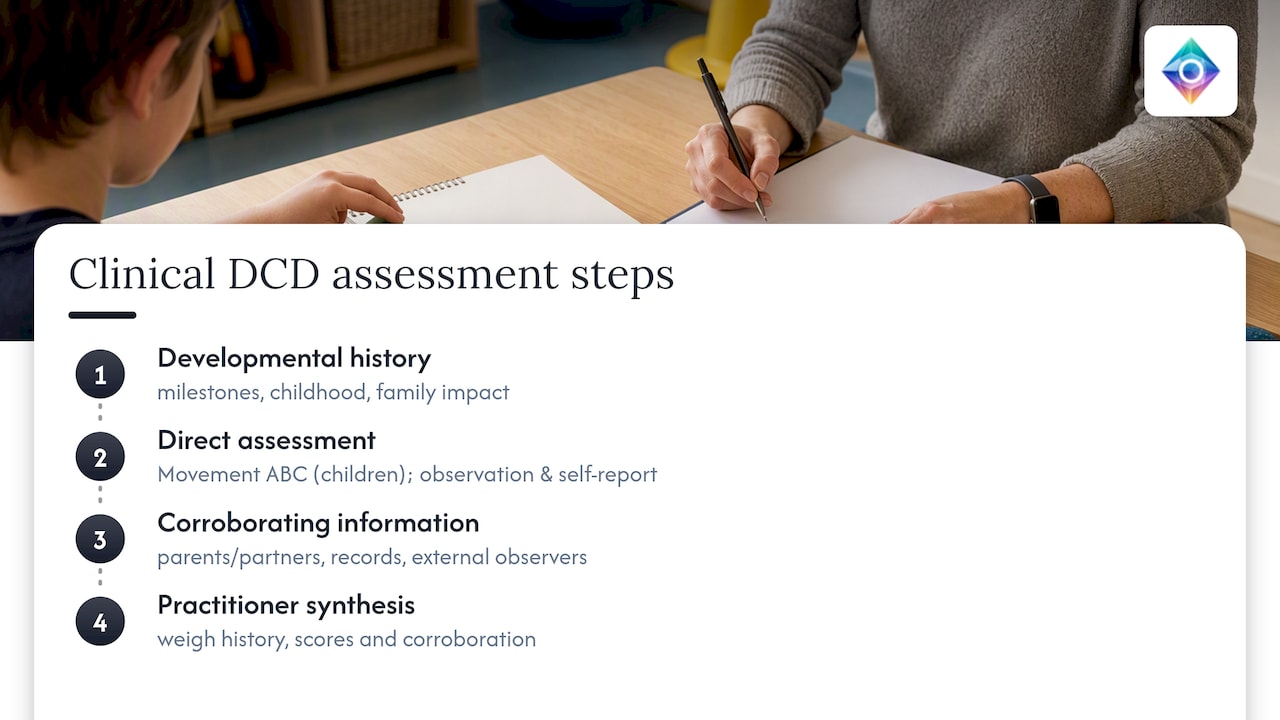
A clinical DCD assessment is a structured process built around direct observation, standardised measurement and history-taking, not a single test administered in isolation. It typically begins with a detailed developmental history: questions about milestones, childhood difficulties, family history and how co-ordination problems have affected school, work or daily life.
Direct assessment follows, often using a standardised battery like the Movement ABC for children, which involves timed and scored tasks covering manual dexterity, ball skills and balance, administered by a trained practitioner against age-based norms, as NHS guidance describes. For adults, where equivalent standardised batteries are less established, the practitioner relies more on structured observation of functional tasks alongside self-report measures.
Throughout the process, the Royal College of Occupational Therapists notes that occupational therapists are generally best placed to lead the assessment, given their training in functional movement and daily living tasks. Gathering information from multiple sources runs through the entire procedure: parents or partners may be interviewed, school or employment records reviewed, and sometimes input sought from teachers or colleagues who have observed the person in a practical setting.
The assessment concludes with the practitioner weighing the history, the standardised scores where available, and the corroborating evidence together, rather than any single piece of information determining the outcome alone.
Common challenges and considerations during clinical testing
Clinical assessment for DCD runs into several practical obstacles that are worth knowing before you start the process. Access is often the first barrier: regional NHS commissioning gaps mean some adults cannot get an NHS assessment at all in their area, a limitation the NHS page on adult dyspraxia states directly, pushing many towards private routes with associated costs.
Overlapping conditions complicate interpretation. Traits linked to ADHD, dyslexia or anxiety can resemble or mask DCD symptoms, which means a thorough assessment has to rule out or account for these alongside co-ordination difficulties rather than treating the presentation as straightforward. Readers exploring this overlap in more depth may find it useful to see how ADHD and dyslexia traits intersect in practice.
Retrospective history is another genuine challenge for adults. Many were never assessed as children, so clinicians must rely on secondhand accounts from parents, old school reports, or the adult’s own recollection, all of which are less precise than a contemporaneous childhood assessment would have been.
Standardisation gaps for adults add a further complication, since the movement batteries built for children do not transfer cleanly to adult presentation, forcing a heavier reliance on self-report and observation. Finally, waiting times for both NHS and private routes can be long, which is part of why gathering strong evidence before the appointment, rather than during it, makes the process more efficient for everyone involved.
Interpretation of test results and what they mean for diagnosis and intervention planning
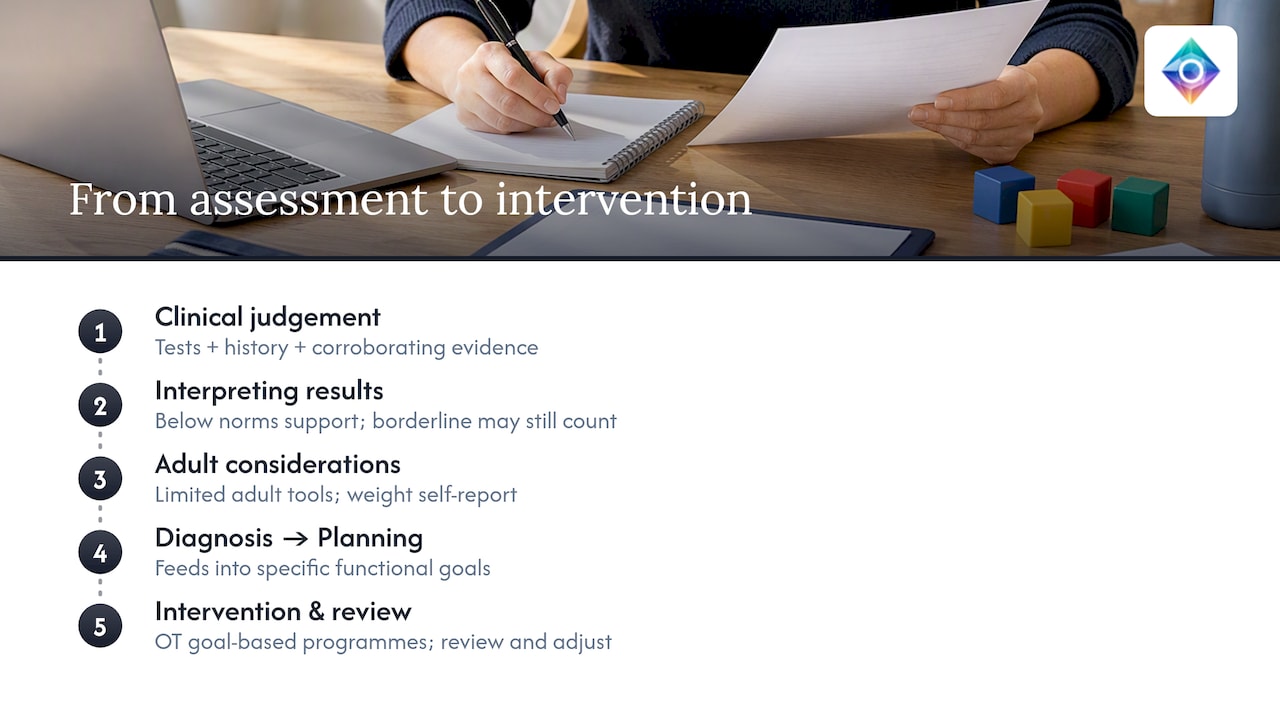
A diagnosis of DCD is not a single score crossing a threshold. It is a clinical judgement built from standardised test results where available, developmental history, and corroborating evidence from multiple sources, weighed together by a trained practitioner, consistent with the multi-source approach the Royal College of Occupational Therapists recommends.
A result that falls below expected norms on a standardised motor assessment supports a diagnosis, but only alongside a developmental history that shows the difficulties are longstanding, not explained by another condition, and significant enough to affect daily functioning. A borderline or inconsistent result does not rule DCD out, particularly in adults where standardised adult-specific tools are limited, which is why self-report and observed functional impact carry extra weight in that population.
Once a diagnosis is reached, the result feeds directly into intervention planning rather than ending the process. Occupational therapy typically follows, built around specific functional goals, such as improving handwriting, managing a particular work task, or developing strategies for daily living activities that have been difficult. RCOT materials describe goal-based home programmes, using structured methods such as the CO-OP approach, as effective at this stage, with progress reviewed and goals adjusted over a series of sessions rather than fixed in advance.
Even when a formal diagnosis is not reached, a clear result from assessment can still guide practical support, such as occupational therapy strategies or workplace adjustments, without the person needing a label to benefit from the help.
A personal note on why this matters
I was diagnosed with ADHD at 42, long after I had quietly adapted to difficulties I never had a name for. That gap between noticing a pattern and getting a clear answer is exactly what Omniprism is built to shorten: a private, accessible way to put language to traits early, so the decision to seek a formal assessment is informed rather than guesswork.
— Valerio Cozzi
Try Omniprism’s free self-assessment
A self-assessment tool can provide an instant plain-language profile across multiple areas including dyspraxia, often without requiring an email or account to get started. If a GP or occupational therapy appointment is on the horizon, the optional Specialist Briefing turns your results into a report designed for clinicians, available as a one-off purchase from Omniprism’s Specialist Briefing page for €9.99.
Parents can access guided versions built for children aged 7 to 10 and young people aged 11 to 13, with a dedicated Youth Briefing option for families who want a documented summary to bring to a school meeting or GP referral.
Start with the free self-assessment on Omniprism and decide from there whether a Specialist Briefing or a clinical referral is the right next step.
This article is general information, not a substitute for advice from a qualified doctor. Consult a qualified healthcare professional about your own circumstances before acting on anything here.
FAQ
What is the best online dyspraxia test for adults?
There is no single “best” online test, since screens like Omniprism are designed to flag traits for further exploration rather than replace a clinical diagnosis. Omniprism is a reasonable starting point because it is privacy-first and gives an instant plain-language profile, but any result should be followed up with a GP if it points to a longstanding pattern.
Can an online dyspraxia screen diagnose DCD?
No. NHS guidance is explicit that diagnosis is a clinical process involving standardised tools such as the Movement ABC, used by trained practitioners, not a questionnaire completed at home.
What should I bring to a GP appointment after a self-assessment?
Bring your assessment result, a short symptom diary with specific examples of affected tasks, and any childhood records or school reports that mention co-ordination or handwriting difficulties, a combination 111 Wales recommends to speed up triage. Corroborating observations from a parent, partner or employer also strengthen the evidence you present.
Why does NHS support for adult dyspraxia vary so much by region?
Commissioning for adult DCD services is decided locally, so some areas have well-established pathways while others have no dedicated NHS service for adults at all, as the NHS page on dyspraxia in adults notes. This regional gap is one reason many adults turn to private assessment or occupational therapy support instead of waiting on an NHS referral.
Does a formal diagnosis change what support I can get?
A diagnosis can open access to occupational therapy and workplace adjustments, and it explains longstanding difficulties in a way that can be useful for adults, according to the RCOT quick guide. That said, practical support such as goal-based occupational therapy can sometimes help even without a formal label, depending on local service criteria.
Sources
- NHS — Developmental co-ordination disorder (dyspraxia) diagnosis
- NHS — Dyspraxia in adults
- Royal College of Occupational Therapists quick guide on DCD
- NICE evidence for developmental follow‑up
- RCOT materials on therapy approaches and home programmes
Recommended
- Speed Your UK ADHD Diagnosis: 5 Things to Bring After a Self Screen
- 50–70% Overlap in Autism and ADHD: What Families and Clinicians Need
- 25–50% Overlap: Parents & Teachers’ Action Plan for ADHD and Dyslexia
- Parents: 14 Domain Self Check to Uncover Autism Misdiagnosed as ADHD
Written and edited by Valerio Cozzi, founder of Omniprism. Omniprism began after my own ADHD diagnosis at 42.
This article is educational. It is not medical advice, not a diagnosis, and not a substitute for assessment by a qualified clinician. The Omniprism self-assessment is free, needs no account and no email address, and runs entirely in your browser — your answers are never sent to a server. The optional Specialist Briefing report is a paid add-on.