Match Tactics to Your Brain to Cut Decision Fatigue in ADHD

Decision fatigue is the drop in decision quality that builds as your brain makes choice after choice. For someone with ADHD, that drop arrives faster and cuts deeper, because working memory and sustained attention are already stretched thin before the first decision of the day even lands. The single most useful fix you can apply right now: pre-decide one recurring daily choice (what you eat for breakfast, what you wear on Mondays) so your brain never has to spend energy on it again.
TL;DR:
- Reducing daily decision options to two or three defaults can significantly delay the onset of decision fatigue in ADHD.
- Routinizing key choices and batching similar decisions help conserve mental resources for more important tasks.
- Externalizing decisions with checklists and visual cues prevents working memory overload and decreases decision-related stress.
- Keeping sleep, nutrition, and medication timing optimized supports decision-making capacity, especially during peak decision periods.
- Identifying whether decision fatigue or core ADHD traits cause your exhaustion guides targeted strategies for relief and longer-term resilience.
What is decision fatigue?
Decision fatigue describes the measurable decline in judgement quality that follows a run of decisions, big or small. One useful way to picture it comes from evidence-accumulation models of the brain: each choice requires your neurons to gather enough information to cross a decision threshold, and that gathering process, called drift rate, slows the more you’ve already asked of it that day. Slower drift rate feels exactly like it sounds. Everything takes longer to decide and everything feels harder to commit to.
Through a normal day, decision fatigue tends to show up as:
- Increasing reliance on defaults or the easiest option, even when it isn’t the best one
- A creeping reluctance to start new tasks that involve any choice at all
- Snapping decisions late in the day that you’d have taken more care over that morning
- A sense of mental static or fog that wasn’t there a few hours earlier
Neuroscience research on perceptual decision-making has traced this slowdown directly to reduced evidence accumulation in the brain, giving the subjective “running out of gas” feeling a measurable neural signature.
How ADHD amplifies decision fatigue
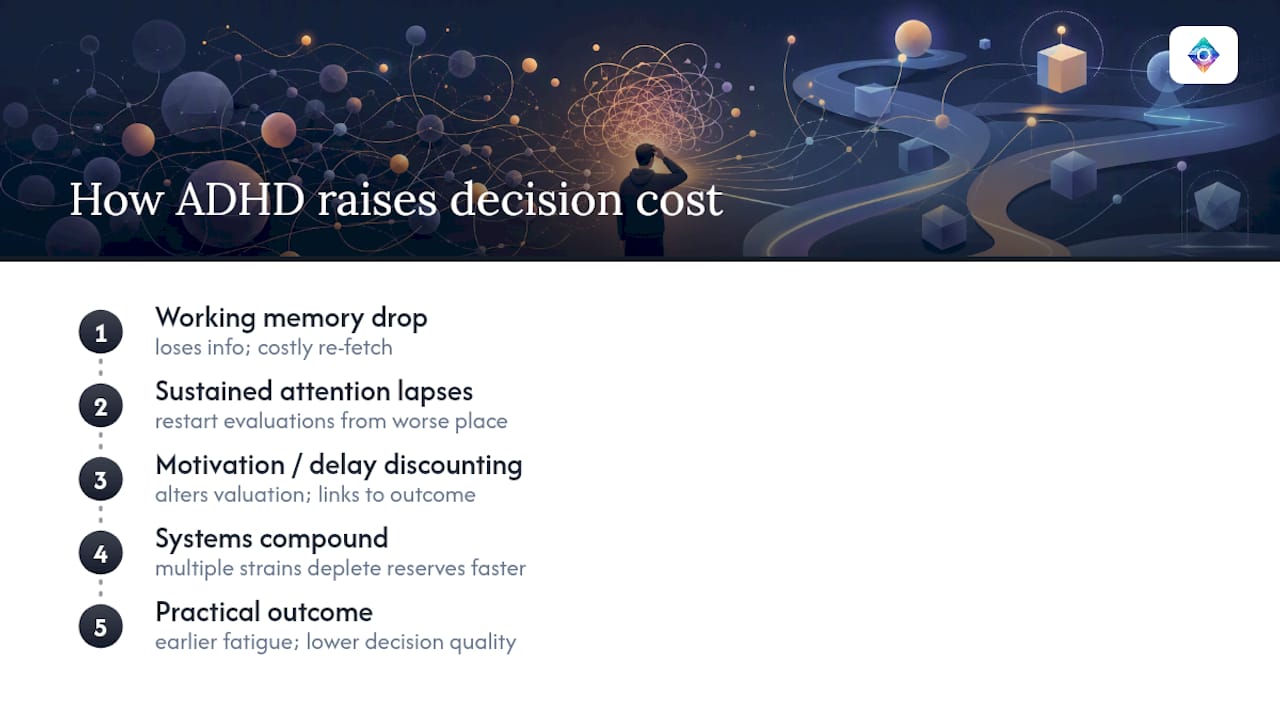
ADHD doesn’t just add a few extra decisions to the pile. It changes how expensive each decision is to make in a significant way. Working memory and sustained attention are the two systems doing most of the heavy lifting in any choice, holding the options in mind while you weigh them against what matters. When both are already running below capacity, as they typically are with ADHD, each decision draws down reserves faster than it would for someone without the condition.
Research combining working memory, sustained attention, and motivational measures found these factors jointly predict poorer decision-making performance under risk in people with elevated ADHD traits. It isn’t one broken system causing the problem. It’s several systems under strain at once, compounding each other.
“Working memory errors were strongly associated with poorer decision-making performance, with sustained attention and delay discounting forming sequential pathways to that outcome.” This is the core finding from a 2026 structural equation model tracing exactly how these deficits chain together rather than acting in isolation.
That sequencing matters practically. If working memory drops a piece of information before you’ve weighed it properly, you’re forced to either re-fetch it (costly) or guess (risky). If sustained attention lapses mid-decision, you restart the evaluation from a worse position than before. Neuroimaging work backs this up structurally: ADHD-linked decision difficulty correlates with altered default mode network and frontostriatal connectivity, the circuits responsible for holding a plan steady while you act on it.
The everyday translation is straightforward, even if the mechanism isn’t. Decisions cost more upfront, so the fatigue threshold arrives sooner. That’s why choosing what to have for lunch can feel disproportionately draining by mid-afternoon, and why a seemingly simple choice, which shirt, which reply, which task first, can trigger a full stop rather than a quick pick. This is choice paralysis in its literal sense: the evaluating system stalling rather than refusing.
Crucially, the same research is clear that this isn’t about ADHD driving people towards riskier choices. The pattern is suboptimal choices, not risk-seeking, meaning the issue is quality of decision-making under strain, not a personality trait for recklessness.
Strategies to manage decision fatigue with ADHD
The fix isn’t willpower. It’s reducing how many decisions your brain has to fully process, so the ones that matter get the resources they need. Four categories cover almost everything worth doing: simplify, routinize, externalise, and protect your energy supply.
1. Simplify: shrink the menu before you open it
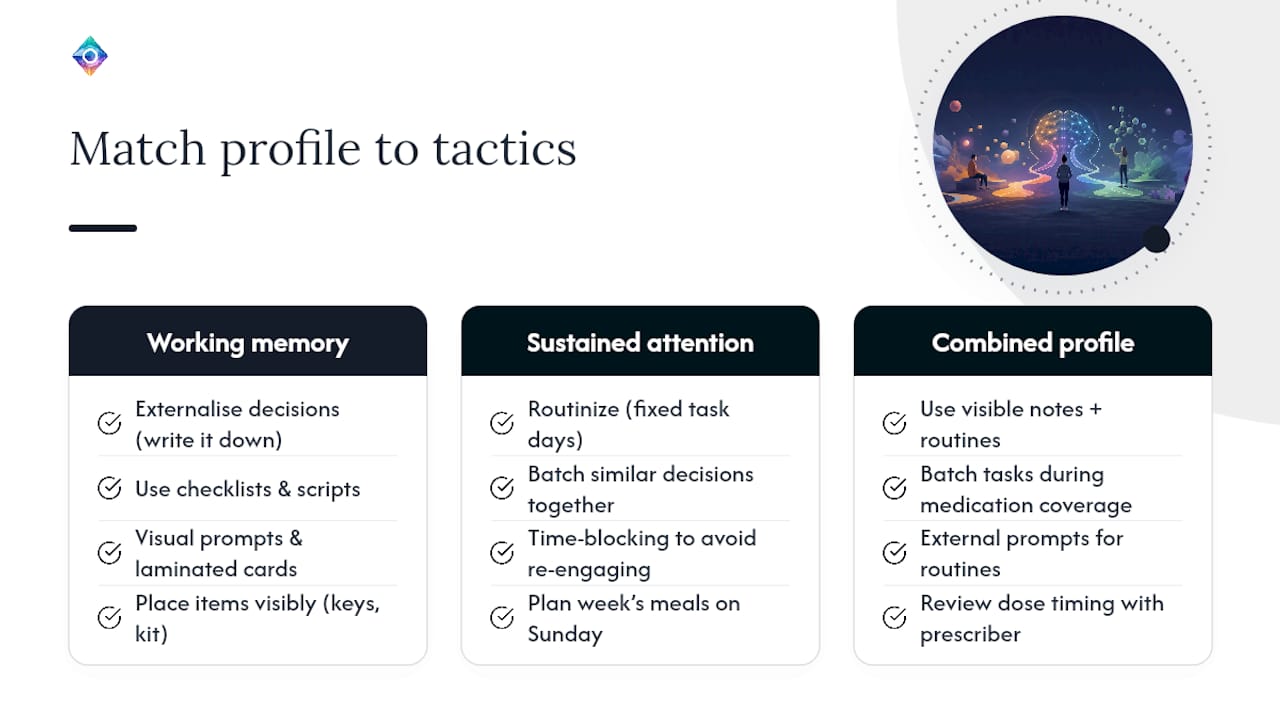
Most decision fatigue comes from too many live options, not from the decisions themselves being hard. Cut your usual choices down to two or three defaults per category. Own three work outfits you rotate, not fifteen. Keep four dinner recipes on permanent standby rather than “deciding what’s for dinner” from scratch each night. A pruned menu removes the evaluation step entirely, because there’s nothing left to compare.
2. Routinize: make the same choice automatically
Routines aren’t about rigidity for its own sake. They’re a way of offloading trivial choices so your executive function is free for the ones that actually need it. If Monday is always laundry and Tuesday is always the food shop, you’ve deleted two decisions a week permanently. Batch similar decisions into one sitting, plan the whole week’s meals on Sunday rather than deciding daily, and you convert seven small drains into one manageable session.
3. Externalise: get the decision out of your head
Checklists, scripts, and visual prompts do the remembering so working memory doesn’t have to. A laminated card by the door listing keys, phone, wallet, medication removes a decision you’d otherwise half-consciously repeat every single morning. Habit cueing works the same way: place your gym kit by the front door the night before and the decision to go is already made before you’re fully awake. Omniprism’s guide to breaking task paralysis covers several of these externalising tricks in more depth if freezing before a task is your specific pattern.
4. Protect your energy: the supply side of the equation
Sleep debt, skipped meals, and dehydration all lower the ceiling on how many decisions you can make well before fatigue sets in. None of this is groundbreaking, but the ADHD-specific point is this: if you’re on medication, its coverage window matters for decision-heavy tasks. A quick review with your prescriber about whether your dose covers the part of the day you make the most demanding choices is worth raising, not something to guess at alone.
How to pick tactics based on your profile
If working memory is your weak point, lean hardest on externalising, write it down, put it somewhere visible, and consider using tools from AI for Students: Study Smarter, Write Honestly | AmmarAI, don’t trust your head to hold it. If sustained attention is the bigger issue, batching and time-blocking help more, because they reduce how often you have to re-engage focus from scratch. Most people with ADHD need a mix of both, but knowing which one drains you faster tells you where to spend your limited setup effort first.
Pro Tip: Pick one category, simplify, routinize, externalise, or protect energy, and fix it for a single week before adding another. Trying to overhaul all four at once is itself a decision-heavy project, and it tends to collapse under its own weight.
A short daily decision checklist and small-menu templates
A morning checklist works because it front-loads your defaults before the day’s fatigue has a chance to build. Run through this once, ideally the night before:
- Outfit: pre-picked from a fixed rotation, no browsing the wardrobe
- Breakfast: the same one or two options, chosen in advance
- Work start task: written down the evening before, not decided fresh
- Decision window: a fixed slot (say, 10am to 11am) reserved for anything genuinely new that needs weighing up
Meal template (rotate weekly, don’t reinvent):
- Monday and Thursday: the same quick meal
- Tuesday and Friday: a second fixed option
- Wednesday: leftovers or takeaway, no cooking decision required
- Weekend: the only two days you allow yourself to choose freely
Evening routine template:
- Same wind-down order every night: screens off, then wash, then read or listen to something, then lights out
Batch anything that isn’t urgent into a single weekly decision window rather than deciding it in the moment. Bills, replies, and non-urgent admin can usually wait for one sitting rather than fragmenting your day fifteen times over.
When decision fatigue becomes burnout: signs and red flags
Ordinary decision fatigue lifts with rest, a good night’s sleep, and it’s mostly gone. ADHD burnout doesn’t lift that easily. It persists for weeks, bleeds into tasks that used to feel automatic, and starts affecting relationships and work performance rather than just your patience for choosing dinner.
Watch for:
- Fatigue that doesn’t improve after a full weekend of rest
- Withdrawing from social contact you’d normally want, sometimes described as social burnout
- Feeling simultaneously exhausted and wired, unable to switch off even though you’re drained
- Small decisions (replying to a text, picking what to watch) starting to feel genuinely overwhelming rather than mildly annoying
- Increasing irritability or emotional flooding over minor triggers
The NHS lists fatigue and difficulty with sleep and emotional regulation among common features of adult ADHD, and burnout often intensifies exactly those pre-existing traits rather than introducing new ones. If you’re noticing several of these together, the immediate move is structured rest, actually blocking time off rather than hoping it happens, cutting non-essential obligations for a short period, and telling someone in your support network what’s going on rather than pushing through alone.
When to seek professional help and what evidence-based services do
Seek an assessment or professional support if decision fatigue is lasting weeks rather than days, if it’s affecting your job or relationships, or if you notice the burnout signs above stacking up rather than easing off.
NICE guideline NG87 recommends environmental and structural modifications as the first line of action for adults with ADHD, reducing the number of decision points at home and work, before medication is escalated. Medication review comes after that environmental review, not instead of it. This matters if you’re wondering whether to raise medication changes with your GP straight away: the guidance suggests structural fixes get tried first, with dose or type reconsidered if problems persist.
Before an appointment, bring:
- A written log of when fatigue hits hardest during your day
- Examples of decisions you’ve been avoiding or delaying
- A list of what you’ve already tried (routines, checklists, sleep changes)
- Specific questions: does my current medication cover my hardest decision-making hours? Would workplace adjustments help?
NICE’s guidance also stresses shared decision-making in treatment planning itself, so come prepared to discuss what’s realistic for your life, not just what’s clinically possible.
How self-assessment and personalised profiles can help you target the right strategies
Knowing which executive function is driving your fatigue, working memory, sustained attention, or something else, changes which tactics are worth your limited setup energy. Guessing wastes the very resource you’re trying to protect.
A structured self-assessment that maps these domains gives you a starting profile rather than a vague sense that “decisions are hard.” Omniprism’s self-assessment tool covers 14 areas including ADHD-related executive traits, producing an instant plain-language profile without tracking or lengthy evaluation. For anyone planning to raise this with a clinician, the optional Specialist Briefing report summarises results in a format built to speed up that conversation, rather than starting from scratch in a short appointment.
The neurological basis of decision fatigue in ADHD
The neural story behind decision fatigue in ADHD centres on how efficiently the brain gathers information before committing to a choice. Evidence-accumulation research finds a measurably slower drift rate in people with ADHD during perceptual decision tasks, meaning the brain needs longer, or more repeated attempts, to reach the same confidence threshold that a neurotypical brain reaches faster.
That slower accumulation isn’t an isolated glitch. It sits alongside broader connectivity differences. The default mode network, which should quieten down during focused tasks, tends to stay more active in ADHD, competing with the frontostriatal circuits responsible for goal-directed planning and value comparison. Research summarising this from a neuroeconomic perspective frames the problem as one of circuit competition rather than simple underperformance. Two systems are effectively arguing over the same bandwidth, and decision-making is what suffers.
Put plainly: your brain isn’t failing to decide. It’s running the decision-making process through a network that’s less efficient at quieting background noise and holding a value comparison steady long enough to finish it. That’s why decisions that involve holding several options in mind simultaneously, comparing prices, weighing pros and cons, feel exponentially harder than decisions with an obvious single right answer.
Impact of medication on managing decision fatigue
Stimulant and non-stimulant ADHD medications work primarily on attention and impulse control, and by extension they often ease some of the working memory and sustained attention strain that drives decision fatigue. When a medication is well matched to someone’s needs, the practical effect can be more consistent focus across a decision, rather than losing the thread halfway through weighing options.
That said, medication doesn’t remove decision fatigue as a phenomenon. It can shift when in the day it hits and how severe it feels, but the environmental strategies covered earlier still matter, arguably more so, because medication coverage windows are finite. If your dose wears off by mid-afternoon and that’s exactly when you’re making your most demanding work decisions, no amount of medication timing alone fixes that mismatch. This is precisely why NICE frames environmental modification as the first-line approach, with medication reviewed as a complement rather than a substitute.
Anyone noticing decision fatigue clustering at a specific time of day is worth raising that pattern with a prescriber directly. Dose timing, formulation, or a second dose later in the day are all legitimate discussion points, not requests to be minimised. Equally, if fatigue persists even with medication working well, that’s a signal the issue may be more structural (too many live decisions in your environment) than pharmacological, and the simplify and routinize strategies above become the more useful lever.
Role of emotional regulation in decision fatigue with ADHD
Emotional regulation and decision-making share the same limited resources, which is exactly why a bad decision often triggers frustration, and frustration then makes the next decision worse. It’s a genuine feedback loop, not just bad luck stacking up.
When working memory and sustained attention are already stretched, small emotional spikes, mild annoyance, low-level anxiety about getting something wrong, take a disproportionate toll because there’s less spare capacity to absorb them. This is part of why decision fatigue in ADHD often presents as irritability rather than obvious tiredness. You might not feel sleepy. You feel short-tempered, snappy over something trivial, and that’s frequently the same underlying depletion wearing a different face.
Practically, this means emotional regulation techniques belong in the same toolbox as the decision-reduction strategies above, not in a separate category. A short pause before responding to a frustrating message, a few slow breaths before opening an inbox full of choices, or naming the emotion out loud (“I’m annoyed, not actually in danger”) all buy back a small amount of the same capacity that decision-making draws on. Treating emotional spikes as data, a signal that your decision-making reserves are running low, rather than as a character flaw, is one of the more useful reframes available here. It also explains why decisions made right after an argument or a stressful call tend to be worse: the emotional cost has already been paid out of the same account.
Techniques to build decision-making resilience over time
Resilience here doesn’t mean toughing out more decisions. It means building a system that needs fewer high-effort decisions in the first place, so the ones that remain get proper attention.
Start by tracking, for one week, when your worst decisions happen. Most people find a pattern: late afternoon, right after a stressful meeting, or first thing before caffeine. Once you know your worst window, protect it deliberately by moving non-essential choices out of it entirely.
Next, build a personal “decision bank”: a short written list of defaults for your five or six most common daily choices, meals, outfits, work start tasks, replies to routine messages. Refer to it instead of re-deciding from scratch. This is functionally the same principle behind the checklist above, but extended into a permanent habit rather than a one-off list.
Third, review and adjust rather than aiming for a perfect system on the first attempt. A default that felt right in January might not fit by March. Building resilience is an iterative process of noticing friction and removing it, not designing the perfect routine upfront.
Omniprism’s piece on time blindness in ADHD is worth a read alongside this, since poor time awareness often compounds decision fatigue by making people underestimate how long a “quick decision” will actually take, adding pressure that makes the decision harder still.
Differences between decision fatigue and general ADHD symptoms
Decision fatigue is a state that builds across a day and eases with rest. Core ADHD traits, inattention, impulsivity, hyperactivity, are relatively stable features that don’t necessarily fluctuate hour to hour in the same way. That distinction is worth holding onto because it changes what actually helps.
If you’re impulsive at 9am and impulsive at 9pm regardless of how many decisions you’ve made in between, that’s a baseline trait, and it responds to different interventions (medication, behavioural strategies, structure) than something that gets worse specifically as the day wears on. Decision fatigue, by contrast, is cumulative and situational. It’s worse on days with more choices, better on days with fewer, and generally resets somewhat overnight, unlike traits that persist regardless of sleep.
The overlap is real, though. ADHD’s underlying executive function deficits are exactly what make the fatigue curve steeper, as covered earlier, so the two aren’t unrelated. But treating every hard afternoon as “just my ADHD” can mean missing a specific, fixable pattern: too many live decisions stacked into one part of your day. Separating the stable trait from the situational drain is often the first useful diagnostic step, and it’s one a structured profile of your own executive function domains can help clarify. Omniprism’s overview of executive dysfunction breaks down which specific deficits tend to show up as which everyday symptoms, which is useful if you’re trying to work out whether what you’re experiencing is baseline ADHD, decision fatigue, or both layered together.
Author perspective: offloading decisions saved my afternoons
Valerio Cozzi was diagnosed with ADHD at 42. He describes learning, later than he’d have liked, that the exhaustion hitting him most afternoons was not laziness. It was decision fatigue, and offloading small daily choices, what to eat, what to wear, when to start work, was what actually gave him his afternoons back. Not motivation. Fewer decisions.
— Valerio Cozzi
How Omniprism can help you match strategies to your own profile
Working out whether working memory, sustained attention, or something else is driving your worst afternoons takes more than guesswork, and guessing burns exactly the resource you’re trying to save. A free instant profile is available across multiple domains, including ADHD-related executive traits, autism, dyslexia, and more, without tracking or a lengthy medical evaluation, so you can see which specific pattern is behind your decision fatigue rather than treating it as one vague problem.
The assessment is built on an evidence-based methodology, detailed on the Omniprism methodology page, and it’s free to complete for adults, with guided versions available for children aged 7 to 10 and young people aged 11 to 13 if you’re assessing this for a family member rather than yourself. Anyone planning to discuss results with a GP or specialist can add the optional Specialist Briefing report, a one-time purchase that turns your results into a clinician-ready summary. Start with the free self-assessment and see which of the strategies covered above actually matches your profile.
This article is general information, not a substitute for advice from a qualified doctor. Consult a qualified healthcare professional about your own circumstances before acting on anything here.
Sources
- PubMed: executive functions and decision-making in ADHD (2026)
- Decision-making and ADHD: a neuroeconomic perspective (Frontiersin, 2024)
- NICE guideline NG87: ADHD diagnosis and management
- JNeurosci: Neurophysiology of perceptual decision-making in ADHD
- Executive and motivational pathways to ADHD traits (BMC Psychology, 2026)
FAQ
How long does ADHD burnout last?
ADHD burnout typically persists for weeks rather than days, distinguishing it from ordinary decision fatigue, which usually eases after a proper night’s sleep or a restful weekend.
Can ADHD make you feel tired but wired?
Yes. The combination of exhaustion and an inability to switch off is a commonly reported feature of ADHD burnout, often linked to overstretched sustained attention and emotional regulation systems.
Is ADHD burnout a real thing?
ADHD burnout is a recognised pattern of prolonged exhaustion and functional decline, and the NHS lists fatigue and emotional dysregulation among common adult ADHD features that intensify during burnout periods.
What are the signs of social burnout in people with ADHD?
Key signs include withdrawing from social contact you’d normally welcome, feeling disproportionately drained by ordinary conversation, and a growing reluctance to make even small social decisions, like replying to messages.
How can I tell if I’m experiencing decision fatigue rather than general ADHD symptoms?
Decision fatigue builds across the day and eases with rest, while core ADHD traits stay relatively stable regardless of how many choices you’ve already made; a tool like Omniprism’s self-assessment can help clarify which pattern fits you.
Recommended
- Time Blindness in ADHD: How to Spot It and Manage It
- ADHD Task Paralysis: Why You Freeze and How to Start
- Executive Dysfunction: Causes, Signs, and What Helps
- When Your Brain Takes Longer to Catch Up
Written and edited by Valerio Cozzi, founder of Omniprism. Omniprism began after my own ADHD diagnosis at 42.
This article is educational. It is not medical advice, not a diagnosis, and not a substitute for assessment by a qualified clinician. The Omniprism self-assessment is free, needs no account and no email address, and runs entirely in your browser — your answers are never sent to a server. The optional Specialist Briefing report is a paid add-on.