Best Autism Tests: Screeners, Self-Assessments and Diagnostic Tools
The best autism test depends on who is being assessed and what you need from it: the AQ-10 is the widely used short screen for adults, the M-CHAT-R/F is the standard parent questionnaire for toddlers, and only a clinical assessment can diagnose. If you want a free, private first look at autism alongside 13 other neurodivergent areas, Omniprism’s free adult self-assessment gives an instant plain-language profile with no email, account or data collection.
Key Takeaways
- No questionnaire diagnoses autism. Screening tests and self-assessments help you decide whether to seek a clinical assessment, and the Autism Research Centre states that a single score does not establish autism.
- Different tests suit different ages: M-CHAT-R/F for children under 30 months, AQ-Child for ages 4 to 11, AQ-10 and CAT-Q for adults and teens from 16.
- Diagnostic tools such as ADOS-2, ADI-R and CARS2 are administered by trained clinicians, and their accuracy varies by tool and setting.
- Omniprism is our pick for a first step: free, instant, private, covering 14 domains, with a €20 Specialist Briefing you can bring to a clinician.
What are the best autism tests?
Autism tests fall into three groups, and mixing them up is the most common mistake. Self-assessments and screening questionnaires are short, can be completed at home and point towards or away from further assessment. Diagnostic tools are used by trained professionals as part of a wider evaluation. Broad profiles sit between the two: they map traits across several areas so the person can describe their experience clearly.
Here is how the main options compare.
| Test | Who it is for | What it is | Cost and time |
|---|---|---|---|
| Omniprism self-assessment | Adults, teens and children | Instant plain-language profile across 14 domains, including autism, ADHD, dyslexia and masking | Free; Specialist Briefing €20 one-off |
| AQ-10 (adult) | Adults | 10-item screening questionnaire | Free for non-profit use; about five minutes |
| CAT-Q | Ages 16 and over | Questionnaire on camouflaging behaviours | Free; 10 to 30 minutes |
| M-CHAT-R/F | Toddlers under 30 months | Two-stage parent-report screen | Free; 5 to 30 minutes |
| AQ-Child | Ages 4 to 11 | 50-item parent-report questionnaire | Free for non-profit use |
| ADOS-2 | All ages | Observational diagnostic tool, clinician-led | Used within a clinical assessment |
| ADI-R | All ages | Parent or caregiver interview of 1.5 to 2.5 hours | Kit $415 (clinician cost) |
| CARS2 | Ages 2 and over | Rating scale based on observation | Kit $371.00 (clinician cost) |
The durations, the M-CHAT-R/F, AQ-10, CAT-Q and ADI-R details and the ADI-R kit price come from a 2025 clinical tools appendix. The CARS2 age range and kit price are on the publisher’s product page. Kit prices are what clinics pay for materials, not what an assessment costs a family.
Which autism test is best for adults?
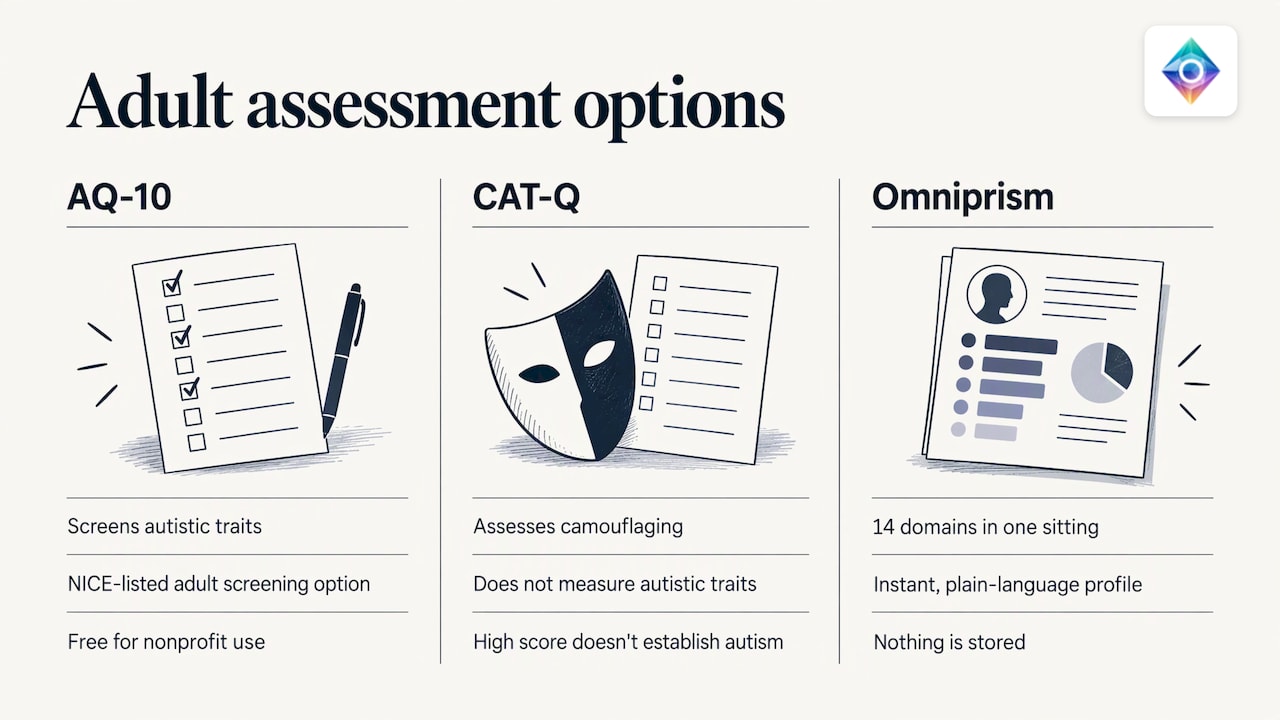
For adults, the best route is a screening step followed by a clinical conversation. The AQ-10 is the best known short screen: it was published by Allison, Auyeung and Baron-Cohen in 2012 and is free for non-profit use. A 2025 paper notes that NICE recommends the AQ-10 as a possible adult screening instrument, in the same breath as reminding readers that questionnaires cannot replace a clinical diagnosis.
The AQ-10 only asks about autistic traits. If you suspect you have spent years hiding them, the CAT-Q looks at camouflaging instead. A 2024 review on girls and women says the CAT-Q can help people reflect on camouflaging, but that a high score does not establish autism because the questionnaire does not measure autistic traits.
This is where a broader profile helps. Omniprism covers 14 domains in one sitting, including autism, ADHD, dyslexia, dyspraxia, dyscalculia, sensory processing, high sensitivity, OCD traits, synesthesia and masking. Many people who suspect autism also recognise ADHD or sensory patterns in themselves, and seeing them side by side gives you a fuller account to describe to a GP. The result is instant, in plain language, and nothing is stored: no email, no account, no tracking.
If you then want something to hand over, the Specialist Briefing costs €20 one-off and summarises your results for a clinician. If you are weighing questionnaires against each other, our comparisons of AQ alternatives go through the other self-report options in detail.
Which autism test is best for children and teens?
The right test depends on the child’s age.
- Under 30 months: the M-CHAT-R/F is a two-stage parent-report screen developed by Robins, Fein and Barton. It can be scored at a well-child visit or by specialists. It is copyrighted, so a website cannot simply repost it; the M-CHAT site allows links to its download.
- Ages 4 to 11: the AQ-Child is a 50-item parent-report questionnaire. A 2025 Spanish validation study reported sensitivity of 0.83 and specificity of 0.96 in its sample, and warned that parent report can introduce informant bias.
- Teens: the Autism Research Centre’s test archive offers adolescent and child AQ forms alongside the adult ones.
Where the concern is speech or language, a speech delay checklist for parents can help you notice what to describe at an appointment.
For families, Omniprism offers a free children and young people assessment, with versions for ages 7 to 10 and ages 11 to 13. It guides the parent or young person through the questions and returns a profile across the same 14 areas. The Youth Briefing is €20 one-off and turns the results into a summary for the professional you see. Our autism checklist for parents explains which signs are worth noting before an appointment.
How is autism typically diagnosed?
Autism is diagnosed by a trained professional who combines several sources of information, not by a single test. A 2024 review recommends multimodal assessment: self-report, direct observation, informant report, and both current and historical developmental information.
In practice, three tools come up most often:
- ADOS-2 is direct observation of behaviour, and the CHOP Research Institute lists it as a direct assessment.
- ADI-R is a semi-structured interview with a parent or caregiver about development.
- CARS2 rates behaviour on a scale, and the publisher says it covers ages 2 to 100, with an alternative form for verbally fluent people aged 6 and over.
Assessment can go beyond these instruments. Amaze notes that developmental history is usually gathered separately from ADOS-2 and that daily living and communication assessments may add information about support needs. In the UK, the route normally begins with your GP, and our guide to NHS steps for assessing masked autism walks through what to bring.
How accurate are autism tests?
Accuracy differs sharply between tools, and the figures below come from studies with different designs, so compare them with care. A 2024 systematic review reported pooled sensitivity and specificity of 78% and 98% for the M-CHAT-R/F, 87% and 75% for ADOS, 77% and 68% for ADI-R, and 89% and 79% for CARS. Sensitivity is the share of autistic people a test picks up, and specificity is the share of non-autistic people it correctly rules out. The review noted that methods varied, many studies used case-control designs and some lacked an independent reference assessment.
A 2021 meta-analysis of 22 child studies put ADOS-2 sensitivity between 0.89 and 0.92 and specificity between 0.81 and 0.85, with ADI-R at 0.75 and 0.82. It also found ADI-R specificity higher in research samples (0.85) than in clinical ones (0.72).
Two cautions are worth knowing before you choose a test:
- Presentation matters. The 2024 review on girls and women says ADOS-2, ADI-R and the AQ may help structure an assessment but are insufficient alone and may under-represent camouflaged presentations. The 2025 AQ-Child paper adds that anxiety or ADHD may contribute to false positives and camouflaging to false negatives.
- Language and culture matter. A 2022 scoping review of early screening tools for children aged 0 to 3 found 26 tools across 81 studies, noted that some lack adequate validation, and cautioned that a tool validated in one culture may perform less well in another, especially if translation is not culturally adapted.
These findings are the reason we build Omniprism’s profile around the whole picture, including masking, rather than one score.
What should I do after taking an autism test?
Take the result to a professional, and take it as an account of your experience rather than a verdict. The Autism Research Centre advises discussing concerns with a GP, family doctor or appropriate autism service. For a toddler, a positive M-CHAT-R/F screen is followed by a second-stage check of the items flagged, and Indiana University School of Medicine notes that a positive screen does not mean every child is autistic.
A practical order that works for most people:
- Complete a free self-assessment and read the profile in full.
- Write down specific examples from childhood and from the present, for work, school and relationships.
- Book a GP appointment and ask for a referral for an autism assessment.
- Bring the summary with you so the conversation starts from your examples.
Waiting times vary by country and service. Autism New Zealand’s adult diagnosis guide reports publicly funded waits commonly of 6 to 12 months or longer in parts of New Zealand, which is one reason to prepare well before the appointment. For the difference between a quiz result and a diagnosis, see why self-assessment is not diagnosis.
Where does Omniprism fit among autism tests?
Omniprism is the best first step when you want clarity before a clinical conversation. The free adult self-assessment returns an instant profile across 14 domains, in plain language, with no email, account or data collection. If you decide to seek an assessment, the Specialist Briefing is a €20 one-off report designed for easy use by healthcare professionals, and parents can use the Youth Briefing at the same price.
Why we start with a broad profile
I was diagnosed with ADHD at 42, and I founded Omniprism because I wanted people to reach that conversation with better words than I had.
We believe a single-condition quiz is too narrow a starting point. Neurodivergent traits overlap, and the research above shows why one score is never enough: camouflaging can hide autistic traits, and anxiety or ADHD can colour how a questionnaire reads. Our profile covers 14 areas so that you see the pattern instead of one number.
We also built it to ask nothing of you. There is no account, no email and no tracking, so you can answer honestly. The free assessment is there for anyone, and the Specialist Briefing is there for the moment you want to put your results in front of a clinician.
Valerio Cozzi
Autism test FAQ
Can an online autism test diagnose me?
No. Only a trained professional can diagnose autism, using a full assessment. Online tests help you recognise traits and decide whether to seek an assessment, and the Autism Research Centre says no single questionnaire score establishes autism.
Are the best autism tests free?
Many are. The AQ-10, CAT-Q and M-CHAT-R/F are free, and Omniprism’s adult and children’s assessments are free. Paid items are the clinician kits, such as the $415 ADI-R kit, and optional reports such as our €20 Specialist Briefing.
Do autism tests work for women who mask?
Standard instruments may under-represent camouflaged presentations, according to a 2024 review of diagnostic procedures for girls and women. A profile that includes masking among its 14 domains gives you more to discuss, and our guide to autistic traits in women lists signs that are often missed.
Can teachers or parents use these tests?
Parents can complete the child versions, and educators can use a profile to understand a student’s needs. Any result should go to the school’s special educational needs lead or a clinician. Our guide to school autism adjustments explains what support can follow.
Sources
- Screening and diagnostic tools for autism spectrum disorder (2024 systematic review)
- Systematic review and meta-analysis of the clinical utility of ADOS-2 and ADI-R (2021)
- Improving diagnostic procedures in autism for girls and women (2024)
- Spanish validation of the Autism Spectrum Quotient for children (2025)
- Tools for early screening of autism spectrum disorders in primary care (2022)
- Autism Research Centre tests archive
- AQ-10 (Adult), Autism Research Centre
- Appendix I. Screening and diagnostic tools (2025)
- CARS2, PARINC
- M-CHAT-R/F (March 2025)
- M-CHAT recommended resources
- Autism Spectrum Disorder Measures, CHOP Research Institute
- Types of autism screening and assessment tools, Amaze
- Screening Tools, Indiana University School of Medicine
- Diagnosis Guide for Adults, Autism New Zealand (2025)
Recommended
- RAADS-R Alternatives: 6 Autism Self-Assessment Tools Compared
- Self Assessment vs Diagnosis: ADHD and Autism Quizzes Aren’t Diagnoses
- Best Anonymous Autism Tests: What to Use and What to Skip
- Parents: 14 Domain Self Check to Uncover Autism Misdiagnosed as ADHD
Written and edited by Valerio Cozzi, founder of Omniprism. Omniprism began after my own ADHD diagnosis at 42.
This article is educational. It is not medical advice, not a diagnosis, and not a substitute for assessment by a qualified clinician. The Omniprism self-assessment is free, needs no account and no email address, and runs entirely in your browser — your answers are never sent to a server. The optional Specialist Briefing report is a paid add-on.