Best Anonymous Autism Tests: What to Use and What to Skip
The best anonymous autism tests are the ones built on a published questionnaire, such as the AQ-10 or the RAADS-R, taken on a site that asks for no email and no account. Omniprism’s free self-assessment fits that description and covers 14 areas, not autism alone. None of them can diagnose you, but a good one tells you whether a formal assessment is worth pursuing.
Key Takeaways
- A screening test is a prompt to seek assessment, never a diagnosis, and a low score does not rule autism out.
- The AQ-10 (10 items) is the quick screen used in NICE guidance; the RAADS-R (80 items) is longer and has published validation data.
- Anonymity depends on the site, not the test: look for no email, no account and a plain statement about what happens to your answers.
- For children, the questionnaire changes by age, and parents need a version built for the child, not an adult quiz.
- Omniprism’s self-assessment is free, needs no email or account, and an optional €20 Specialist Briefing summarises results for a clinician.
What makes an autism test anonymous?
An anonymous test lets you answer, see a result and leave without handing over your name, email address or an account. That is the practical definition, and it is worth checking before you start, because plenty of “free” tests ask for an email address before showing a score.
Three things matter:
- No sign-up wall. You should reach your result without an email or password.
- A clear statement on storage. The site should say whether answers are kept, and where.
- A recognised questionnaire behind it. Anonymity is no use if the questions are made up.
That last point is where quality varies most. A German guideline overview notes that the 2016 guideline named several questionnaires circulating online as not validated, and that screening results are an indication, not a diagnosis. A private test with weak questions is still a weak test.
Which online autism tests are worth using?
Four options cover most readers: two adult questionnaires with a clinical pedigree, one for toddlers, and a broader self-assessment. The table sets out what each is, how long it takes and who it is for.
| Test | Intended for | Length | Cost | What it is good for |
|---|---|---|---|---|
| AQ-10 | Adults | 10 items | Free for non-profit use | Quick screen for whether to seek assessment |
| RAADS-R | Adults | 80 questions | Varies by host site | Detailed trait profile with published validation |
| M-CHAT-R/F | Toddlers aged 16 to 30 months | 20 items plus follow-up | Free | Parent-completed early screen |
| Omniprism self-assessment | Adults, teens and children (guided) | 14 areas | Free; Specialist Briefing €20 | Wide trait profile and a clinician summary |
AQ-10: the fast screen
The AQ-10 is the short test most UK clinicians know. NICE recommends it for adults with possible autism who do not have a moderate or severe learning disability, to help decide whether to refer for a comprehensive assessment. The Autism Research Centre says it is free for non-profit use including research and education, with fees possible for commercial users.
Because it is so short, it is a screen and nothing more. It suits you if you want a quick, low-effort first look.
RAADS-R: the longer questionnaire
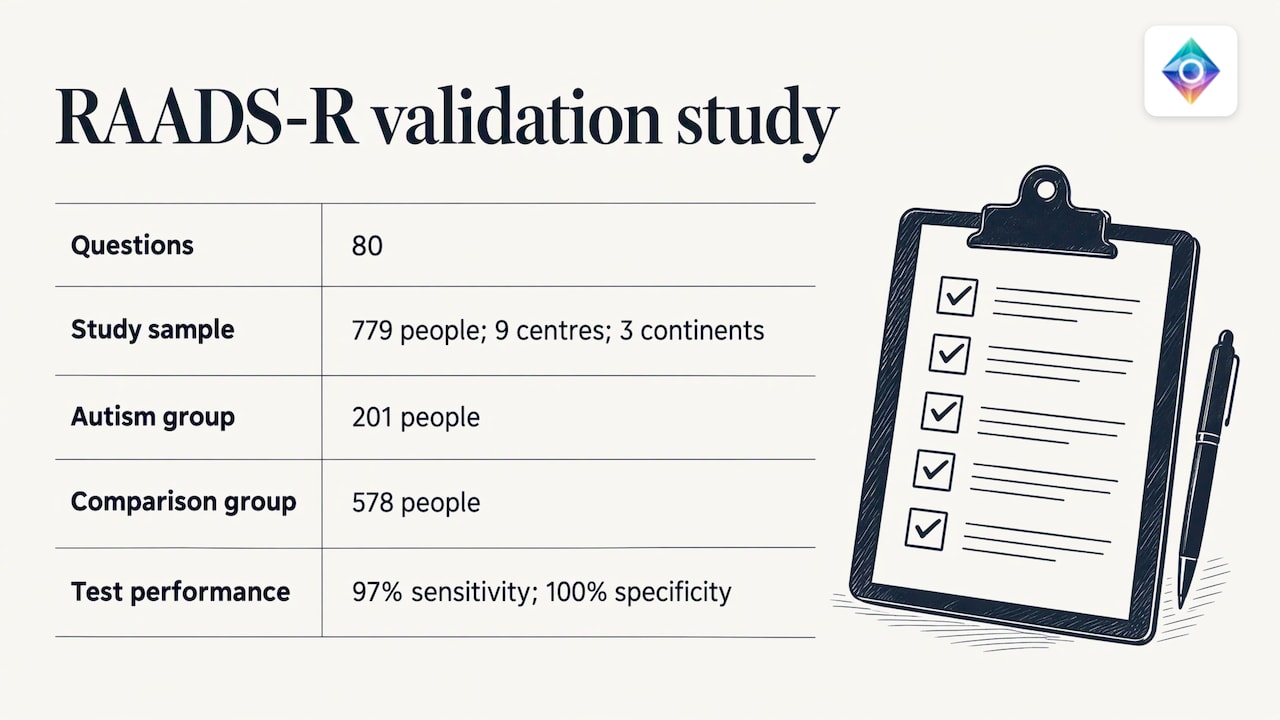
The RAADS-R has 80 questions. In the original validation study, 779 people across nine centres on three continents (201 with autism and 578 comparisons) produced sensitivity of 97% and specificity of 100%, and the authors concluded it is a useful adjunct diagnostic tool for adults. That is a clinical setting with people already being assessed, so it does not mean an online score carries the same weight.
Its length is its advantage: it asks about areas a 10-item screen cannot reach. If you want more detail on how it compares with other self-report tools, our guides to RAADS-R alternatives and AQ alternatives set the options side by side.
M-CHAT-R/F: for toddlers
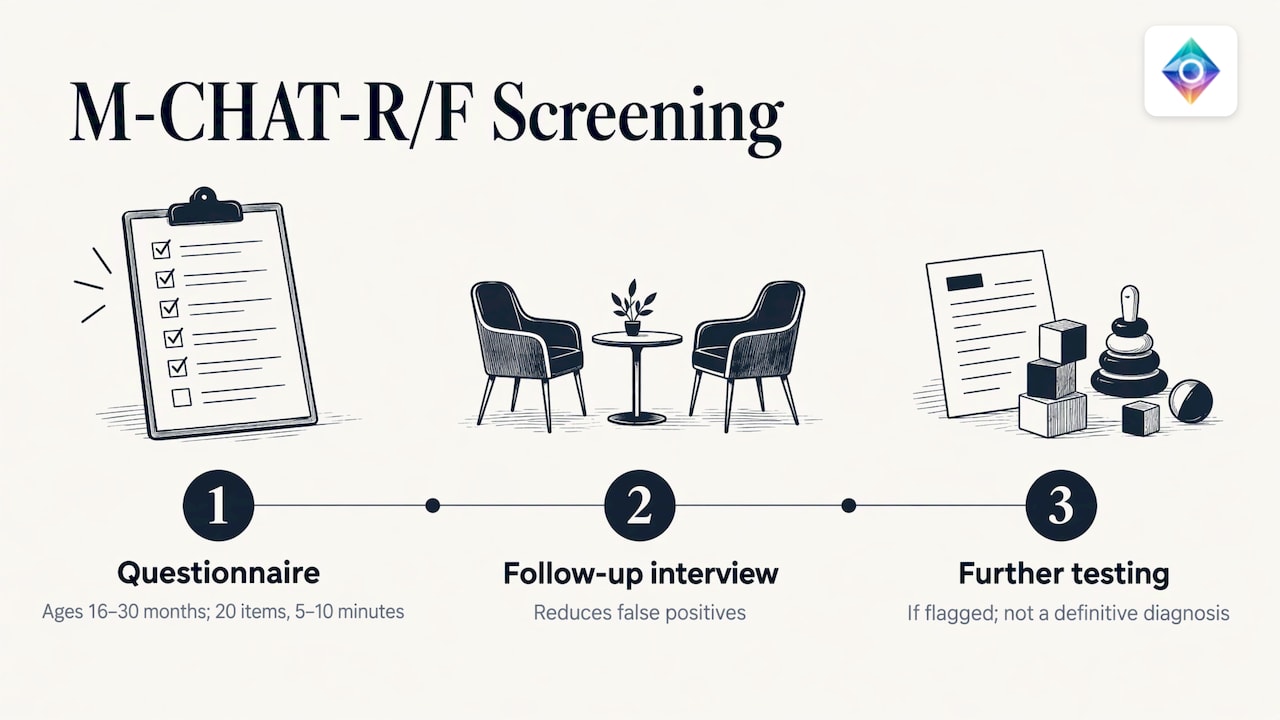
Parents of very young children need a different tool. Louisiana’s health department describes the M-CHAT-R/F as free for children aged 16 to 30 months, a 20-item questionnaire with a follow-up interview to reduce false positives. The questionnaire takes 5 to 10 minutes. It can flag a child who needs further testing, and it cannot give a definitive diagnosis.
Omniprism: the wider profile
Our self-assessment is free at omniprism.app/assessment.html. It needs no email, no account and collects no data, and it returns an instant plain-language profile across 14 areas, including autism, ADHD, dyslexia, masking, dyspraxia, sensory processing and others. That breadth is the point for many people: autism rarely travels alone, and a single-condition quiz can miss the pattern. Our guide to how autism gets misread as ADHD shows why.
Do anonymous autism tests without an email work?
They work as a screen, which is what they are designed to be. Cleveland Clinic clinicians say quiz results should never replace a formal diagnosis, because assessment draws on more than one test, including follow-up questions and observation. They also point out that self-perception can be flawed, which is exactly why a structured questionnaire beats an unstructured “do I tick these boxes” list.
The useful way to read a result:
- A high score means a conversation with a GP is reasonable.
- A low score does not close the question, especially if you mask. Our piece on masking and adult autism signs explains why.
- A result is stronger when you can point to real examples from childhood and daily life.
For a longer treatment, see our neurodivergence self-assessment guide and the piece on self-assessment versus diagnosis.
How do I choose between them?
Match the test to your question.
- “Is it worth asking my GP?” Use the AQ-10. It is the tool NICE names for this purpose.
- “I want a detailed picture before I decide.” Use the RAADS-R or a broader profile such as ours.
- “Could it be autism, ADHD or both?” Choose a test that covers several areas, because overlap is common. If you wonder about anxiety too, read how adults tell autism from social anxiety.
- “I want to hand something to a clinician.” Pick a tool that produces a summary. Our Specialist Briefing does that, described below.
Whichever you pick, read the privacy statement first. If you cannot find one, treat the site as not anonymous.
What about tests for children and teenagers?
Adult quizzes are the wrong instrument for a child. Questions about work, relationships and self-reflection do not fit, and parents answer for younger children. We built guided assessments for children and teens for that reason: the Children’s Assessment (ages 7 to 10) and the Young Person’s Assessment (ages 11 to 13), with a Youth Briefing at €20 for sharing results with a professional.
If your worry is a toddler who is slow to talk, a speech delay checklist for parents is a sensible companion to a screening questionnaire. For school-age children, our guide to school autism adjustments covers what to ask for once you have an answer.
Full assessments are longer than any quiz. Cleveland Clinic says they can take from a few hours to several sessions, because clinicians rule out other conditions and gather detail to plan support.
What are the signs that make people take an autism test?
Most people take a test after recognising themselves in a description. The NHS lists signs in adults including finding it hard to talk to people, taking things literally, fixed routines, stimming, intense specialist interests and strong sensitivity to light, sound or textures. The National Autistic Society adds that adults often feel like an outsider, reach burnout, or put effort into behaviours others do automatically.
If that reads like your life, a test is a reasonable first step.
What should I do after a result suggests autistic traits?
Take it to your GP. For adults, NICE guidance says that a person without a moderate or severe intellectual disability who scores above 6 on the AQ-10, or where suspicion is high, should be offered a comprehensive autism assessment. That wording comes from the December 2011 consultation draft of the guideline, so confirm the current NHS referral route with your GP surgery.
Before the appointment:
- Save or print your result.
- Write down three or four specific examples from childhood and from work or home.
- Note anything a family member could confirm.
- Ask which route your local service uses.
Our Specialist Briefing turns your results into a clear summary designed for a clinician to read quickly. It costs €20 one-off.
Why we built Omniprism this way
I was diagnosed with ADHD at 42, and the most useful thing I could have had earlier was a clear, private picture of my own patterns that I could show someone.
We built Omniprism around that idea. Autism, ADHD, dyslexia and other neurodivergent traits overlap, so we cover 14 areas in one assessment instead of asking you to guess which single quiz to take. We ask for no email and no account, and we collect no data, so you can answer honestly without wondering where your answers end up.
Our results come in plain language, and the Specialist Briefing is designed so a healthcare professional can take in your profile quickly. Families get guided assessments for children and teens. We believe that gives you a stronger starting point for a conversation with your GP or specialist.
Valerio Cozzi
Try the free assessment
If you want an instant, private profile, start the free self-assessment. You will see your results straight away, and you can add the Specialist Briefing afterwards if you want something to bring to an appointment. Professionals can see how we work on our page for psychologists, coaches and companies.
FAQ
Can an online test diagnose autism?
No. Online tests can help identify autistic characteristics or whether you should speak to a doctor, but they are not diagnostic tools. Diagnosis needs a clinician who can ask follow-up questions and consider your history.
Is there a free autism test without an email?
Yes. Our self-assessment at Omniprism is free and needs no email or account. Other free tests exist, so check each site’s privacy statement before you begin.
Is the AQ-10 or the RAADS-R better?
They do different jobs. The AQ-10 is a 10-item screen that NICE recommends for deciding on referral, while the RAADS-R has 80 questions and gives a more detailed picture. Many people use the short one first.
Can a low score mean I am not autistic?
Not necessarily. A low or inconclusive screening result does not rule out autism. If your daily experience still matches the signs, speak to your GP.
Sources
- NICE: Autism spectrum quotient (AQ-10) test
- NICE: Autism in adults guideline (consultation draft, December 2011)
- NHS: Signs of autism in adults
- Ritvo et al. (2011): The Ritvo Autism Asperger Diagnostic Scale-Revised
- Autism Research Centre: AQ-10 (Adult)
- National Autistic Society: Signs that a child or adult may be autistic
- Cleveland Clinic: Am I Autistic? Don’t Diagnose With a Quiz
- Cleveland Clinic: Autism test, what to expect
- Louisiana Department of Health: Developmental Screening for Autism
- Medical News Today: Do online autism tests work?
- Autismus Wissen: Screening questionnaires and online tests
Recommended
- Self Assessment vs Diagnosis: ADHD and Autism Quizzes Aren’t Diagnoses
- RAADS-R Alternatives: 6 Autism Self-Assessment Tools Compared
- Parents: 14 Domain Self Check to Uncover Autism Misdiagnosed as ADHD
- AQ Alternatives: RAADS-R, SRS-2 and Other Options Compared
Written and edited by Valerio Cozzi, founder of Omniprism. Omniprism began after my own ADHD diagnosis at 42.
This article is educational. It is not medical advice, not a diagnosis, and not a substitute for assessment by a qualified clinician. The Omniprism self-assessment is free, needs no account and no email address, and runs entirely in your browser — your answers are never sent to a server. The optional Specialist Briefing report is a paid add-on.