AQ Alternatives: RAADS-R, SRS-2 and Other Options Compared
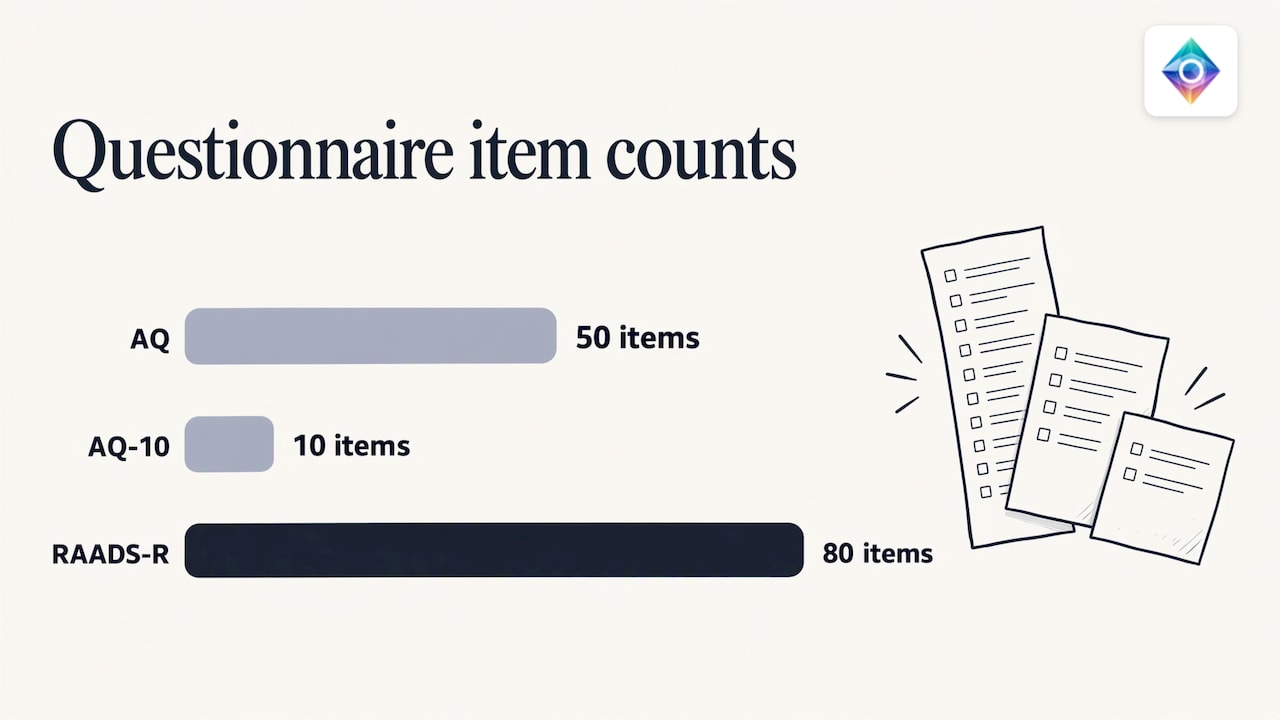
The closest alternative to the Autism Spectrum Quotient (AQ) for adults is the RAADS-R, an 80-item questionnaire that covers more ground, including sensory-motor symptoms. For children and teenagers, the usual choice is the SRS-2, and for a wider picture of how you think and process, a broad self-assessment such as Omniprism covers 14 areas in one sitting. None of them can diagnose autism, so the best option is the one that gives you the clearest information to take to a clinician.
Key Takeaways
- The AQ has 50 items and five areas; the RAADS-R has 80 items and four areas, so they ask different questions rather than the same ones twice.
- Research on both tools shows modest accuracy: one 2018 study of 93 adults found sensitivity of 0.45 for the AQ and 0.52 for the RAADS-R.
- No questionnaire score confirms autism. A clinical assessment does.
- Children and teenagers need tools built for their age, such as the SRS-2 or a guided youth assessment.
- Pick a tool by what you want from the result: a research-style score, a clinician-style questionnaire, or a broad plain-language profile.
What are the alternatives to the AQ?
The AQ is the best-known autism questionnaire, but it is far from the only one. Here are the main options, with what each is built to do.
| Tool | Items | What it covers | Designed for |
|---|---|---|---|
| AQ | 50 | Social skill, attention switching, attention to detail, communication, imagination | Adults aged 16+ without intellectual disability |
| AQ-10 | 10 | Short form of the AQ | Quick screening in adults |
| RAADS-R | 80 | Social relatedness, circumscribed interests, language, sensory-motor | Adults without intellectual disability |
| SRS-2 | Varies by form | Social responsiveness | Ages 4 to 18, with adult forms |
| EQ | See the ARC page | Empathy | Adults |
| Omniprism | 14 areas | ADHD, autism, dyslexia, masking, dyspraxia, dyscalculia, sensory processing, high sensitivity, OCD traits, synesthesia and more | Adults, teens and children (guided) |
The AQ examines five broad areas: social skill, attention switching, attention to detail, communication and imagination. The same source describes the RAADS-R as covering four domains: social relatedness, circumscribed interests, language and sensory-motor symptoms. The SRS-2 is widely used for ages 4 to 18 and has adult forms that you can complete yourself or that someone who knows you well can complete.
The Autism Research Centre, which hosts the AQ family, also lists the adult Empathy Quotient (EQ) for download in English, Arabic and Romanian. Licensing varies: the adult AQ-10 is free for nonprofit research and education, while fees may apply to for-profit healthcare, commercial and IT users.
If you want an everyday web version, note that people on the National Autistic Society community have long pointed out that there is no single official website for the AQ-50, EQ and RAADS-R, and the same test text circulates in many places. That is worth knowing before you trust any scoring page you find.
AQ vs RAADS-R: what is the difference?
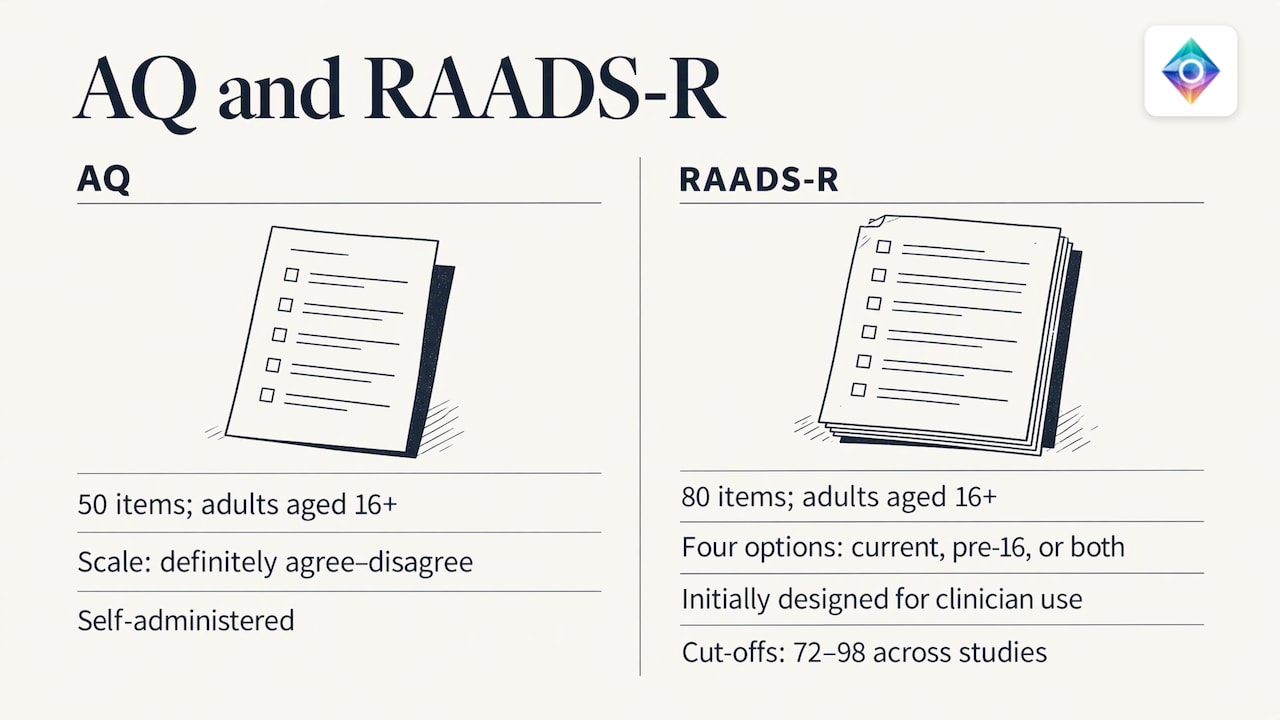
The AQ is a 50-item self-administered screen for autism traits in adults aged 16 and older without intellectual disability. The RAADS-R is an 80-item questionnaire for the same adult group, and it was initially designed for clinician administration.
Format is where they part ways most clearly. The AQ asks you to answer on a scale from “definitely agree” to “definitely disagree”. The RAADS-R uses four response options, and the Swedish validation study describes answers that distinguish whether a trait applies now, applied before age 16, or both. That childhood question matters, because a clinician assessing adults is looking for traits that have been there since early life.
Scoring is the second difference. The RAADS-R has a scoring guide, yet the literature is not settled on where to draw the line: recommended cut-offs range from 72 to 98 across studies. A score of 80 can therefore look “positive” in one paper and “negative” in another.
The setting also changes results. The same Rutgers work reports that the RAADS-R performed significantly better when a clinician was available to clarify questions than in self-administered or mail-in versions. If you take it alone at home, a confusing item is yours to interpret, and it is worth noting which ones you were unsure about.
For a longer side-by-side of six self-assessment tools, see our guide to RAADS-R alternatives compared.
How accurate are the AQ and RAADS-R?
Both tools are best seen as conversation starters. A 2018 study of 93 adults aged 18 to 61 found relatively low diagnostic validity for self-report measures: the AQ had a sensitivity of 0.45 and a specificity of 0.52, and the RAADS-R had a sensitivity of 0.52 and a specificity of 0.73. In plain terms, many people with autism scored below the line, and many people without it scored above.
The short AQ-10 has drawn particular attention in the UK. In 2020, NICE surveillance documentation highlighted evidence from Ashwood and colleagues (2016) that the AQ-10 may miss many cases, reporting a 64% false negative rate in a study of 476 adults.
There are three reasons the numbers can look worse in real clinics than in the original papers:
- Study design. Original validations often used case-control designs, which are criticised for overestimating sensitivity and specificity compared with cohort studies in clinical populations.
- Intelligence and verbal ability. AQ scores are significantly correlated with IQ in work cited by Bishop and Seltzer (2012) and Baron-Cohen and colleagues (2001), and the Swedish study notes that high verbal ability can compensate for and camouflage impairments.
- Masking. Autistic women in particular often camouflage their traits, and screening tools built on older, male-centric criteria have documented limits in detecting autism in women.
If masking is part of your story, our pieces on autistic traits in women and how masking hides adult autism signs explain what questionnaires tend to miss and how the NHS route works.
Can an AQ or RAADS-R score diagnose autism?
No. The ESCAP practice guidance states that screening tools alert clinicians to the possibility of autism but are not diagnostic instruments and cannot confirm a diagnosis. The Autism Research Centre says the same of its own tests: no single score indicates autism, and diagnosis requires clinical assessment, including clinical judgement.
A result that raises questions is still useful. A sensible sequence looks like this:
- Save your answers, not only your total, and mark the items you were unsure about.
- Write down examples from childhood and from now, since assessors ask for both.
- Book a GP appointment and bring a one-page summary. Our copyable report examples for GP appointments show a format that works.
- Ask whether a full diagnostic assessment is appropriate, rather than asking the GP to interpret a score.
The UK-specific steps, including how masking affects the conversation, are in our guide to unmasking autism safely. For the wider question of why a quiz is not a diagnosis, read self-assessment vs diagnosis.
Which questionnaire suits children and teenagers?
The AQ and RAADS-R are built for adults, so a parent looking at them for a ten-year-old is using the wrong instrument. The SRS-2 is the widely used choice for ages 4 to 18. A parent or teacher usually completes it rather than the child, because it asks about observed behaviour.
For younger children, early signs are often about communication first. A checklist on recognising speech delays helps you separate the things worth raising with a health visitor from ordinary variation.
The ESCAP guidance adds a point that reassures many parents: because sensitivity is generally higher than specificity, screening tools often identify other developmental problems alongside autism, and from a public health view this is considered an asset for early support. It also notes that no single measure can be recommended for early detection.
Omniprism offers guided assessments for children and teenagers in age bands, with a children’s assessment for ages 7 to 10 and a young person’s assessment for ages 11 to 13. Teachers looking at classroom support can read our guide to legal school autism adjustments.
How do I choose between these tools?
Start with what you want to walk away with.
- A familiar research-style score: the AQ or AQ-10. Treat the number as a rough indicator only.
- A longer questionnaire that asks about now and before age 16: the RAADS-R, ideally with someone available to clarify questions.
- A child’s or teenager’s profile: the SRS-2 through a professional, or an age-appropriate guided assessment.
- A broad view across several neurotypes: a multi-domain tool, since ADHD, autism, dyslexia, dyspraxia and sensory differences often overlap. Our guide on autism vs social anxiety shows why a single-condition questionnaire can leave questions open.
Privacy deserves a thought too. Many online AQ pages ask for an email address or keep your answers. Omniprism asks for no email or account and collects no data.
Omniprism: a broader alternative
Omniprism is a self-assessment that gives an instant, plain-language profile across 14 areas, including ADHD, autism, dyslexia, masking, dyspraxia, dyscalculia, sensory processing, high sensitivity, OCD traits and synesthesia. It is free to take. If you want something to hand to a clinician, the optional Specialist Briefing summarises your results in a format designed for healthcare professionals, for a one-off €9.99. You can start the free self-assessment now, and clinicians or coaches can see how it fits their practice on the professionals page.
It is a self-reflection and preparation tool, not a diagnosis, in the same way as the AQ and RAADS-R.
Our perspective
We built Omniprism because one condition-specific questionnaire rarely tells the whole story. Someone who scores low on the AQ may still have sensory differences, a dyslexic profile or ADHD traits that shape daily life, and a single total hides all of that.
I was diagnosed with ADHD at 42, and I know how much easier the appointment feels when you can describe your patterns in specific terms rather than a vague sense that something is different.
That is why we show a profile across 14 areas in plain language, with no email, no account and no data collection, so you can answer honestly. Our Specialist Briefing exists so the clinician sees a structured summary instead of a pile of impressions. We do not claim it replaces an assessment, and we think the best use of any questionnaire, ours included, is to make that assessment more useful.
Valerio Cozzi
FAQ
Is the RAADS-R better than the AQ?
It is longer and asks about sensory-motor symptoms and about traits before age 16, which the AQ does not. Accuracy is still modest: in a 2018 study of 93 adults, the RAADS-R had sensitivity of 0.52 and the AQ 0.45. Neither is a diagnostic tool, so “better” depends on what you need to show a clinician.
Is the AQ-10 enough to decide whether to seek an assessment?
Not on its own. NICE surveillance documentation cited a study reporting that the AQ-10 missed 64% of cases in 476 adults. If you recognise yourself in the traits, a low score should not stop you speaking to your GP.
Are online autism tests free to use?
Many are, but licensing differs. The adult AQ-10 is free for nonprofit research and education, and fees may apply to commercial users. Omniprism’s self-assessment is free, and only the optional Specialist Briefing is paid.
Can I use these questionnaires for my child?
The AQ and RAADS-R are for adults, so use age-appropriate tools. The SRS-2 covers ages 4 to 18, and Omniprism offers guided assessments for children and young people. Raise any concerns with your GP or school SENCO.
Sources
- Screening Tests and Tools for Autism in Adulthood, AIDE Canada
- Early Autism Screening: A Comprehensive Review (PMC)
- Autism Spectrum Quotient 10 items (AQ-10), Autism Research Centre
- Empathy Quotient (EQ) for Adults, Autism Research Centre
- Tests Archive, Autism Research Centre
- RAADS-R Swedish validation study, Journal of Autism and Developmental Disorders
- Rutgers University thesis on autism screening performance
- Examining the Diagnostic Validity of Autism Measures Among Adults, Autism in Adulthood
- 2020 surveillance of autism guidelines, NICE
- Testing adults by questionnaire for social and communication disorders (PMC)
- Diagnostic challenges of autism spectrum disorder in women, 2025
- ESCAP practice guidance for autism (PMC)
- The right and best websites for the AQ-50, EQ and RAADS-R, National Autistic Society community
- How to Recognize Speech Delays: A Parent’s Checklist
Recommended
- RAADS-R Alternatives: 6 Autism Self-Assessment Tools Compared
- Self Assessment vs Diagnosis: ADHD and Autism Quizzes Aren’t Diagnoses
Written and edited by Valerio Cozzi, founder of Omniprism. Omniprism began after my own ADHD diagnosis at 42.
This article is educational. It is not medical advice, not a diagnosis, and not a substitute for assessment by a qualified clinician. The Omniprism self-assessment is free, needs no account and no email address, and runs entirely in your browser — your answers are never sent to a server. The optional Specialist Briefing report is a paid add-on.