Autism Self-Assessment Guide: How to Do One and Use the Results
An autism self-assessment is a structured set of questions about your own experience of communication, routines, sensory input and energy, and it works best as preparation for a conversation with a clinician. It cannot diagnose autism, but done carefully it gives you a written record of your traits, with examples, which is the material a GP and an assessor ask you for. If you want to begin now, our Free Adult Self-Assessment gives an instant plain-language profile across 14 areas, with no email, account or data collection.
Key Takeaways
- A self-assessment or checklist is a way to organise what you notice about yourself. The National Autistic Society says screening questionnaires are not medical diagnoses and may not be accurate.
- The most useful output is a list of concrete examples: what you do, how often, and what it costs you in effort.
- In the UK you generally start with your GP, so bring your notes and a short summary of why you are asking.
- Children and teens have their own guided versions, and a parent’s observations carry real weight in a referral.
How do I complete an autism self-assessment, step by step?
Five steps cover it. Each one has a point where people commonly go wrong.
- Choose one tool and set aside 20 to 30 minutes. Pick a time when you are not rushed or exhausted. Answers given in a hurry drift towards what you think you should say. Our free assessment returns an instant profile, so you can finish in one sitting and keep the result private.
- Answer for your typical self across many years, not your best or worst week. If you have learnt to hide your traits, answer for how things are inside, not how they look to others. A German self-observation checklist advises describing the inner experience rather than outward appearance.
- Write one example beside every area that feels true. The same checklist asks you to rate how often something happens (rarely, sometimes, often, always) and to attach an example to each area. “I find eye contact tiring” is a start; “in meetings I look at people’s foreheads and lose the thread of what they say” is evidence.
- Note the cost, not just the outcome. Simply Psychology’s guide to adult assessment in the UK says the useful detail is what it takes you to manage, for example planning conversations in advance and needing the following day clear, rather than simply that you can hold a conversation.
- Ask someone who knows you well to add their view. AANE, an autism organisation in the United States, suggests adults include insights from significant others alongside their own list of observations.
Where people go wrong is usually step 2. Anyone who has masked for years tends to describe the polished version of themselves. If your answers feel smoother than your life does, go back and answer for the version of you that exists after a long day.
What is an autism self-assessment, and what can it tell me?
It is a reflective questionnaire. You read statements about your experience and rate how well they fit. Some tools are short screeners, and others are longer profiles that look at several areas at once.
The National Autistic Society describes screening tools as questionnaires that indicate whether someone is likely to be autistic. It adds that results can vary between tools and that scoring can be hard to interpret. The widely available adult versions include the Autism Quotient-10 and Autism Quotient-50, and a children’s Autism Quotient-10.
So a self-assessment answers a modest question: do my experiences resemble the patterns clinicians look for, and in which areas? That is a useful question. It tells you whether a referral is worth pursuing and what to emphasise when you get one. Our guide to self-assessment versus diagnosis goes further into where the line sits.
What traits does an autism self-assessment checklist cover?
The National Autistic Society groups the core characteristics into differences in communication and social interaction, and differences in behaviours and interests. The second group includes focused interests, repeated movements, a preference for routine and sensory differences.
In practice, a good checklist turns those into everyday areas you can recognise:
| Area | What to look for in your own life |
|---|---|
| Social communication | Finding small talk effortful, missing implied meaning, needing time to recover after socialising |
| Routines and change | Distress when plans shift, strong comfort in predictable patterns |
| Focused interests | Deep, long-lasting absorption in particular subjects |
| Sensory experience | Light, sound, texture or smell that others barely notice |
| Repetitive movement | Stimming such as rocking, tapping or humming, especially when stressed or happy |
| Masking | Rehearsing, copying or suppressing behaviour to fit in, and the exhaustion that follows |
| Work and daily life | Planning, organisation and managing everyday responsibilities |
The last two rows matter more than people expect. Many adults reach assessment after years of coping well enough on the surface. Our article on how masking hides adult autism signs explains why those adults often score lower than their lived experience suggests.
Traits overlap across conditions. Some experiences on any autism checklist also occur with ADHD or anxiety. That is one reason our assessment covers 14 domains, including ADHD, autism, dyslexia, masking, dyspraxia, dyscalculia, sensory processing, high sensitivity, OCD traits and synesthesia, so you see the whole picture and not a single score in isolation.
How do I read my autism self-assessment result?
Read it as a pattern, not a verdict. A high score in an area tells you where to look more closely, and a low score tells you that area is probably not where your difficulty sits.
Three things help you read it sensibly.
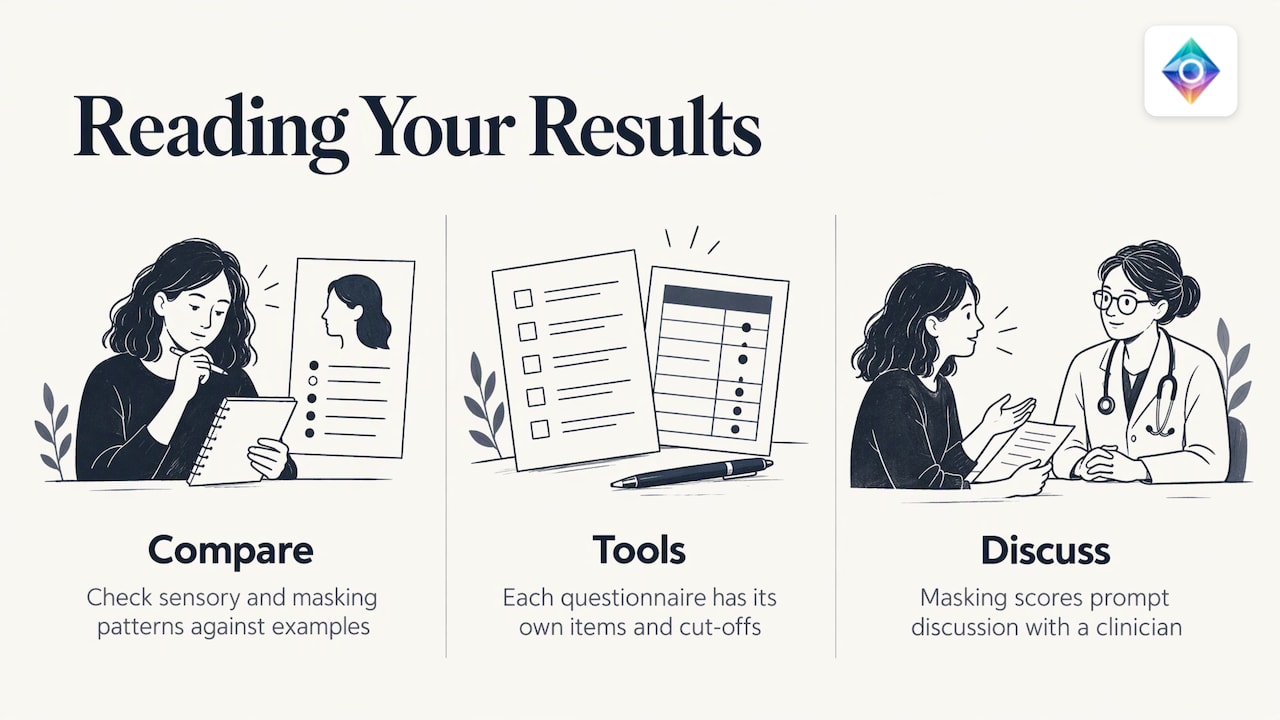
Compare the pattern with your examples. If the profile highlights sensory processing and masking, check that your written examples back that up. Where they do, that area belongs at the top of your notes.
Remember that tools differ. The National Autistic Society notes that results can vary between tools. A score from one questionnaire does not translate directly to another, because each has its own items and cut-offs. Questionnaire scores are generally built from adding item responses against a threshold, and a short explainer on how assessments are scored shows the general logic behind that.
Look at specific measures with care. A research article on adult diagnosis by Pagán, Flint and Loveland describes the Camouflaging Autistic Traits Questionnaire, which has 25 items scored from 25 to 175 and in which higher scores indicate more camouflaging. The authors caution that, used as the only indicator of autism, it may produce more false positives because factors such as anxiety also affect camouflaging. In other words, a masking score is a prompt for discussion with a clinician.
If you want to compare the best-known questionnaires, our guides to RAADS-R alternatives and AQ alternatives set them side by side.
How do I use my results to get a professional autism assessment?
In England, you generally cannot refer yourself. Leicestershire Partnership NHS Trust states that you speak to your GP first, who carries out an initial screening check. The NHS page on autism assessments explains how to get one and what happens during it. Local routes and waiting times differ, so check with your own GP surgery or integrated care board.
A short, organised summary makes that GP appointment more productive. Prepare:
- A one-page summary of the areas where you recognise yourself, each with one or two examples.
- Evidence from before you learnt to mask, such as school reports or things family members remember.
- A note on cost: the effort, recovery time and consequences behind how you cope.
- Anything you have noticed yourself, such as a diary of incidents. The National Autistic Society recommends keeping a diary or written record of behaviours and concerns and sharing it with professionals.
Once you reach assessment, expect more than one appointment. AANE says that two to three appointments are typical, ending with a report appointment. Simply Psychology notes that adult assessment has no pass mark, because it is a clinical judgement assembled from your history, so there is nothing to rehearse. Written notes help because recall under pressure is unreliable.
The NICE guideline on autism in adults covers diagnosis for people aged 18 and over, and its guidance for under-19s says that an autism-specific tool should not be relied on alone to diagnose. Assessors draw on developmental history, observation and your own account. Your notes feed directly into that history. For a longer walk-through, see our UK guide to preparing for an autism assessment.
Pro Tip: Put the examples that show masking at the top of your summary and say plainly that you mask. The clinician cannot see the effort unless you describe it.
What about autism self-assessment for children and teens?
For a child, the observer matters as much as the questionnaire. A parent or carer completes or guides the answers, and the picture improves when a teacher or other adult adds what they see at school or in clubs.
The CDC explains that a brief screening test does not provide a diagnosis but can show whether a child needs a closer look from a specialist. A formal evaluation is carried out by trained professionals such as a developmental paediatrician, child psychologist, speech and language therapist or occupational therapist.
In England, Leicestershire Partnership NHS Trust describes a route in which parents or carers complete a Parent-Carer Questionnaire and a School Questionnaire, returned to the GP within six months. Your own area may use different forms, so ask your GP or school’s special educational needs coordinator what applies locally.
We offer a Children & Young People Free Assessment, with guided versions for ages 7 to 10 and ages 11 to 13. Parents who want a starting list of signs can also read our autism checklist for parents, and teachers and parents can see what school adjustments are available.
Why we built Omniprism this way
I was diagnosed with ADHD at 42. Looking back, the most useful thing I could have had earlier was a clear, private picture of how my mind works, without having to hand over my details first.
We built Omniprism around that idea. Our adult assessment gives you an instant profile across 14 areas in plain language, and we collect no data, so you can answer honestly. Honest answers are what make a profile worth taking to a clinician.
The same applies to families. The children’s and teens’ assessments are guided, so a parent can describe what they see in a way that a GP, school or specialist can follow. That is how we think self-understanding and professional assessment should fit together: the first prepares you for the second.
Valerio Cozzi
Ready to take the next step?
Start with the Free Adult Self-Assessment. When you have your profile and want something to hand to your GP or assessor, the Specialist Briefing summarises your results for clinicians for a one-off €20. For families, the Youth Briefing does the same for a child or teen, also at €20 one-off. Clinicians and coaches can see how we work with them on our professionals page.
FAQ
Can an autism self-assessment tell me if I am autistic?
No. It can show whether your experiences resemble recognised autistic traits and whether a referral is worth pursuing. Only a clinical assessment gives a diagnosis, and the National Autistic Society says screening results are not medical diagnoses and may not be accurate.
Is an autism checklist the same as an autism test?
A checklist helps you reflect on and record your experiences, and a scored questionnaire turns your answers into a number. Neither is diagnostic. Some checklists say outright that they are not tests, and some of the experiences they list also appear with ADHD or anxiety.
Do I need a self-assessment before I see my GP?
You do not need one, but it helps. In England your GP is the usual first step, and a short written summary with examples makes it easier to explain why you are asking for an assessment.
Can I fill in an autism self-assessment for my child?
Yes. A parent or carer can complete a guided assessment for a child or teen, ideally with input from school. The CDC notes that a brief screening does not give a diagnosis but can show whether a specialist should take a closer look.
Sources
- Signs that a child or adult may be autistic, National Autistic Society
- Deciding whether to seek an autism assessment, National Autistic Society
- Autism assessments, NHS
- Autism spectrum disorder in adults: diagnosis and management, NICE CG142
- Autism recognition, referral and diagnosis under 19s, NICE summary
- Diagnosing Autism in Adults, Pagán, Flint and Loveland, PMC
- Screening for Autism Spectrum Disorder, CDC
- Thinking about an autism assessment, Leicestershire Partnership NHS Trust
- The Diagnosis Journey, AANE
- Adult Autism Assessment: What Happens, Simply Psychology
- Erwachsene Selbstbeobachtungs-Checkliste, autismus-ratgeber.de
- How Career Assessments Are Scored: A 2026 Guide, NueCareer
Recommended
- Self Assessment vs Diagnosis: ADHD and Autism Quizzes Aren’t Diagnoses
- RAADS-R Alternatives: 6 Autism Self-Assessment Tools Compared
- How to Prepare for an Autism Assessment: A UK Guide
- Best Anonymous Autism Tests: What to Use and What to Skip
Written and edited by Valerio Cozzi, founder of Omniprism. Omniprism began after my own ADHD diagnosis at 42.
This article is educational. It is not medical advice, not a diagnosis, and not a substitute for assessment by a qualified clinician. The Omniprism self-assessment is free, needs no account and no email address, and runs entirely in your browser — your answers are never sent to a server. The optional Specialist Briefing report is a paid add-on.