How to Document Symptoms for a Diagnosis in the UK
To document symptoms for a diagnosis, write down each trait with a concrete example, how often it happens, where it happens and what it costs you in daily life, then add evidence from childhood and bring it all to your GP or assessor. A clinician is looking for a pattern across settings and years that causes real impairment, so a dated, example-led record serves you far better than a list of labels.
This guide is for adults, parents, young people, educators and professionals preparing for a neurodevelopmental assessment such as ADHD or autism. It uses UK clinical templates and guidance, and it shows where a structured profile can save you time.
Key Takeaways
- Describe each trait with an example, a frequency (never, rarely, sometimes, often), a setting and the effect on your life.
- Evidence from childhood matters as much as current difficulties, because these conditions are neurodevelopmental.
- Keep the focus on the diagnostic questions: referrals can be declined when they are mostly about other difficulties such as anxiety.
- A self-assessment profile is a record to take into the appointment. A diagnosis still comes from a qualified clinician.
- Record strengths and the adjustments you already use, because they shape the support that follows.
How do you document symptoms for a diagnosis?
Work through these seven steps over a week or two, adding to the notes as memories surface.
-
Choose the questions you are answering. Ask whether your difficulties fit ADHD, autism or another profile, and organise your notes under those headings. Domains used in a Scottish request template for neurodevelopmental assessment are a useful frame: social interaction, social communication, flexibility of thought, attention, hyperactivity and impulse control, language, physical health, learning and development, and family circumstances. Where it goes wrong: writing a general account of how you feel, which leaves the clinician to work out which parts matter.
-
Write one line per trait, with a real example. “I lose focus in meetings” is a label. “Twice a week I miss the end of a meeting and have to ask colleagues what was agreed” is evidence. Expert consensus guidance on identifying and treating neurodevelopmental conditions in the UK says to obtain specific examples of behaviour rather than relying on views of what is typical or atypical.
-
Rate the frequency. The ACE pre-assessment manual asks people to record how often each symptom has appeared over recent months or years: never, rarely, sometimes or often, with specific examples for anything rated sometimes or often. Using the same four words in your notes makes them easy for a clinician to read.
-
Record the adjustments you already make. List the alarms, routines, lists, avoided situations and help from other people that keep things running. The same manual cautions that frequency ratings may be lowered by compensatory strategies or adjustments, so write down how things would be without them. This is the step people most often skip, and it is where the true picture sits.
-
Add the timeline. Note when each pattern started and where it appears: home, school or work, friendships, money, health. Because autism and ADHD are neurodevelopmental, evidence of difficulties should be present in both childhood and adulthood. School reports, comments from teachers and accounts from relatives all count.
-
State the impact. For each area, write what it costs you: missed deadlines, lost jobs, strained relationships, exhaustion, debt. Clinical classifications require clinically significant distress or impairment in social, occupational or other important areas of functioning before a diagnosis is endorsed, so impact is the part that carries the most weight.
-
Put it on one or two pages. Lead with a short summary, then the domains, then the childhood evidence. Attach any completed questionnaire. A clinician with a short appointment will read a clean page, and will struggle with a diary.
If you want the first draft of this structure done for you, the free Adult Self-Assessment gives a plain-language profile across 14 areas as a starting point for your notes.
What should I record about childhood and development?
This is the part adults find hardest and parents find most natural. A professional guide to documenting a history of attention difficulties suggests sending a pre-assessment questionnaire about two weeks before the appointment, covering birth details, early health issues, walking and talking milestones, clumsiness, reading and spelling difficulties, school report comments on concentration, forgetfulness and daydreaming, and how the child got on with other children.
For adults, that translates into a short list of sources to gather:
- Old school reports, especially teacher comments from primary years.
- A few written lines from a parent, sibling or old friend describing you as a child.
- Your own memories of specific episodes, dated as best you can.
The Scottish ADHD Coalition advises adults to bring evidence about how they were as a child, such as school reports or letters from family and friends to the mental health team assessment.
Parents of young children can use the same structure. A speech delay checklist for parents helps you note early language milestones, which assessors usually ask about. For preschoolers, our page on clinician-ready notes for ADHD symptoms in preschoolers shows how to phrase what you see.
The Scottish template also asks for descriptions across settings, so write down whether a pattern appears at school, at home and with friends. A trait that shows up in only one place is a different finding from one that follows the child everywhere, and the assessor needs to know which you are describing.
Can I give my doctor a list of symptoms?
Yes, and a well-built list helps. The key is what the list contains. Nottinghamshire Healthcare NHS Foundation Trust says referrals can be declined when they contain a lot of information about other difficulties, such as anxiety, and too little description of ADHD or autism symptoms. It advises focusing on evidence of meeting the diagnostic criteria.
In practice:
- Put the attention, hyperactivity, social communication and sensory examples first.
- Mention anxiety, low mood or sleep problems briefly and in context, since they matter to the overall picture.
- Use the same wording the clinician uses, such as “persistent” and “pervasive”, only where your examples support it. The same trust describes ADHD symptoms as severe, persistent and pervasive, affecting relationships, work, education, finances and day-to-day tasks.
For a first GP appointment, the Scottish ADHD Coalition suggests adults take a completed ASRS self-report scale, a short screening questionnaire, along with their notes. If you want to see what a one-page summary looks like, our copyable neurodiversity report examples for GP appointments show a layout you can adapt, and our guide to describing ADHD symptoms with a clinician checklist covers the wording.
If you are unsure whether your difficulties are serious enough to raise, when impairment spans two areas of life explains how UK ADHD diagnosis weighs impact.
What does a clinician want to see in an assessment?
Knowing the assessor’s checklist helps you prepare. The NAIT Neurodevelopmental Assessment Workbook states that an assessment should include early developmental history, a narrative of current presentation in different contexts, standard history including medical and social background, current medications, an informant account and observation.
That gives you a simple map for your own notes:
| Clinician needs | What to bring |
|---|---|
| Early developmental history | School reports, milestone notes, family accounts |
| Current presentation in different contexts | Dated examples from home, work or school, and social life |
| Medical and personal history | Diagnoses, medications, previous mental health contact |
| Informant account | A written paragraph from someone who knows you well |
| Impact | A list of areas where difficulties cost you something |
The informant matters more than most people expect. The consensus guidance advises collecting specific examples from informants rather than their general impressions, so ask the person to give two or three situations they remember, not a character summary.
How do I document strengths as well as difficulties?
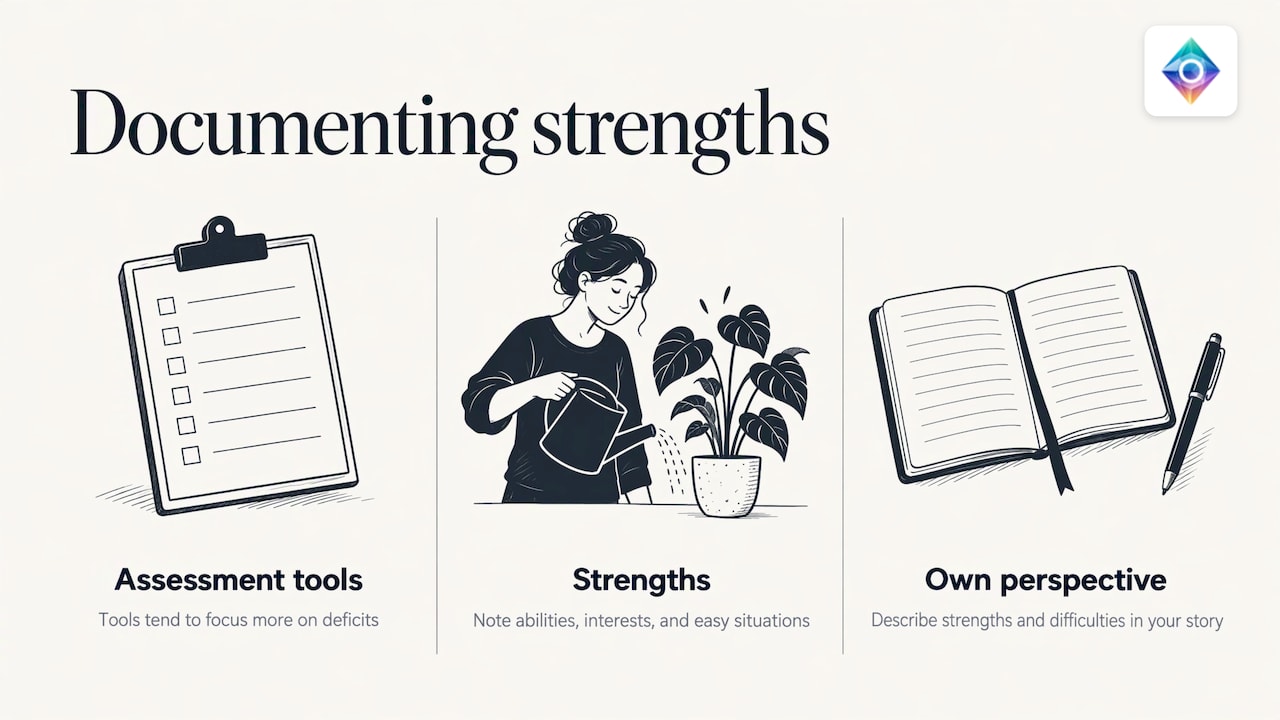
Diagnostic tools lean towards problems. The NAIT workbook says assessment tools tend to be more deficit focused than strengths based and that clinicians should consider adapting conversations and reports to reflect that neurodevelopmental differences need not be seen as deficits. A 2023 paper in Frontiers in Psychiatry argues that providing strengths-based information during an autism evaluation offers an alternative to stigmatising messages.
So add a short strengths section to your notes: things you do unusually well, interests you sustain, situations where you function easily. These help the clinician see why you present as you do now, and they inform which supports will fit. The workbook describes a formulation approach that lets the person tell their developmental story and identify strengths and difficulties from their own perspective. Our page on mapping neurodivergent strengths across 14 domains shows how to do this without a diagnosis.
Does a symptom record or self-assessment count as a diagnosis?
No. It is the evidence a diagnosis is built from. A professional guide to documenting ADHD history notes that there is no clear cut-off point for whether ADHD is present, which is why assessors compile a wide-ranging life history and test abilities rather than relying on a single score.
Your notes support that process. They give the clinician a head start on the history, and they make sure the details you remember at home are the ones you actually say in the room. The NAIT workbook also frames diagnosis within a neurodiversity paradigm as a valuable anticipatory support and a means of developing self-identity and understanding of difference, which is a good reason to take the preparation seriously.
Autism and ADHD frequently occur together, so if your notes point to both, say so. Our comparison of autism and ADHD symptoms, overlap and diagnosis helps you separate which examples belong where.
Where can I get a structured profile of my symptoms?
Omniprism’s free assessments return an instant profile in plain language across 14 areas, including ADHD, autism, dyslexia, masking, dyspraxia, dyscalculia and sensory processing. We collect no email, account or data. Adults can start with the Free Adult Self-Assessment, and parents and young people can use the Children & Young People Free Assessment, which offers guided questions for children and teens.
When you are ready to take your results to a GP or clinician, the Specialist Briefing summarises them in a form designed for clinicians, as a one-off €20 purchase. Parents can use the Youth Briefing, also €20 one-off.
Why does a clear symptom record matter?
I was diagnosed with ADHD at 42. Looking back, what I lacked before that appointment was a way to turn a lifetime of half-remembered difficulties into something a clinician could read in a few minutes.
That is why we built Omniprism around a profile across 14 areas that appears instantly, in plain language, with no account and no tracking. People should be able to see their own patterns without handing over their data first.
The Specialist Briefing exists for the next step: it summarises your results so that the conversation with a healthcare professional starts from organised information. We designed it for easy use by clinicians, and for parents we offer the same through the Youth Briefing.
Valerio Cozzi
FAQ
Where can I list symptoms and get a diagnosis?
You list symptoms in your own notes or a structured profile, and the diagnosis comes from a qualified clinician after assessment. In England, the usual route starts with your GP, who can refer you for assessment if they think it is appropriate. The Scottish ADHD Coalition guide for adults describes taking a completed screening scale to the GP appointment.
What are diagnostic symptoms?
They are the specific traits that a clinician checks against the criteria for a condition, together with evidence that they are persistent, appear across settings and cause impairment. For ADHD and autism, that includes evidence from both childhood and adulthood. Your examples are what turn a general trait into something a clinician can assess.
How long should my notes be?
One or two pages is enough for most appointments. Start with a short summary, then group examples by domain, then add childhood evidence and a line on strengths. Keep longer material, such as school reports, as attachments the clinician can open if needed.
Should parents and teachers both contribute?
Yes. The Scottish template asks about concerns across several settings, and the consensus guidance favours specific examples from informants. A teacher’s observation of how a child behaves in class often complements what parents see at home.
Sources
- Nottinghamshire Healthcare NHS Foundation Trust: How to screen for neurodiversity
- NAIT: Request for Neurodevelopmental Assessment Template (Appendix 2)
- NAIT: Neurodevelopmental Assessment Workbook, March 2022
- Guidance for identification and treatment of individuals with ADHD and autism: expert consensus statement, 2020
- Frontiers in Psychiatry, 2023: Toward a more comprehensive autism assessment
- ACE Pre-Assessment Manual, 2024
- Scottish ADHD Coalition: Guide to adult ADHD assessment
- David Grant: Guide to documenting a history of attentional and/or hyperactivity difficulties, January 2014
Recommended
- Sensory Processing Checklist for UK Children: Prepare for NHS Meetings
- Describe ADHD symptoms: clinician checklist and private assessment
- How to Prepare for an Autism Assessment: A UK Guide
- How to Prepare for an ADHD Assessment in the UK
Written and edited by Valerio Cozzi, founder of Omniprism. Omniprism began after my own ADHD diagnosis at 42.
This article is educational. It is not medical advice, not a diagnosis, and not a substitute for assessment by a qualified clinician. The Omniprism self-assessment is free, needs no account and no email address, and runs entirely in your browser — your answers are never sent to a server. The optional Specialist Briefing report is a paid add-on.