How to Prepare for an ADHD Assessment in the UK
To prepare for an ADHD assessment, learn what the traits look like, gather records from your childhood, write down specific examples of where difficulties show up, and follow any instructions your clinician sends. These steps are drawn from NHS guidance on preparing for an autism or ADHD assessment, and the sections below show how to do each one.
Key Takeaways
- Concrete examples from home, work or school are more useful to a clinician than general statements such as “I can’t focus”.
- Childhood evidence matters: school reports, and accounts from relatives or friends who knew you then, help show a lifelong pattern.
- Rating scales and self-assessments help build a picture but are never used alone to diagnose ADHD.
- For a child, expect the clinician to ask for information from parents and school as well as from the child.
- You do not need to manufacture evidence you do not have; bring what exists and say honestly what is missing.
How do you prepare for an ADHD assessment?
Six steps cover almost every UK assessment, whether it is NHS or private, online or in person. Do them in this order, and expect it to take a few evenings spread over a week or two rather than one sitting.
- Learn what ADHD traits look like. Read the official descriptions so you can recognise your own experience in them. Our guide to describing ADHD symptoms for a clinician shows how to turn vague impressions into usable statements.
- Find out the format. Check whether your appointment is online or in person, how long it lasts, and whether anyone else will be asked to take part. Follow any questionnaires or instructions the service has sent, and return them before the date.
- Collect records from childhood. Look for school reports, old teacher comments, and any earlier health or educational assessments. If paper evidence has gone, the Scottish ADHD Coalition guide to adult assessment suggests that letters from family and friends who remember you as a child can serve instead.
- Write down specific examples. Aim for five to ten, from different settings: a missed deadline, a chaotic morning routine, a relationship strain, a job you left. Note roughly when each began and how often it recurs.
- Prepare your health information. List current medication, previous diagnoses and any relevant reports, plus a brief note on sleep, mood and anxiety, since clinicians look at those too.
- Arrange a second voice. If a partner, parent or old friend can attend or complete a form, ask them early so they have time to think.
Pro Tip: Keep one running note on your phone for the fortnight before the appointment. Add each example the moment it happens, with the setting and what it cost you. Memory under questioning is patchy, and a note saves you from going blank.
What happens in an ADHD assessment?
Most adult assessments are built around a long conversation about your current difficulties, your earlier years, and your physical and mental health. Under NICE guideline NG87, ADHD should only be diagnosed by a specialist psychiatrist, paediatrician or other appropriately qualified healthcare professional with training and experience in diagnosing it. Your GP can refer you, but cannot usually make the diagnosis themselves.
Clinicians look for a pattern rather than a single symptom. Ohio State clinicians stress that ADHD is lifelong and that the assessor must establish a pattern beginning in childhood. This is why the questions about your school years can feel oddly specific: they are testing whether what you describe today has roots.
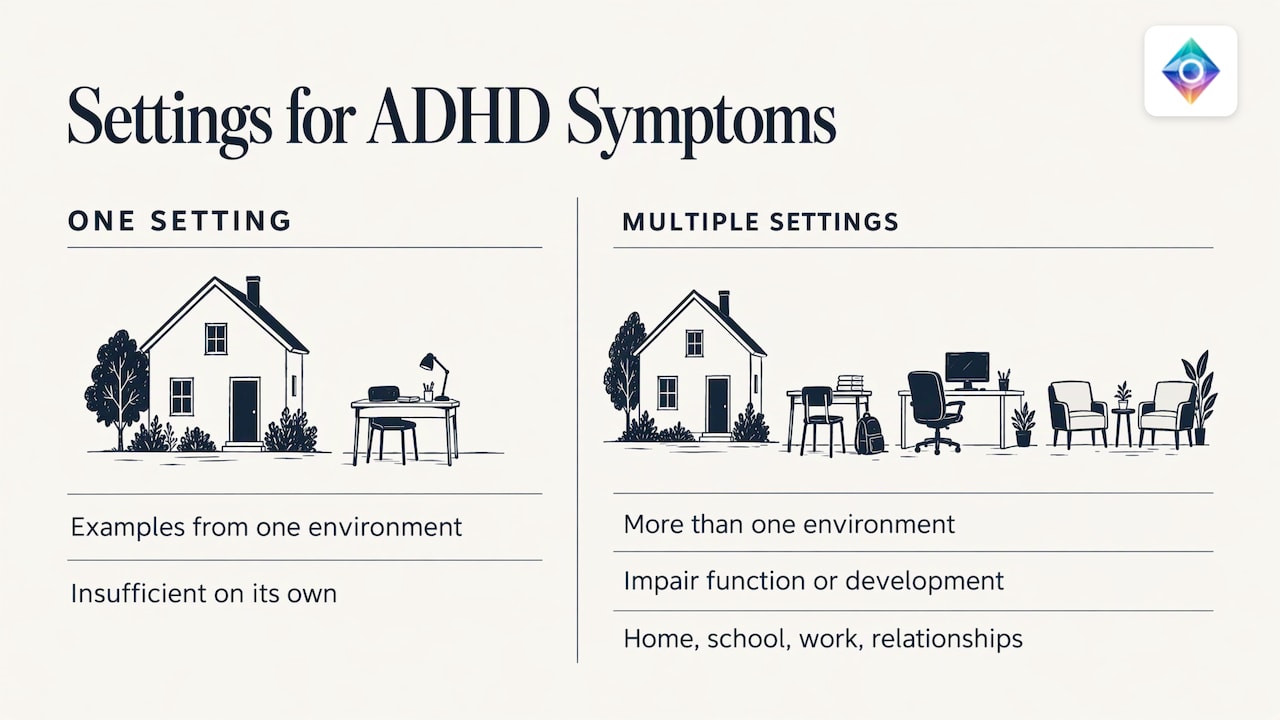
The pattern also has to show up in more than one place. The Australian ADHD guideline consumer companion says diagnostic symptoms must interfere with function or development in more than one setting, such as home, school, work or relationships. If your examples all come from one environment, add others. Our article on when impairment spans two areas explains how this requirement is usually applied in UK diagnoses.
The same guideline notes that clinicians should obtain a medical assessment to exclude other causes of symptoms and to identify associated conditions that need investigation or support. The NICE draft guideline adds that assessors should consider other explanations and coexisting conditions, including anxiety or depression, autism, and learning disabilities or specific learning difficulties. So if you are asked about mood, sleep or sensory experiences, it is part of ruling things in and out, not a sign that your concerns are being doubted.
What should you bring to an ADHD assessment?
Bring whatever the service has asked for first, then add the following where you have them:
| Item | Why it helps |
|---|---|
| Completed pre-assessment forms | Services often send these ahead and expect them back before the date |
| School reports and teacher comments | Evidence of childhood onset |
| Letters or notes from relatives and friends | A substitute when paper records are lost |
| List of current medication | Clinicians need it to interpret symptoms safely |
| Previous health or educational reports | Shows prior assessments and what they concluded |
| Your written examples | Keeps you on track when nervous |
| A summary of your self-assessment results, if you have done one | A structured starting point for the conversation |
A useful rule is that concrete beats general. A clinician can do far more with “I have missed three tax deadlines in four years despite setting reminders” than with “I’m disorganised”.
Rating scales may also be part of the process. The Australian guideline says they can help build a clinical picture but should not be used alone to diagnose ADHD, and that clinicians may also review school records such as report cards and test results. That applies to any questionnaire you complete beforehand, including ours.
How do you prepare your child for an ADHD assessment?
For children and teenagers, the assessment draws on more voices than the child’s. The American Academy of Pediatrics guideline, published by the CDC, says information about symptoms and functioning can be gathered from parents, school staff and other adults who interact with the child, and that symptoms and impairment should be assessed in multiple settings. The same guideline advises clinicians to build a profile that includes the child’s strengths and talents, so do not leave strengths out of your notes.
A practical plan for parents:
- Ask the school early. Request recent reports and a short note from the class teacher or SENCo describing what they see. Our piece on classroom adjustments that help ADHD in UK schools lists the kinds of observations teachers can usefully record.
- Write down home examples. Homework battles, mornings, bedtime, friendships, and how long each takes.
- Include early development. If speech or language was slow, a guide on recognising speech delays can help you structure what you remember about those years.
- Describe the child honestly and kindly. Tell your child, in words suited to their age, that they will be talking to someone whose job is to understand how they think, and that nobody is in trouble.
The AAP experts also point out that understanding the parents’ approach to parenting and environmental stressors can explain differences between what is seen at home and at school. Mention changes such as house moves, bereavement or a new school, because they help the clinician interpret the picture.
For younger children, our clinician-ready notes for preschool ADHD symptoms show what to record. For teenagers, turning everyday behaviours into evidence covers the examples that tend to matter at that age.
Can you prepare without diagnosing yourself?
Yes, and it is the right approach. Preparing means gathering information, not deciding the outcome. A helpful test is to ask whether a note describes something that happened, such as “I left the oven on twice this month”, or a conclusion, such as “this proves I have ADHD”. Keep only the first kind.
Mental Health 360 reminds readers that diagnosis requires a full clinical and psychosocial assessment by an appropriately qualified professional, not a checklist or online test alone. Constant symptom monitoring while you wait can also make you more anxious without adding useful evidence. Describe how difficulties affect your life, think about your childhood, and leave it there.
If you have no school reports, no one to ask and few memories of childhood, say so. You do not need to create evidence, and an honest account of what is unavailable is itself information for the assessor.
Why does preparation matter for an ADHD assessment?
Most people arrive at an assessment having lived with their difficulties for years, yet cannot explain them in the forty minutes they are given. That is the gap we built Omniprism to close. Our free self-assessment gives an instant plain-language profile across 14 areas, including ADHD, autism, dyslexia, masking, dyspraxia, dyscalculia and sensory processing, with no email, account or data collection, so you can see your own patterns before anyone asks you about them.
I was diagnosed with ADHD at 42, and I know that those who go through an assessment later in life often have decades of explanations to sort through. A structured profile gives that sorting a starting point.
We do not offer diagnosis, and we do not claim to. The profile is a way of organising what you already know about yourself, and the optional Specialist Briefing turns it into a summary a clinician can read quickly. Our aim is better conversations with healthcare professionals, not shortcuts around them.
Valerio Cozzi
Where can you get a summary to hand your clinician?
Once you have finished the free Omniprism self-assessment, you can buy the Specialist Briefing for a one-off €9.99. It summarises your results in a format designed for clinicians, so you can bring a single page to the appointment alongside your examples and records. For children and teenagers, there are guided assessments for ages 7 to 13 and a youth version that parents can complete with their child.
What happens after an ADHD assessment?
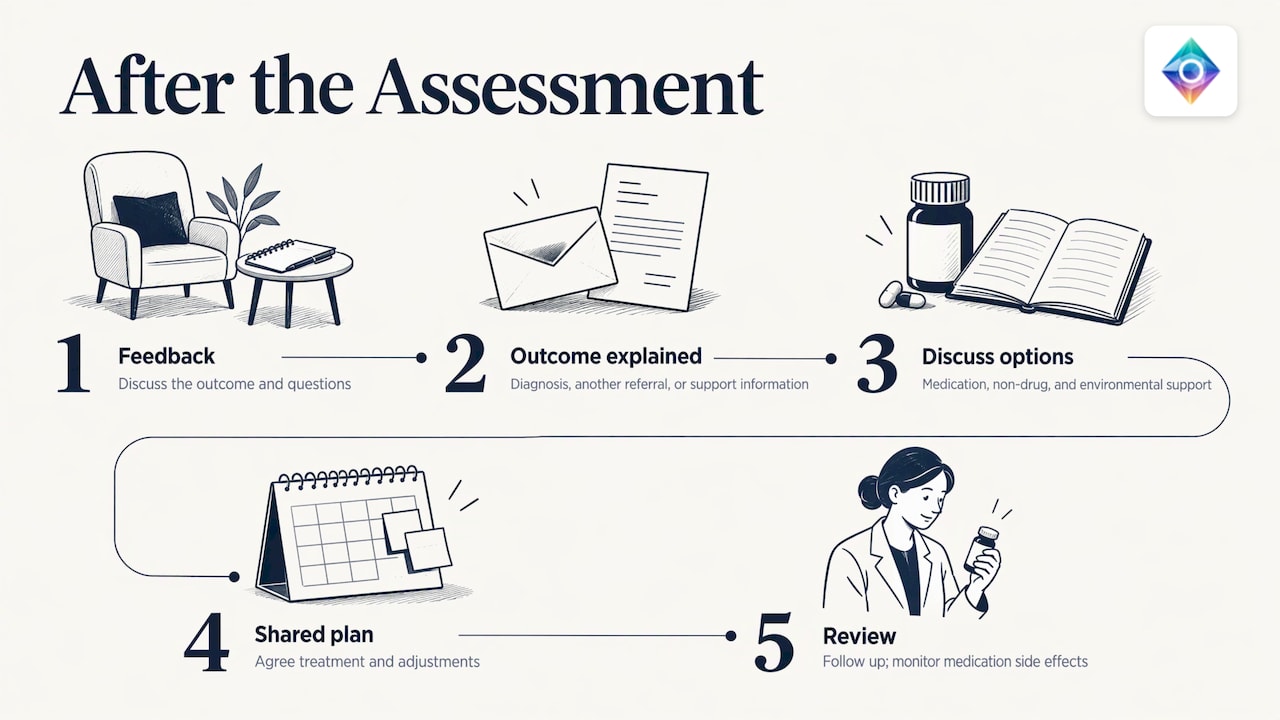
Adults are typically offered a follow-up. Sheffield Partnership NHS Foundation Trust says adults are offered a follow-up appointment after the diagnostic assessment to discuss the outcome and further treatment options.
For children, Sheffield Children’s NHS Foundation Trust arranges a feedback session. If ADHD is diagnosed, a letter summarises the assessment and confirms the diagnosis, and support and medication options may be discussed. If it is not, the reasons are explained and referrals or support information may follow. The outcome can also be a referral for another or coexisting condition, or a description of difficulties that fits no single label but can still guide support.
A good post-diagnosis conversation covers more than medication. NICE recommends a structured discussion of the potential benefits and harms of diagnosis, environmental changes, education and workplace adjustments, relationships, coexisting conditions, substance misuse or self-medication, and driving, all feeding into a shared treatment plan. It also recommends review and follow-up according to severity, whether or not you take medication, with monitoring of side effects for those who do.
A British Journal of General Practice educational review adds that after diagnosis the assessor should explain ADHD, allow time for reflection and questions, discuss non-drug options, and arrange follow-up and liaison with your GP. Write your own questions down before the feedback appointment, because information tends to slip away in the room.
FAQ
How long should I spend preparing for an ADHD assessment?
A few evenings across one to two weeks is enough for most people. Spend the first on reading about ADHD traits and the format, the next on records and contacts, and the last on writing your examples. Return any forms the service has sent by the date they ask.
Do I need a diagnosis-style questionnaire before I go?
No. The service will usually send its own forms, and you should complete those. A self-assessment can help you organise your thoughts, but rating scales are not used alone to diagnose ADHD.
What if nobody remembers my childhood?
Bring what you do have, such as old school reports, letters from relatives or friends, or your own recollections. Tell the assessor plainly what is unavailable. You are not expected to produce evidence that does not exist.
Can I be assessed without seeing my GP first?
It depends on the route. In the NHS, your GP typically refers you to a specialist service, while private providers set their own entry rules. In either case, the diagnosis must come from a suitably qualified specialist, as set out in NICE guidance.
Sources
- Guide to adult ADHD assessment, Scottish ADHD Coalition
- ADHD: diagnosis and management (NG87), NICE
- NICE NG87 recommendations
- NICE draft guideline, short version
- ADHD Guideline Consumer Companion, Australia
- AAP ADHD clinical practice guideline, via CDC
- What to expect during your ADHD assessment, Ohio State
- After an ADHD assessment, Sheffield Children’s NHS Foundation Trust
- ADHD, Sheffield Partnership University NHS Foundation Trust
- Assessments for adult ADHD: what makes them good enough? British Journal of General Practice
- I’m waiting for an ADHD assessment, Mental Health 360
- How to recognise speech delays
Recommended
- Speed Your UK ADHD Diagnosis: 5 Things to Bring After a Self Screen
- UK ADHD Diagnosis: When Impairment Spans Two Areas
- ADHD Assessment Cost: Free Screen or Paid Report?
- Describe ADHD symptoms: clinician checklist and private assessment
Written and edited by Valerio Cozzi, founder of Omniprism. Omniprism began after my own ADHD diagnosis at 42.
This article is educational. It is not medical advice, not a diagnosis, and not a substitute for assessment by a qualified clinician. The Omniprism self-assessment is free, needs no account and no email address, and runs entirely in your browser — your answers are never sent to a server. The optional Specialist Briefing report is a paid add-on.