Describe ADHD symptoms: clinician checklist and private assessment

ADHD symptoms fall into three clusters: inattention, hyperactivity, and impulsivity. Most people show a mix of both inattentive and hyperactive-impulsive traits, known as the combined presentation, though some show only one. A diagnosis under NICE guidance or the DSM-5-TR only applies when these traits appear across more than one setting and genuinely get in the way of daily life. Some digital tools can help turn scattered observations into a structured account that can be brought to a clinician.
TL;DR:
- Most adults with ADHD show a mix of inattentive and hyperactive-impulsive traits, which must be present across multiple settings to qualify for diagnosis.
- ADHD symptoms in children are outward and physical, while adults often experience internal restlessness, time management issues, and emotional regulation challenges.
- Proper diagnosis requires a specialist assessment that includes detailed history, informant reports, and ruling out other conditions like anxiety or learning disorders.
- Common triggers for seeking assessment include repeated missed deadlines, safety incidents, relationship conflicts, or academic struggles, with self-recorded incidents strengthening referral cases.
- Structured self-assessments help reveal pervasiveness and impairment, but a clinical diagnosis depends on professional evaluation focusing on functional impact.
What are the three types of ADHD symptoms?
Clinicians group ADHD into three presentations, and knowing which one fits you (or your child) makes it far easier to describe what’s actually happening rather than just saying “I think I have ADHD.”
Predominantly inattentive presentation shows up mainly as attention and organisation difficulties, without much visible hyperactivity. According to the NHS, the inattentive symptom checklist includes:
- Being easily distracted by unrelated thoughts or sounds
- Making careless mistakes in work, schoolwork, or other tasks
- Difficulty organising tasks and belongings
- Frequently losing items needed for daily activities
- Appearing not to listen when spoken to directly
- Struggling to follow through on instructions or finish tasks
- Avoiding tasks that need sustained mental effort
Predominantly hyperactive-impulsive presentation centres on restlessness and impulsive behaviour rather than attention problems. The same NHS guidance lists:
- Excessive fidgeting or tapping hands and feet
- Inability to stay seated in situations where it’s expected
- Feeling restless, or in children, running or climbing excessively
- Talking excessively
- Blurting out answers before a question is finished
- Difficulty waiting for a turn
- Interrupting or intruding on others’ conversations or activities
Combined presentation means enough symptoms from both lists are present, and it’s the most common pattern seen in clinical assessments, per the NHS. When you’re describing symptoms to anyone, naming the presentation type first gives the listener an immediate frame for everything that follows.
How do ADHD symptoms differ between children and adults?
Age changes the shape of ADHD considerably, even when the underlying traits stay the same. In children, symptoms tend to be outward and physical: daydreaming in class, fidgeting, loud talking, difficulty following multi-step instructions, and impulsive play that looks like poor self-control rather than defiance, according to NHS guidance on children and teenagers. Symptoms usually appear before age 12, often well before that.
Adults describe something quieter but no less disruptive:
- Chronic difficulty managing time, leading to missed deadlines or constant lateness
- Executive dysfunction: struggling to start, sequence, or finish tasks despite knowing what needs doing
- Internal restlessness rather than visible fidgeting
- Emotional dysregulation, including quick frustration or intense reactions to small setbacks
- Relationship strain from forgetfulness or inconsistent follow-through
Mayo Clinic notes that adult ADHD often looks less hyperactive on the surface but still carries real impulsivity and concentration problems underneath. Masking plays a big role here too. Many girls and women learn to compensate socially, and certain professions reward hyperfocus and improvisation in ways that hide impairment for years. NICE has pointed out that symptoms can shift with environment, so a supportive job or a flexible school setting can quietly mask difficulties that would otherwise be obvious, which is one reason diagnosis often comes decades later than it should.
How is ADHD diagnosed and who can diagnose it?
A diagnosis has to come from a specialist, not a checklist filled in alone. NICE states that assessment should be carried out by a psychiatrist, paediatrician, or another clinician specifically trained in diagnosing ADHD, taking into account social, family, and occupational context alongside symptoms.
The process usually runs through these steps:
- Detailed history taking, covering childhood behaviour, school reports where available, and current functioning across work, home, and relationships.
- Informant reports, often from a parent, partner, or teacher, since self-report alone rarely captures the full picture.
- Standardised screening tools to structure symptom counts against recognised criteria.
- Ruling out other explanations, including anxiety, sleep problems, or thyroid issues that can mimic ADHD symptoms.
Diagnostic manuals don’t fully agree on the detail. DSM-5-TR sets explicit symptom-count thresholds, nine inattentive and nine hyperactive-impulsive symptoms for children, with a lower bar for adults, while ICD-11 uses a slightly different symptom set and less prescriptive wording. That’s partly why checklists you find online vary depending on which framework they follow. If you want a plain breakdown of what the DSM-5 thresholds actually mean, this guide to DSM-5 ADHD criteria walks through it clearly.
When should you seek an ADHD assessment?
The threshold NICE and clinical guidance both point to is impairment, not just the presence of traits. If symptoms cause at least moderate disruption in two or more settings, work and home, or school and social life, that’s generally when a referral becomes worth pursuing, according to primary care guidance on adult ADHD.
Common triggers for seeking assessment include:
- Repeated missed deadlines or warnings at work despite genuine effort
- Safety incidents such as near-miss driving or workplace accidents linked to inattention
- Ongoing relationship conflict tied to forgetfulness or impulsive reactions
- A child struggling academically or socially despite support at home
Pro Tip: Keep a running note on your phone for two weeks before an appointment, logging specific incidents rather than general feelings. “Missed the 10am deadline twice this week” carries more clinical weight than “I’m always disorganised.”
If you’re preparing for that first appointment, this checklist on what to bring after a self-screen covers the practical side well.
How do ADHD symptoms affect daily life?
Impairment is where ADHD stops being a personality quirk and becomes something worth naming. At work or in study, it shows up as missed deadlines, inconsistent output between good and bad days, and difficulty sustaining effort on tasks that don’t offer instant reward. Mayo Clinic links this pattern to poor occupational performance and unstable relationships in adults specifically.
Socially, it often looks like interrupting conversations, forgetting plans or promises, and emotional swings that feel disproportionate to the trigger. Practically, it can mean losing keys and documents on a weekly basis, impulsive spending that outpaces income, or taking risks (financial, physical, or otherwise) without weighing consequences first. None of these examples need to all apply for ADHD to be worth investigating. Even two or three, repeated consistently across settings, are usually enough to justify a proper look.
What helps manage ADHD symptoms?
Management works best when it’s layered rather than relying on a single fix. Structured routines, fixed schedules, visual reminders, broken-down tasks, reduce the cognitive load of executive dysfunction without needing any clinical input at all. Workplace or school adjustments, such as extended deadlines or quiet working spaces, address the environment rather than the person.
Psychological approaches add another layer. CBT and ADHD-specific coaching help build planning and emotional regulation skills, particularly useful for adults diagnosed later in life who’ve spent years compensating without a framework. For children, reducing screen time alongside consistent routines can noticeably ease evening meltdowns and improve engagement at school.
Medication remains one of the most researched options for moderate to severe symptoms, but it requires specialist prescribing and ongoing monitoring, never a self-directed decision. What works for one person often does very little for another, which is exactly why the assessment process matters so much before treatment begins.
How does structured self-assessment help describe ADHD symptoms?
Structured self-reporting makes pervasiveness and impairment visible in a way that’s hard to convey verbally under time pressure in a ten-minute appointment. Omniprism’s self-assessment maps traits across 14 domains, including ADHD, and returns an instant plain-language profile with no email or account required. For families, guided assessments for children and teens exist too. None of it replaces clinical diagnosis, but a structured account of symptoms often becomes the decisive evidence a clinician needs to move forward with a referral.
When do ADHD symptoms usually start, and how do they change over time?
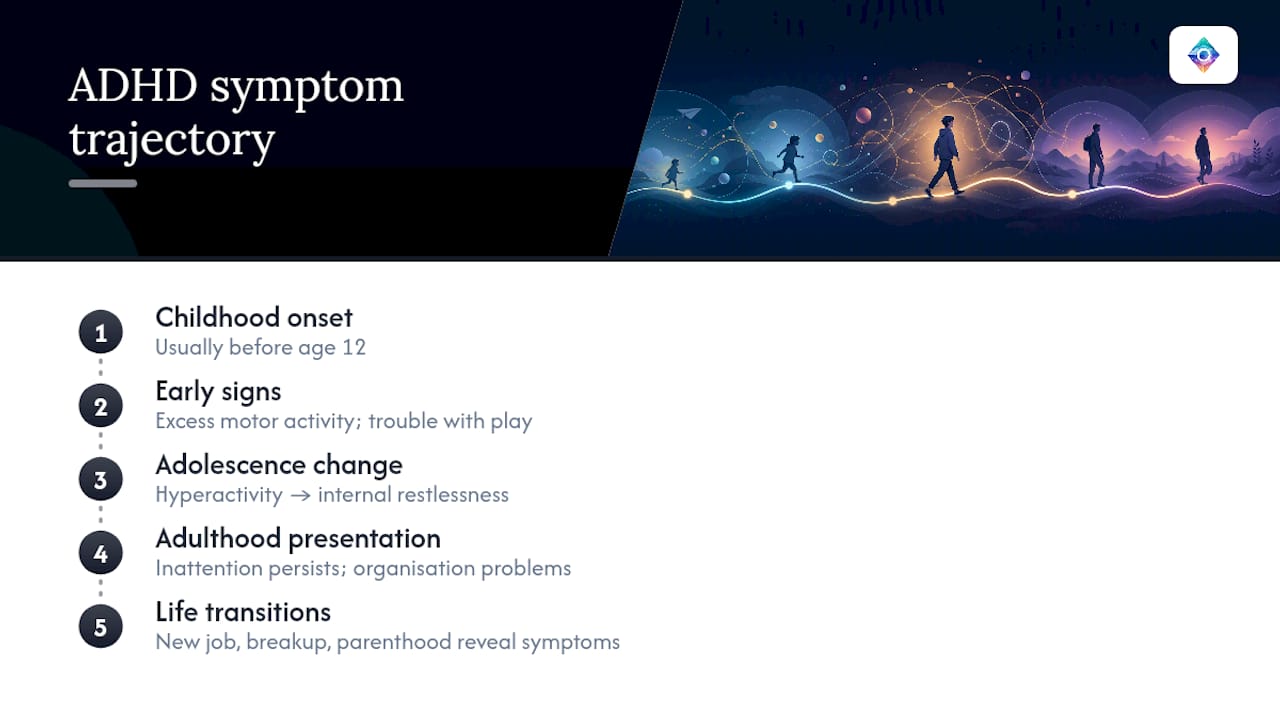
ADHD symptoms typically emerge before age 12, and in many cases well before school age, showing up as excessive motor activity, difficulty with structured play, or trouble following simple instructions. This developmental origin matters because it’s part of the diagnostic picture: symptoms that appear suddenly in adulthood with no childhood history point towards a different explanation, not ADHD.
The trajectory isn’t static, though. Hyperactivity, the most visible childhood symptom, tends to soften with age, turning into internal restlessness rather than visible fidgeting by the teenage or adult years. Inattention and executive dysfunction, by contrast, often persist or become more noticeable as life demands more independent organisation, university deadlines, job responsibilities, running a household, than school ever did.
This is exactly why so many adults get diagnosed only after a major life transition exposes what structure had previously covered. A well-supported school environment, a forgiving employer, or a partner who quietly manages the admin side of life can mask impairment for years, as NICE’s guidance on context points out. Remove that scaffolding, through a new job, a breakup, or parenthood, and symptoms that were always present suddenly become impossible to ignore. Understanding this trajectory helps explain why a 45 year old with no childhood diagnosis can still meet full diagnostic criteria: the traits were there all along, just buffered by circumstances that no longer apply.
What are common myths about ADHD symptoms?
The idea that ADHD is just an excuse for laziness or poor discipline is probably the most damaging myth still in circulation, and it directly contradicts what NICE frames as a genuine neurodevelopmental condition requiring clinical assessment, not willpower.
Another persistent myth is that ADHD only affects children and gets “grown out of.” Symptoms frequently persist into adulthood, according to CDC guidance, just in a form that looks less like bouncing off the walls and more like chronic disorganisation or emotional volatility.
There’s also a widespread assumption that ADHD always looks hyperactive. The predominantly inattentive presentation involves no outward hyperactivity at all, which is a major reason quiet, daydreaming children, often girls, get missed for years while louder classmates get flagged immediately.
Finally, plenty of people assume a symptom checklist alone is enough to self-diagnose. Checklists are genuinely useful for organising your thinking and preparing for an appointment, but NICE is explicit that diagnosis depends on pervasiveness and impairment judged by a trained clinician, not a tally of ticked boxes. Getting this wrong in either direction, dismissing real impairment as laziness, or assuming every distracted moment means ADHD, does a disservice to people who actually need support.
How do ADHD symptoms overlap with anxiety and learning difficulties?
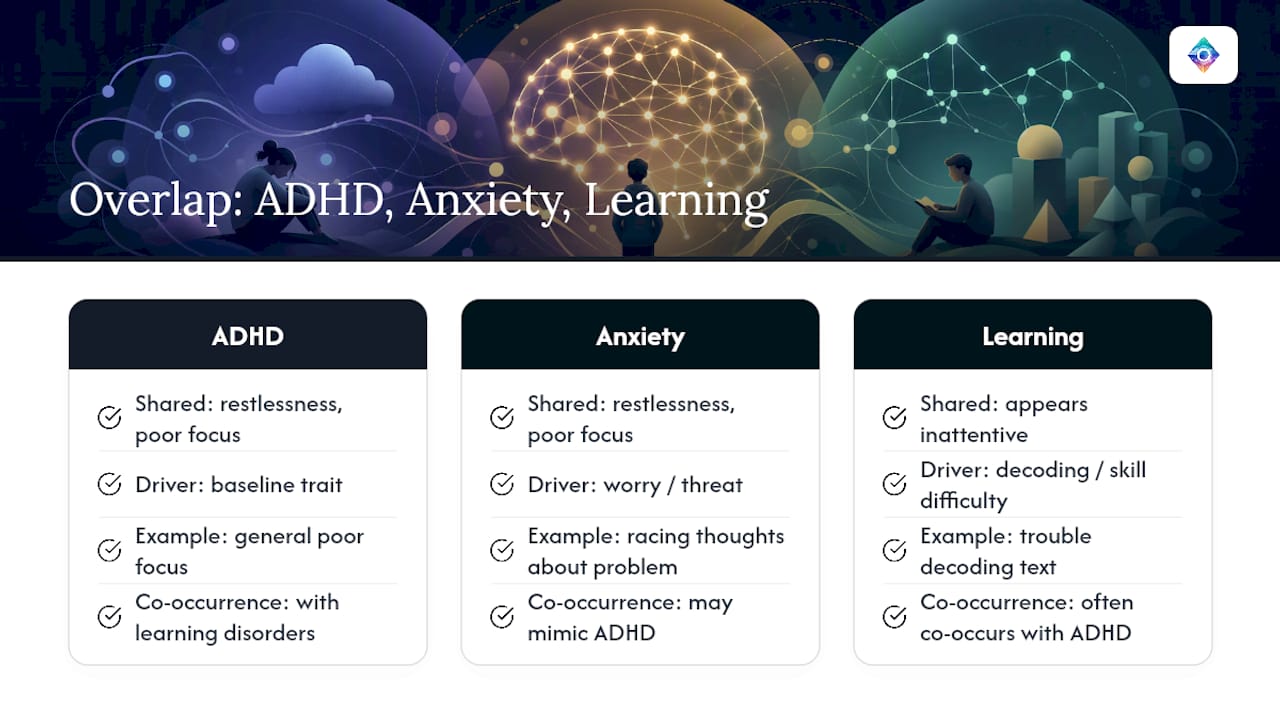
Distinguishing ADHD from conditions with overlapping symptoms is one of the hardest parts of assessment, which is exactly why NICE recommends ruling out alternative explanations before confirming a diagnosis.
Anxiety and ADHD share a striking amount of surface overlap. Both can cause restlessness, difficulty concentrating, and trouble sitting still, but the underlying driver differs: anxiety-related restlessness tends to stem from worry and anticipated threat, while ADHD-related restlessness is more of a baseline trait unrelated to any specific concern. Someone with anxiety might describe racing thoughts about a specific looming problem; someone with ADHD is more likely to describe a general difficulty maintaining focus on anything, worry-inducing or not.
Learning disorders, such as dyslexia or dyscalculia, overlap differently. A child struggling to finish reading assignments might look inattentive when the real issue is decoding text, not sustaining focus. The two conditions also co-occur fairly often, which complicates things further: a child can have both dyslexia and ADHD, and each needs its own support strategy.
The practical takeaway is that a good assessment doesn’t just confirm ADHD. It also checks what else might explain, or coexist with, the symptoms you’re describing, which is why professional evaluation matters more than pattern-matching against a single list.
A founder’s perspective on describing ADHD clearly
Valerio Cozzi was diagnosed with ADHD at 42. That late diagnosis shaped his conviction that clearer, more specific symptom descriptions, not vague self-doubt, are what actually move a clinical conversation forward. Self-reflection matters, but it works best alongside proper professional support, not instead of it.
— Valerio Cozzi
Getting a clearer picture before your appointment
There are other routes into an ADHD assessment, a GP referral with a rough symptom list, or waiting until things get bad enough to force the issue. Neither gives you much structure going in. There are self-assessment tools available that offer privacy-first evaluations across multiple domains, providing instant, plain-language profiles without requiring email or account creation.
For those wanting to go further, the optional Specialist Briefing report costs a one-off purchase fee and summarises your results in a format designed for easy use by healthcare professionals, exactly the kind of structured evidence that speeds up a referral conversation. Families can also access guided assessments built specifically for children and young people. If you’re ready to see where you stand, start the free self-assessment and decide from there whether a Specialist Briefing is worth adding.
This article is general information, not a substitute for advice from a qualified doctor. Consult a qualified healthcare professional about your own circumstances before acting on anything here.
Sources
- ADHD in adults — NHS
- Comparison of DSM-5-TR and ICD-11 descriptions for ADHD — PMC
- Symptoms of ADHD — CDC
- Adult attention-deficit/hyperactivity disorder (ADHD) — Mayo Clinic
- ICD-11 neurodevelopmental disorders — WHO
FAQ
How do I describe my ADHD symptoms to a doctor?
Describe specific incidents rather than general feelings, “I missed three deadlines this month” instead of “I’m disorganised.” Note which settings the symptoms appear in (work, home, relationships) and how long they’ve been happening, since NICE requires evidence of pervasiveness and impairment, not just isolated struggles.
What are the 9 major symptoms of ADHD?
There isn’t a single fixed list of nine; DSM-5-TR actually lists nine inattentive symptoms and nine separate hyperactive-impulsive symptoms, eighteen in total. Common inattentive ones include distractibility, disorganisation, and forgetfulness, while hyperactive-impulsive ones include fidgeting, interrupting, and impulsive talking, as detailed by the NHS.
What are 7 signs of ADHD in adults?
Common adult signs include chronic lateness, difficulty finishing tasks, internal restlessness, forgetfulness, emotional dysregulation, impulsive decisions, and trouble sustaining focus on unrewarding tasks. Mayo Clinic links this combination to strained relationships and inconsistent work performance.
What are the 5 symptoms of ADHD?
No official framework narrows ADHD to exactly five symptoms; the recognised lists run to eighteen under DSM-5-TR. If you’re looking for a quick starting checklist, distractibility, restlessness, impulsivity, disorganisation, and forgetfulness cover the core traits most often flagged, per NHS guidance.
Can a self-assessment tell me if I have ADHD?
No self-assessment can diagnose ADHD; only a trained clinician can do that, following the process NICE outlines. A tool like Omniprism’s free self-assessment can help organise your observations into a clearer picture to bring to that appointment.
Recommended
- ADHD Red Flags: What Parents and Adults Should Know
- DSM-5 ADHD Criteria: A Clear Guide for Parents and Clinicians
- Teen ADHD Signs: Turn Everyday Behaviors Into Evidence for Clinicians
- ADHD vs. OCD: Key Differences, Overlap, and Next Steps
Written and edited by Valerio Cozzi, founder of Omniprism. Omniprism began after my own ADHD diagnosis at 42.
This article is educational. It is not medical advice, not a diagnosis, and not a substitute for assessment by a qualified clinician. The Omniprism self-assessment is free, needs no account and no email address, and runs entirely in your browser — your answers are never sent to a server. The optional Specialist Briefing report is a paid add-on.