What are the signs of dyslexia in a child?
The signs of dyslexia in a child are a persistent cluster of difficulties with reading, writing and spelling, often with earlier clues in speech and language. The NHS notes that dyslexia mainly affects reading, writing and spelling, and can also touch memory, number work and organisation, but it does not affect intelligence. No single sign proves anything, so what matters is how many you see, how long they last and how your child compares with classmates of the same age.
Key takeaways
- Look for a cluster of signs that lasts over time, not one odd mistake. Many children make the odd letter reversal.
- The clues change with age: speech and rhyme in the early years, spelling and decoding in primary school, slow reading and written output in secondary school.
- Start with your child’s teacher or the school’s SENCo. In UK schools, support does not depend on a formal diagnosis.
- A formal diagnosis comes from a specialist assessor or educational psychologist, not a GP.
- Strengths matter as much as struggles, and they shape how you support your child at home.
What are the early signs of dyslexia in preschool children?
Before a child reads a word, dyslexia can show up in how they handle sounds. The British Dyslexia Association (BDA) stresses that many young children show these behaviours, and that it is the severity and the persistence that count. The early indicators it lists include:
- delayed speech or persistent baby talk
- difficulty learning nursery rhymes or clapping a rhythm
- trouble sequencing, such as the order of a daily routine
- mixing up words that sound alike, or muddling the order of sounds in long words
- little interest in letters or books once peers have started to show it
Dyslexia is primarily a language-based difficulty. A PubMed review of four decades of research concluded that weak alphabetic coding, meaning difficulty linking sounds to letters, is the basic cause in most cases, rather than a problem with vision. That is why rhyme, sound games and word-finding often show the first clues.
Speech and language delay has many causes, and dyslexia is only one of them. If your child is a late talker, a speech delay checklist for parents can help you describe what you see before you speak to a health visitor or GP. We go through what kindergarten teachers can spot in dyslexia signs in kindergarten.
What are the signs of dyslexia at primary school age?
Primary school is when most families first notice something. According to the BDA’s primary-age list, look for:
- messy written work and poor handwriting, sometimes with letter reversals
- difficulty blending sounds into words
- confusion over sequences such as the alphabet or the days of the week
- spelling that is wildly inconsistent, with the same word spelt several ways on one page
- reading that is slow, guessed from the first letter, or avoided
- a gap between what your child says in conversation and what they manage on paper
That last point is often called a spiky profile. The BDA describes children with high ability but lower-than-expected literacy as a typical pattern, and it advises parents to look for a persistent cluster of indicators rather than one defining symptom.
Some children hide the difficulty. They memorise a reading book, volunteer to hand out the pencils, or become the class clown when it is their turn to read aloud. Behaviour, tiredness or stomach aches on school mornings can be the first thing a parent notices.
Is it dyslexia, dysgraphia or dyscalculia?
The labels overlap. Handwriting trouble alone may point towards dysgraphia, which we compare in dysgraphia vs dyslexia. Maths trouble alone may be dyscalculia, which NHS children’s health services describe as a learning difficulty with maths and understanding numbers that does not affect intelligence. Our four steps to tell dyscalculia from dyslexia help you sort which is which. ADHD and dyslexia also frequently sit together, which we cover in our ADHD and dyslexia action plan.
What are the signs of dyslexia in secondary school students?
By secondary school, a child may have learned to decode but still read slowly and tire quickly. Typical signs include:
- very slow reading and a need to reread to follow the meaning
- good spoken answers but written work that is short, disorganised or full of spelling errors
- difficulty taking notes, copying from the board or finishing exams in time
- trouble with planning, organising a bag and meeting deadlines
- falling confidence, avoidance of homework, or saying they are “stupid”
The BDA lists signs for secondary-age children as a separate stage because the picture changes: the child compensates, and the difficulty shows up in volume of work rather than in single mistakes. Our study strategies for dyslexic students are written for exactly this age.
Is there a dyslexia signs checklist I can use?
Yes, and you can build a useful one in ten minutes. Write down what you see under three headings: speech and sound, reading and spelling, and everyday organisation. Next to each item, note the date, an example and how often it happens. A page of dated examples is far more useful to a teacher than “I think she might be dyslexic”.
Pro Tip: Bring three pieces of your child’s written work from different weeks, plus your dated notes, to the SENCo meeting. Patterns are easier to see on paper than in memory.
Before you conclude anything, rule out the simple explanations. The BDA says a child should have had a sight test and hearing check within the last two years before a diagnostic assessment, because sensory problems can mimic dyslexic symptoms.
What causes dyslexia, and does it affect intelligence?
Dyslexia is not caused by laziness, poor teaching or low intelligence. The NHS states plainly that it does not affect intelligence. The research summarised on PubMed points to phonological processing, the skill of hearing and working with the sounds in words, as the core difficulty, as noted above.
Dyslexia is also best seen as a continuum rather than a switch. Guidance for schools from Brighton & Hove describes it as a continuum with no clear cut-off points, which is why teachers speak of degrees of difficulty and why your own observations count.
Who diagnoses dyslexia in children in the UK?
The BDA explains that diagnosis is made by a specialist teacher assessor or an educational psychologist, not a doctor. Its first advice is to speak to your child’s teacher or the school’s SENCo. Assessment typically looks at reading, writing, spelling, phonological awareness, processing speed and memory.
Expect the process to take time. BDA guidance on the assessment day says appointments are one-to-one, and parents are often not in the room. Most families in the UK pay for a private assessment, because it is not usually available through the NHS, according to the BDA diagnosis page.
Does my child need a diagnosis to get help at school?
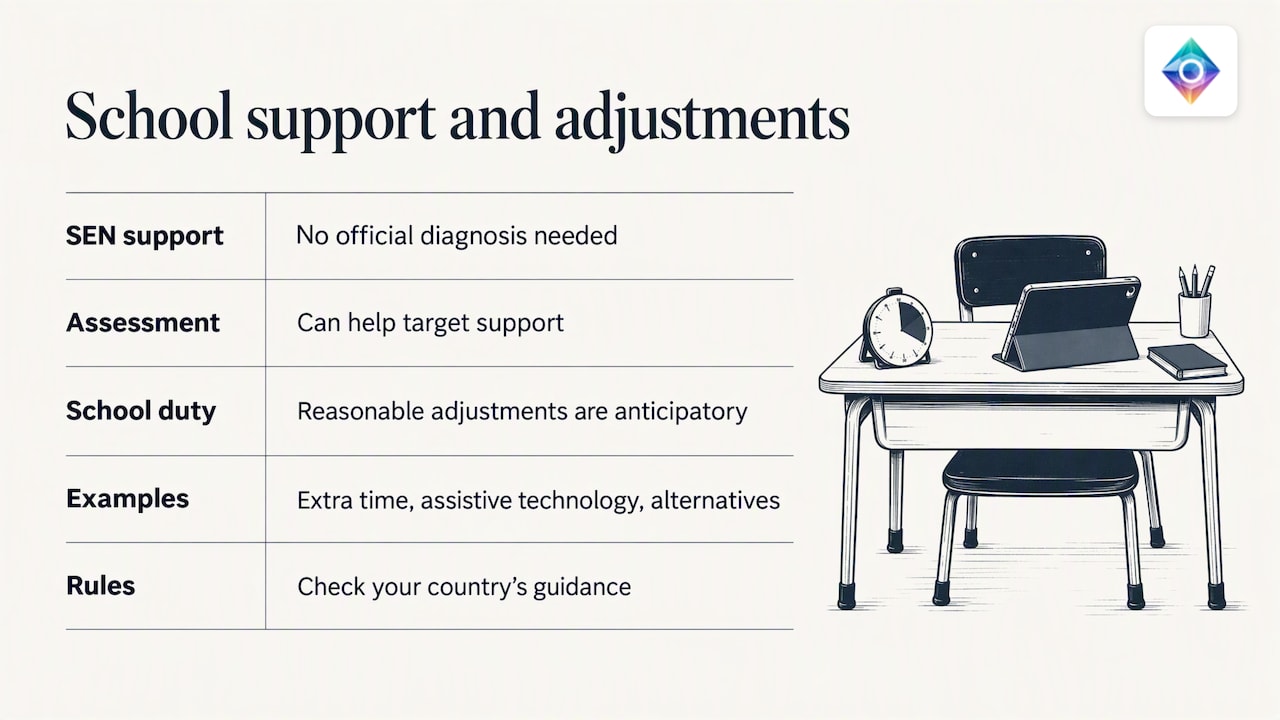
No. The BDA says that a pupil does not need an official diagnosis for SEN support, although a diagnostic assessment can help target the support. The Brighton & Hove guidance adds that under the Equality Act 2010 schools must make reasonable adjustments, and that these duties are anticipatory, so they should be considered before a family asks.
That is guidance for England and the wider UK, so check the rules in your own country if you live elsewhere. Examples of adjustments include extra time, assistive technology and alternative ways to show learning. The same logic applies to other needs: see school adjustments for ADHD and legal school adjustments for autism, which matters if you are also wondering how to support an autistic teen.
How can I support a dyslexic child at home?
Home support works best when it protects confidence and keeps reading pleasant. A few practical habits:
- Read together every day, taking turns, and let audiobooks count as reading. Understanding stories matters as much as decoding them.
- Play with sounds: rhyming games, clapping syllables and swapping the first sound of a word are low-pressure ways to train phonological skills.
- Keep homework short and chunked, with breaks, and agree with the school what is reasonable.
- Praise effort and name strengths. Researchers advocate a Positive Dyslexia approach that builds on creativity, big-picture thinking and problem-solving to protect motivation and self-esteem.
- Use technology: speech-to-text, spell-checkers and text-to-speech reduce the load on writing.
- Keep a log of what helps, so teachers and assessors see the same picture you do.
What does Omniprism think about checking for dyslexia?
We built Omniprism because the road from “something feels different” to a clinical conversation is long and confusing. I was diagnosed with ADHD at 42, and I wish a plain-language profile had existed to help me describe what I was experiencing.
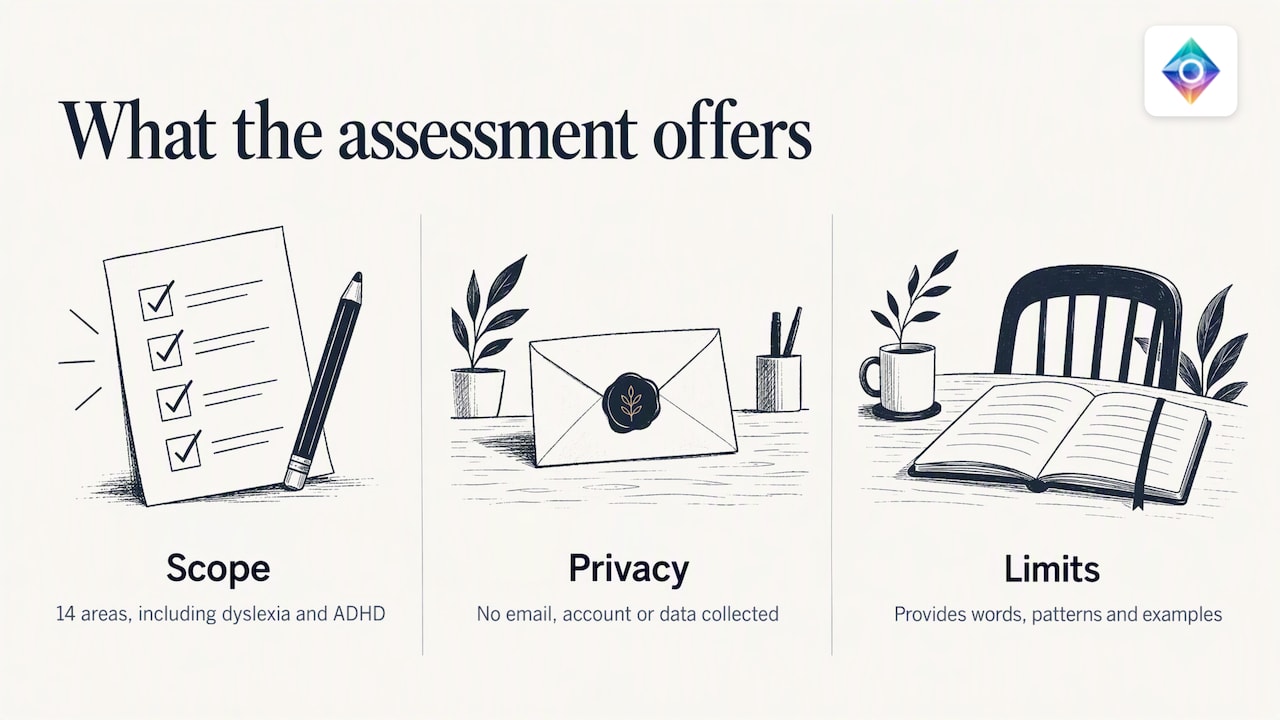
Our view is that parents and young people deserve structure before they reach a professional. Dyslexia rarely travels alone, so we cover 14 areas in one assessment, including dyslexia, ADHD, autism, dyspraxia and dyscalculia. We collect no email, account or data, because families should be able to explore without being tracked.
We are also clear about limits. A self-assessment is not a diagnosis and does not replace a specialist assessor or educational psychologist. Its job is to give you words, patterns and examples so that the conversation with the SENCo or clinician starts further along.
— Valerio Cozzi
Where can I start a child’s assessment with Omniprism?
Omniprism has guided assessments for children aged 7 to 10 and young people aged 11 to 13, which you can find alongside the other options on our children and young people page. You get an instant, plain-language profile across 14 areas. If you want something to hand to a clinician or the school, the optional Specialist Briefing summarises the results for a one-off €9.99. Please read our disclaimer first, as the tool supports your conversations and does not diagnose.
FAQ
At what age can you spot dyslexia?
Some clues appear before school, such as late speech, trouble with nursery rhymes and difficulty learning letter names. A formal diagnosis is usually made once a child has had time to learn to read, but concerns can be raised with a SENCo or health visitor earlier. You do not need to wait for a label to ask for help.
Is reversing b and d a sign of dyslexia?
Not on its own. Many young children reverse letters while learning to write, and the BDA says it is the severity and persistence of these behaviours that matter. Reversals that continue well beyond the early years, alongside other signs such as poor sound blending and inconsistent spelling, are worth raising with the school.
Can a child have dyslexia and be good at other subjects?
Yes. Dyslexia does not affect intelligence, and many children show a spiky profile with strong speaking, reasoning or creative skills next to weaker literacy. Those strengths are worth naming to teachers and assessors, because they help shape realistic support.
Who do I speak to first if I think my child is dyslexic?
Start with your child’s class teacher or the school’s SENCo, and take dated examples of what you have noticed. Check that sight and hearing tests are up to date. Then decide with the school whether a private diagnostic assessment would add anything.
Sources
- Dyslexia in children, NHS
- Specific reading disability (dyslexia): what have we learned in the past four decades? PubMed
- Neurodiversity support, Bedfordshire and Luton children’s health, NHS
- Is my child dyslexic? British Dyslexia Association
- Signs of dyslexia (Early Years), British Dyslexia Association
- Signs of dyslexia (Primary school age), British Dyslexia Association
- Diagnosis, British Dyslexia Association
- Assessments: before, during and after, British Dyslexia Association
- SEN Support, British Dyslexia Association
- Dyslexia and literacy difficulties, Brighton & Hove schools guidance
- Positive Dyslexia research thesis, White Rose eTheses
Recommended
- Dyslexia Signs in Kindergarten: 5 Clues to Bring to School
- Dysgraphia vs Dyslexia: Spot Classroom Signs With a 14 Domain Self Check
- 25–50% Overlap: Parents & Teachers’ Action Plan for ADHD and Dyslexia
- 6 Evidence Backed Study Strategies Dyslexic Students Can Try This Week
Written and edited by Valerio Cozzi, founder of Omniprism. Omniprism began after my own ADHD diagnosis at 42.
This article is educational. It is not medical advice, not a diagnosis, and not a substitute for assessment by a qualified clinician. The Omniprism self-assessment is free, needs no account and no email address, and runs entirely in your browser — your answers are never sent to a server. The optional Specialist Briefing report is a paid add-on.