25–50% Overlap: Parents & Teachers' Action Plan for ADHD and Dyslexia

Yes, ADHD and dyslexia commonly overlap. Between roughly 25% and 50% of children with one condition also meet criteria for the other, and having one raises the odds of having the other by two to three times. They’re distinct conditions with different root causes, but treating them as separate boxes to check misses kids who need both a reading intervention and attention support at the same time.
TL;DR:
- Up to 50% of children with ADHD also meet criteria for dyslexia, with genetic and epidemiological studies supporting a shared risk factor.
- Dyslexia results from phonological processing deficits, while ADHD affects attention regulation, leading to different observable reading behaviors requiring distinct interventions.
- A comprehensive evaluation should include developmental history, standardized reading tests, ADHD rating scales, classroom observation, and cognitive testing for an accurate diagnosis.
- Combining supports like multisensory phonics, timed sessions, visual schedules, and assistive technology is essential for children with both conditions to improve reading and attention.
- Medication improves ADHD symptoms and may enhance reading performance indirectly, but structured phonics instruction remains necessary for addressing dyslexia directly.
Table of Contents
- How Common Is the ADHD and Dyslexia Overlap?
- ADHD vs. Dyslexia: Different Roots, Similar Symptoms on the Surface
- What a Thorough Evaluation for Co-Occurring ADHD and Dyslexia Should Include
- What Twin Studies and Cognitive Research Reveal About the Cause
- Practical Support Strategies for Kids With Both ADHD and Dyslexia
- Does Medication Help Reading, or Just Attention?
- Your Next Steps: A Simple Action Plan
- Why I Think Self-Assessment Tools Deserve a Place in This Process
- Turn Your Observations Into a Clinical Conversation
- Sources
How Common Is the ADHD and Dyslexia Overlap?
The range you’ll see cited, between about one fourth and one half, isn’t sloppy science. It reflects real differences in how studies define and measure each condition. A study that relies on strict phonological testing for dyslexia and a narrow ADHD diagnostic interview will land closer to the lower end. A study pulling from clinical referral samples, where kids already show enough trouble to get evaluated at all, tends to land higher.
Genetic and epidemiological research, including work from the Netherlands Twin Register, found that individuals with one condition were 2.1 to 3.1 times more likely to have the other compared with the general population. That’s not a small effect.
Key figure: Depending on the study, 1 in 4 to 1 in 2 children with ADHD or dyslexia also meet criteria for the other condition.
The practical takeaway for parents and teachers: if a child struggles with reading, screen for attention and executive function issues too. If a child has an ADHD diagnosis and reading is a persistent grind despite decent effort, don’t assume it’s just distraction. Ask about decoding.
ADHD vs. Dyslexia: Different Roots, Similar Symptoms on the Surface
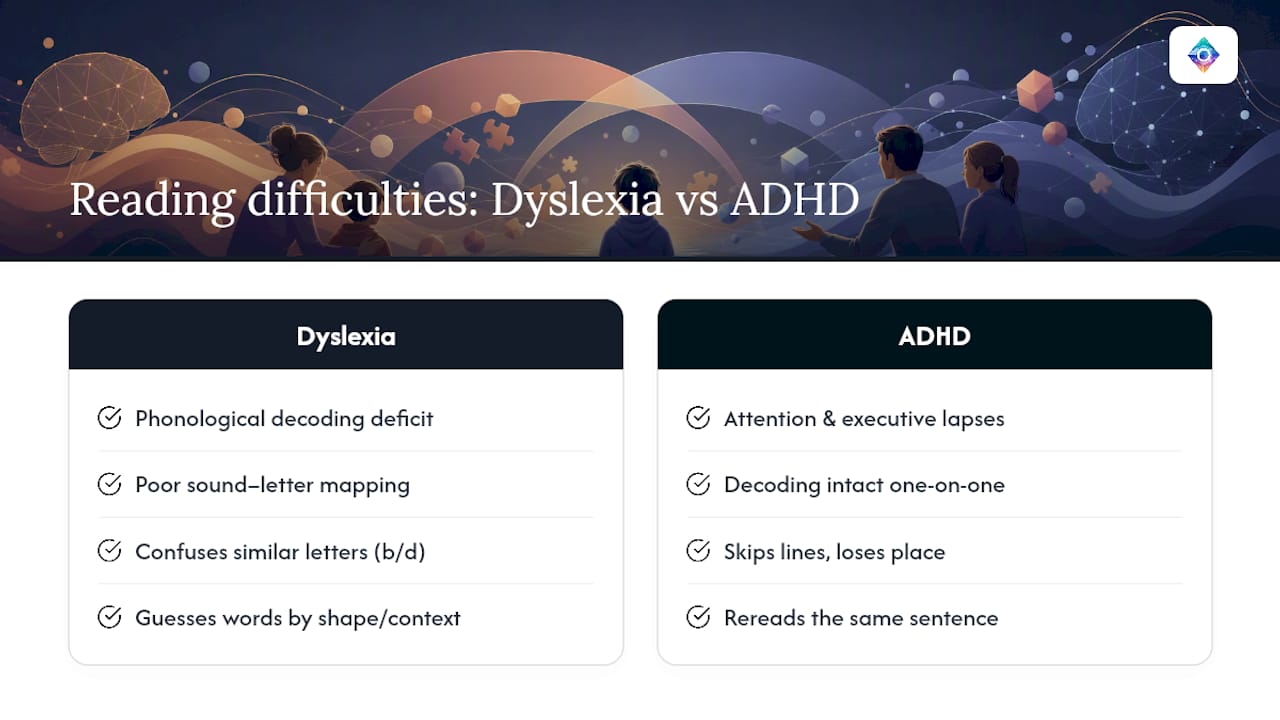
Dyslexia is a language-based decoding impairment. According to the International Dyslexia Association, the core deficit sits in phonological processing, the ability to map sounds to letters and blend them into words. A dyslexic child can be laser-focused and still can’t sound out an unfamiliar word.
ADHD is fundamentally about attention regulation and executive function, not language processing. A child with ADHD might decode words just fine one-on-one but lose the thread of a paragraph because sustained focus keeps slipping.
Watch for the difference in practice. A dyslexic reader guesses at words based on shape or context and mixes up similar-looking letters (b/d, was/saw). A child with ADHD-driven reading trouble skips lines, loses their place, rereads the same sentence repeatedly, or reads accurately but retains nothing. Both patterns look like “reading problems” from across the room. They call for different fixes.
What a Thorough Evaluation for Co-Occurring ADHD and Dyslexia Should Include
A complete evaluation rarely happens in a single 30-minute appointment. Because ADHD symptoms and dyslexia symptoms overlap in observable ways, especially inattention and slow reading, clinicians need a fuller picture to sort out which condition is driving which behavior.
A thorough workup typically includes:
- A detailed developmental and academic history, including early language milestones and family history of reading difficulty
- Standardized achievement testing for reading (decoding, fluency, comprehension) separate from cognitive testing
- ADHD-specific rating scales completed by both parents and teachers
- Direct classroom observation or teacher input on attention, task completion, and reading behavior
- Cognitive testing to assess working memory and processing speed, which affect both conditions
Diagnoses often arrive staggered, dyslexia flagged in early elementary years through reading assessments, ADHD noticed later once classroom demands for sustained attention increase. If you suspect both, say so explicitly when requesting an evaluation. Ask the school psychologist or clinician directly whether the evaluation will screen for both conditions, not just the one that prompted the referral. Reviewing the DSM-5 criteria for ADHD beforehand helps you ask sharper questions.
Pro Tip: Keep a simple log of specific reading moments for two weeks before any evaluation, what word gave your child trouble, how long homework took, whether they lost focus or lost the words. Specific examples carry more weight with clinicians than “reading is hard for him.”
What Twin Studies and Cognitive Research Reveal About the Cause
Twin studies consistently point to shared genetic risk as the best explanation for why ADHD and dyslexia travel together. The same body of genetic research that established the 25% to 50% co-occurrence range also found overlapping genetic markers between the two conditions. Neither condition causes the other. Both draw from an overlapping pool of inherited risk factors.
Cognitive research fills in part of the mechanism. Working memory and executive function deficits, hallmarks of ADHD, independently predict reading fluency and comprehension problems, even in kids without a phonological deficit. A child can decode words accurately and still struggle to hold a sentence’s meaning in mind while reading the next one. That’s an attention and working memory problem wearing a reading-problem costume.
None of this is fully mapped yet. Researchers still don’t have a clean neurobiological explanation for why the genetic overlap exists, and that gap is exactly why careful behavioral evaluation still matters more than any single test.
Practical Support Strategies for Kids With Both ADHD and Dyslexia
Supports that work for dyslexia alone or ADHD alone often fall short for kids with both. The reading intervention needs an attention scaffold built around it, and the attention supports need to account for the extra cognitive load reading already demands.
Effective combined strategies include:
- Structured, multisensory phonics instruction. Programs that pair sound, sight, and movement (tracing letters while saying sounds) remain the strongest evidence-backed approach for decoding deficits, according to dyslexia intervention research.
- Short, timed sessions. Fifteen to twenty minutes of focused reading work beats an hour of diminishing returns. Use a visible timer so the child can see the session has an end.
- Chunking and visual schedules. Break reading assignments into smaller sections with checkboxes. Executive function struggles make an undivided page feel endless.
- Body doubling and frequent breaks. A parent or aide sitting nearby, even silently working on something else, measurably helps some kids with ADHD stay on task longer.
- Assistive technology as a bridge, not a crutch. Audiobooks paired with print text, text-to-speech tools, and read-aloud extensions let a child access content while decoding skills catch up.
- Checklists for multi-step reading tasks. “Read the paragraph, underline the main idea, write one sentence” works better than “read and summarize.”
For school-based support, an IEP or 504 plan should specifically request extended time on reading tasks, structured literacy instruction (not just extra practice with the same method that isn’t working), preferential seating away from distractions, and permission to use audiobooks or text-to-speech for grade-level content the child can’t yet decode independently. Many of these accommodation strategies mirror what works in workplace settings for adults with ADHD, just scaled down for a classroom.
Pro Tip: Track progress with something concrete, words read correctly per minute, not a vague “seems better this month.” A simple weekly one-minute reading fluency check gives you and the teacher real data on whether the intervention is working.
Does Medication Help Reading, or Just Attention?
Stimulant medications like methylphenidate reliably improve ADHD symptoms, that part is well established. What surprises a lot of parents is that several studies also found gains in decoding and reading measures for kids with both ADHD and reading disability, according to a review of medication treatments for comorbid ADHD and reading disability. The likely explanation isn’t that stimulants fix phonological processing. Better sustained attention gives a child more usable practice time and fewer lost repetitions during reading instruction.
Atomoxetine, a non-stimulant option, shows more mixed results, with some studies noting improvement in working memory and decoding and others showing little reading benefit at all.
The caveat matters: medication treats attention, not dyslexia. A child on effective ADHD medication who never receives structured phonics instruction will likely still struggle with decoding. The two interventions need to run in parallel, not one instead of the other.
Your Next Steps: A Simple Action Plan
Start now, not after the next report card. Reading and attention problems compound over school years, and earlier intervention consistently produces better outcomes than a “wait and see” approach.
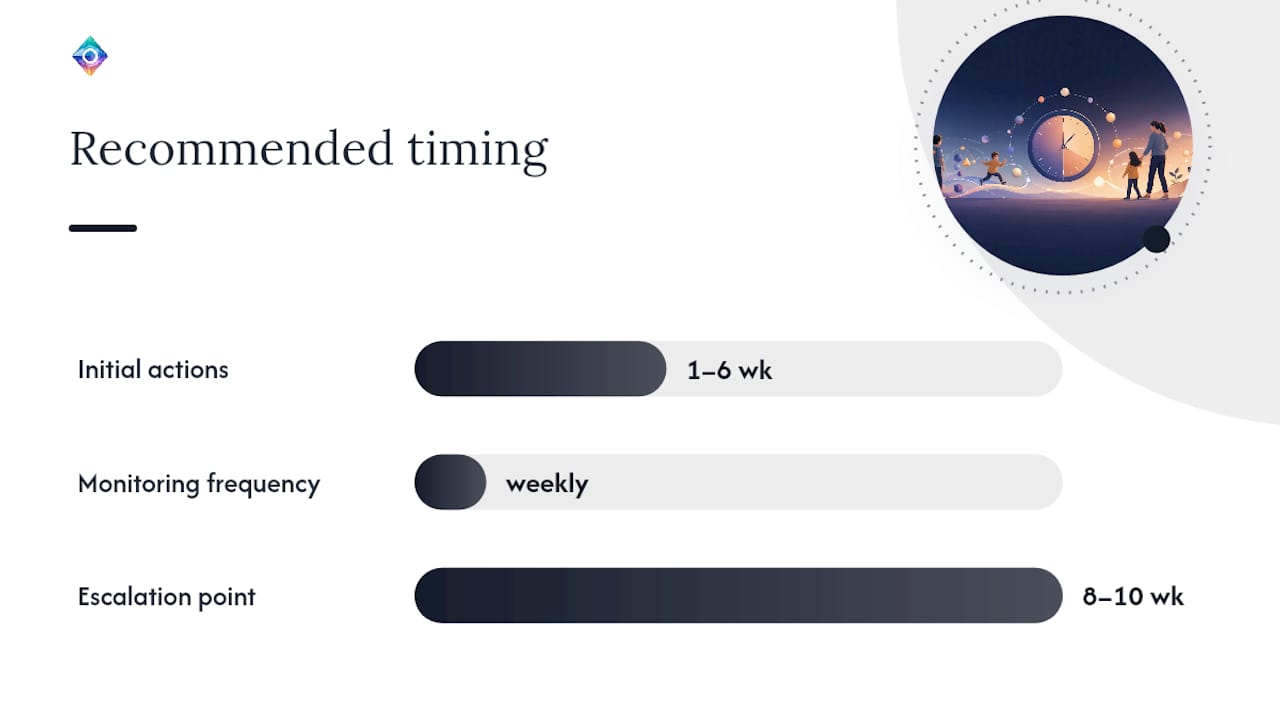
Over the next one to six weeks:
- Document specific reading and attention examples at home and ask the teacher for classroom observations
- Request a formal evaluation that screens for both dyslexia and ADHD, not just the presenting concern
- Ask your clinician directly: “Could this be both conditions, and how will the evaluation tell them apart?”
- Ask the school team what structured literacy program they use and whether accommodations can start before a formal diagnosis is finalized
- Track response to any intervention with a simple weekly measure (reading fluency, homework completion time) and escalate to a specialist if there’s no movement after 8 to 10 weeks
Reviewing common ADHD red flags before your appointment can help you organize what you’ve noticed into language a clinician can act on quickly.
Why I Think Self-Assessment Tools Deserve a Place in This Process
Families usually arrive at a clinician’s office with a vague sense that “something’s off” and not much else. That vagueness costs time. A structured self-assessment, filled out honestly at home, gives parents and older kids a way to organize scattered observations, the reading avoidance, the lost focus, the homework meltdowns, into something a professional can actually work with.
That’s the role I’d argue tools like Omniprism’s assessments play best: not diagnosis, but preparation. A parent walking into an evaluation with organized notes across multiple domains gets further in that first appointment than one working from memory. The ethical line here matters. A self-assessment sharpens the conversation. It doesn’t replace the clinician having it.
— Valerio
Turn Your Observations Into a Clinical Conversation
You don’t need a formal diagnosis in hand to start organizing what you’re seeing at home and school. You can get a free, instant profile across multiple domains, including ADHD and dyslexia traits, without appointments, waitlists, or data collection, so you can walk into a school meeting or a clinician’s office already knowing what to describe.
For younger kids, the Children’s Assessment (ages 7 to 10) uses guided, age-appropriate questions a parent can complete alongside the child. For older kids showing signs of both reading struggles and attention issues, the Young Person’s Assessment (ages 11 to 13) captures more nuanced self-reporting as kids get better at describing their own experience. Either way, the result is a plain-language profile you can bring straight into that first evaluation appointment. If a Specialist Briefing report would help frame things for a clinician, that option is available after your free assessment. Start the neurodivergence self-assessment today and walk into your next school or clinical meeting with real answers instead of guesses.
Sources
For deeper clinical grounding, see the International Dyslexia Association’s guide to ADHD and dyslexia and NIMH’s overview of ADHD diagnosis and treatment for official diagnostic pathways.
This article is general information, not a substitute for advice from a qualified doctor. Consult a qualified healthcare professional about your own circumstances before acting on anything here.
- Genetic and epidemiological evidence on co-occurrence of ADHD and dyslexia (Netherlands Twin Register / related research)
- International Dyslexia Association — Attention-Deficit/Hyperactivity Disorder (AD/HD) and Dyslexia