Parents & Teachers: Four Steps to Tell Dyscalculia From Dyslexia
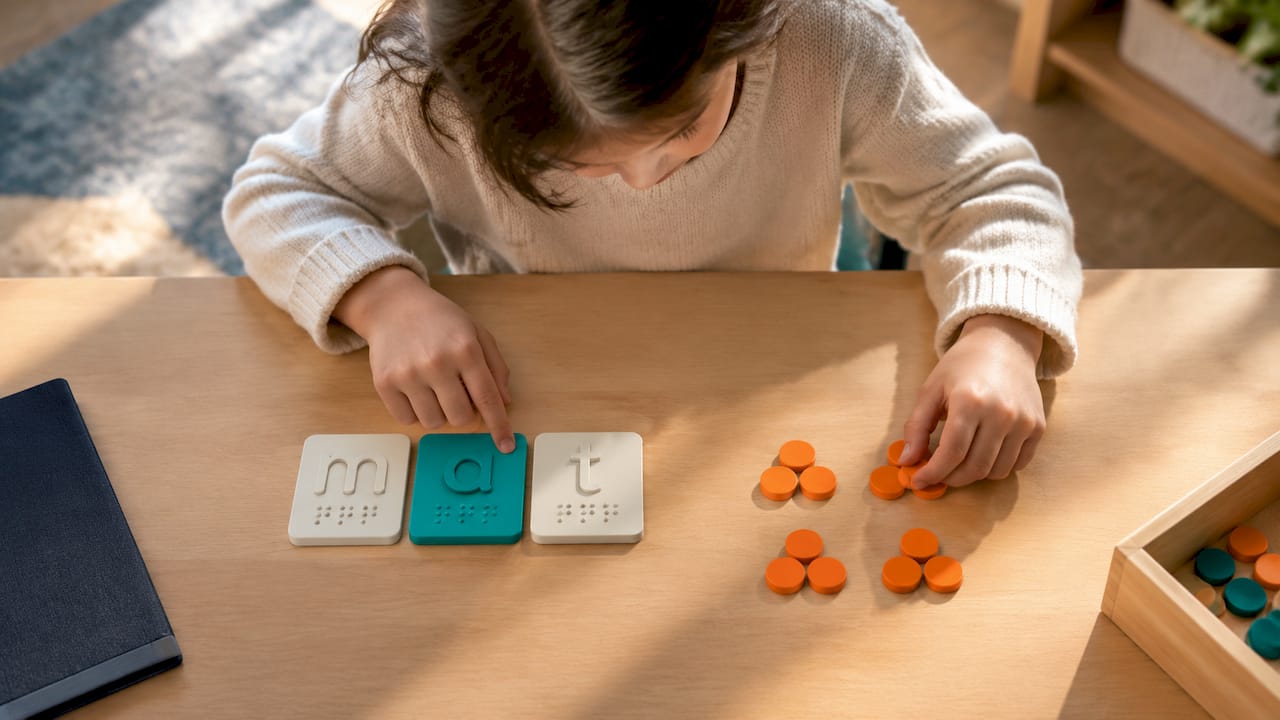
Dyscalculia is a specific difficulty processing numbers and quantities. Dyslexia is a specific difficulty with word-level reading and spelling. They are separate conditions with different cognitive roots, but they can occur together, and the only reliable way to know which one (or both) a learner has is a proper assessment.
TL;DR:
- Many children with dyscalculia also experience difficulties with mathematical word problems, especially when sentence decoding adds to their fragile number sense.
- Early identification of dyscalculia is crucial, as foundational number sense difficulties can persist and undermine advanced subjects like algebra into adolescence.
- Assessment typically involves multiple observations and interventions over time, with formal testing including visuo-spatial and symbolic magnitude tasks for dyscalculia.
- Support strategies tailored to the specific condition, such as concrete manipulatives for dyscalculia or phonics for dyslexia, significantly improve learning outcomes.
- Understanding that dyscalculia is distinct from maths anxiety or instruction issues guides effective intervention and helps prevent misdiagnosis or overlooked interventions.
What is dyslexia?
Dyslexia primarily affects accurate, fluent word reading and spelling, according to the Rose report and British Psychological Society definitions. At its core sit phonological awareness (breaking words into sounds), verbal memory, and processing speed. These are the mechanics behind reading, not intelligence or effort.
Signs vary a lot by age:
- Preschool and early primary: slow letter-sound learning, trouble rhyming, mixing up similar-sounding words.
- Junior school: laboured decoding, poor spelling that doesn’t match verbal ability, avoiding reading aloud.
- Teens and adults: slow reading speed under time pressure, spelling that stays inconsistent despite years of correction, exhaustion after long reading tasks.
Prevalence check: peer-reviewed synthesis puts dyscalculia’s rate at around 5 to 6% of school-aged children, a figure researchers frequently use as a rough benchmark for dyslexia too, given how often the two are studied together.
What is dyscalculia?
Dyscalculia is a persistent, unexpected impairment in numerical magnitude processing, what researchers call “number sense”. The SASC working definition, updated in 2025, separates true dyscalculia from the broader category of “specific learning difficulty in mathematics”, which can have many causes. Dyscalculia specifically means the brain struggles to judge quantity, size, and numerical relationships automatically.
In daily life, that shows up as:
- Struggling to estimate whether £20 will cover a shopping basket.
- Difficulty subitising, instantly recognising small quantities without counting them one by one.
- Confusion reading timetables, working out journey times, or telling which of two numbers is bigger.
- Persistent trouble with basic arithmetic facts that peers memorise easily.
National Numeracy describes this pattern as unexpected relative to a person’s age and general ability, not a knowledge gap that more practice fixes. Crucially, it isn’t the same as maths anxiety or a bad run of teaching. Anxiety and poor instruction produce real struggles too, but the underlying number sense is usually intact once the emotional barrier or instructional gap is addressed.
How are dyscalculia and dyslexia different?
The clearest distinction is which mental system breaks down. Dyslexia centres on phonological and verbal processing, the sounds and symbols of language. Dyscalculia centres on numerical magnitude processing, the intuitive sense of “how much” or “how many”. Practitioner-level research on the cognitive bases of both conditions shows dyscalculia often reveals itself on tasks comparing dot arrays or digit sizes, tasks that have nothing to do with language at all.
The error patterns look different too:
- A dyslexic learner might solve a maths word problem correctly once it’s read aloud to them, because the number reasoning was never the issue.
- A learner with dyscalculia might read a word problem fluently but still misjudge which operation to use or misplace a decimal point without noticing.
- Dyslexic spelling errors tend to be phonetically plausible; dyscalculia number errors tend to involve magnitude, writing 51 for 15, or misjudging that 0.7 is smaller than 0.25.
Working memory and processing speed complicate the picture further, because both conditions can involve them, just applied to different material. A slower processing speed affects verbal sequencing in dyslexia and numerical sequencing in dyscalculia, which is one reason the two conditions get muddled in casual observation.
How do they overlap, and can you have both?
Yes, you can have both, and it happens often enough that assessors actively check for it. Government-commissioned evidence reviews frame identification as assessing a continuum rather than a yes/no test, because these conditions rarely present in isolated, textbook form.
A learner with both conditions often struggles with maths word problems specifically, not because the numbers defeat them, but because decoding the sentence structure adds a second layer of load on top of an already fragile number sense. Watch for a child who can complete a bare calculation but falls apart the moment it’s wrapped in a sentence, or who learns a maths strategy one week and can’t apply it the next because they never fully grasped why it worked.
That said, not every maths struggle is dyscalculia. Weak working memory, high anxiety, and patchy early teaching all cause real maths difficulties that look similar on the surface but respond to completely different support.
How is each condition identified and assessed?
Assessment rarely starts with a formal test. It usually follows a sequence:
- Classroom observation and conversation. A teacher or parent notices a persistent, unexpected gap between effort and outcome.
- Targeted intervention. Extra structured teaching is tried first, partly because response to intervention is itself diagnostic information.
- Screening. Schools may use screening tools that flag likely dyslexia or dyscalculia traits, without confirming a diagnosis.
- Specialist assessment. An educational psychologist or specialist assessor runs a full battery, phonological tasks and reading fluency measures for dyslexia; symbolic and non-symbolic magnitude comparison tasks, alongside visuo-spatial working memory checks, for dyscalculia, following an approach consistent with recent peer-reviewed assessment guidance.
Assessors are looking for a persistent pattern across time and settings, not a single low score on one bad day. If you’re heading into an assessment meeting, bring examples of the child’s work over several months, notes on what interventions have already been tried, and any patterns you’ve spotted at home that don’t show up at school (or vice versa).
How can parents and educators help? Practical strategies
Support works best when it’s matched to the actual mechanism, not a generic “try harder” plan.
For dyslexia:
- Structured, cumulative phonics teaching rather than whole-word guessing.
- Text-to-speech tools for reading-heavy subjects so content isn’t gatekept by decoding speed.
- Written instructions alongside spoken ones, and extra time for anything read under pressure.
For dyscalculia:
- Physical manipulatives (counters, base-ten blocks) held onto longer than typically expected, because the leap to abstract numbers happens later.
- Number lines used explicitly, not just displayed on a wall.
- Direct teaching of estimation and magnitude judgement, rather than assuming it develops on its own.
Across both conditions, cutting working memory load helps more than almost anything else. Break instructions into smaller chunks, use visual supports consistently, and lean on assistive technology rather than treating it as a last resort. One evidence review found that reducing memory demands through multimodal instruction tends to help more in practice than exercises aimed at directly training memory capacity.
Pro Tip: When teaching a new maths concept to a learner with suspected dyscalculia, teach the estimate before the exact answer. Ask “is it closer to 10 or 100?” before working the sum. This builds the magnitude sense that calculation drills alone never reach.
Impact on emotional well-being and secondary effects
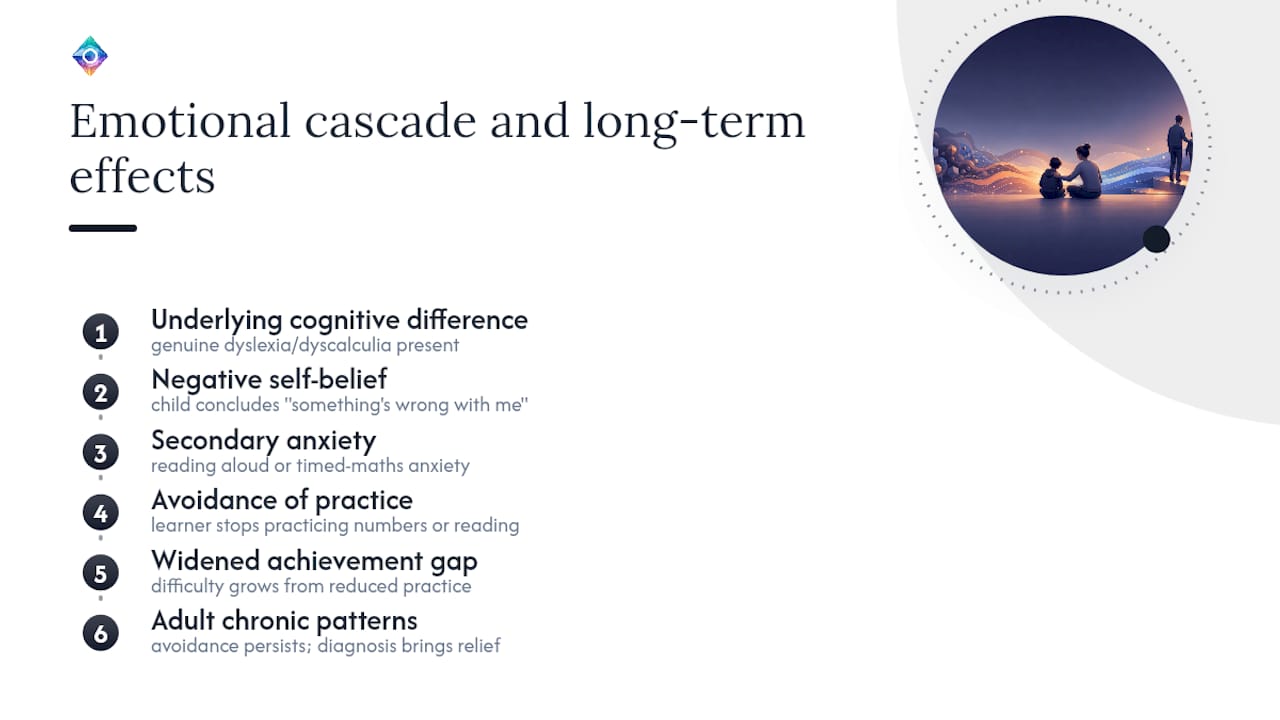
Both conditions carry a well-documented emotional cost that often outlasts the academic struggle itself. Children who can’t decode a page as fast as their classmates, or who watch a peer solve a sum in seconds while they’re still counting on their fingers, tend to draw one conclusion: something is wrong with them specifically. That belief hardens fast, usually well before anyone names the actual condition.
Secondary anxiety around reading aloud or timed maths tests is common, and it compounds the original difficulty rather than sitting alongside it. A learner who becomes anxious about numbers can start avoiding practice altogether, which then widens the very gap the anxiety grew from. This is part of why experts caution against treating every maths struggle as pure anxiety, or every reading struggle as pure laziness. The emotional layer is real, but it usually sits on top of a genuine cognitive difference, not instead of one.
In adults, undiagnosed dyscalculia or dyslexia often surfaces as chronic avoidance: dodging jobs involving mental arithmetic, letting a partner handle all the household finances, or over-preparing for any meeting that might involve reading aloud. These coping patterns can look like a personality trait for decades before anyone connects them back to an unassessed learning difference. Self-esteem damage from childhood schooling frequently persists into adult life even when practical workarounds have been found, which is one reason many adults find naming the condition, even later in life, brings genuine relief rather than just information.
Do dyscalculia and dyslexia involve different brain areas?
Neuroimaging research points to genuinely different networks. Dyslexia research consistently implicates left-hemisphere regions tied to phonological processing, particularly areas supporting the connection between written symbols and speech sounds. Dyscalculia research points instead toward the parietal lobe, especially the intraparietal sulcus, a region repeatedly linked to numerical magnitude processing and quantity representation.
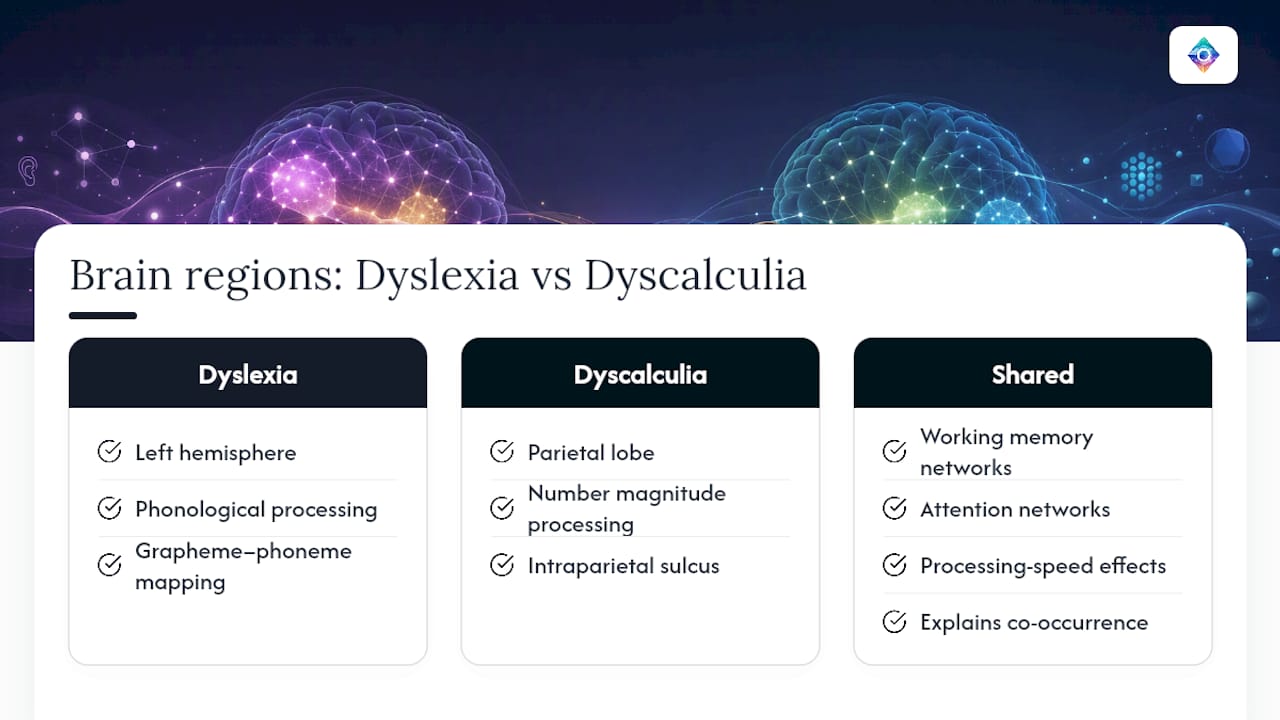
This distinction matters practically, not just academically. It’s part of why a learner can be strong in one domain and struggling in the other. A brain can process language fluently while still stumbling over the intuitive sense of quantity, and vice versa, because the two functions don’t share the same neural infrastructure. Practitioner-level reviews of the cognitive bases of both conditions treat this separation as one of the stronger arguments against lumping every learning difficulty into a single vague category.
None of this means the brain regions work in total isolation. Working memory and attention networks, which sit largely outside both the language and number systems, get recruited by both conditions and probably explain why processing speed problems show up in each, just applied to different material. That shared scaffolding is also why co-occurrence isn’t surprising once you look at the underlying architecture rather than the surface symptoms.
When are dyscalculia and dyslexia typically detected?
Dyslexia tends to get spotted earlier, often within the first two years of formal schooling, because reading is taught explicitly and consistently from day one, and delays show up quickly against a clear benchmark. Most children are expected to blend sounds and recognise common words within a fairly narrow window, so a lag stands out to teachers fast.
Dyscalculia detection typically lags behind by a year or more. Number sense is harder to observe directly than reading, and early arithmetic can often be passed through memorisation and counting strategies that mask the underlying difficulty until maths gets more abstract, usually around the introduction of fractions, decimals, or multi-step word problems. Recognition of dyscalculia is also more recent as a field, and research remains less extensive than for dyslexia, which means fewer teachers are trained to spot the early signs.
The developmental trajectories diverge too. Without support, dyslexia’s core reading deficit tends to persist into adulthood but often becomes manageable through compensatory strategies, assistive technology, and enough repeated exposure to build automaticity. Dyscalculia’s trajectory is patchier: because maths curricula stack concept on concept, an unaddressed number-sense gap in Year 3 can quietly undermine algebra in Year 9, well after anyone remembers where the original difficulty started. That’s part of why early identification matters more for dyscalculia specifically, the compounding cost of delay is steeper.
What treatments and interventions work for each condition?
There’s no cure for either condition, because they’re differences in cognitive processing, not disorders to be eliminated. The goal is targeted skill-building and compensation, and the two conditions respond to different toolkits.
For dyslexia, structured literacy programmes built on systematic phonics remain the most consistently supported approach, often delivered through one-to-one or small-group specialist teaching. Assistive technology, text-to-speech, speech-to-text, and audiobooks, extends this by removing the decoding bottleneck from subjects that don’t need to test reading speed at all.
For dyscalculia, effective intervention leans heavily on concrete-to-abstract teaching sequences: physical manipulatives first, pictorial representations second, abstract numerals last, held for longer than a typical curriculum pace allows. Intervention research is fairly consistent that programmes explicitly teaching number relationships and estimation, alongside cumulative practice with concrete materials, outperform purely drill-based repetition, which tends to leave conceptual gaps intact even when scores briefly improve.
Both conditions benefit from formal access arrangements, extra time in exams, reader or scribe support where appropriate, and exam papers formatted to reduce unnecessary reading or visual clutter. None of this requires waiting for a diagnosis to begin; evidence-based teaching approaches help regardless, though a formal assessment usually unlocks the accommodations that make the biggest day-to-day difference.
What are the biggest myths about dyscalculia and dyslexia?
The most persistent myth is that dyscalculia is just “maths anxiety” or a kind of “number dyslexia”. Neither framing holds up. Expert commentary specifically warns against this conflation, pointing out that dyscalculia is a distinct impairment in magnitude processing, while anxiety is usually a downstream reaction to repeated failure rather than the root cause.
A second myth: that dyslexia is simply about seeing letters backwards. Letter reversals happen in plenty of young readers without dyslexia and are a normal part of early development. The real signature is difficulty with phonological processing, sound-symbol mapping, and reading fluency, not visual scrambling.
A third myth worth challenging directly: that people with dyscalculia can’t be good at maths generally. That’s not accurate. Someone with dyscalculia can grasp abstract mathematical logic, geometry, or pattern-based reasoning perfectly well while still struggling badly with mental arithmetic or estimating quantities. The deficit is specific to numerical magnitude, not to mathematical thinking as a whole.
Finally, many people still assume every maths difficulty must be dyscalculia, or every reading struggle must be dyslexia. Weak instruction, undiagnosed vision problems, inconsistent schooling, and general anxiety all produce overlapping symptoms without either underlying condition being present. That’s exactly why assessment exists, rather than pattern matching from a checklist.
Why does getting this distinction right matter to me?
I was diagnosed with ADHD at 42, long after school reports full of “not applying himself” had prompted someone to ask a harder question. What struck me afterwards wasn’t the diagnosis itself, it was how much clearer everything became once I had accurate language for what my brain was actually doing differently. That’s the whole reason accessible assessment matters to me: not to hand out labels, but to replace decades of guesswork with something specific enough to act on. If a pattern like this feels familiar and won’t resolve with more effort or better teaching, assessment is the next honest step, not a last resort.
— Valerio Cozzi
Can a self-assessment help before you seek a formal diagnosis?
A free self-assessment covering multiple areas of neurodivergence, including dyslexia and dyscalculia traits, alongside ADHD, autism, dyspraxia, and sensory processing patterns, is available. It gives you an instant, plain-language profile with no data collection and no waiting list, which makes it a practical first step before, or alongside, a formal educational assessment.
Guided assessments built specifically for children and teens are available, designed so a parent isn’t trying to force an adult questionnaire onto a nine-year-old. If you’re weighing up whether to seek a formal dyscalculia or dyslexia assessment for your child, the children’s assessment for ages 7 to 10 or the young person’s assessment for ages 11 to 13 can help you spot which traits are showing up before you sit down with a school or specialist. An optional Specialist Briefing report can turn assessment results into a structured document to share with a professional, helping avoid explaining a scattered pattern of symptoms from memory. Start with the free self-assessment and see which of the 14 areas stand out.
Sources
- Rose report / BPS definitions (summary toolkit)
- Dyscalculia and dyslexia in school-aged children (Frontiers, 2025)
- What is dyscalculia? — National Numeracy
This article is general information, not a substitute for advice from a qualified doctor. Consult a qualified healthcare professional about your own circumstances before acting on anything here.
FAQ
Can you have dyscalculia and dyslexia at the same time?
Yes. The two conditions can co-occur, and researchers frame assessment as evaluating a continuum rather than assuming one diagnosis excludes the other.
What are the four types of dyslexia?
Definitions of “types” vary across sources and aren’t standardised in the core research; the Rose report and BPS instead describe dyslexia as a single condition affecting word reading and spelling, with presentations that vary in severity rather than falling into fixed categories.
Can you give some examples of dyscalculia in everyday life?
Common examples include misjudging whether cash in hand covers a purchase, struggling to read a bus or train timetable, and difficulty instantly recognising small quantities without counting, patterns National Numeracy documents directly.
Can people with dyscalculia be good at maths?
Yes. Dyscalculia affects numerical magnitude processing specifically, so someone can excel at abstract mathematical reasoning, geometry, or pattern recognition while still struggling with mental arithmetic or estimation.
How do I find out whether it’s dyscalculia, dyslexia, or both?
Start with a conversation with a teacher or GP about persistent, unexpected difficulties, and consider a structured self-assessment tool to clarify which traits are present before pursuing a formal specialist evaluation.
Recommended
- Spot Twice Exceptional Autism: Use a 14 Domain Self Check to Build Evidence
- Giftedness vs Autism: What Parents and Teachers Need to Know
- ADHD Red Flags: What Parents and Adults Should Know
- Autism vs. ADHD: Comparing Symptoms, Overlap, and Diagnosis
Written and edited by Valerio Cozzi, founder of Omniprism. Omniprism began after my own ADHD diagnosis at 42.
This article is educational. It is not medical advice, not a diagnosis, and not a substitute for assessment by a qualified clinician. The Omniprism self-assessment is free, needs no account and no email address, and runs entirely in your browser — your answers are never sent to a server. The optional Specialist Briefing report is a paid add-on.