Dyslexia Signs in Kindergarten: 5 Clues to Bring to School
Yes, kindergarten-age children can show meaningful early indicators of dyslexia, though a formal diagnosis usually comes later. Key signs include weak phonological awareness such as trouble with rhymes, poor letter-sound knowledge, and difficulty blending simple words like “cat” or “dog”. If you notice these, speak with your child’s teacher or SENCo and start collecting dated examples straight away.
Key Takeaways
Early signs of dyslexia in kindergarten children involve persistent difficulty with phonological awareness and letter-sound knowledge, which can be identified through careful observation and record-keeping.
| Point | Details |
|---|---|
| Observe consistent patterns | Focus on clusters of behaviors such as difficulty rhyming, letter mapping, and blending, rather than isolated struggles. |
| Build concrete evidence | Keep a detailed log of your child’s specific difficulties with dates and examples to support discussions with teachers. |
| Start home practice early | Reinforce phonics and language skills through short, regular activities aligned with school lessons to improve literacy. |
| Seek professional assessment when needed | Request evaluations for persistent difficulties that do not respond to well-delivered teaching or when speech and hearing issues are suspected. |
| Use Omniprism’s structured tools | Complete the guided assessment to create a privacy-friendly, actionable profile that aids conversations with educators or healthcare providers. |
1. Signs to watch in kindergarten
Spotting a pattern matters more than any single moment of struggle. The British Dyslexia Association notes that severity and persistence across several behaviours are the real clues, not one isolated incident, since many young children show occasional difficulty with these tasks.
Watch for a cluster that includes:
- Difficulty learning or remembering nursery rhymes, or trouble noticing that words rhyme at all, which the NHS and the British Dyslexia Association both list among early indicators.
- Not learning letter names or struggling to connect letters with their sounds despite repeated teaching, a pattern documented in longitudinal research on Dutch-speaking children with dyslexia.
- Trouble segmenting or blending simple words (cat, pin, sun), or reading guesses that bear no sound relationship to the word on the page.
- Frequent unrelated word substitutions, slow or hesitant attempts at reading aloud, muddled sequencing (days of the week, the alphabet) and general forgetfulness around instructions.
- Letter reversals (writing “b” for “d”), which on their own are common at this age and not a reliable sign, according to the same Dutch-speaking children study.
Family history adds useful context. Children with a parent or sibling who has dyslexia carry a higher statistical risk, according to research on predicting individual risk, but this is background information to mention at a school meeting, never a verdict on its own.
2. How to build evidence and what to say to your child’s teacher or SENCo
A school can only act on specifics. Vague worry (“he seems behind”) moves nothing forward, but a dated example does, as the NHS and the British Dyslexia Association’s checklists both recommend keeping a running record of concerns rather than a single snapshot.
- Start a simple log with dates: note what your child struggled with and the context (home, bedtime story, homework).
- Keep short samples: a photo of mark-making or early writing, a 30-second audio or video clip of a reading attempt.
- Write a short timeline: when you first noticed speech, rhyme or letter difficulties, and whether they have changed.
- Request a meeting with the class teacher or SENCo and ask directly for classroom screening or assessment.
- Bring family history if relevant, alongside your concrete examples, not instead of them.
Schools can begin SEN Support without waiting for a formal diagnosis, and the British Dyslexia Association confirms that formal assessment, when needed, is normally carried out by an educational psychologist or specialist teacher. The NHS also suggests ruling out hearing or vision issues with a GP first, since these can mimic or compound reading difficulty.
Pro Tip: Bring your log on paper or a phone screen to the meeting; a teacher who can quickly review dated examples will have more context than one handed a verbal summary.
3. What you can do at home now
Home practice works best when it mirrors what the school is already teaching, rather than introducing a competing method. The Education Endowment Foundation’s phonics evidence reports an average impact of five months’ additional progress from phonics instruction, with the strongest results when sessions are explicit and systematic.
- Practise rhyme and syllable clapping in short sessions a few times a week rather than one long session.
- Teach letter sounds explicitly, then ask your child to blend them aloud instead of guessing from a picture.
- Keep mark-making and early writing playful, and check with the teacher which phonics sequence the class follows so you reinforce the same sounds in the same order.
- Read aloud together daily and talk about new words, since the EEF’s early literacy guidance notes that oral language and interactive reading support the wider system that phonics alone does not cover.
Targeted phonics support delivered four or five times a week for up to fourteen weeks tends to produce the clearest gains, according to the same EEF evidence, which points to consistency rather than occasional marathon sessions.
4. When to seek professional assessment or extra help
Escalate when difficulties persist despite consistent, well-delivered teaching, or when speech is hard to understand, hearing or vision might be involved, or other developmental concerns sit alongside the reading struggle. Formal dyslexia assessment is typically carried out by an educational psychologist or specialist teacher, and the British Dyslexia Association notes that families often arrange or pay for this privately, while school-based routes vary by setting.
An assessment report usually identifies specific areas of difficulty and recommends adjustments or interventions the school can put in place. Pathways and terminology differ between regions, so check your local school’s SEND procedures for the exact process that applies to your child.
5. A founder’s note on turning observation into useful information
I’m Valerio Cozzi, founder of Omniprism, diagnosed with ADHD at 42. A structured checklist does not replace a professional, but it gives you language and evidence that make school and clinician conversations faster and more concrete.
6. Common misconceptions about dyslexia signs in kindergarten
The most persistent myth is that letter reversals confirm dyslexia. Reversing “b” and “d” is developmentally typical at this age and, on its own, carries little diagnostic weight, as the research on Dutch-speaking children with dyslexia linked above makes clear.
A second misconception treats a slow start in reading as automatic proof of dyslexia. Many children simply need more time or different teaching; what distinguishes a risk profile is persistence of difficulty across several domains despite good instruction, not a single lagging skill.
Parents also sometimes assume a child must be struggling with every subject for dyslexia to be relevant. In practice, early signs are often narrow and specific, limited to sound and letter work, while a child’s reasoning, vocabulary and general knowledge can be entirely typical.
Finally, some parents wait for a “proper diagnosis” before asking for any help at all. Schools can offer SEN Support based on observed need long before any formal assessment takes place, so a diagnosis is not a prerequisite for support to begin.
7. How dyslexia signs differ from typical developmental variations
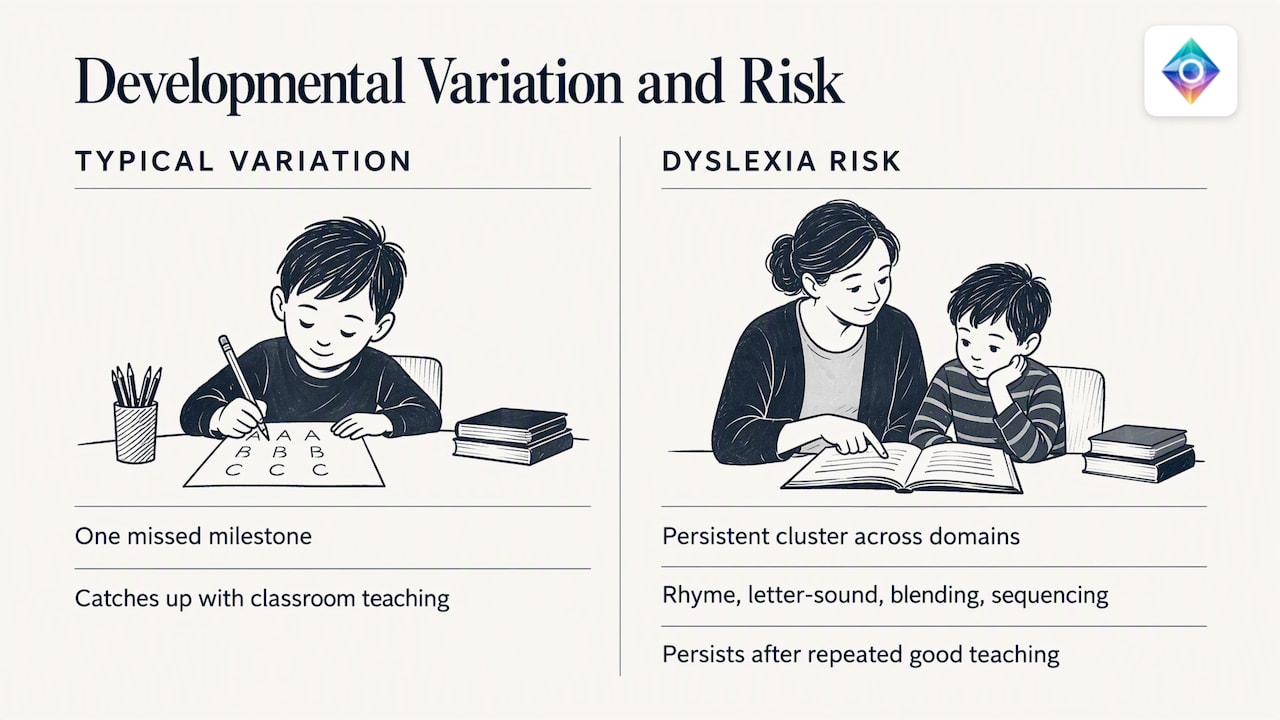
Most kindergarten children show some unevenness in early literacy skills, and that variation on its own is not cause for concern. The difference lies in persistence, breadth and response to teaching.
A child with typical developmental variation usually catches up with ordinary classroom instruction within a reasonable stretch of time. A child showing a dyslexia risk profile tends to keep struggling with phonological tasks, letter-sound mapping and blending even after repeated, well-delivered teaching, a pattern the longitudinal study on Dutch-speaking children with dyslexia associates with later difficulties.
Breadth matters too. One missed milestone, such as being slightly behind on alphabet recall, rarely signals a problem by itself. A cluster covering rhyme, letter-sound knowledge, blending and sequencing together is far more informative, which is why checklists ask about several domains rather than a single skill.
8. Impact of early identification on long-term educational outcomes
Identifying a risk profile early gives schools more time to put targeted support in place before gaps widen. The Education Endowment Foundation’s phonics evidence shows that structured, explicit teaching produces measurable gains, and those gains compound when intervention starts before a child falls far behind peers rather than after.
Screening research that combines parent and teacher observations with direct tasks also finds that early risk indicators can shift with instruction and development, according to a study tracking children from age 5 to 15. That means early flags are not fixed predictions. They are a starting point for support that can change a child’s trajectory, particularly when phonics instruction is paired with oral language and shared reading rather than delivered in isolation.
9. How to communicate concerns effectively with pediatricians or healthcare providers
Bring the same dated log you prepared for school: specific examples, approximate dates, and any changes you have noticed over time. A GP visit is also the right moment to raise hearing or vision concerns, since the NHS recommends ruling these out as straightforward contributors to reading difficulty.
Describe behaviours rather than conclusions. Saying “he mixes up the sounds in short words and can’t tell me two words that rhyme” gives a clinician more to work with than “I think she might be dyslexic.” If speech has also been a concern, a speech delay checklist can help you organise those observations before the appointment.
Ask directly whether a referral for speech and language assessment or further developmental review is warranted, and request this in writing if your provider agrees, since a written referral tends to move faster through school and specialist systems than a verbal note.
10. Neurodivergent traits that often appear alongside dyslexia
Dyslexia rarely travels alone, and kindergarten is often the stage where overlapping traits first become visible. Attention difficulties are among the most common co-occurring patterns, and our action plan for overlapping ADHD and dyslexia looks at how the two can present together in early school years.
Motor coordination and handwriting difficulties sometimes appear alongside reading struggles too. If mark-making and pencil control seem to lag well behind reading concerns, our comparison of dysgraphia and dyslexia signs can help you work out which pattern fits better, since the two are often confused but call for different support.
Attention difficulties can also show up on their own before reading problems become obvious, and our notes on ADHD symptoms in preschoolers cover what that can look like at this age. None of these overlaps mean a child has every condition at once. They mean a broader look, rather than a narrow focus on reading alone, tends to give parents and professionals a fuller picture.
11. Why a narrow checklist mindset undersells this stage
The conventional advice on this topic leans heavily on checklists, and checklists are useful, but they flatten a genuinely layered picture. A five-year-old’s reading struggle sits inside a wider developmental context: attention, motor skills, speech and family history all interact, and treating phonological awareness as an isolated box to tick misses that.
What the evidence actually supports is persistence and breadth over any single symptom. A child who stumbles over rhymes once in a while is not a child showing a risk profile. A child who consistently cannot connect sounds to letters after weeks of explicit teaching, across several related skills, is.
If you take one thing from this, prioritise building a concrete, dated record over searching for a single confirming sign. Parents who arrive at a school meeting with specifics move the conversation forward faster than those who arrive with a feeling, however well founded that feeling might be.
— Valerio Cozzi
12. A privacy-first way to structure what you have observed
Collecting examples is useful, but turning them into something a teacher or clinician can act on quickly is where many parents get stuck. We built our guided assessment for children to close that gap: it walks you through structured questions about your child’s development, delivers an instant plain-language profile, and never asks for an email address, an account or any stored personal data.
- Complete a guided assessment for your child and receive a profile across multiple developmental domains straight away.
- Use the results as a conversation starter with your child’s teacher, SENCo or GP, not as a diagnosis.
- Add an optional Specialist Briefing, a one-off 9.99 EUR report designed for healthcare professionals.
Our self-assessment and children’s tools are free to start, and if you decide a clinician-ready summary would help your next conversation, you can get a Specialist Briefing once you have completed the guided assessment.
This article is general information, not a substitute for advice from a qualified doctor. Consult a qualified healthcare professional about your own circumstances before acting on anything here.
FAQ
Can you tell if a 5 year old is dyslexic?
You can spot meaningful indicators, such as weak phonological awareness or persistent trouble connecting letters with sounds, but a confirmed diagnosis at age 5 is uncommon. The NHS notes that formal diagnosis is difficult in very young children, so the practical step is to share observed patterns with the school rather than seek a label straight away.
At what age do signs of dyslexia start?
Early language and pre-literacy differences can appear before formal reading instruction even begins, sometimes showing up as late speech or limited interest in rhymes and letters. The NHS states there is no single age at which dyslexia suddenly starts, since difficulties often become clearer once formal decoding and spelling tasks begin at school.
What are red flags for dyslexia?
The clearest red flags are persistent difficulty with nursery rhymes, poor letter-sound knowledge despite teaching, and trouble blending simple words, according to the British Dyslexia Association. Letter reversals alone are common at this age and not considered a reliable red flag on their own.
What are some tips for people with dyslexia?
Short, frequent practice on phonics, rhyme and blending tends to work better than long infrequent sessions, with the Education Endowment Foundation reporting measurable gains from explicit, systematic teaching. Pairing phonics with shared reading and conversation, rather than phonics alone, gives broader support for literacy development.
Sources
- Signs of dyslexia (Early Years) - British Dyslexia Association
- [Dyslexia in children
- Towards a further characterization of phonological and literacy problems in Dutch-speaking children with dyslexia - PubMed
- Phonics | EEF
Recommended
- Dysgraphia vs Dyslexia: Spot Classroom Signs With a 14 Domain Self Check
- 6 Evidence Backed Study Strategies Dyslexic Students Can Try This Week
- Parents & Teachers: Four Steps to Tell Dyscalculia From Dyslexia
- 25–50% Overlap: Parents & Teachers’ Action Plan for ADHD and Dyslexia
Written and edited by Valerio Cozzi, founder of Omniprism. Omniprism began after my own ADHD diagnosis at 42.
This article is educational. It is not medical advice, not a diagnosis, and not a substitute for assessment by a qualified clinician. The Omniprism self-assessment is free, needs no account and no email address, and runs entirely in your browser — your answers are never sent to a server. The optional Specialist Briefing report is a paid add-on.