Plain Language Autism Report: What It Contains and How to Use It
A plain language autism report is a short, jargon-free summary of how a person experiences communication, sensory input, routines and support needs, written so that the person, their family, teachers and clinicians can all read it. It does not replace a formal diagnostic report, but it makes that report easier to discuss, and our Specialist Briefing (€20 one-off) turns a completed self-assessment into a clinician-ready summary.
Key Takeaways
- A profile is a one- or two-page snapshot. It sits alongside fuller reports and does not replace them.
- Good plain-language reports use Plain English, explain any technical term and balance strengths with support needs.
- Parents in a 2022 English study wanted a summary of key points at the top and a clear structure.
- Keep only what is relevant to the person reading it: a teacher, a GP and an employer need different details.
- Omniprism’s free assessments give an instant plain-language profile with no email, account or data collection.
What is a plain language autism report or profile?
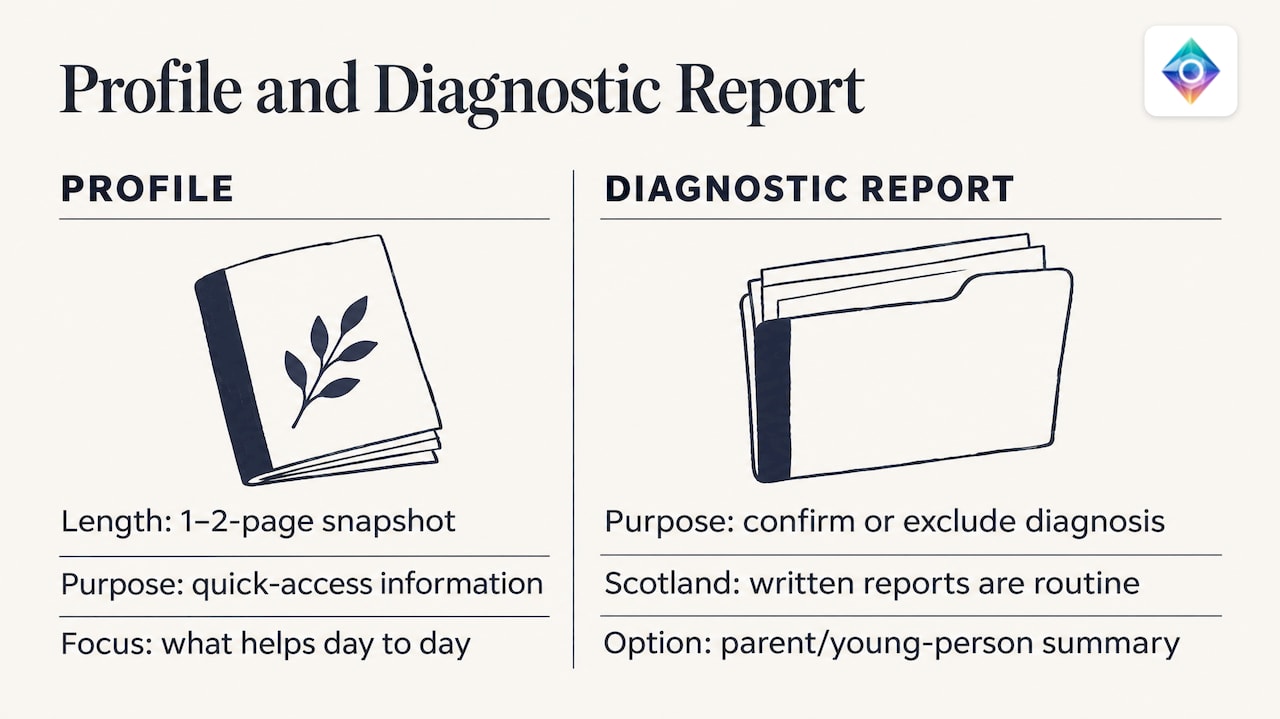
A profile is a one- or two-page summary of important information about a person, presented as a quick-access snapshot. It may cover likes and dislikes, strengths, motivators, challenges, communication style, sensory needs and key support contacts.
A formal diagnostic report is a different document. In Scotland, written reports confirming or excluding a diagnosis are routine practice, and the Irish psychologists’ guidelines say the outcome must be one of three categories: a diagnosis is supported, it is not supported, or no conclusion can be drawn. The same guidelines allow a separate summary report for parents or the young person to help them understand the full one.
The plain-language version is that summary layer. It answers the everyday question: what does this person find easy, what is hard, and what helps?
What should an autism profile include?
A Canadian education chapter lists history and background, a summary of assessment information, interests, strengths and learning styles, and current development. A family toolkit from the Global Autism Research Council suggests a one-page format covering preferred language, strengths, how the person shows yes or no, how they ask for help, sensory preferences and early signs of stress.
The same toolkit suggests asking three questions rather than labelling someone high or low functioning: what can this person do, what is difficult, and what support changes the outcome? That framing holds strengths and needs together, which is also the logic of a spiky profile.
A useful checklist for the content:
- Communication: how the person speaks, signs or signals, and what helps them be understood.
- Sensory processing: sounds, light, touch and textures that help or overwhelm.
- Predictability: how changes of routine affect them and what eases transitions.
- Executive functioning: planning, starting tasks, switching between them.
- Co-occurring needs such as ADHD, anxiety or sleep difficulties, which the toolkit lists among common everyday impacts.
- What helps, in concrete terms a new person could act on.
How do you write a report in plain language?
The National Autism Implementation Team’s guide recommends Plain English, avoiding technical language, explaining necessary terms and using online readability checkers. It also says reports should not quote deficit-based wording from diagnostic manuals directly, and should respect whether someone prefers “condition”, “being autistic” or “being neurodivergent”.
In practice:
- Lead with a summary. A 2022 interview study of 30 parents in North East England produced ten recommendations, including a summary of key points at the top and clear signposting of the report’s structure.
- Use everyday examples. “Loud canteens make it hard to eat” says more than “sensory hypersensitivity”.
- Explain unavoidable terms once, in a sentence, where they first appear.
- Pair each difficulty with what helps. This keeps the document useful for adjustments.
- Check the person agrees. Irish guidelines give parents the chance to discuss and amend incorrect information before a report is finalised.
Clarity is valued. A 2026 US study found that 53% of parent comments praised the plain language and clarity of accessible report formats. Speech and language therapists’ guidance also suggests considering two versions of a document with the same information to meet different access needs. For families thinking about how language develops, a parent’s checklist on speech delays is a helpful companion.
What should a report avoid?
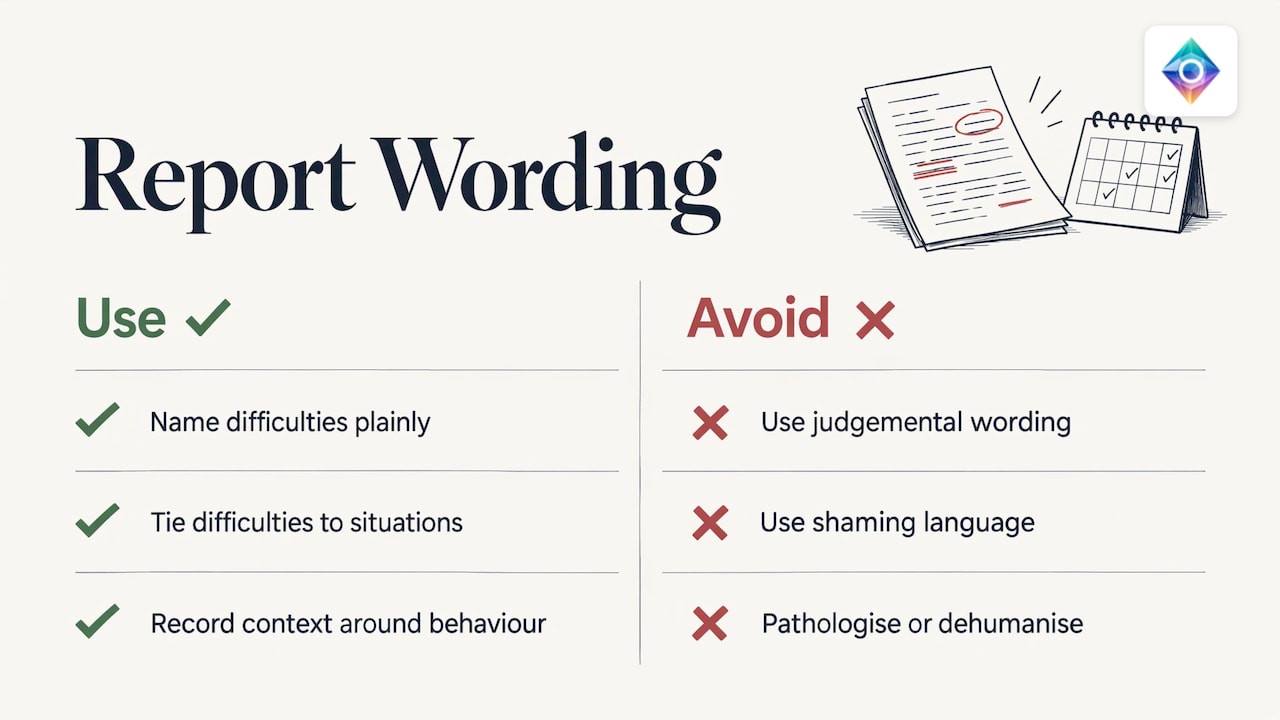
The NAIT guide asks writers to consider whether wording is judgemental, shaming, pathologising or dehumanising, while still describing difficulties clearly enough that services and support can be accessed. It notes that research from 2017 found professionals use deficit-based language more often than neutral or strengths-based language.
The workable balance is to name the difficulty plainly and tie it to the situation: “finds unannounced changes of plan very stressful, and copes better with a written schedule”. The GARC toolkit adds that behaviour is information: it may reflect demands, pain, sensory overload, communication difficulty or fatigue, so a good profile records context, not just the behaviour.
How do you use a profile at school, at work and with clinicians?
Keep it relevant. The ACT Community guide advises including only what is pertinent to the support situation and notes that profiles help most with people who have only occasional contact, such as supply teachers or librarians. A family toolkit describes a one-page profile as a simple summary to give to school, clubs and health staff. Teachers wanting a concise student profile may also like this guide to social-emotional worksheets.
For adjustments in school, see our guide to legal school autism adjustments. In a clinic, the profile gives the clinician a starting point. The Irish guidelines note that many families only take in part of verbal feedback, which is why something written and readable matters afterwards.
If you do not understand terms in an assessment report, the National Autistic Society says you can ask the clinician to explain them.
Pro Tip: Write the one-page profile for a specific reader. Remove anything that reader cannot act on, and add one line on what helps when things go wrong.
How do you get a plain-language profile from Omniprism?
The Free Adult Self-Assessment gives an instant profile across 14 areas, including autism, ADHD, dyslexia, masking, dyspraxia, dyscalculia and sensory processing, in plain language, with no email, account or data collection. Families can use the Children & Young People Free Assessment, with versions for ages 7 to 10 and ages 11 to 13.
When you want something to hand to a clinician, the Specialist Briefing is €20 one-off, and the Youth Briefing is also €20 one-off. Both summarise results for healthcare professionals. A self-assessment is not a diagnosis, as we explain in self assessment vs diagnosis; it prepares you for that conversation.
Our perspective
I was diagnosed with ADHD at 42. Before that, I had no clear words for how my mind worked, and that is the gap we built Omniprism to close.
We believe a profile should be readable by the person it describes first. That is why our results arrive instantly, in plain language, across 14 areas, and why we ask for no email, no account and no data. Understanding yourself should not require handing yourself over.
We also believe the profile is most powerful when it travels. A Specialist Briefing is designed for easy use by healthcare professionals, so the conversation starts from your own description rather than from a blank page.
The research above points the same way: short, strengths-aware, plain summaries help people be understood.
Valerio Cozzi
FAQ
Is a plain language autism report the same as a diagnosis?
No. It is a readable summary of traits, strengths and support needs. A diagnosis comes from a formal assessment by qualified clinicians, and the summary can help you prepare for or understand it.
How long should an autism profile be?
One or two pages is the usual guidance for a quick-access profile. Put the most important points first and include only what the reader needs.
Can parents write a profile for their child?
Yes. Parents commonly write one-page profiles for school, clubs and health staff, covering what people admire about the child, what matters to them and how best to support them. Our autism checklist for parents can help you gather observations.
What should I do if my report is hard to understand?
Ask the clinician to explain the terms and, where possible, ask for a plainer or shorter version. Services may be able to produce two versions of the same information.
Sources
- Information to Share in a Profile (ACT Community, 2015)
- Neuro-Affirming Reports Guide (NAIT, 2024)
- Professional Practice Guidelines (Psychological Society of Ireland, 2022)
- Chapter 2: The Student with Autism Spectrum Disorder (Manitoba Education)
- GARC Family & Caregiver Autism Toolkit (2026)
- What parents want in an autism diagnostic report (PMC, 2022)
- Parent experiences with children’s psychological evaluation (Discover Public Health, 2026)
- Autism guidance (RCSLT, 2023)
- Neurodiversity Family Toolkit (Sycamore Trust)
- What happens during an autism assessment (National Autistic Society)
- How to Recognize Speech Delays
- Social Emotional Worksheets for Kids
Recommended
- Copyable One Page Neurodiversity Report Examples for GP Appointments
- Disclosing Autism at Work: Should You, and How?
- Parents & Teachers: Legal School Autism Adjustments That Work
- How to Prepare for an Autism Assessment: A UK Guide
Written and edited by Valerio Cozzi, founder of Omniprism. Omniprism began after my own ADHD diagnosis at 42.
This article is educational. It is not medical advice, not a diagnosis, and not a substitute for assessment by a qualified clinician. The Omniprism self-assessment is free, needs no account and no email address, and runs entirely in your browser — your answers are never sent to a server. The optional Specialist Briefing report is a paid add-on.