Late Autism Diagnosis: What It Means and How to Get One
A late autism diagnosis is autism identified in adolescence or adulthood, and it is not autism that began then: the traits were present from early development but went unrecognised. In the UK, NHS Autism Central says people can be diagnosed at any age, and many whose autism was missed are identified after a child or relative is diagnosed. If you suspect this is you, a free structured self-assessment such as our Free Adult Self-Assessment gives you a plain-language profile to organise your thoughts before you speak to your GP.
Key Takeaways
- Autism does not first develop in adulthood; traits must be present from early life, even if they only became obvious later, as NHS England’s guidance on autistic adults explains.
- Masking, mental health problems and non-stereotypical presentations are common reasons recognition is delayed.
- In England, NICE recommends a team-based assessment that draws on childhood history, so gathering old school reports and family recollections helps.
- Screening quizzes and self-assessments are not diagnoses, but they can structure a GP conversation.
What counts as a late autism diagnosis?
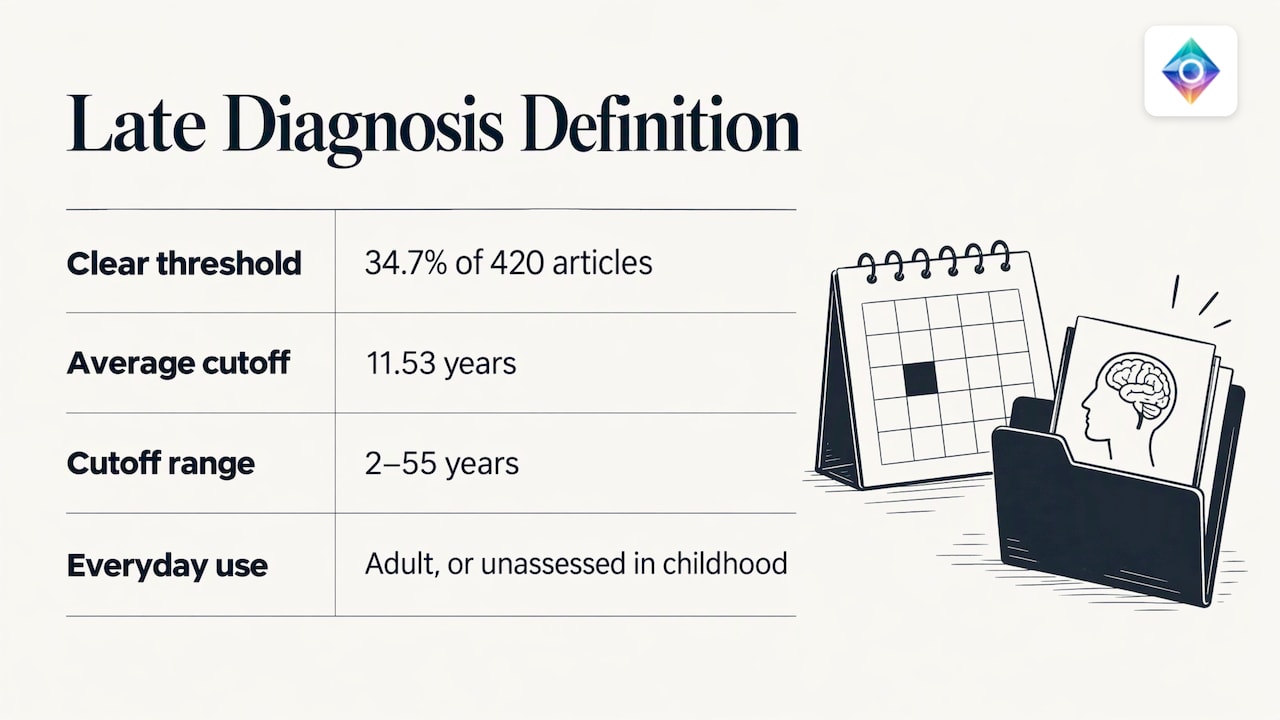
There is no agreed cut-off. A 2024 systematic review of 420 articles found only 34.7% gave a clear threshold for “late” diagnosis, with cut-offs averaging 11.53 years and ranging from 2 to 55. In everyday use, the phrase usually means being identified as an adult, or after childhood without having been assessed.
The diagnostic criteria require that characteristics were there in the developmental period. ICD-11 describes onset in the developmental period, typically early childhood, while symptoms may not fully show until social demands exceed a person’s capacities. “Late-onset autism” is therefore better understood as late-identified autism.
A diagnosis made at 30, 50 or 80 carries the same weight as one made in childhood, according to the Canadian Psychological Association.
Why do some people get diagnosed late?
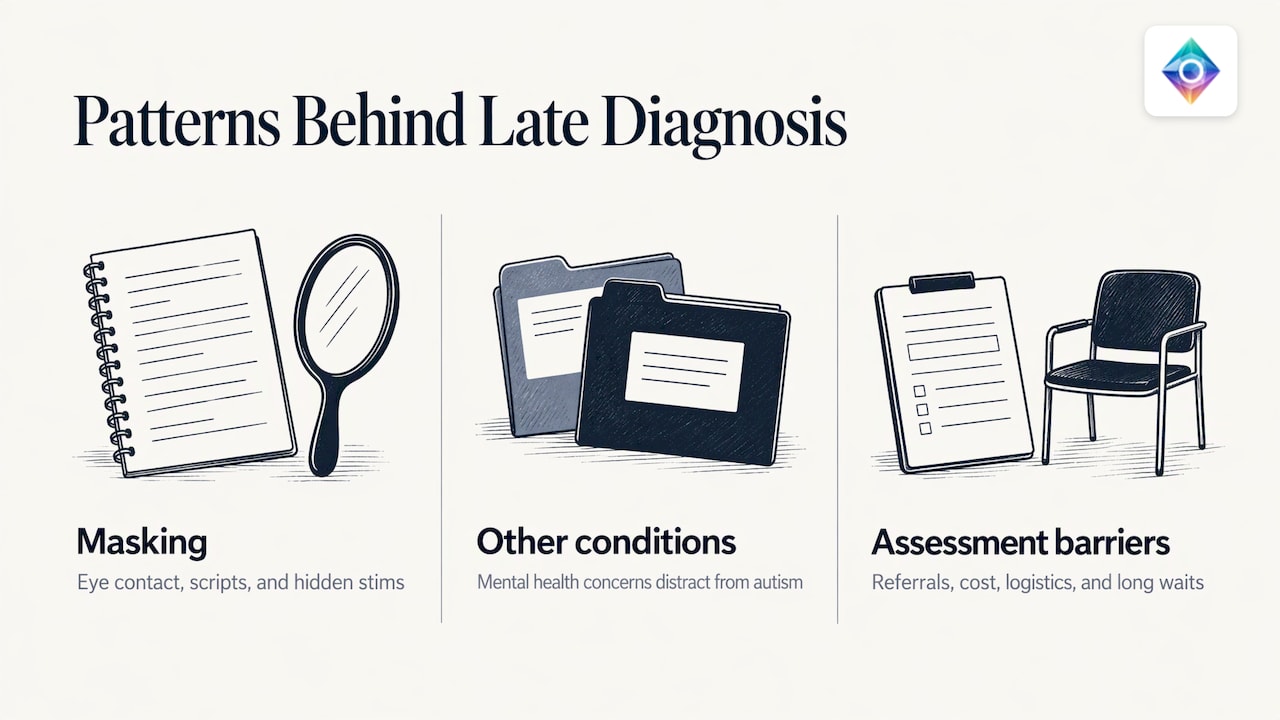
Three patterns come up repeatedly in the research.
Masking. AANE describes masking as forcing eye contact, rehearsing scripts and hiding stims, one reason many autistic women and nonbinary people are identified late. A 2025 review of diagnostic challenges in women found camouflaging carries a cognitive cost that leads to fatigue, burnout, depression and anxiety, and that higher camouflaging scores are linked with later diagnosis in females. Our own guides on autistic traits in women and how masking hides adult autism signs go deeper.
Other conditions taking the spotlight. A qualitative study of adults seeking diagnosis described missed opportunities because mental health concerns distracted from autism, along with a long sense of feeling different. Anxiety can overlap with autism, which is covered in our piece on autism versus social anxiety.
Barriers to assessment. A 2026 mixed-methods review of 50 studies lists difficulty obtaining referrals, financial and logistical factors, limited awareness of non-stereotypical presentations, camouflaging and long waits.
Life changes can also expose traits. NHS inform describes signs surfacing in new environments and life events, such as difficulty in job interviews, keeping a job, socialising or managing relationships.
How do you get assessed as an adult in the UK?
Here is the route, in order.
- Note your experiences. Write down differences in social communication, interests and routines, and sensory reactions, with examples from childhood and now. Our Free Adult Self-Assessment produces an instant profile across 14 areas, with no email, account or data collection, which gives you a structured starting point.
- Try a screening tool if you like. The National Autistic Society notes the AQ-10 and AQ-50 are not diagnoses and results can vary between tools; a positive screen may prompt a GP appointment.
- Gather early evidence. NICE guideline CG142 recommends an informant or documentary evidence of early development, such as school reports. Ask a parent, sibling or old friend what they remember.
- See your GP. NICE says an AQ-10 score of 6 or above, or clinical suspicion, should trigger a comprehensive assessment. Bring your notes. Our Specialist Briefing (€20 one-off) is a report summarising your results for clinicians, so your GP does not have to piece your history together from a conversation.
- Attend the assessment. NICE describes a team-based assessment covering core features from childhood into adulthood, functioning at home, in education and at work, coexisting conditions and sensory sensitivities. Tools may include the ADI-R, ADOS-G, AAA, ASDI or RAADS-R.
- Plan for the wait. Waits can be lengthy, which is why preparing well matters. Your GP can tell you the current local pathway and any right-to-choose options.
Assessment can be harder in adulthood because standard instruments need early developmental information that may be difficult to obtain, and learned coping strategies can conceal traits. Organised evidence is the most practical answer to that.
What are the signs of autism in adults?
NHS inform says traits must have been present from a young age and significantly affected daily life. NICE directs assessors to social communication, restricted or repetitive behaviours and interests, and sensory differences. Sensory reactivity differences are present in around 94% of autistic adults, according to NHS England.
In adults the signs often look like exhaustion after socialising, scripted conversations, intense focus on specific interests, and difficulty with unwritten workplace rules. Traits can overlap with alexithymia, the difficulty identifying feelings, which we cover in alexithymia and autism. ADHD frequently sits alongside autism, and our self-assessment versus diagnosis guide explains what a quiz can and cannot tell you.
What can a late diagnosis change?
A systematic review of 26 studies found diagnosis can bring understanding, acceptance and community, while some adults still meet stigma and thin post-diagnosis support. A meta-ethnography of eight studies described people moving from feeling like an alien to a sense of relief.
The National Autistic Society lists practical gains: making sense of feeling different, reasonable adjustments at work, access to social care and benefits, and stronger self-advocacy. It also notes that many in the autistic community accept self-identification as a personal choice while people wait.
For peer connection, the same 2025 review reports nearly two-thirds of participants in an Australian survey received post-diagnosis support from other autistic people. Local groups and online networks are worth exploring, at your own pace.
What if it is your child or a student?
Parents are often the trigger: adults are frequently identified after a child or relative is diagnosed. Our Children & Young People Free Assessment offers guided assessments for children and teens, with age-specific versions for ages 7 to 10 and ages 11 to 13, and a Youth Briefing at €20 one-off to share with professionals. Educators can read about school autism adjustments.
Our view on late diagnosis
Many people reach adulthood knowing they are different but without words for it. We built Omniprism so that the first step does not need an account, an email address or a waiting list: you complete the assessment, read a plain-language profile across 14 areas, and nothing is collected.
A late diagnosis is a clinical process, and it goes best when you arrive prepared. That is why we offer the Specialist Briefing, designed to be easy for healthcare professionals to use. Diagnosed with ADHD at 42, I know how much clearer a conversation becomes when you can hand over something organised.
Valerio Cozzi
Ready to organise your thoughts?
Start with the Free Adult Self-Assessment for an instant profile. When you are ready to see a clinician, the Specialist Briefing turns your results into a summary they can read quickly.
FAQ
Can you be diagnosed with autism at 50 or older?
Yes. NHS Autism Central states that people can be diagnosed at any age. The assessor will still look for evidence that differences were present from a young age.
Can autism develop in adulthood?
No. Under current criteria, autism characteristics are present in early development, although they may not become fully evident until later. That is why the term late-identified is more accurate than late-onset.
Is an online quiz enough for a diagnosis?
No. The National Autistic Society says the only way to know for sure is a formal assessment. A self-assessment can help you describe your experiences and decide whether to ask your GP for a referral.
What evidence helps if my parents cannot remember my childhood?
NICE accepts informants or documentary evidence such as school reports. The British Association for Psychopharmacology guidance adds that clinicians can rely on other informants and your current circumstances when caregivers are unavailable.
Sources
- NHS Autism Central: Diagnosis
- NICE CG142: Autism spectrum disorder in adults
- NHS England: Meeting the needs of autistic adults in mental health services
- NHS inform: Diagnosing autistic young people and adults
- Russell et al. 2024, systematic review of late diagnosis, Autism Research
- Khudiakova et al. 2026, lived experience review
- Nayyar et al. 2025, experiences of receiving a diagnosis
- Dolfi and Tudose 2025, diagnostic challenges in women
- Qualitative study of seeking an autism diagnosis
- Gellini and Marczak 2023, meta-ethnography
- National Autistic Society: Deciding whether to seek an assessment
- AANE: Masking, a guide
- Canadian Psychological Association fact sheet
Recommended
- Autism vs. ADHD: Comparing Symptoms, Overlap, and Diagnosis
- 50–70% Overlap in Autism and ADHD: What Families and Clinicians Need
- Self Assessment vs Diagnosis: ADHD and Autism Quizzes Aren’t Diagnoses
- Masking Hides Adult Autism Signs: UK NHS Steps to Assess
Written and edited by Valerio Cozzi, founder of Omniprism. Omniprism began after my own ADHD diagnosis at 42.
This article is educational. It is not medical advice, not a diagnosis, and not a substitute for assessment by a qualified clinician. The Omniprism self-assessment is free, needs no account and no email address, and runs entirely in your browser — your answers are never sent to a server. The optional Specialist Briefing report is a paid add-on.