Alexithymia and autism: why the two get confused so often

Alexithymia turns up in roughly half of autistic people, yet it is not autism itself. It’s a distinct trait, difficulty identifying and describing feelings, that changes what kind of support actually works. Get the two confused and you end up treating the wrong problem. This piece walks through what alexithymia is, how it overlaps with autism, and what to do differently once you know it’s there.
TL;DR:
- Alexithymia is characterized by difficulty identifying and describing feelings, and it is distinct from autism, often requiring different support strategies.
- Sensory overload and reduced interoceptive accuracy can delay recognition of distress, leading to higher risks of anxiety and depression in autistic individuals with alexithymia.
- Support should focus on sensory triggers first and utilize visual, tactile, or physiological tools rather than solely relying on verbal emotional labelling.
- Routine screening for alexithymia is recommended in autism assessments to tailor interventions toward emotional awareness, not just social skills training.
What is alexithymia and what are its core facets?
Alexithymia describes a specific gap between having an emotion and knowing what it is. Someone can feel their chest tighten, their thoughts race, their stomach drop, and still have no word for what’s happening inside them. It isn’t shyness, and it isn’t a lack of feeling. The feeling is there. The translation layer is missing.
Researchers usually break it into three facets, most commonly measured using the Toronto Alexithymia Scale (TAS-20):
- Difficulty identifying feelings (DIF): struggling to tell the difference between, say, anxiety and excitement, because both produce a similar racing heart and unsettled stomach.
- Difficulty describing feelings (DDF): knowing something is happening emotionally but being unable to put it into words other people would recognise.
- Externally oriented thinking (EOT): a tendency to focus on concrete, external details of a situation rather than the internal emotional experience of it.
These three facets don’t always move together. Someone might score high on DIF but relatively low on EOT, which matters because each facet predicts different outcomes later on, something covered in more detail further down.
Self-report has real limits here. Asking someone with high DIF to rate their own emotional awareness is a bit like asking a colour-blind person to describe a sunset; they can try, but the tool itself is part of what’s compromised. That’s why clinicians increasingly pair questionnaires with observation, physiological markers, or carer reports rather than relying on a single score.
How common is alexithymia in autistic people compared with other groups?
The clearest figure comes from a systematic review and meta-analysis pooling data across multiple studies: around 49.93% of autistic people meet criteria for alexithymia, against roughly 4.89% in non-autistic samples.
The gap in numbers: Autistic people are affected by alexithymia at nearly ten times the rate seen in the general population, based on pooled data across dozens of studies.
That’s not a small overlap. It means alexithymia sits close to a coin-flip likelihood in the autistic population, while it stays a minority trait everywhere else. But the number isn’t fixed across every study, and the variation tells its own story:
- Clinical samples run higher. Research on adults attending autism clinics has found rates between 55% and 66%, likely because people seeking clinical support tend to have more pronounced difficulties overall.
- Instrument choice matters. Different cut-off thresholds on the TAS-20 produce different prevalence estimates, so comparing studies that used different scoring conventions can be misleading.
- Subgroup patterns are still being mapped. Some studies report sex differences in presentation, though the evidence base here is thinner than for overall prevalence and shouldn’t be over-read.
The practical takeaway: if you’re autistic, alexithymia is common enough that it deserves a direct conversation with whoever supports you, not just an assumption that emotional confusion is simply “part of the autism.”
Are alexithymia and autism the same thing?
No. They’re separable constructs that happen to co-occur often, and conflating them is one of the more consequential mistakes in how autism gets supported.
The clearest account of this is what’s known as the alexithymia hypothesis, laid out in detail in a widely cited review of the alexithymia and autism relationship. The argument runs like this: many of the social and emotional differences historically attributed to autism itself, difficulty recognising others’ emotions, apparent flatness of affect, trouble with empathic responses, are better explained by co-occurring alexithymia than by autism on its own. Autistic people without alexithymia often show typical patterns of emotion recognition and empathic response. Autistic people with alexithymia show the deficits usually pinned on autism as a category.
Factor and network analyses across both autistic and non-autistic populations back this separability up. Alexithymia forms its own distinct statistical cluster, appears in the general population independent of autism entirely, and predicts specific outcomes (which we’ll get to) that autism traits alone don’t fully explain.
The practical implications are significant:
- Treating every social-emotional difficulty as “autism” can misdirect support towards social skills training when what’s actually needed is emotional literacy work.
- Alexithymia is not autism-specific. It shows up across psychiatric conditions and, in some clinical samples, predicts depressive symptom severity more strongly than autism traits do once both are modelled together.
- Routine screening makes sense wherever social-emotional difficulties are reported, autistic or not, rather than assuming a single explanation fits every case.
This is also where the double empathy problem becomes relevant. A lot of what gets labelled as autistic people “lacking empathy” is really a two-way communication mismatch, and understanding that dynamic changes how you interpret social difficulty in the first place.
How does alexithymia affect emotional processing?
Interoception, the sense of what’s happening inside your own body, sits at the centre of most current explanations for alexithymia. Heart rate, muscle tension, gut sensations, breathing rate: these are the raw signals emotions are built from. When interoceptive accuracy is reduced, the raw signal still arrives, but reading it correctly becomes harder. Anxiety and hunger can feel confusingly similar. Excitement and dread can blur together.
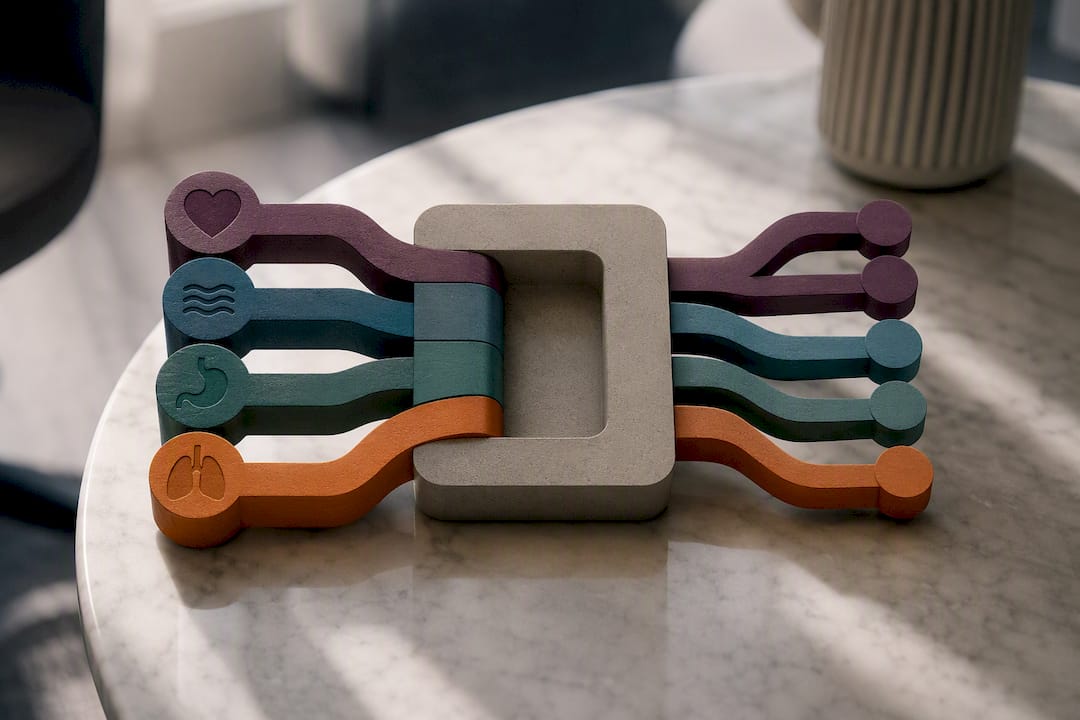
Autistica, the UK autism research charity, explains this plainly: alexithymia can blunt someone’s ability to detect the physical signals of their own anxiety early, which means the anxiety often has to build to a much higher level before it’s noticed at all. By the time it’s recognised, it may already be closer to a crisis than a manageable signal.
Sensory processing differences appear to feed directly into this chain. A study of adults attending autism clinics found that difficulty identifying and describing feelings partially mediates the relationship between sensory processing differences and the severity of anxiety and depression symptoms.
- Sensory overload happens first. Too much noise, light, or unpredictable input floods the system.
- Interoceptive signals get harder to parse under that load, so the person can’t easily tell “I’m overwhelmed” from “I’m angry” from “I’m scared.”
- Distress builds without a clear label, and by the time it surfaces, it often looks like a meltdown or shutdown rather than a manageable feeling that was caught early.
On the neurobiological side, reviews point to overlapping activity in the insula, amygdala, and anterior cingulate cortex, regions associated with interoceptive awareness and emotional salience, though this research is still developing and shouldn’t be read as a settled map of “where alexithymia lives in the brain.” It’s a plausible mechanism, not a diagnosis on a scan.
How is alexithymia measured and what are the assessment limits?
The Toronto Alexithymia Scale (TAS-20) remains the standard instrument, and it’s worth understanding its structure if you’re reading a report that references it.
- The DIF subscale asks about distinguishing between different emotional states and telling emotions apart from physical sensations.
- The DDF subscale asks how easily someone can put feelings into words other people would understand.
- The EOT subscale measures the tendency to focus on external facts and concrete details rather than internal emotional experience.
- Total scores typically use cut-offs to categorise people as non-alexithymic, borderline, or alexithymic, though exact thresholds vary slightly between studies.
- Complementary tools include behavioural emotion-recognition tasks, interoceptive accuracy tests (such as heartbeat-counting tasks), and structured clinician interviews, which help cross-check self-report against observed patterns.
The obvious limitation is that the TAS-20 is a self-report measure asking people to accurately describe a difficulty that, by definition, involves inaccurate self-perception. Someone with severe alexithymia may under-report their own difficulty simply because they lack the internal reference point to recognise it in themselves. Cultural and linguistic differences in emotion vocabulary add another layer of noise, since some languages carve up emotional experience quite differently from English. This is why a single questionnaire score should rarely be the whole story. Carer reports, clinician observation, and physiological markers all add information a self-report scale can’t capture alone.
What outcomes are linked to alexithymia in autistic people?
Alexithymia doesn’t just sit there as an interesting trait. It predicts real outcomes, and the two main facets predict different ones.
The predictive split: difficulty identifying feelings tends to predict later anxiety, while difficulty describing feelings tends to predict later social-communication difficulties, according to longitudinal research tracking autistic adolescents and young adults.
That distinction is genuinely useful in practice. It means two autistic people who both score as “alexithymic” overall might need quite different support depending on which facet is driving their profile:
- High DIF, lower DDF: watch for anxiety building silently, since the person may struggle to notice their own escalating distress before it peaks.
- High DDF, lower DIF: expect more friction in social situations, since even correctly identified feelings are hard to communicate to others in the moment.
- High on both: likely needs support across emotional recognition and expression, not just one or the other.
Cross-sectionally, alexithymia correlates strongly with both anxiety and depression symptoms in autistic samples, and the clinic-based mediation findings mentioned earlier reinforce why: sensory processing differences drive distress, alexithymia blocks early recognition of that distress, and the emotional load compounds before anyone, including the person themselves, notices it’s happening. Depression research adds a sharper point still: in some multivariate models, alexithymia traits predicted depressive symptom severity more strongly than autism traits did. That’s not a minor statistical footnote. It suggests that when an autistic person is struggling with low mood, alexithymia may be doing more of the work than autism itself, which has direct implications for where treatment attention should go.
None of this means alexithymia causes anxiety or depression outright. But the pathway is consistent enough across studies that it’s worth taking seriously as a monitoring target, not just a curiosity.
What practical support actually helps?
Start with sensory triggers before asking anyone to label their feelings. Clinicians working with autistic service-users often find that what gets called an “emotional crisis” is, underneath, a sensory overload that built up unnoticed. Map the environment, the noise levels, the lighting, the physical demands, before assuming the distress is purely emotional in origin.
Concrete, non-verbal tools tend to outperform pure conversation for people with alexithymia:
- Visual emotion charts that pair facial expressions or colour scales with physical sensations, giving people an external reference point instead of relying on internal labelling alone.
- Body maps where someone marks where in their body they feel tension, heat, or unease, building the interoceptive link gradually rather than expecting instant verbal fluency.
- Physiological markers, like a smartwatch tracking heart rate, can flag rising stress before it’s consciously noticed, giving a practical early-warning system.
- Task-based interoceptive training, such as heartbeat-counting exercises, has some evidence behind it as a way to gradually improve the accuracy of internal body signals.
Therapy itself benefits from the same shift. Clinical recommendations for adapting interventions point towards building on observable indicators of distress rather than demanding fluent verbal emotional insight from the outset. Vocabulary can be built gradually, often through role-play with concrete anchors (“this is what frustration looks like on your body”) rather than abstract discussion. Combining behavioural strategies with sensory-first approaches tends to work better than either alone.
Educators face a version of this same challenge: spotting distress before a child can articulate it. The same early-identification logic that applies in classroom settings for struggling students applies just as well to autistic children who may not yet have the words for what they’re experiencing, watching behaviour and context rather than waiting for a verbal report.
Pro Tip: If you support an autistic person who seems to “explode out of nowhere,” check the hour before the incident for sensory load, not the minute before. The trigger is usually earlier and quieter than it looks.
Services should build alexithymia screening into routine autism assessment, adjust treatment targets based on which facets show up, and weight carer reports and physiological markers alongside self-report rather than treating a questionnaire score as the final word.
How a structured self-assessment can help you prepare for support
There are self-assessment tools that give instant profiles across multiple domains, including sensory processing, masking, and emotional patterns relevant to alexithymia, without positioning themselves as a diagnosis. It’s a starting point for noticing patterns, not a replacement for clinical assessment.
I was diagnosed with ADHD at 42, and one of the things that struck me hardest during that process was how long I’d misread my own physical stress signals as something else entirely, tiredness, irritability, anything but what it actually was. Building Omniprism came partly out of wanting a faster, less intimidating way for people to start noticing those patterns before they hit a wall.
- The free assessment maps traits across domains including sensory processing and emotional awareness, giving you language for patterns you may already sense but haven’t named.
- The optional Specialist Briefing report summarises your results in a format designed to make clinical conversations more focused and less overwhelming.
- Guided versions exist for children aged 7 to 10 and young people aged 11 to 13, for families wanting to start this conversation early.
You can read more about how the assessment is built on the Omniprism methodology page, and full terms are set out in the disclaimer.
Alexithymia and autism, for autistic people, families and professionals
The conventional advice, “help autistic people build social skills”, misses the mark for a huge proportion of the people it’s aimed at. If roughly half of autistic people have alexithymia, then a chunk of what looks like a social skills gap is actually an emotional labelling gap, and no amount of scripted conversation practice fixes that.
What the research actually supports is a shift in sequence: check for alexithymia first, map sensory triggers second, and only then decide whether the difficulty in front of you is really about social skills at all. The dominance of alexithymia traits over autism traits in predicting depression severity should unsettle anyone who assumes autism explains everything about an autistic person’s emotional life.
If I had one priority to hand a family or a clinician reading this, it would be: stop asking “what are you feeling?” as a first question. Ask what the body is doing instead. The words tend to follow once the physical signal has somewhere to land.
— Valerio Cozzi
This article is general information, not a substitute for advice from a qualified doctor. Consult a qualified healthcare professional about your own circumstances before acting on anything here.
Sources
- Investigating alexithymia in autism: A systematic review and meta-analysis
- Alexithymia in adult autism clinic service‑users: Relationships with sensory processing differences and mental health
FAQ
Does alexithymia affect how autistic people handle blame and arguments?
Difficulty identifying feelings in the moment can make it harder to separate personal responsibility from general emotional overwhelm during conflict, which sometimes gets misread as blame-shifting when it’s actually confusion about what’s being felt and why.
How does alexithymia affect intimacy in autistic relationships?
Alexithymia can make it harder to notice and communicate emotional needs during intimate moments, since the same identification and description difficulties that affect everyday emotions apply here too; partners often benefit from agreeing on non-verbal or physical cues in advance.
What signs suggest an autistic person is interested in someone despite alexithymia?
Interest may show up through consistent behaviour, remembering details, seeking proximity, or engaging deeply with shared interests, rather than through verbal or facial expressions of affection, which alexithymia can make harder to produce or read.
How do autistic people with alexithymia typically handle arguments?
Arguments can escalate faster than expected because the physical signs of rising frustration go unnoticed until they’re intense, and once noticed, describing what triggered the reaction can be genuinely difficult in the moment rather than a refusal to explain.
Is alexithymia the same as anxiety?
No. Alexithymia is a difficulty identifying and describing emotions, while anxiety is a specific emotional state; the two frequently interact, since alexithymia can delay recognition of anxiety until it has already intensified, but they are distinct constructs.
Recommended
- Autism vs. ADHD: Comparing Symptoms, Overlap, and Diagnosis
- The Double Empathy Problem: What Autistic and Non-Autistic People Get Wrong About Each Other
- Autistic Burnout vs Depression: How to Tell the Difference
- Autistic Traits in Women: Signs Often Missed or Masked
Written and edited by Valerio Cozzi, founder of Omniprism. Omniprism began after my own ADHD diagnosis at 42.
This article is educational. It is not medical advice, not a diagnosis, and not a substitute for assessment by a qualified clinician. The Omniprism self-assessment is free, needs no account and no email address, and runs entirely in your browser — your answers are never sent to a server. The optional Specialist Briefing report is a paid add-on.