How to Identify Sensory Triggers: A Step-by-Step Guide
You identify sensory triggers by keeping a short log for about a week: write down when and where something happened, which senses were involved, how the reaction showed, and what helped. Then read the entries for patterns across places, times and your physical state. Omniprism’s free adult self-assessment gives you a plain-language starting profile, including sensory processing, before you begin logging.
Key Takeaways
- A sensory trigger is an input, such as a sound, light, texture, smell or feeling of heat, that can push someone towards overwhelm, and triggers are personal to each person.
- A simple log kept for a week, covering time, place, senses, response and what helped, is the method NHS services recommend for spotting patterns.
- Tiredness, hunger, stress and illness lower tolerance, so the same input can be fine one day and unbearable the next.
- Parents, teachers and clinicians get the clearest picture by comparing observations from several settings.
- If triggers interfere with daily life, take your notes to a GP or occupational therapist.
How do you identify sensory triggers?
The steps below work for adults and for parents observing a child. Each one says what to record and where people usually go wrong.
- Choose a week and set up the log. Chelsea and Westminster Hospital NHS recommends a simple sensory log for a week, noting the time and place, what happened, the senses involved, how the response showed, and what helped. A notes app or a paper page is enough. The usual mistake is writing only about the worst moments, which hides the milder episodes that reveal the pattern.
- Record your state before the event. Note sleep, hunger, stress and illness. The same hospital page says sleep, stress, illness, busy environments and routine changes can raise or lower tolerance, so a trigger may only show itself on a poor night.
- Name the sense, using all eight. Sheffield Children’s NHS Foundation Trust has a sensory profile form that covers eight senses: auditory, tactile, vestibular, proprioception, smell, taste, visual and interoception (the sense of what is happening inside the body, such as hunger or temperature). Many people log only sound and light and miss touch, movement and internal signals.
- Look at what happened just before and just after. The AIDE Canada Sensory Processing Differences Toolkit suggests becoming a sensory detective. If the person was distressed after a loud, crowded place and calmer after a sensory-seeking activity, they were likely overwhelmed. If they were very calm before and more alert afterwards, they were probably seeking input to raise their arousal.
- Observe across settings and people. The NHS Greater Manchester sensory toolkit recommends observing a child in a range of environments, gathering information from the professionals and carers involved, and using a Person, Place, Activity framework. Teachers see school, parents see home, and neither sees the whole picture alone.
- Mark what helped. For every entry, write down what eased the reaction: leaving the room, ear defenders, a snack, quiet. These notes become your plan.
- Review and adjust. After the week, read the entries together and look for repeats. The same toolkit advises reviewing sensory plans within 6 to 8 weeks, so repeat the log after you have tried changes.
If you want a structured profile to sit beside your log, the free assessment covers 14 areas, needs no email or account, and gives instant results. It is a convenient way to see whether sensory processing stands out for you before you start noting daily examples.
What are common sensory triggers?
Triggers are unique to each person, and the University of New Hampshire’s guidelines for prescribers advise asking new patients what their triggers are and how they avoid or reduce them. A list still helps you know where to look. The National Autistic Society lists these common ones for people who are hyper-sensitive (over-responsive) to input:
| Sense | Examples |
|---|---|
| Sight | Bright or fluorescent lighting, cluttered spaces, eye contact |
| Sound | Loud speech, unexpected noises, background noise |
| Touch | Crowded places, fabric textures, some food textures |
| Smell | Perfumes, cooking odours |
| Taste | Certain flavours |
| Interoception | Feeling too hot or too cold |
The same page states that research suggests between 53% and 95% of autistic people experience sensory processing differences. These differences are processed in the brain and are not caused by a physical problem with the eyes or ears.
Triggers are not limited to autism. Queensland Health lists autism, ADHD, generalised anxiety disorder, PTSD and sensory processing disorder among the conditions that increase susceptibility to sensory overload. That is why people who suspect ADHD or other traits often find the sensory log useful too.
What does sensory overload look like?
Overload can be easy to miss because it does not always look dramatic. The National Autistic Society describes signs such as not speaking, appearing disengaged, difficulty focusing, stimming (repetitive movement or sound that helps regulate feelings), pacing or rocking, and stronger responses like crying, shouting or hiding.
Chelsea and Westminster Hospital NHS lists early signs of a meltdown or shutdown as fidgeting, covering ears, pacing and fast breathing. Understood.org adds plugging ears, shutting eyes, covering the face, avoiding certain places, running out of situations and complaining about clothing or textures. Queensland Health explains that the body can respond as it would to a threat, with a raised heart rate, cold hands and feet or pale skin, and that these symptoms can take up to half an hour to subside. In children, a meltdown can be mistaken for misbehaviour.
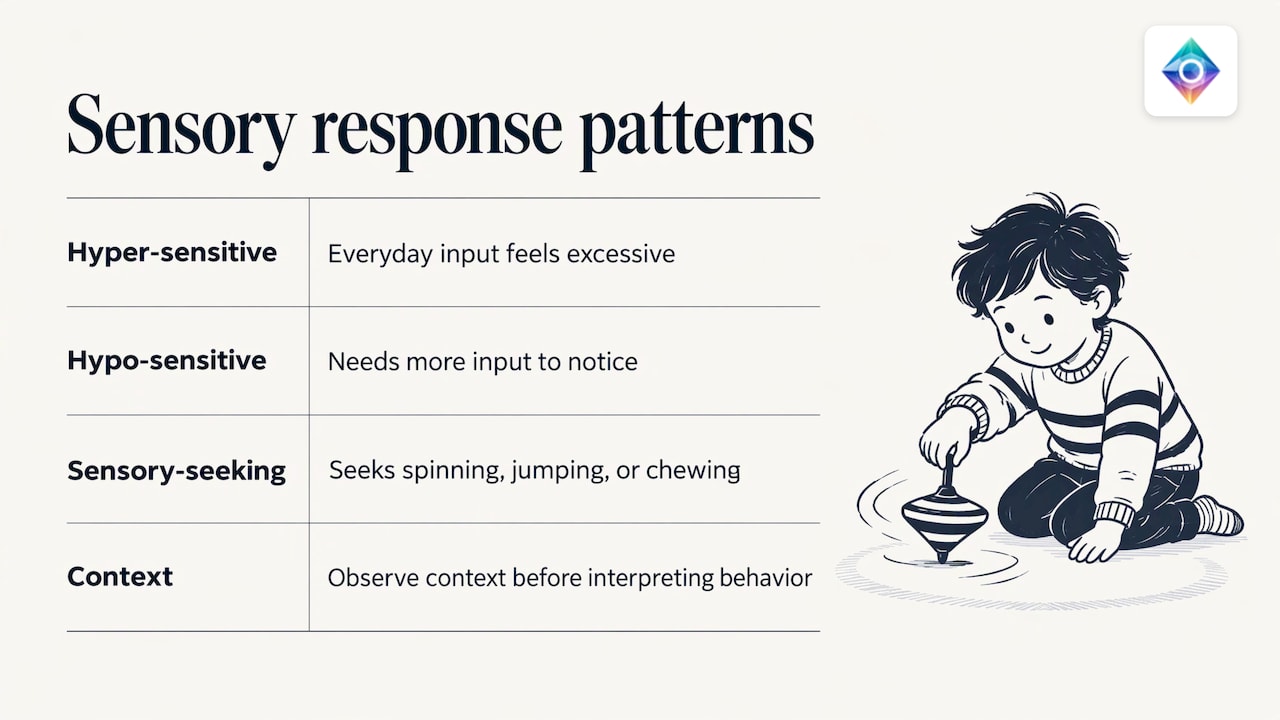
Responses vary in direction. The hospital describes three patterns: hyper-sensitive, where everyday input feels like too much; hypo-sensitive, where more input is needed to notice anything; and sensory-seeking, where someone actively looks for sensations such as spinning, jumping or chewing. Many children show a mix. The AIDE Canada toolkit adds that the same behaviour, such as chewing clothing, can be a coping strategy for over- or under-stimulation, which is why context has to be observed before interpreting it.
For hypo-sensitive children, safety matters as well. The Autism Association of Australia notes that a high pain threshold can lead a child to touch something like a hot stove, so supervision around heat and sharp objects is part of safe support.
Why does a small trigger sometimes cause overload?
A reaction that seems out of proportion often has a build-up behind it. Rebound Health describes a cumulative load principle: each added sensory demand increases the load, so a minor trigger can be the last straw after earlier ones. A child may cope with a noisy classroom when rested and find the same room unbearable after poor sleep.
The same applies to adults. Reconnect Center separates triggers into environmental input and internal states such as fatigue, hunger, illness and hormonal shifts. It gives the example of a poor night’s sleep, a skipped meal and a fluorescent-lit meeting producing overload that no single factor would have caused.
This is the reason step two of the log records your state before the event. When two entries look identical but one ended in overload, compare sleep, food and the earlier hours of the day.
The Greater Manchester toolkit also warns that triggers are often not evident at the time, such as a change in family circumstances, or not visible, such as an unfamiliar smell. Practitioners are told not to assume there are no triggers. The toolkit also explains that the brain stores past experiences, so a previous unpleasant sensory experience can provoke a defensive reaction the next time. If a place keeps causing trouble with no obvious cause, ask what happened there before.
For a closer look at telling overload apart from a meltdown, our guide to sensory overload versus meltdown shows how to map episodes. Adults who want to follow this up at work can use our four quick steps for sensory overload at work.
What helps after a sensory trigger?
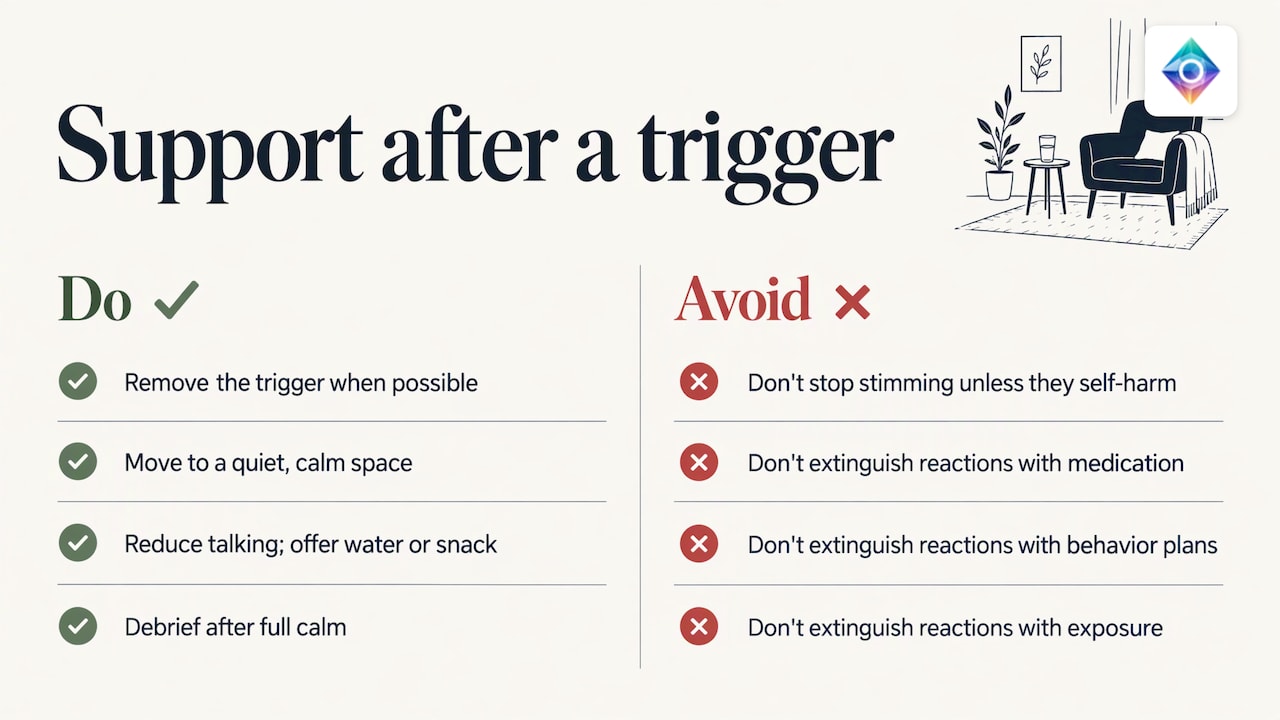
Once a trigger is identified, the National Autistic Society advises removing it where possible. If it cannot be removed, move the person to a quieter place, reassure them they are safe and provide a safe space. Do not stop stimming unless the person is hurting themselves, and explain what to expect before sensory-heavy activities.
During a meltdown or shutdown, Chelsea and Westminster Hospital NHS suggests moving to a calm space, reducing talking, offering water or a chewy snack, breathing deeply together, and offering steady pressure if the person wants it. It also advises leaving any debrief until the person is fully calm.
In a classroom, the changes can be small: moving tables away from loud speakers, as Understood.org suggests, or adjusting lighting and seating. Our three fixes for a sensory friendly classroom cover this for teachers. Parents can pair it with our guide to legal school adjustments for autism.
Home and school work best when they agree. A guide on sensory play and child development can help parents think about what sensory input a child enjoys, which in turn makes it easier to share consistent notes with school.
When triggers significantly interfere with daily life, the University of New Hampshire guidelines say a referral to a licensed occupational therapist is appropriate. In the UK, start with your GP, or with the school’s SENCo (special educational needs coordinator) for a child. The guidelines also state that behavioural reactions to sensory input are a sign of sensory needs and should not be treated as something to extinguish with medication, behaviour plans or exposure.
Can a self-assessment help me understand my sensory profile?
A log shows what happens in your daily life. A self-assessment shows where your overall pattern sits, and the two work well together. Omniprism’s free adult assessment gives an instant profile across 14 areas, including sensory processing, high sensitivity, ADHD, autism and dyslexia, and it does not collect data or ask you to create an account.
For children and teens there are guided assessments: the Children & Young People Free Assessment, with versions for ages 7 to 10 and ages 11 to 13. When you are preparing for a clinical conversation, the Specialist Briefing at €20 one-off summarises your results for a clinician, and the Youth Briefing does the same for a child or teen at €20 one-off. Professionals can see how we work with psychologists, coaches and companies.
Adults who want to go further can read our guide to NHS and OT steps for sensory processing in adults or try the two minute sensory diet self assessment. Parents preparing for an appointment can use our sensory processing checklist for UK children.
Our perspective on sensory triggers
I was diagnosed with ADHD at 42, and I built Omniprism because people deserve to understand how they process the world without first waiting for a clinic or handing over personal data.
We believe sensory triggers are best understood as information about a person’s needs. A trigger log tells you what happened, and a profile across 14 areas tells you where to look first. Together they give you words to use with a GP, an occupational therapist, a teacher or a manager, and that is the point of the Specialist Briefing: a clear summary a clinician can read quickly.
Our assessments are designed to be private, instant and written in plain language, so a parent, a young adult or an educator can start today.
Valerio Cozzi
FAQ
How long should I keep a sensory log?
Chelsea and Westminster Hospital NHS suggests about a week as a starting point. Repeat it after you have made changes, and the Greater Manchester toolkit suggests reviewing plans within 6 to 8 weeks.
Is sensory overload a diagnosis?
No. Mentally United explains that sensory overload is not a clinical term or diagnosis. Sensitivity can shift with tiredness, stress, illness or surroundings, and overload often involves several senses at once.
Can ordinary sounds like chewing be triggers?
Yes. Mentally United notes that specific sounds such as chewing, sniffing or pen clicking can cause strong anger or anxiety in people with misophonia, regardless of how loud they are. Phones can also add sensory load through constant alerts, bright screens and autoplay videos.
Do children grow out of sensory sensitivities?
The Autism Association of Australia says it is uncommon for autistic children to grow out of sensory sensitivities. Instead, children and families get better at managing them as the child gets older, which is why a record of what helps is worth keeping.
Who should I show my notes to?
Share them with your GP, an occupational therapist, or for a child, the school SENCo. The Autistica guide on anxiety in autistic children suggests consulting several people who know the person well and keeping a diary of distressing and calming sensory experiences while waiting for assessment.
Sources
- Autism and sensory processing, National Autistic Society
- Sensory processing difficulties, Chelsea and Westminster Hospital NHS
- Sensory profile, Sheffield Children’s NHS Foundation Trust
- Sensory Processing Differences Toolkit, NHS Greater Manchester
- Sensory Processing Differences Toolkit, AIDE Canada
- Sensory Considerations for Medical Providers, University of New Hampshire
- Sensory overload is real, Queensland Health
- What is sensory overload?, Understood.org
- Sensory sensitivities, Autism Association of Australia
- Sensory Overload: What It Looks Like, Rebound Health
- What Is Sensory Overload in Adults?, Reconnect Center
- Sensory overwhelm in everyday life, Mentally United
- Anxiety in autistic children with learning disabilities, Autistica
Recommended
- Sensory Diets for Adults: Start With a Two Minute Self Assessment
- Stop sensory overload at work: 4 quick steps UK employees can use
- NHS and OT steps for sensory processing in UK neurodivergent adults
- Sensory Overload vs Meltdown: Map Episodes for Neurodivergent Adults
Written and edited by Valerio Cozzi, founder of Omniprism. Omniprism began after my own ADHD diagnosis at 42.
This article is educational. It is not medical advice, not a diagnosis, and not a substitute for assessment by a qualified clinician. The Omniprism self-assessment is free, needs no account and no email address, and runs entirely in your browser — your answers are never sent to a server. The optional Specialist Briefing report is a paid add-on.