Sensory Overload vs Meltdown: Map Episodes for Neurodivergent Adults
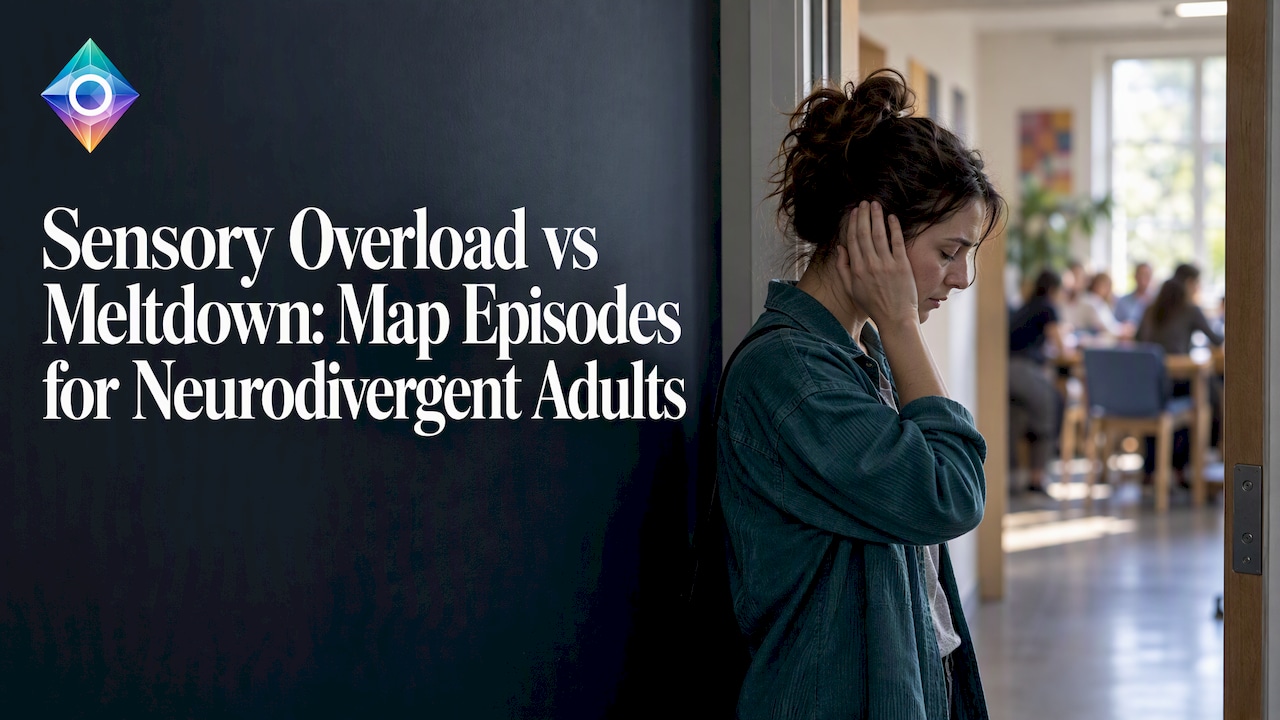
Sensory overload is an internal overwhelm of the senses; a meltdown is the involuntary behavioural response that can follow it. The two commonly occur together but are not the same thing, and neither one alone confirms autism or ADHD. If you recognise either happening now, the first practical step is to reduce stimulation: lower the noise, dim the lights, and create space.
Key Takeaways
Sensory overload is a common experience that can lead to meltdowns, which require immediate reduction of stimulation and tailored support to prevent escalation.
| Point | Details |
|---|---|
| Sensory triggers vary widely | Common triggers include loud noises, bright lights, unexpected touch, strong smells, and crowded spaces. |
| Meltdowns are involuntary responses | They occur when sensory overload exceeds an individual’s capacity to cope, manifesting as shouting, withdrawal, or physical signs. |
| Recognize early signs of overload | Early indicators include covering ears, squinting, increased fidgeting, withdrawal, and agitation, allowing prompt intervention. |
| Immediate response focuses on calming | Move to a quieter space, minimize language, offer reassurance, and avoid demands or restraint during episodes. |
| Proactive adjustments reduce frequency | Using routines, sensory tools, quiet spaces, flexible clothing, and scheduled breaks can prevent overload and burnout. |
What is sensory overload?
Sensory overload happens when the brain receives more sensory input (sound, light, touch, smell, movement) than it can process at once. It is not a formal diagnostic label. It is a state that anyone can experience, though some people reach that threshold far more easily than others.
Common triggers vary person to person, but tend to cluster around:
- Loud, overlapping or sudden noises, such as alarms or crowded rooms
- Bright, flickering or fluorescent lighting
- Unexpected touch, tight clothing or certain fabric textures
- Strong smells, including cleaning products or perfumes
- Crowded or visually busy spaces with constant movement
Sensory sensitivity shows up across autistic people, people with ADHD traits and the general population, according to a systematic review on sensory-modulation difficulties. Most of the studies behind this finding rely on questionnaires and self-report, so they describe associations rather than fixed categories, and they cannot be used to diagnose anyone on their own.
What is a meltdown (and how it looks)?
A meltdown is an intense, involuntary response to a situation that has become overwhelming. It is not a tantrum, and it is not a bid for attention or control. According to National Autistic Society guidance, meltdowns happen when a person’s capacity to cope is exceeded, and the resulting reaction is outside their conscious control at that moment.
Meltdowns can look very different depending on the person and the moment:
- Outward signs: shouting, crying, lashing out, kicking or running away from the situation
- Quieter signs (sometimes called a shutdown): going silent, withdrawing, avoiding eye contact or becoming unable to speak
- Physical signs: rocking, covering ears or eyes, or appearing frozen
Because a meltdown is involuntary, correcting or punishing someone during one tends to make things worse rather than better. NHS guidance on supporting a child with autism recommends reducing demands and waiting until the person has recovered before discussing what happened, rather than attempting to reason with them mid-episode.
How to tell the difference: signs and early warnings
Spotting the gap between overload and a full meltdown gives you a window to intervene before things escalate. The signs typically progress in stages:
- Early internal signs: covering ears, squinting, increased stimming (rocking, fidgeting, repetitive movement) or a sudden urge to leave the room
- Withdrawal signs: going quiet, disengaging from conversation or avoiding eye contact
- Escalation signs: raised voice, pacing, aggression or attempts to flee the environment entirely
Context matters as much as the behaviour itself. Worth noting and recording: the setting, which sensory inputs were present, how much sleep and food the person has had, and whether anything in the routine recently changed. Behaviour alone rarely tells the full story: a person’s baseline, their usual coping patterns and what else is happening around them all shape what you are seeing.
How to respond now: immediate steps during overload or a meltdown
When overload or a meltdown is happening, the priority is reducing demands and stimulation, not analysis. NHS guidance sets out immediate steps that apply to both children and adults:
- Move to a quieter space if one is available, or reduce noise and lighting where you are
- Keep language minimal: short phrases, not questions or explanations
- Reassure without placing demands on the person to respond or comply
- Avoid restraint unless there is a genuine safety risk and you are trained to manage it
- Allow stimming or self-soothing movements unless they risk injury
Avoid arguing, bargaining or asking repeated questions, since these all add further demand to an already overloaded system. Unexpected touch can intensify distress, so check before making contact. Trying to physically stop stimming that is not harmful often removes one of the only coping tools the person has available.
Pro Tip: Keep a short, pre-agreed phrase or signal ready (a card, a word, a hand gesture) that the person can use to ask for space before things escalate.
Call emergency services if there is a risk of serious injury, breathing difficulty, or exposure to something poisonous. Outside of those situations, the goal is simply to wait it out safely and calmly.
Prevention and supportive adjustments
Reducing how often overload and meltdowns happen matters more than managing each one as it comes. Useful strategies include calm, predictable play ideas:
- Predictable daily routines, with advance notice before changes happen
- A designated quiet space at home, school or work
- A sensory kit: headphones, sunglasses, fidget tools or a weighted item
- Flexible clothing and seating that avoid known sensory triggers
- Scheduled breaks built into the day rather than offered only after distress appears
Occupational therapy can help build an individualised sensory plan, and schools or workplaces can put reasonable adjustments in place once triggers are better understood. NHS guidance specifically recommends occupational therapy input when sensory processing is affecting daily functioning.
Left unaddressed, repeated overload tends to compound. Over time, this can contribute to autistic burnout and a reduced capacity to manage everyday demands, which is why planning ahead, rather than only reacting, tends to pay off.
When to seek professional help
Seek urgent medical help immediately if there is a risk of serious injury, breathing difficulty or exposure to something harmful. Outside an emergency, book a clinical or occupational therapy appointment when episodes are frequent, getting worse, or starting to limit daily life at school, work or home.
Before the appointment, Sheffield Children’s NHS Foundation Trust recommends keeping a short record of triggers, early signs and recovery time, since individual patterns vary and this detail helps clinicians build a personalised plan.
Evidence summary and limits
NHS and National Autistic Society guidance both frame meltdowns as involuntary overwhelm, not misbehaviour, and recommend calming over correction. A 2022 systematic review found sensory-modulation difficulties reported across children with ADHD traits as well as autistic samples, though most of this evidence comes from questionnaire-based studies rather than observed or clinical testing, which limits how confidently it can be generalised.
A 2026 review from the University of Reading and King’s College London argues that sensory reactivity is better understood across behavioural, emotional, physiological and neural dimensions together, rather than through any single measure. The practical implication is straightforward: combining self-report with caregiver or context observation gives a more reliable picture than either source alone.
The emotional and cognitive differences between sensory overload and meltdown
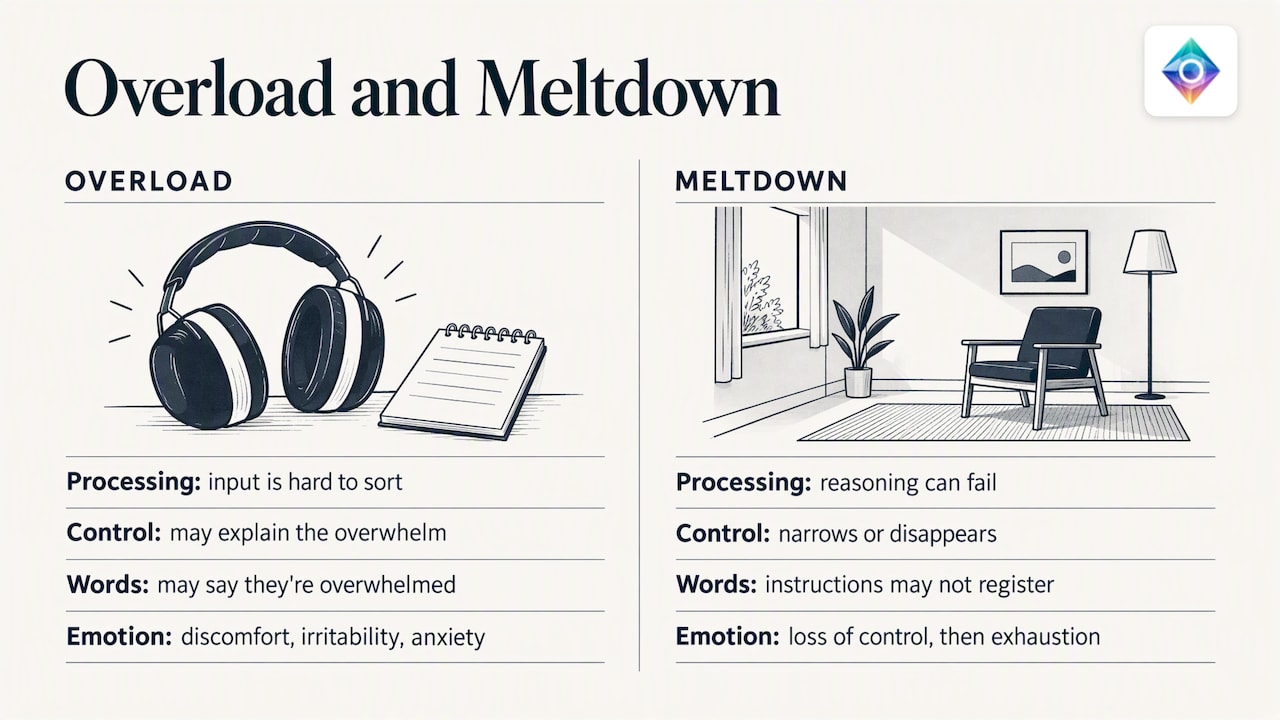
Sensory overload is primarily a processing problem: the brain is receiving more input than it can sort, filter or prioritise, and the person is often still aware of what is happening to them. They may know they feel overwhelmed and even be able to say so, even if they cannot yet fix it.
A meltdown moves past that point. Conscious control over the response narrows or disappears, and the person is no longer able to reliably reason, negotiate or follow instructions. This is a cognitive shift, not a choice. Demands that would be manageable in a calm state, such as answering a question or following a two-step instruction, can become impossible mid-meltdown because the brain’s capacity for that kind of processing is temporarily unavailable.
Emotionally, overload often feels like mounting discomfort, irritability or anxiety that builds gradually. A meltdown, by contrast, often involves a sense of losing control entirely, followed afterwards by exhaustion, shame or confusion about what happened. Many people describe the recovery period as needing complete quiet and time alone, distinct from the overload itself.
This distinction matters practically. During overload, a calm word or a change of environment can still land. During a meltdown, the same gesture may not register at all, because the person’s capacity to process incoming information, verbal or otherwise, has dropped. Recognising which state someone is in changes what kind of support will actually help, rather than add to the load.
How sensory overload can escalate into a meltdown
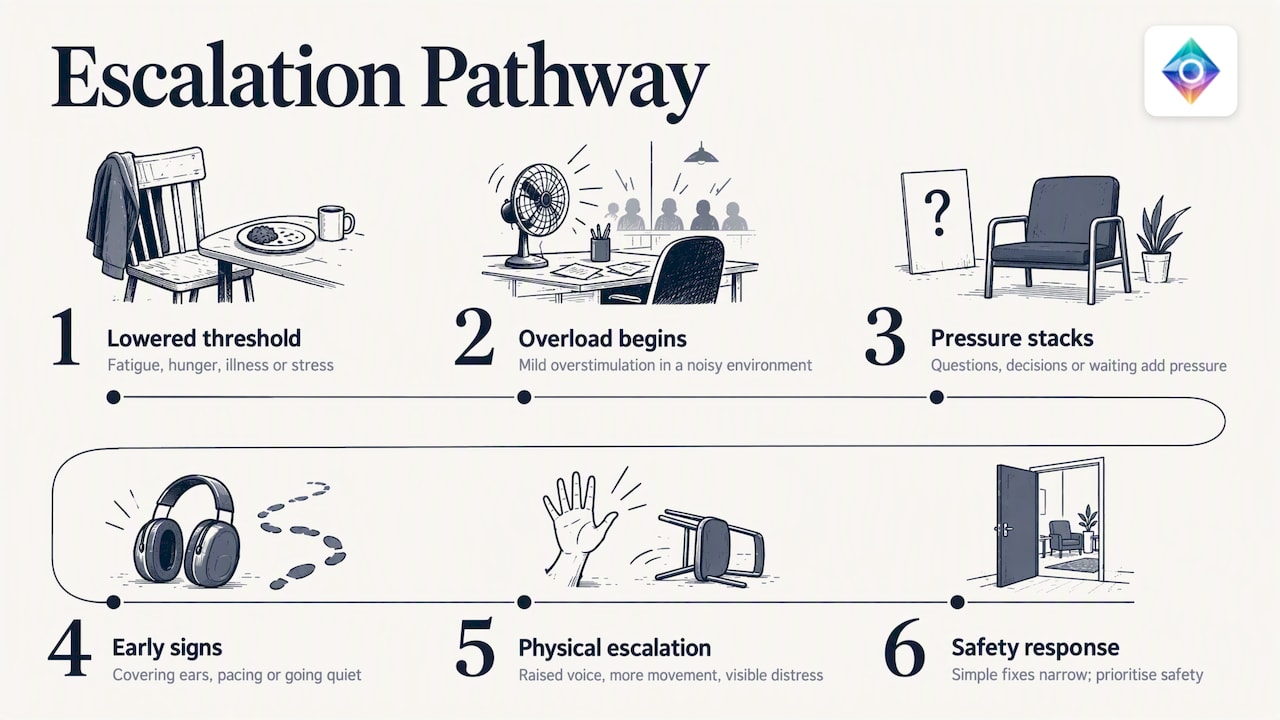
Not every episode of sensory overload turns into a meltdown. Escalation tends to happen when overload is not relieved and additional pressure continues to build on top of it. A person might start out mildly overstimulated in a noisy environment, then find that a demand (being asked a question, needing to make a decision, having to wait) pushes their system further.
This buildup is often described as stacking: one sensory stressor compounds another, and small additional demands have an outsized effect because capacity is already near its limit. Fatigue, hunger, illness or emotional stress can lower that threshold further, meaning the same noisy room that was tolerable yesterday becomes unbearable today.
Early signs, such as covering ears, pacing or going quiet, mark the point where intervention is most effective. Once physical signs of escalation appear, such as raised voice, increased movement or visible distress, the window for a simple fix (leaving the room, reducing noise) narrows considerably. At that stage, the goal shifts from prevention to safety and de-escalation.
Because the escalation pathway is individual, there is no fixed timeline from overload to meltdown. Some people move through it in seconds; others hold overload for hours before it tips over. Sheffield Children’s NHS Foundation Trust recommends tracking what happens before, during and after an episode, since this pattern tends to be consistent for a given person even when the exact trigger varies.
Impact of sensory overload and meltdowns on daily functioning and mental health
Frequent sensory overload and meltdowns shape far more than the moment they happen in. Many people adjust their routines, work, travel and social plans around avoiding known triggers, which can narrow daily life considerably over time.
The cumulative effect of unmanaged overload is a recognised contributor to autistic burnout, a state of exhaustion and reduced functioning that can take weeks or longer to recover from. Repeated episodes can also affect mental health more broadly: anticipating overload in advance often brings anxiety, and the aftermath of a meltdown frequently brings shame or low mood, particularly when others have misread the episode as bad behaviour.
Masking (suppressing visible signs of overload to appear fine in public) adds a further layer of strain, since the effort of appearing regulated competes for the same limited processing capacity that overload is already using up. This can mean overload builds invisibly until it becomes a meltdown in a safer environment, often at home, once the effort of holding it together elsewhere is no longer needed.
None of this is inevitable. Identifying triggers early, building in recovery time and making reasonable adjustments at school or work all reduce both the frequency of episodes and their knock-on effects. The goal is not to eliminate sensory sensitivity, which is not realistic, but to reduce how often someone is pushed past their capacity without warning or support.
Communication tips for supporting individuals experiencing sensory overload or meltdown
What you say, and how much of it, matters as much as what you do. During overload or a meltdown, ordinary conversation becomes an additional demand on a system that is already stretched, so the goal is to reduce verbal load rather than increase it.
Keep language short and concrete: single words or short phrases work better than full sentences or open questions. Avoid asking “why” or “what’s wrong”, since these require the kind of reflective processing that is often unavailable in the moment. Offer closed, simple choices instead, such as “quiet room or outside?”, rather than open-ended ones.
Tone carries weight even when words do not land. A calm, flat tone tends to help more than an urgent or raised one, even when the words themselves are simple. Give extra time for a response: processing speed often slows considerably during overload, and filling silence with repeated questions adds pressure rather than clarity.
After the episode, resist the urge to debrief immediately. National Autistic Society guidance recommends waiting until the person has fully recovered before discussing triggers or what happened, since recovery time is not the moment for teaching or correction. When the conversation does happen later, framing it as fact-finding (what helped, what made things harder) tends to work better than framing it as reviewing what went wrong.
Differences in sensory overload and meltdowns among different age groups
Sensory overload and meltdowns look different depending on age, partly because coping tools and communication ability change over time. Young children often have the fewest alternative coping strategies available, so overload can move to a full meltdown quickly and visibly, through crying, shouting or physical movement.
Teenagers often develop more capacity to mask overload in front of peers, which can mean the outward signs are less visible at school but build up more intensely at home afterwards. Guidance drawing on input from neurodivergent teenagers themselves highlights that predictable routines and having genuine options, rather than instructions, during distress are consistently valued at this age.
Adults frequently present with shutdowns rather than outward meltdowns, particularly in professional or public settings where visible distress carries social risk. This can make adult sensory overload harder for others to spot, since withdrawal or quietness is easy to mistake for disengagement rather than overwhelm. Adults also tend to have more established coping strategies, built up over years, but those strategies can fail under unusually high or sustained demand, such as during a major life change or a period of poor sleep.
Across all ages, the underlying mechanism is similar: capacity is exceeded and the response becomes involuntary. What differs is the vocabulary available to describe it, the social cost of showing it, and the coping tools a person has had the chance to build.
A personal note on making sense of these patterns
I was diagnosed with ADHD at 42, after years of episodes I could not fully explain to myself or to doctors. A structured profile of your own patterns, built over time rather than guessed at in a single appointment, can turn a confusing cluster of episodes into something you can actually bring to a clinician and discuss.
— Valerio Cozzi
How Omniprism can help you build a clearer picture
If you recognise some of these patterns in yourself or someone you support, a structured starting point can help more than another search session. Our free self-assessment covers 14 domains, including sensory processing, ADHD and autism traits, and gives an instant plain-language profile with no account, email or data collection required, in line with our privacy policy.
For readers who want something more clinician-ready, our optional Specialist Briefing report (€9.99, one-off) summarises your results in a format designed for easy use by healthcare professionals. We also offer guided assessments for children aged 7 to 10 and young people aged 11 to 13 through our pages for children and young people, alongside information for professionals who want to use the outputs in clinical settings. Start with our self-assessment if you want a clearer, structured record of your own patterns to bring to your next appointment.
This article is general information, not a substitute for advice from a qualified doctor. Consult a qualified healthcare professional about your own circumstances before acting on anything here.
FAQ
Is sensory overwhelm linked to ADHD or autism?
Sensory sensitivity has been reported in autistic people, people with ADHD traits and the general population, according to a systematic review on sensory-modulation difficulties. It is not exclusive to either diagnosis, and experiencing it does not confirm either one on its own.
How can you tell if it’s an autistic meltdown?
A meltdown is an intense, involuntary response to overwhelm rather than a deliberate reaction, and it can include shouting, physical movement or complete withdrawal, according to National Autistic Society guidance. Autism is one context in which meltdowns commonly occur, but the behaviour itself cannot confirm a diagnosis without wider assessment.
What does an ADHD-related meltdown feel like?
NHS guidance on ADHD in adults does not define a formal “ADHD meltdown” category, but it does describe emotional dysregulation and intense reactions linked to impulsivity as part of the condition. The experience can look similar to an autistic meltdown, with reduced control over the response in the moment.
Does sensory overload mean you are autistic?
No, sensory overload alone does not indicate autism. It is reported across autistic people, people with ADHD traits and the general population, and a proper assessment needs to look at a wider pattern of traits rather than one sensation-related experience.
Sources
- Meltdowns: a guide for all audiences (National Autistic Society)
- Supporting a child with autism (NHS)
- Systematic review on sensory-modulation difficulties and ADHD (Cardiff ORCA repository)
- Managing meltdowns in children with autism (Sheffield Children’s NHS Foundation Trust)
- 2026 review on sensory reactivity (University of Reading / King’s College London)
Recommended
- Sensory Diets for Adults: Start With a Two Minute Self Assessment
- NHS and OT steps for sensory processing in UK neurodivergent adults
- Stop sensory overload at work: 4 quick steps UK employees can use
- Autistic Burnout vs Depression: How to Tell the Difference
Written and edited by Valerio Cozzi, founder of Omniprism. Omniprism began after my own ADHD diagnosis at 42.
This article is educational. It is not medical advice, not a diagnosis, and not a substitute for assessment by a qualified clinician. The Omniprism self-assessment is free, needs no account and no email address, and runs entirely in your browser — your answers are never sent to a server. The optional Specialist Briefing report is a paid add-on.