Stop sensory overload at work: 4 quick steps UK employees can use

Sensory overload at work happens when noise, light, smell, or touch exceed what your nervous system can process, triggering fight, flight, or shutdown responses. The single most useful move in the moment is to remove yourself from the input, even briefly, and slow your breathing. This guide covers the symptoms to watch for, the specific triggers common in offices, immediate tactics, the workplace adjustments you can request, and how to build a personal sensory plan you can actually use.
TL;DR:
- Most sensory triggers in offices, especially noise and lighting, combine to create a cumulative overload that escalates quickly without clear warning signs.
- Immediate strategies like stepping outside, using earplugs, or grounding techniques can help reset your nervous system during overload episodes.
- Requesting workplace adjustments such as quiet spaces, control over lighting, flexible hours, or remote work is possible without a diagnosis and should be supported by clear impact statements.
- Building a personal sensory plan involves identifying your top triggers and calming inputs, then scheduling routine protective measures and low-sensory periods.
- Using a structured self-assessment, like Omniprism, can clarify your sensory profile and assist in confidently communicating needs to managers or healthcare professionals.
What are the symptoms of sensory overload at work?
Sensory overload rarely announces itself politely. It builds, then tips over into something you can’t think your way out of.
The emotional signs come first for many people: a spike of anxiety that seems disproportionate to what’s happening, irritability that surprises even you, or sudden tearfulness in a meeting that was otherwise unremarkable. Cognitively, you lose the thread of a conversation, your thoughts slow down, and a task that normally takes ten minutes suddenly feels impossible. Physically, it can show up as a tension headache, nausea, a racing heart, or the more extreme response: freezing up or shutting down entirely, unable to speak or move.
- Emotional: anxiety spikes, irritability, tearfulness, a feeling of dread about returning to the room
- Cognitive: losing focus, slowed processing, a sense of mental fog or overwhelm
- Physical: headaches, nausea, rapid heartbeat, freeze or shutdown responses
None of this presents identically across people. Autistic employees often describe a sudden, total shutdown rather than a gradual build. People with ADHD frequently report the cognitive fog hitting first, with irritability close behind. Highly sensitive people tend to notice the physical signs earliest, particularly headaches and a racing pulse, well before the emotional impact catches up. NHS guidance from Leicestershire frames chronic exhaustion and reduced tolerance to stimuli as hallmarks of burnout linked to unmanaged sensory load.
Common workplace triggers, organised by sense
Most offices weren’t designed with sensory load in mind, and the triggers tend to cluster by sense rather than appearing randomly.
Sound is often the biggest culprit: unpredictable speech patterns, the constant hum of HVAC systems, sudden alarms, and background chatter that never quite settles into a manageable level. Visual triggers include glare off screens, flickering fluorescent lighting, moving content on shared displays, and cluttered noticeboards that never seem to rest the eye. Touch and proximity issues show up through hotdesking arrangements that put you next to strangers, accidental physical contact in tight corridors, and uniform fabrics that irritate skin all day. Smell catches people off guard, too: perfume in a lift, cleaning products applied mid-shift, or a colleague’s lunch reheating nearby. Proprioception and interoception, the internal senses that track your body’s position and state, get disrupted by prolonged sitting, poor temperature control, or skipping breaks until you’re dizzy or dehydrated.
- Auditory: unpredictable speech, HVAC noise, alarms, background chatter
- Visual: glare, flicker, moving screens, cluttered walls
- Touch/proximity: hotdesking, accidental contact, coarse uniform fabric
- Smell: perfume, cleaning products, food odours
- Proprioception/interoception: prolonged sitting, poor temperature control, missed breaks
None of these triggers act alone. PAS 6463 guidance on sensory-inclusive design treats sensory load as cumulative, meaning a noisy office with bad lighting and no quiet space compounds far faster than any single factor would suggest.
Immediate actions to use when sensory overload hits
The goal in the moment isn’t to fix the environment. It’s to buy yourself enough space to reset.
- Leave, if you can. Step outside, go to a stairwell, or find an empty meeting room. A simple exit line works: “I need five minutes, I’ll be right back.”
- Ground yourself. Try box breathing (four seconds in, four held, four out, four held) or press your feet firmly into the floor and name five things you can see.
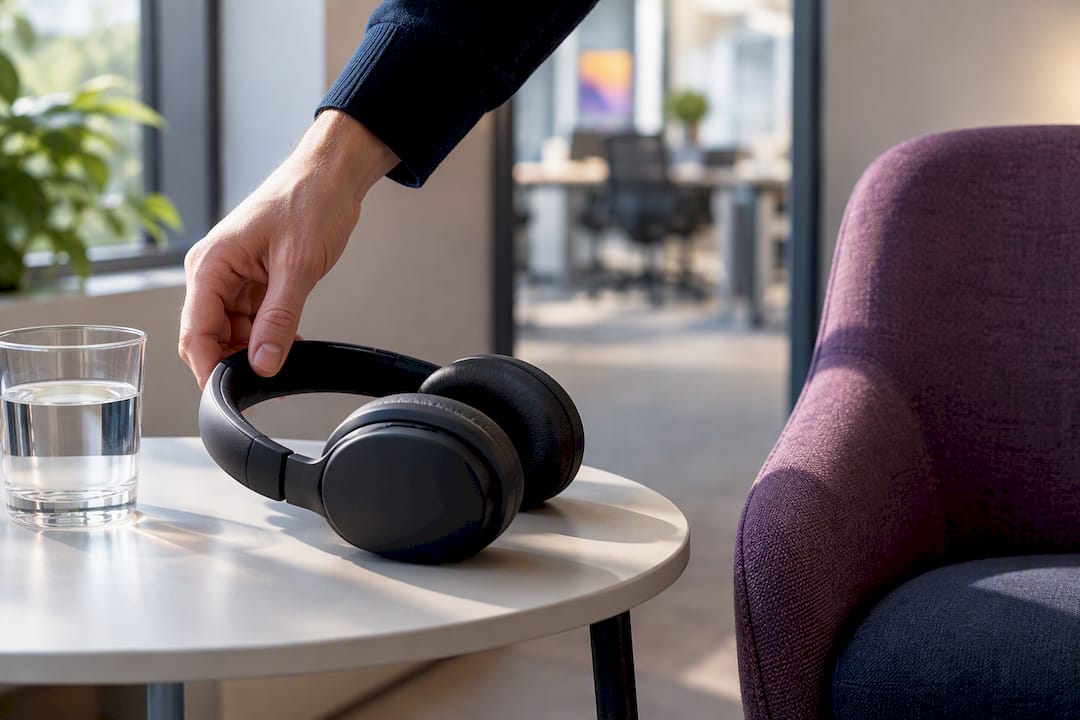
- Reduce input fast. Put in earplugs, put on noise-cancelling headphones, or slip on tinted glasses if light is the problem.
- Plan a short recovery. Take a timed ten-minute break, drink water, and use proprioceptive input such as pressing your palms together or a firm hand squeeze to help your nervous system settle.
Pro Tip: Keep a small “reset kit” in your bag or desk drawer, earplugs, a fidget object, and sunglasses, so you’re never caught without a tool when overload strikes without warning.
ACAS guidance on neurodiversity adjustments specifically recommends noise-cancelling headphones and quiet rooms as practical, low-cost interventions employers can offer without much friction.
Practical workplace adjustments you can ask for
You don’t need a diagnosis to request changes, and you don’t need to accept the first “no” as final.
Reasonable requests tend to fall into a short list: a quiet space or booking system for one, control over your own lighting rather than shared overhead fluorescents, flexible start and finish times to dodge the loudest office hours, a fixed desk instead of hotdesking, and the option to work remotely on your heaviest sensory days.
- Access to a quiet room or booth, even for short periods
- Personal lighting control, or a desk away from glare
- Flexible hours to avoid peak noise
- A fixed seat instead of hotdesking
- Remote or hybrid work options on high-need days
Under the Equality Act 2010, employers must make reasonable adjustments where a disabled worker faces substantial disadvantage, and adjustments are judged on cost and practicality rather than perfection. PAS 6463 pushes this further by treating the environment itself, not just personal aids like headphones, as fair territory for change: better acoustics, layout, and thermal comfort all count. When you ask, propose a short trial. Two weeks with a defined adjustment and one or two measures of success (fewer overload episodes, better focus in the afternoon) makes the request concrete and easy for a manager to say yes to.
Build a personal sensory plan
A plan only works if it’s specific enough to act on the next time things get loud.
Start with a quick self-audit: name your top three triggers and your top three protective inputs. Be honest, even if the list feels oddly mundane (open-plan chatter and a particular hand cream, for instance). Then build a sensory diet around those findings, short movement breaks every ninety minutes, chewing gum or a crunchy snack for oral input, screen filters for glare, and scheduled blocks of low-sensory work when you know the office will be at its loudest.
- Identify your top three triggers and top three calming inputs
- Add movement breaks, chewing input, or screen filters to your daily routine
- Schedule low-sensory work blocks around predictable noisy periods
- Write it down on one page with a review date and simple success measures
Document the plan on a single page with a review date, so it’s a living document rather than something you write once and forget. This is where a structured self-assessment earns its place: Omniprism’s self-assessment maps traits across 14 domains, including sensory processing, in one sitting, which turns a vague sense of “noise is hard” into specific, nameable patterns you can build a plan around.
How to talk to your manager or HR about sensory overload
The clearest requests name the impact first, then propose a fix.
- State the impact plainly. “Background noise in the open-plan area makes it hard to concentrate after 2pm, and I’ve noticed more mistakes on tasks I’d normally handle easily.”
- Propose a time-limited trial. “Could I try working from the quiet room on Tuesdays and Thursdays for two weeks, and we review how it’s going?”
- Keep notes. Track what worked and what didn’t, and offer a clinician or specialist summary if you have one.
- If refused, escalate calmly. Raise it with HR directly, or contact ACAS for free, independent advice on reasonable adjustments before assuming the conversation is closed.
A founder’s take on managing sensory input
I was diagnosed with ADHD at 42, long after I’d already built years of coping habits without knowing why I needed them. What changed things wasn’t therapy alone, it was finally having language for patterns I’d lived with for decades. That’s the whole premise behind Omniprism: give people a clear, assessment-led starting point before they’re stuck guessing at what’s actually going on.
— Valerio Cozzi
How Omniprism can help you act on this
Omniprism gives you a privacy-first self-assessment across 14 domains, including sensory processing, with no email, account, or data collection required, so you get an instant, plain-language profile without months of waiting for a clinical appointment. That profile becomes the backbone of the one-page sensory plan described above: instead of guessing at your top triggers, you get a structured starting point you can hand to a manager, an HR contact, or a clinician.
If you want a more formal document to support an adjustment request or a GP conversation, the optional Specialist Briefing summarises your results in a format designed for professionals to use quickly; current prices are available on the pricing page. Psychologists, coaches, and employers exploring this for a team can also look at Omniprism for Professionals. Start with the free self-assessment and see whether your own patterns match what this guide describes.
Sources
- Gov
- Adjustments for neurodiversity - Acas
- Beyond accommodations: supporting autistic health professionals — Leicestershire NHS
- How learning spaces affect neurodivergent students — Frontiers in Education (2026)
This article is general information, not a substitute for advice from a qualified doctor. Consult a qualified healthcare professional about your own circumstances before acting on anything here.
FAQ
How do you cope with sensory overload at work?
Remove yourself from the trigger where possible, even for five minutes, and use a grounding technique like box breathing or naming things you can see. Longer term, requesting adjustments such as a quiet space or flexible hours under the Equality Act 2010 addresses the root cause rather than just managing episodes.
What are the main symptoms of sensory overload?
Symptoms span emotional signs like anxiety and irritability, cognitive signs like losing focus and mental fog, and physical signs including headaches, nausea, and a racing heart. Presentation varies: autistic people often report sudden shutdown, while people with ADHD more commonly notice the cognitive fog first.
How does noise affect people with ADHD at work?
Unpredictable or background noise disrupts concentration and raises anxiety significantly more for neurodivergent people than for neurotypical colleagues, according to a 2026 peer-reviewed study in Frontiers in Education. This makes acoustic control and access to quiet spaces genuinely effective adjustments rather than a nice-to-have.
How does social overstimulation affect people with ADHD?
Constant social input, meetings, open-plan chatter, hotdesking, compounds with other sensory triggers rather than acting alone, which is why PAS 6463 guidance treats sensory load as cumulative. For many people with ADHD, this shows up as sudden irritability or a sharp drop in focus after prolonged social contact, even when the day started fine.
Can I ask my employer for sensory-related adjustments without a diagnosis?
Yes. Adjustment requests can be based on described impact rather than a formal diagnosis, and ACAS guidance recommends starting with a specific, time-limited trial such as two weeks in a quiet space with agreed success measures.
Recommended
- Sensory Diets for Adults: Start With a Two Minute Self Assessment
- Workplace Accommodations for ADHD: A Practical Guide
Written and edited by Valerio Cozzi, founder of Omniprism. Omniprism began after my own ADHD diagnosis at 42.
This article is educational. It is not medical advice, not a diagnosis, and not a substitute for assessment by a qualified clinician. The Omniprism self-assessment is free, needs no account and no email address, and runs entirely in your browser — your answers are never sent to a server. The optional Specialist Briefing report is a paid add-on.