Best Sensory Processing Tests: Self-Check to Clinical Tools
The best sensory processing test depends on what you need: for a first, private picture of your own or your child’s sensory patterns, Omniprism’s free self-assessment gives an instant plain-language profile, while a formal result comes from clinician-administered tools such as the SPM-2, Sensory Profile 2 or SIPT. Most people searching this keyword want the first step, then a sensible way into the second.
Key Takeaways
- Sensory processing and high sensitivity are two of the 14 areas in the Omniprism profile, which is free, needs no account and returns results instantly.
- The SPM-2, Sensory Profile 2, SIPT and SOSI-M are professional instruments, each tied to an age band and a qualification level.
- The HSP Scale is the best-known adult self-report measure of sensitivity, and its authors advise reading scores as a continuum.
- In the NHS, sensory processing difficulties are assessed by an occupational therapist rather than diagnosed as a stand-alone condition.
- A printed profile of examples, not just a score, is what makes a clinical appointment more productive.
What are the best sensory processing tests?
Tests fall into three groups: self-assessments you complete yourself, rating scales completed by a parent, teacher or the person themselves but scored by a professional, and direct observations carried out by a trained therapist. The table puts them side by side. Prices are the publishers’ listed figures in US dollars, so UK costs through a clinic will differ.
| Test | Best for | Who completes or runs it | Time | Published price |
|---|---|---|---|---|
| Omniprism Free Adult Self-Assessment | Adults who want a first profile | You | Instant results | Free |
| Omniprism Children & Young People Assessment | Parents of children and teens | Parent, guided | Instant results | Free |
| SPM-2 | Ages 4 months to 87 years | Rating scale, Level C qualification | 20 to 30 minutes per main form | $20.00 to $23,901.00 |
| Sensory Profile 2 | Birth to 14 years 11 months | Caregiver or teacher, level B | 5 to 20 minutes | From $400.60 |
| Adolescent/Adult Sensory Profile | Teens and adults | Self-questionnaire, 60 items | Not listed | From $214.10 |
| SOSI-M | Ages 5 to 14 | Practitioner observation | 20 to 40 minutes | $25.00 to $800.00 |
| SIPT | Ages 4 to 8 years 11 months | Trained occupational therapist, 17 tasks | Not listed | Not listed |
The Omniprism profile covers sensory processing alongside ADHD, autism, dyslexia, dyspraxia, dyscalculia, masking, high sensitivity, OCD traits and synesthesia, so you see how sensory patterns sit within the wider picture rather than in isolation. That matters because sensory differences often arrive together with other neurodivergent traits, and a single-domain test cannot show the overlap.
How do you test for sensory processing?
The route that works for most people runs in four steps.
- Take the free self-assessment. Adults can use the Free Adult Self-Assessment; parents of children and teens can use the Children & Young People Free Assessment. Answer for how you are most days, not on your best or worst day. Omniprism collects no email, account or data, so there is nothing to set up.
- Read the sensory and sensitivity areas first. Note which situations come up: noise in open-plan offices, clothing labels, food textures, crowds, bright light, movement. Specific examples are what a clinician will ask for.
- Write down real instances. Three or four concrete moments from the last month tell a therapist more than a general statement that you are sensitive.
- Take the profile to a professional. The Specialist Briefing (€20 one-off) turns your results into a summary written for clinicians, and the Youth Briefing (€20 one-off) does the same for a child or teen.
The steps stop short of a formal score because the formal instruments are restricted. The SPM-2 requires Level C qualification and the Sensory Profile 2 requires level B, according to the publishers’ own listings linked in the table, so a person cannot buy and score them for themselves.
Can the NHS diagnose sensory processing disorder?
Not as a stand-alone diagnosis. A UK charity for families of disabled children notes that sensory processing difficulties are not recognised as a stand-alone diagnosis within the NHS, but that an occupational therapist can assess for and identify them. The same page notes that people with these difficulties usually have other neurodifferences, such as autism, ADHD or dyspraxia.
In practice that means the useful appointment is usually with an occupational therapist (OT), a clinician who looks at how sensory experience affects daily life, or with the team assessing a related condition. Our guides on NHS and OT steps for sensory processing in adults and a sensory processing checklist for UK children set out how to prepare for those meetings.
Which professional sensory tests are used, and what do they measure?
Three names recur in the research literature. A review of assessment tools in children found that the most commonly used are the Sensory Integration and Praxis Test, the Sensory Processing Measure and the Sensory Profile, and the sections below describe what each one looks at.
SPM-2
The Sensory Processing Measure, Second Edition, is a norm-referenced behaviour rating scale published in 2021 with five age levels from infant to adult. According to WPS, its publisher, it reports on visual, auditory, tactile, olfactory and gustatory, proprioceptive and vestibular systems, plus praxis and social participation. Its norms rest on 3,850 typically developing participants. It is the broadest age range of any test in this article.
Sensory Profile 2
Authored by Winnie Dunn, the Sensory Profile 2 is a caregiver and teacher rating family covering home, school and community, from birth to 14 years 11 months. A teacher questionnaire exists for ages 3 to 14 years 11 months, and a short form is designed for quick screening and research programmes, per Pearson’s scoring documentation. The teacher version is the reason it features in school-based assessment.
SIPT, SOSI-M and COP-R
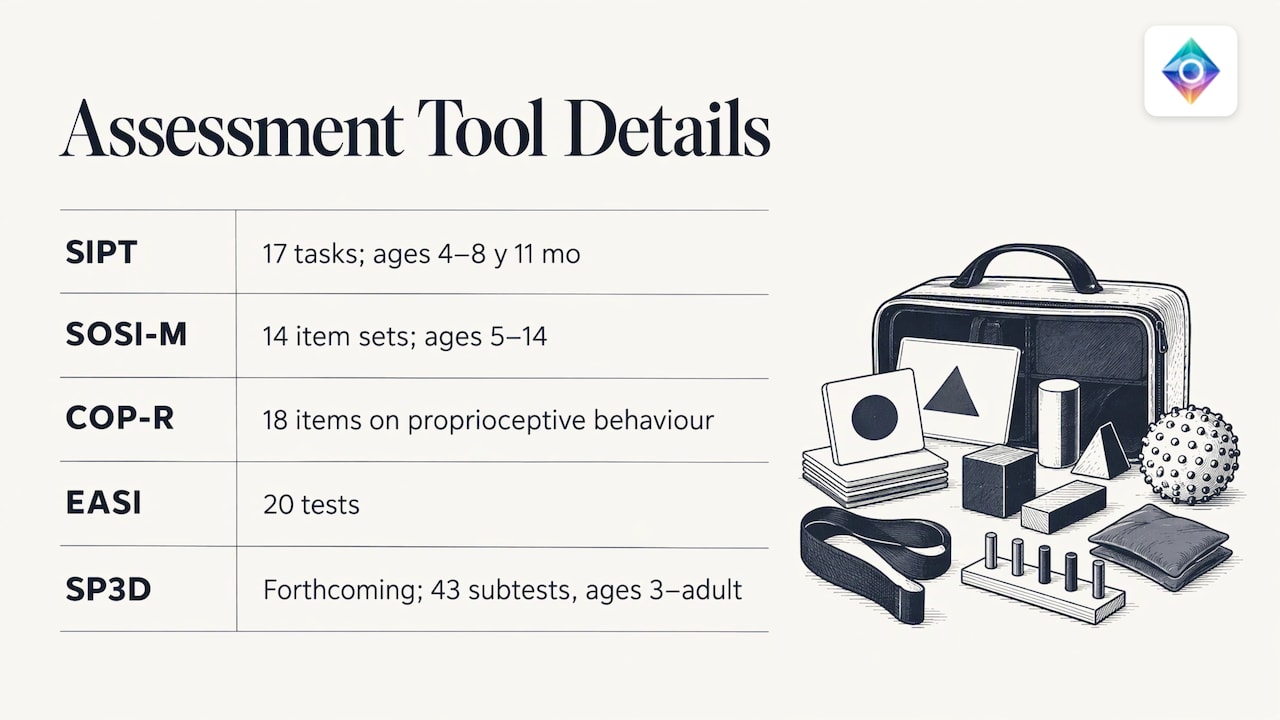
The SIPT is a computer-scored assessment of 17 tasks for ages 4 to 8 years 11 months, according to the American Occupational Therapy Association’s assessment list. The SOSI-M observes proprioception, vestibular processing, motor planning and postural control across 14 item sets for ages 5 to 14. Its companion, the COP-R, has 18 items on proprioceptive behaviour; the original COP was described in a peer-reviewed study in the American Journal of Occupational Therapy as a 15-minute observation during free play, validated on 130 children with developmental disabilities.
Newer instruments are in development. A UK training provider reports that the EASI contains 20 tests and that the forthcoming SP3D will cover ages 3 to adult with 43 play-based subtests.
What are the best HSP tests?
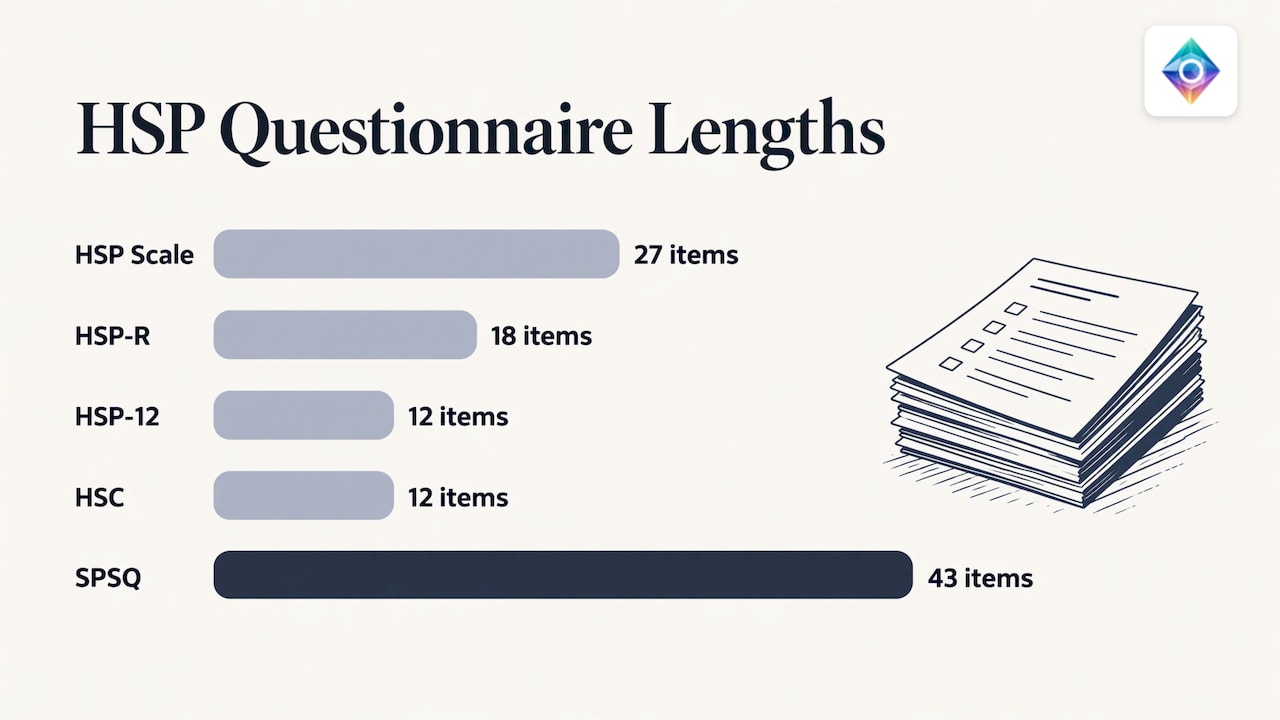
High sensitivity, or sensory processing sensitivity, is studied with its own questionnaires. The Sensitivity Research site lists the 27-item HSP Scale, the 18-item HSP-R and the 12-item HSP-12 as adult self-report measures, and the 12-item HSC for ages 8 to 18. The HSC-Rating System for 3-year-olds can only be used by trained experts.
A newer option is the Sensory Processing Sensitivity Questionnaire. A 2022 paper in the Journal of Personality Assessment describes it as measuring sensitivity to subtle stimuli, depth of processing and emotional reactivity, with 43 items across six factors.
Elaine Aron’s research team advises treating sensitivity as a continuum, noting that highly sensitive people have scored in the top 15 to 30 per cent of samples. Cut-offs are statistically unreliable because self-report contains noise. So the best way to use any HSP test is to read where you sit on the range and which situations drive it, which is exactly what a profile with examples delivers. High sensitivity is one of the 14 areas in the Omniprism assessment, so you get that reading with no questionnaire licence to hunt down.
Which test suits a child, a teenager or a classroom?
For children under 15, the clinical choices are the Sensory Profile 2, the SPM-2 and, for motor and praxis questions in younger children, the SIPT or SOSI-M. A sensory integration education provider stresses that no single test fits everyone: age, cognitive ability, setting, time, cost and therapist qualifications all shape the choice of tool.
Before any of these, parents can complete the Omniprism child assessment, with age-specific versions for the 7 to 10 years and 11 to 13 years groups. The guided format lets a parent answer on a child’s behalf and bring a structured summary to a school or clinic. For younger children, a parent’s guide to sensory play and child development describes the everyday sensory experiences these questionnaires ask about.
Educators can pair a profile with practical changes: our article on three fixes for a sensory friendly classroom covers the adjustments that need no specialist equipment.
How do you prepare test results for a professional assessment?
A clinician working with the SPM-2 or Sensory Profile 2 starts from rating-scale items and then looks for patterns. WPS suggests pairing the SPM-2 rating scale with the direct-observation SOSI-M, so caregivers complete the scale while the practitioner observes motor skills. That division of labour means your contribution is accurate, specific reporting.
A 2026 systematic review identified 29 validated questionnaires and scales for central sensitivity syndrome and sensory processing sensitivity, which shows how many ways sensory sensitivity is measured. A self-assessment result is best treated as a structured starting point: bring it, with your examples, and let the clinician choose the instrument.
For adults, our guide to sensory diets for adults shows how to act on a profile in daily routines while you wait for an appointment. Where interoception, the sense of your body’s internal signals, is part of the picture, the article on interoception in autism adds caregiver checks.
Where can I take a sensory processing self-assessment for free?
The Omniprism assessments are free and need no account. Adults start with the Free Adult Self-Assessment, and families with the Children & Young People Free Assessment. After either, the optional Specialist Briefing or Youth Briefing, each €20 one-off, summarises the results for a clinician. Psychologists and coaches who need clear client profiles can see the professionals page.
Why do we put a self-assessment first?
Most sensory tests were built for clinics, and rightly so: they need training to score and interpret. Our view is that the step before the clinic deserves its own good tool.
That is why Omniprism gives an instant profile across 14 areas, collects no email, account or data, and writes results in plain language. A person can see their sensory patterns next to attention, autism traits, dyslexia and the rest, then decide what to do with that picture.
I was diagnosed with ADHD at 42, and that experience shaped how we think about the wait between noticing something and being heard. A summary written for clinicians, which is what our Specialist Briefing is, is designed to make that first conversation easier.
Valerio Cozzi
Sensory processing tests: common questions
At what age is sensory processing disorder diagnosed?
There is no single age. The published tools cover the whole lifespan: the SPM-2 spans 4 months to 87 years, the Sensory Profile 2 birth to 14 years 11 months, and the SIPT ages 4 to 8 years 11 months. Assessment usually follows when sensory differences affect school, work or daily routines.
Does sensory seeking mean ADHD or autism?
Not by itself. People with sensory processing difficulties usually have other neurodifferences such as autism or ADHD, according to the Amaze Sussex guidance, but sensory patterns alone do not identify which. A profile that covers ADHD, autism and sensory processing together shows how they overlap.
Can I buy the SPM-2 or Sensory Profile 2 myself?
These are professional instruments with set qualification levels, so they are administered by a trained clinician. Individuals can begin with the free Omniprism self-assessment and bring the results to that clinician.
Is the HSP test a diagnosis?
No. The HSP Scale measures sensitivity as a trait on a continuum, and researchers advise against fixed cut-offs. Use your score to describe your experience and to talk with a professional about it.
Sources
- Sensory Processing Measure, Second Edition (SPM-2), WPS
- Sensory Profile 2, Pearson Assessments
- Adolescent/Adult Sensory Profile, Pearson Assessments
- Sensory Profile 2 scoring documentation, Pearson Q-global
- SOSI-M, WPS
- SPM-2 and SOSI-M combination guide, WPS
- AOTA children and youth sensory processing assessments
- Development of the Comprehensive Observations of Proprioception, American Journal of Occupational Therapy, 2012
- Assessment of Central Sensitivity Syndrome and Sensory Processing Sensitivity, systematic review, 2026
- The Different Faces of (High) Sensitivity, Journal of Personality Assessment, 2022
- Sensitivity measures, Sensitivity Research
- Tips for SPS research, HSPerson.com
- Sensory Integration Assessments, Sensory Integration Education
- Sensory processing, Amaze Sussex
- Assessment of sensory processing characteristics in children, Jorquera-Cabrera et al., 2017
Recommended
- Sensory Processing Checklist for UK Children: Prepare for NHS Meetings
- Sensory Diets for Adults: Start With a Two Minute Self Assessment
- RAADS-R Alternatives: 6 Autism Self-Assessment Tools Compared
- Turn an Online ADHD Test Covering 14 Domains Into Clinician Ready Evidence
Written and edited by Valerio Cozzi, founder of Omniprism. Omniprism began after my own ADHD diagnosis at 42.
This article is educational. It is not medical advice, not a diagnosis, and not a substitute for assessment by a qualified clinician. The Omniprism self-assessment is free, needs no account and no email address, and runs entirely in your browser — your answers are never sent to a server. The optional Specialist Briefing report is a paid add-on.