Interoception in Autism: OT Tools and a Self Check for Caregivers

Interoception is the sense that tells you when you’re hungry, need the toilet, or feel your heart racing before you clock that you’re anxious. Autistic people frequently process these internal signals differently from non-autistic people, whether that means missing them entirely, feeling them too intensely, or struggling to work out what a signal actually means. That difference touches everyday things like eating, sleeping, and recognising emotions, and the rest of this guide covers what it looks like, how it’s assessed, and what actually helps.
TL;DR:
- Most autistic individuals experience variability in interoception, including under-responsiveness, over-responsiveness, or difficulty distinguishing internal signals, which affects daily self-care.
- Common signs of interoceptive differences include missed hunger cues, late perception of bladder signals, unrecognized pain, and unnoticed fatigue, often leading to health risks or meltdowns.
- Structured, consistent practice such as body scans, timed prompts, and external cues can gradually improve interoceptive awareness, especially when tailored to the individual’s responsiveness profile.
- Formal assessment tools like the Interoception Sensory Questionnaire help identify specific patterns, but results are variable due to measurement differences and daily fluctuations.
- Seeking professional support is advisable if there are persistent issues with eating, toileting, or safety signals, with assessments guiding accommodations and targeted strategies.
What is interoception and how does it shape everyday feelings?
Interoception is your body’s internal sensory system. It picks up signals from your heart, gut, lungs, muscles, and skin, and turns them into information your brain can act on, according to Harvard Medical School’s overview of the science. Hunger, thirst, a full bladder, a rising temperature, muscle fatigue, the specific ache of a stubbed toe. All of these arrive through the same channel that also, less obviously, shapes what you feel emotionally.
That last part surprises people. The gut flutter before a difficult phone call and the way your chest tightens when you’re overwhelmed aren’t metaphors. They’re interoceptive data your brain is reading and labelling, often before you consciously register an emotion at all. When that reading goes smoothly, you eat before you’re starving, you notice you’re tired before you snap at someone, and you can name “anxious” instead of just feeling awful without knowing why.
For most people, this runs quietly in the background. You don’t decide to notice thirst; you just do, and you get a glass of water. The system only becomes visible when it doesn’t work the way you’d expect, which is exactly where autism enters the picture.
Everyday signals worth watching for, in yourself or a child:
- Hunger and fullness (do meals get skipped, or does eating continue past comfortable fullness?)
- Thirst (is water only requested when someone else prompts it?)
- Bladder and bowel sensations (does “I need the loo” arrive with almost no warning?)
- Temperature (wearing a coat in summer, or shorts in the cold, without apparent discomfort)
- Heart rate and breathing changes (early physical signs of stress or excitement)
- Pain location and intensity (a graze ignored, or a mild bump reacted to as agony)
- Fatigue (pushing through exhaustion until a sudden collapse or meltdown)
These aren’t quirks to correct. They’re data points that tell you where interoceptive support might genuinely help.
How does interoception differ in autistic people?
Autistic people commonly show one of three broad interoception patterns: under-responsive, over-responsive, or difficulty telling signals apart. A 2024 narrative review by Loureiro and colleagues found mixed results across studies overall, but consistent evidence that autistic people often struggle specifically with integrating internal and external information, meaning the raw signal might arrive fine, but working out what it means or what to do about it doesn’t happen automatically.
Hypo-responsive (under-registering) looks like missing signals that most people would find hard to ignore. Someone might not notice hunger until they feel dizzy, or not register a full bladder until it’s urgent, or fail to notice a broken bone is broken because the pain signal simply didn’t register as “seek help now.”
Hyper-responsive (over-registering) is the opposite: signals arrive at full volume. A mildly full stomach can feel unbearably uncomfortable. A small ache reads as intense pain. Heart rate rising from mild excitement can trigger a full panic response, because the body is shouting rather than speaking.
Discrimination difficulty sits between the two. The signal is there, and it’s roughly the right intensity, but distinguishing “this is hunger” from “this is anxiety” from “this is needing the toilet” is genuinely hard. This is where autistic people often describe feeling “something’s wrong in my body” without being able to name what.
None of these profiles are fixed. A systematic review and meta-analysis points out that findings vary a great deal depending on which aspect of interoception a study measures, accuracy (how well someone detects a signal against an objective measure), sensibility (how confident they feel about their own detection), or attention (how much focus they give internal states). Mixing these up is a major reason two studies on “interoception in autism” can report opposite conclusions.
A few other patterns worth knowing:
- Profiles can shift with age; some autistic children who are hypo-responsive to pain become more hyper-responsive to interoceptive signals as adults, or vice versa.
- Alexithymia (difficulty identifying and describing emotions) frequently co-occurs with autism and often travels alongside interoception differences, though the two are not identical.
- Anxiety and gastrointestinal problems show up more often alongside interoceptive difficulties, which can create a loop: gut discomfort goes unnoticed until it’s severe, which raises anxiety, which further muddies the signal.
- Neural theories point to the insula and thalamus as candidate hubs for processing interoceptive signals, but researchers frame this as a hypothesis under investigation rather than a settled mechanism.
What common signs and everyday challenges should I look for?
Interoception differences show up in ordinary moments, not dramatic ones. These are the patterns caregivers and autistic adults report most often.
- Eating and drinking. Meals get forgotten entirely during a focused activity, or someone eats past the point of obvious discomfort because “full” never quite registers. Thirst might only be noticed once a headache sets in.
- Toileting. A child (or adult) might have accidents not from lack of awareness in general, but because the bladder signal arrives too late to act on, or arrives so faintly it’s dismissed as nothing.
- Sleep. Fatigue signals can be missed for hours, leading to a sudden crash, or felt so strongly that lying down feels urgent even in the middle of an important task.
- Illness detection. A fever, an ear infection, or appendicitis can go unnoticed until it’s advanced, because pain and discomfort signals don’t reliably translate into “something is wrong, tell someone.”
- Pain response. Reactions can look mismatched to the injury, minimal response to something that should hurt a great deal, or severe distress over something minor.
- Emotional recognition. Naming a feeling in the moment is hard. Someone might say “I don’t know why I’m upset” quite genuinely, because the bodily cues that usually inform that label were never clearly read.
- Meltdown build-up. Early warning signs, a slightly faster heartbeat, tensing shoulders, a hard-to-place unease, often go unnoticed until they’ve escalated past the point where a calm exit is realistic.
If several of these show up together and follow a consistent pattern rather than a one-off bad day, that’s usually a reasonable sign that targeted interoceptive support, rather than general behaviour strategies, is worth exploring.
Why does interoception matter for mental wellbeing and safety?
Missed or misread internal signals don’t stay contained to the body; they spill into anxiety, exhaustion, and long-term wellbeing. When you can’t reliably tell “hungry” from “anxious” from “overstimulated,” your brain has less accurate information to plan around, and that uncertainty itself becomes a source of stress. This is one of the reasons interoception and mental health are so closely linked in autistic people.
Evidence snapshot: Dr Emma Goodall guidance for the National Autistic Society notes that trauma and overwhelm can themselves reduce interoceptive accuracy, meaning stress doesn’t just result from poor interoception, it can actively worsen it, creating a cycle that’s hard to break without deliberate support.
Autistic burnout, the state of exhaustion, reduced capacity, and loss of skills that many autistic adults describe after prolonged unsupported stress, often has interoception woven through it. If fatigue and overload signals aren’t registering until they’re extreme, there’s no early warning to slow down before burnout sets in. By the time exhaustion is undeniable, the recovery is often longer and harder.
Safety is the sharper edge of this. A child who doesn’t reliably notice pain might not report a broken arm. An adult who doesn’t notice a rising temperature might not dress for weather in a way that protects them from heat exhaustion or hypothermia. Self-care tasks that depend on noticing a need, drinking enough water, eating regularly, going to the toilet before it’s urgent, all rely on interoception working at least reasonably well, and clinicians are increasingly advised to factor this in rather than assume physical symptoms are being reported accurately. NHS England’s guidance on supporting autistic adults in mental health services specifically flags interoception and alexithymia as factors clinicians should account for when interpreting how a patient reports pain or distress, because a standard rating scale can badly misrepresent what’s actually happening.
How is interoception assessed?
The most widely used tool in this space is the Interoception Sensory Questionnaire (ISQ), a self-report or caregiver-report measure that screens across several bodily domains, hunger, thirst, temperature, pain, and more, to build a picture of where signals are being missed, over-registered, or hard to distinguish. It’s not a diagnostic test on its own, but it gives clinicians and families a structured starting point rather than a vague impression.
Beyond formal questionnaires, assessment tends to draw on a mix of sources:
- Self-report or caregiver-report screening, like the ISQ, which captures lived experience but relies on the person being able to reflect on and describe their own patterns.
- Objective measures, such as heartbeat detection tasks, which test whether someone can accurately notice a physiological signal independent of what they believe about themselves. These sometimes disagree with self-report, which is part of why the research literature looks inconsistent.
- Clinical observation over time, particularly useful for younger children or those who struggle to describe internal states verbally.
- Structured support planning tools, such as Dr Emma Goodall Interoception Evaluation and Support Plan, which pairs assessment with practical next steps rather than leaving a family with a score and no direction.
If you’re trying a rough self-check at home before involving a professional, open prompts work far better than yes or no questions. Asking “what does your body feel like right before you get hungry?” invites someone to actually notice and describe a pattern. Asking “are you hungry?” invites a guess. Clinicians consistently favour the open version because it builds the mapping between sensation and meaning rather than just extracting a single answer.
Why do results vary so much between tools and studies? Partly because interoceptive accuracy, sensibility, and attention are genuinely different things, and partly because anxiety, gastrointestinal issues, and even the testing environment can all shift someone’s results on a given day. A single questionnaire score is a useful data point, not a verdict, which is why most clinicians want more than one source of information before drawing conclusions.
Practical strategies and activities to improve interoceptive awareness
Interoceptive awareness responds to consistent practice more than to any single clever trick. Clinician guidance reported by the Student Wellbeing Hub suggests practising interoceptive activities two to three times a day for several weeks, built into existing routines rather than treated as a separate task on top of everything else. Consistency matters more than intensity here.
Here are activities worth building into a daily or weekly rhythm, drawn from occupational therapy practice and NHS resources on interoception:
- Body scan. Sit or lie down and mentally check in with each body part in turn, feet, legs, stomach, chest, hands, face, naming any sensation noticed. Two minutes is plenty to start.
- Hand breathing. Trace a hand’s outline with a finger, breathing in going up each finger and out going down. It gives a visual and tactile anchor to a signal (breath) that’s otherwise invisible.
- Belly breathing. Placing a hand on the stomach while breathing slowly makes the physical movement of breath easier to notice than trying to feel it in the abstract.
- Gym-ball rolling. Lying over a gym ball and gently rolling forward and back, a technique used in NHS-supported interoception resources for children, gives strong, clear pressure input that can help build body awareness, particularly useful for toileting and general body-mapping.
- Timed drink and meal prompts. For hypo-responsive profiles, a simple timer or visual chart (“drink at 10am, 12pm, 2pm”) removes reliance on a signal that might not arrive until dehydration is well underway.
- Hydration and food charts. Ticking off a glass of water or a meal on a visible chart turns an invisible internal cue into a visible external one, useful for both children and adults.
- Wearable reminders. A smartwatch buzz or phone alarm can stand in for a missed internal signal, particularly for adults managing hyperfocus or masking fatigue at work.
- Sensory diet items. Weighted lap pads, chewy snacks, or fidget tools can help regulate an over-responsive system by providing predictable, controllable input.
Pro Tip: Pick two activities, not eight. Trying to build a whole new routine at once is where most families and adults give up within a week. Two consistent habits, done daily for a few weeks, beat a long list attempted once.
Adaptations matter here. For hypo-responsive profiles, the priority is making missed signals visible through external cues, timers, charts, wearables. For hyper-responsive profiles, the priority tends to be reducing signal intensity or building tolerance gradually, through calming sensory input and predictable routines rather than more stimulation. Children generally need more scaffolding and shorter, gamified activities, while adults often do better with self-directed apps, journals, or wearable prompts they can adjust themselves.
Caregiver communication makes a measurable difference too. Open-ended prompts, “what does your tummy feel like right now?”, “what happens in your body just before you get upset?”, build the connection between sensation and meaning far better than closed questions. Over time, this scaffolding can be withdrawn as the person builds their own internal vocabulary for what their body is telling them.
What does the research say, and where are the gaps?
The evidence base on interoception and autism is real but genuinely mixed, and it’s worth being honest about that rather than overselling certainty either way. The 2024 narrative review by Loureiro and colleagues found inconsistent results across individual studies, but a repeated signal that autistic people often struggle specifically with integrating interoceptive information with the wider context around them, not necessarily with detecting a signal at all.
Key points the current research supports:
- Interoceptive processing differences are common in autism, but they don’t follow one single pattern; hypo-responsive, hyper-responsive, and discrimination-difficulty profiles all appear across the literature.
- The insula and thalamus are proposed as neural regions involved in interoceptive processing, but this remains a working hypothesis rather than an established mechanism.
- Interoceptive training trials, sometimes referred to under names like the ADIE trial, show promising but limited evidence that structured practice can improve some interoceptive measures and reduce anxiety markers in autistic adults, though sample sizes and follow-up periods remain modest.
- A systematic review and meta-analysis points to measurement inconsistency, particularly the conflation of accuracy, sensibility, and attention, as a major driver of contradictory findings across studies.
What does this mean practically? The evidence is strong enough to justify taking interoception seriously as a factor in autistic wellbeing and daily functioning. It is not strong enough to support rigid claims about exactly which children will show which profile, or to promise that any single training programme will work the same way for everyone. The honest, useful takeaway is that structured, consistent practice appears to help many people, while acknowledging that the science hasn’t yet mapped out precisely why or for whom it works best.
When should I seek professional help and what should I ask for?
Some situations call for more than home strategies. Seek input from a GP, paediatrician, or occupational therapist if you notice severe or worsening eating restriction, illness or injury going undetected until advanced, persistent toileting failure past an age where it’s expected, safety risks from missed pain or temperature signals, or escalating anxiety and meltdowns that aren’t easing with home strategies.
Bring specific questions rather than a general concern: ask what an interoception assessment involves, whether the ISQ or a similar tool is appropriate, and what adjustments a school or workplace could realistically put in place off the back of an assessment. Reasonable outcomes might include scheduled drink and meal breaks, sensory tools, or written rather than verbal check-ins for wellbeing. A clear assessment result gives schools and employers something concrete to act on, rather than a vague request for “more understanding.”
What ADHD taught me about missing my own body’s signals
I wasn’t diagnosed with ADHD until I was 42, and one of the strangest realisations that came with it was how often I’d been ignoring my own hunger, thirst, and fatigue for years without registering any of it as a pattern. It wasn’t autism, and I won’t pretend it was, but it gave me a genuine respect for how much interoception shapes daily life without most people ever naming it. Building small, boring daily habits, checking in on basic needs at set times rather than waiting to feel them, made more difference than any single insight ever did.
— Valerio Cozzi
How Omniprism’s self-assessment can help you understand interoception differences
Home strategies and clinical assessment aren’t either/or. A self-assessment gives you a structured starting point before, or alongside, seeing a professional. Omniprism’s self-assessment covers 14 domains including autism, sensory processing, ADHD, and masking, giving you an instant plain-language profile without waiting lists or a lengthy intake process.
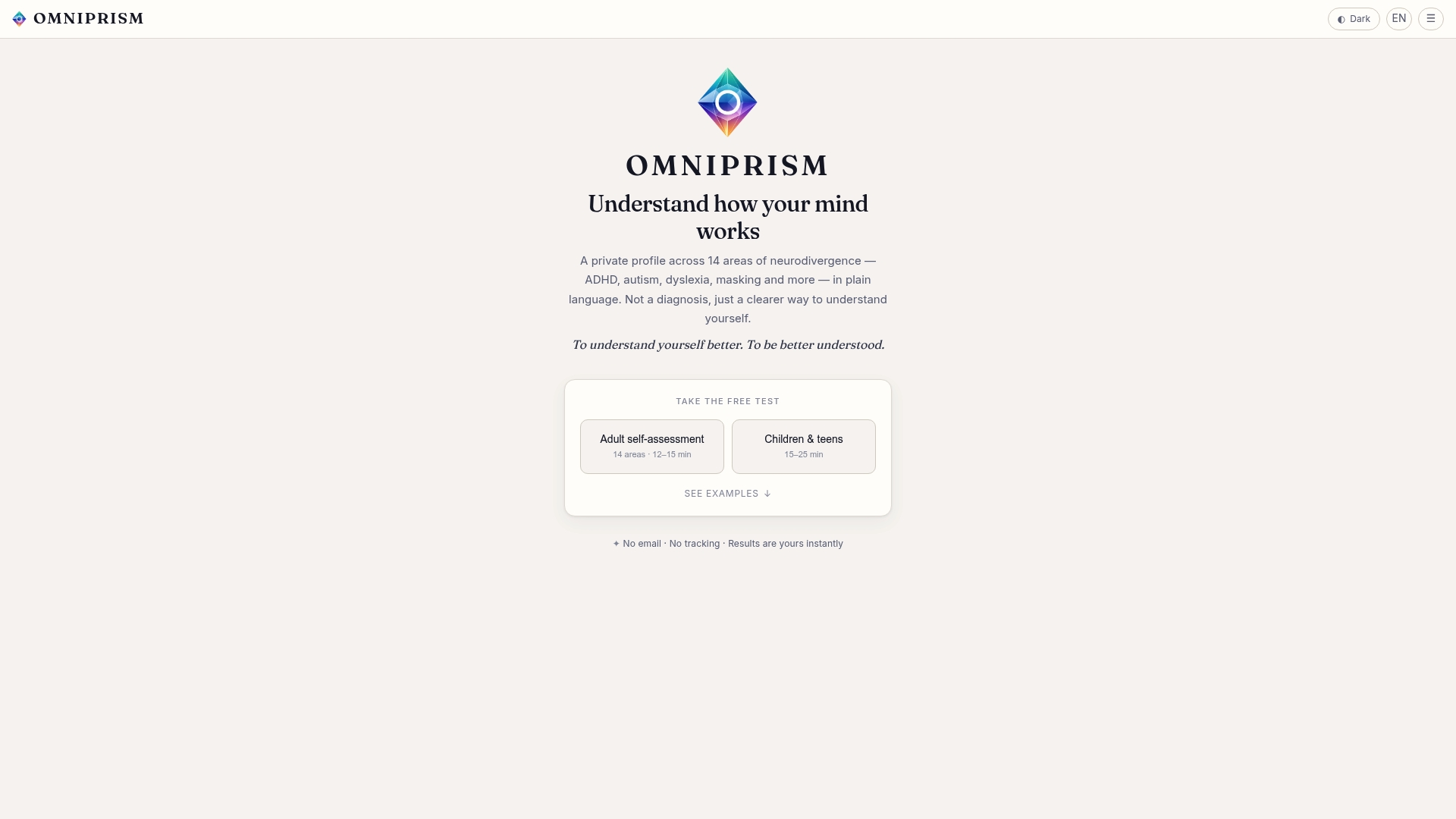
That profile isn’t a diagnosis, and it’s not meant to replace an occupational therapist or GP when someone needs formal support for eating, toileting, or safety concerns covered earlier in this piece. What it does well is give you language and structure to bring into that conversation, which is exactly why Omniprism’s paid Specialist Briefing report exists: a summarised, clinician-friendly document built from your results that you can hand to a GP or therapist instead of trying to explain years of unnamed patterns in a ten-minute appointment. Families weighing this up for a child or teenager can use the guided assessment for young people, designed specifically to make the process accessible rather than overwhelming for that age group. You can check exactly how the assessment works and what the results cover on the methodology page before you start.
If you recognise several of the everyday signs described earlier, missed hunger cues, unpredictable meltdown build-up, difficulty naming emotions, taking Omniprism’s free self-assessment is a sensible next step to put a name to what you’re noticing.
Sources
- Interoception in Autism: A Narrative Review of Behavioral and Neurobiological Data — Loureiro et al., 2024
- Interoception and mental wellbeing in autistic people — Emma Goodall (National Autistic Society)
- Interoception advice — Children and Family Health Devon (NHS resource)
- Making sense of interoception — Harvard Medical School magazine
For related context on how interoception differences interact with other traits, see how autistic inertia can compound missed hunger or thirst cues during hyperfocus, and how a spiky skills profile can mean strong abilities in one area sitting alongside real struggles with body awareness in another. If you’re untangling autism traits from ADHD traits more broadly, the comparison of autism versus ADHD is a useful next read, and the neurodiversity-focused reflections on intention versus action from theNeedle offer a wider lens on why noticing a need and acting on it aren’t the same thing.
This article is general information, not a substitute for advice from a qualified doctor. Consult a qualified healthcare professional about your own circumstances before acting on anything here.
FAQ
What are the symptoms of poor interoception?
Common signs include missing hunger, thirst, or toilet needs until they’re urgent, unclear emotional labelling (“I don’t know why I feel bad”), mismatched pain responses, and sudden fatigue crashes rather than gradual tiredness.
Can autistic people improve interoception?
Yes. Structured, repeated practice, such as body scans and timed prompts done regularly over several weeks, shows promising results in trials, though evidence is still limited and individual results vary.
What is the “6 second rule” in autism?
This isn’t a recognised clinical term in the interoception research; if you’ve seen it referenced elsewhere, it likely refers to a general pause-before-reacting technique rather than an established interoception protocol.
What is interoception in autism?
Interoception in autism refers to how autistic people often process internal bodily signals, hunger, pain, emotion, differently, showing patterns of under-registering, over-registering, or difficulty telling signals apart, according to a 2024 narrative review.
Recommended
- Spot Twice Exceptional Autism: Use a 14 Domain Self Check to Build Evidence
- Autism vs. ADHD: Comparing Symptoms, Overlap, and Diagnosis
- Autistic Burnout vs Depression: How to Tell the Difference
- Autistic Traits in Women: Signs Often Missed or Masked
Written and edited by Valerio Cozzi, founder of Omniprism. Omniprism began after my own ADHD diagnosis at 42.
This article is educational. It is not medical advice, not a diagnosis, and not a substitute for assessment by a qualified clinician. The Omniprism self-assessment is free, needs no account and no email address, and runs entirely in your browser — your answers are never sent to a server. The optional Specialist Briefing report is a paid add-on.